Contents12 sections
This guide was first published in German on handgetestet.de.
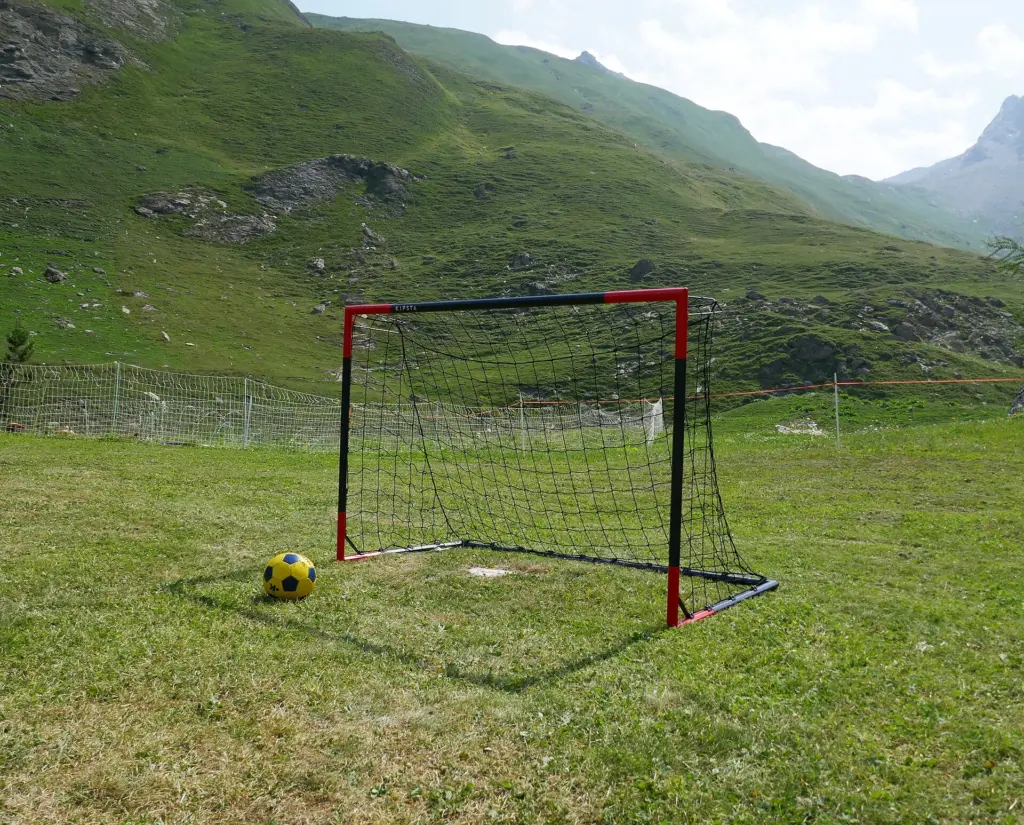
A backyard soccer goal is almost always bought by width. What really matters, though, is what holds it in the ground. For families with children from about six years old, we recommend a 180 x 120 cm steel goal with the ground anchors already in the box, such as the EXIT Maestro. If you only kick a ball around now and then and put the goal away after playing, a pop-up set will serve you well. Aluminum suits goals that get moved often, but it needs the right accessories.
How big can a backyard goal be?
Smaller than you might think. In their instructions, Hudora and EXIT recommend three meters of clear space around the assembled goal to walls, fences and other obstacles. A goal 180 cm wide and 60 cm deep can quickly take up an area of about eight by seven meters. That adds up. A 3 x 2 meter goal belongs on a large lawn rather than in front of the patio.
For elementary school kids, 120 x 80 cm or 180 x 120 cm is enough. More area mainly means more balls in the net and fewer in the neighbor’s flower bed. Teenagers who want to do goalkeeper training benefit from a width of 220 cm or more.
Steel, aluminum or pop-up?
Steel goals are heavy and therefore stand more steadily. EXIT galvanizes and powder-coats the frames of the Maestro and Coppa, while Hudora uses powder-coated steel with 75 mm posts for the Advanced. Scratches in the coating can rust, as Hudora explicitly points out in its instructions.
Aluminum does not rust and is easier to carry. According to the manufacturer, the EXIT Scala in 180 x 120 cm weighs 14 kg including packaging, the steel Maestro of the same size 15 kg. So the difference lies less in the weight than in the maintenance. The fine print, however, says that the Scala comes with neither ground anchors nor a counterweight.
Pop-up goals unfold by themselves from a bag. Hudora warns to keep them away from your face while doing so. They are light, quickly stowed away and intended for children who play soft shots over short distances. They are not built for hard shots from ten meters.
Why does a goal tip over, and what holds it in place?
Often because it has been set up incorrectly or someone is hanging from it. The Unfallkasse Rheinland-Pfalz, a German statutory accident insurer, names swinging from the crossbar as one cause of serious and fatal accidents with movable small-sided goals; the injuries mostly affect the head, neck and chest. Under the standard DIN EN 748, freestanding soccer goals must be adequately secured against tipping over. A goal is considered stable enough if it does not tip when a horizontal force of 1,100 newtons is applied to the middle of the crossbar. Stiftung Warentest, Germany’s consumer testing organization, pointed out as early as 2014 that the crossbar in particular tempts children to climb.
These rules are aimed at clubs and municipalities. In the backyard, the manufacturers‘ instructions apply, and they are clear. EXIT writes that an unsecured goal can fall over and cause serious or fatal injuries. Hudora requires that the goal always be secured against tipping, even when not in use, and that other measures be taken on ground that is too hard for stakes to grip. Both prohibit climbing on and hanging from the frame.
And sandbags? The German Foundation for Safety in Sport (Stiftung Sicherheit im Sport) does not consider them a suitable permanent safeguard and advises using only the systems provided by the manufacturer. For portable goals there is a dedicated standard, DIN EN 16579. EXIT cites it for the Maestro and Coppa; for the Scala, EXIT states EN 71 and a TÜV inspection. Hudora does not name a standard on its product pages.
The typical bad purchase looks like this: a goal for paving or a patio that, according to its instructions, only stands safely with ground anchors in a lawn. According to EXIT, the Scala may explicitly only be anchored and used on soft ground. If you want to play on paved surfaces, clarify beforehand which safeguard the manufacturer provides for that. Similar questions come up with a basketball hoop for the driveway (in German).
Six backyard goals compared
| Model | Dimensions (W x H x D) | Frame and anchoring | Best for |
|---|---|---|---|
| EXIT Maestro | 180 x 120 x 60 cm | Steel, galvanized and powder-coated; ground anchors and training screen included | Families with elementary school kids |
| EXIT Coppa | 220 x 170 x 80 cm | Steel, galvanized and powder-coated; ground anchors and training screen included | Older children, larger lawns |
| EXIT Scala (aluminum) | 180 x 120 x 80 cm | Aluminum; ground anchors and counterweight not included | Lawns where the goal gets moved often |
| Hudora Advanced 180 | 180 x 120 x 60 cm | Steel, powder-coated, 75 mm posts; 5 stakes | Children and teenagers who shoot hard |
| Hudora Pro Tect Advanced 180 | 180 x 120 x 60 cm | Steel with foam padding; 5 stakes | Children from 6 years, goalkeeper training |
| Hudora Pop Up 2-pack | 120 x 80 x 80 cm | foldable, carrying bag; 2 x 4 stakes | Small yards, park, quick games |
EXIT Maestro
A 180 x 120 cm steel goal with 38 mm posts, galvanized and powder-coated. According to EXIT, the box contains an anchoring set with ground anchors and anchor tubes as well as a target screen that hooks on. The manufacturer cites the EN 16579 standard and an assembly time of about 30 minutes for two people. EXIT gives a two-year warranty on the frame and six months on the net.
EXIT Coppa
Same design, but 220 cm wide and 170 cm high. That’s big enough for some serious goalkeeping. Here, too, ground anchors and a target screen are included. At 19 kg including packaging it stays portable, but it needs a lawn where the three meters of clearance all around are really free.
EXIT Scala
The aluminum goal has 45 mm posts, a net with hexagonal mesh and stainless steel fittings. EXIT approves it for ages three and up and refers to EN 71 and TÜV. The ground anchors for natural grass are only available separately. If you forget them, you have a goal that, according to its instructions, may not be used that way.
Hudora Advanced 180
Hudora bolts together posts and crossbar with a diameter of 75 mm, and the rear frame clicks into place. Five stakes hold the goal in the lawn. It also comes in widths of 120, 240 and 300 cm, and according to the instructions assembly takes two adults.
Hudora Pro Tect Advanced 180
The posts and crossbar are covered in foam padding, which Hudora describes as impact protection. For children who stand in goal and throw themselves after the ball, that is a real argument. The tubes slot together without tools. Hudora rates the goal for ages six and up.
Hudora Pop Up 2-pack
Two 120 x 80 cm goals that measure only about 38 x 38 x 2 cm when folded. Inserted poles support the sides, and four stakes per goal hold it to the ground. That is plenty for two-on-two in the backyard or the park. As a permanent goal it is not much use.
Which goal suits which backyard?
- Lawn behind the house, children between six and ten: EXIT Maestro, because the anchoring is already included.
- Lots of space and a child who wants to play in goal: EXIT Coppa or Hudora Pro Tect Advanced with padded frame.
- The goal shouldn’t block the lawn permanently: Hudora Pop Up, back in the bag after the game.
- The goal stays outside all year and shouldn’t rust: EXIT Scala, but only together with the ground anchors.
In the end, the same order applies to every one of these goals. Anchor first, then play. The crossbar is not a climbing frame. If you are planning your backyard for active play anyway, the trampoline guide (in German) covers the same questions about clearance and anchoring.
Frequently asked questions
How much space does a backyard soccer goal need?
More than you think. Hudora and EXIT recommend three meters of clear space around the goal to walls and fences. A goal 180 cm wide and 60 cm deep can quickly take up about eight by seven meters. For elementary school kids, 120 x 80 or 180 x 120 cm is enough.
Steel or aluminum: which soccer goal is better?
Steel goals are heavy and stand more steadily, but scratches in the coating can rust. Aluminum does not rust; at 14 kg, the EXIT Scala weighs hardly less than the steel Maestro. However, the Scala does not come with ground anchors or a counterweight.
How do you secure a soccer goal against tipping over?
With the systems provided by the manufacturer, on a lawn usually ground anchors or stakes. The German Foundation for Safety in Sport (Stiftung Sicherheit im Sport) does not consider sandbags a suitable permanent safeguard. Hudora requires that the goal always be secured, even when not in use. Both manufacturers prohibit climbing on or hanging from the crossbar.
Can a backyard goal stand on paving?
Only if the manufacturer provides a way to secure it there. According to their instructions, many goals only stand safely with ground anchors in a lawn; the EXIT Scala may explicitly only be anchored and used on soft ground. Clarify this before buying.
Who is a pop-up soccer goal suitable for?
For children who play soft shots over short distances, in small yards or in the park. The Hudora Pop Up 2-pack unfolds from a bag and is held down with stakes. It is not built for hard shots from ten meters or as a permanent goal.
Which goal is suitable for goalkeeper training?
Teenagers benefit from a width of 220 cm or more, for example the EXIT Coppa at 220 x 170 cm. For children who throw themselves after the ball in goal, the Hudora Pro Tect Advanced 180 has foam padding on the posts and crossbar as impact protection.
Sources
- EXIT Toys: Maestro 180 x 120 cm
- EXIT Toys: Coppa 220 x 170 cm
- EXIT Toys: Scala aluminum 180 x 120 cm
- EXIT Toys: Coppa instruction manual (PDF)
- EXIT Toys: Scala instruction manual (PDF)
- Hudora: Advanced 180 soccer goal
- Hudora: Pro Tect Advanced 180 soccer goal
- Hudora: Pop Up soccer goal 2-pack
- Unfallkasse Rheinland-Pfalz: How to keep a goal from falling (PDF)
- Stiftung Sicherheit im Sport: Safety of soccer goals (PDF)
- Stiftung Warentest: Accident risk with mobile soccer goals
Where to buy
- EXIT Maestro Stahl-Fußballtor 180x120Check price at Amazon.de
- EXIT Coppa Stahl-Fußballtor 220x170Check price at Amazon.de
- EXIT Scala Aluminium-Fußballtor 180x120Check price at Amazon.de
- Hudora Fußballtor Advanced 180Check price at Amazon.de
- Hudora Fußballtor Pro Tect Advanced 180Check price at Amazon.de
- Hudora Pop Up Fußballtor 2er SetCheck price at Amazon.de