Contents12 sections
This guide was first published in German on handgetestet.de.
A thermo composter doesn’t automatically turn kitchen and garden waste into soil faster. For a home garden with mixed waste, we still recommend an insulated plastic composter with 400 to 600 liters and a mesh at the bottom, such as the Garantia Thermo-King 600. If you mostly have leaves and shrub cuttings, two open wooden bins are the better choice. On the balcony, a worm bin does the job.
So why thermo at all? The German Environment Agency (Umweltbundesamt, UBA) writes in its composting guide that a clear influence of the type of composter on the duration of decomposition has not yet been proven. What counts is the mix in the bin. But the insulation keeps heat in the bin, and the lid keeps the rain out.
Thermo, quick, wood: what’s actually the difference?
„Thermo composter“ and „quick composter“ usually mean the same device: a plastic bin closed at the top and sides, with insulated walls, standing open at the bottom on the soil. The insulation is meant to keep the heat of decomposition in the bin. The UBA mainly cites as an advantage that the process can continue in winter.
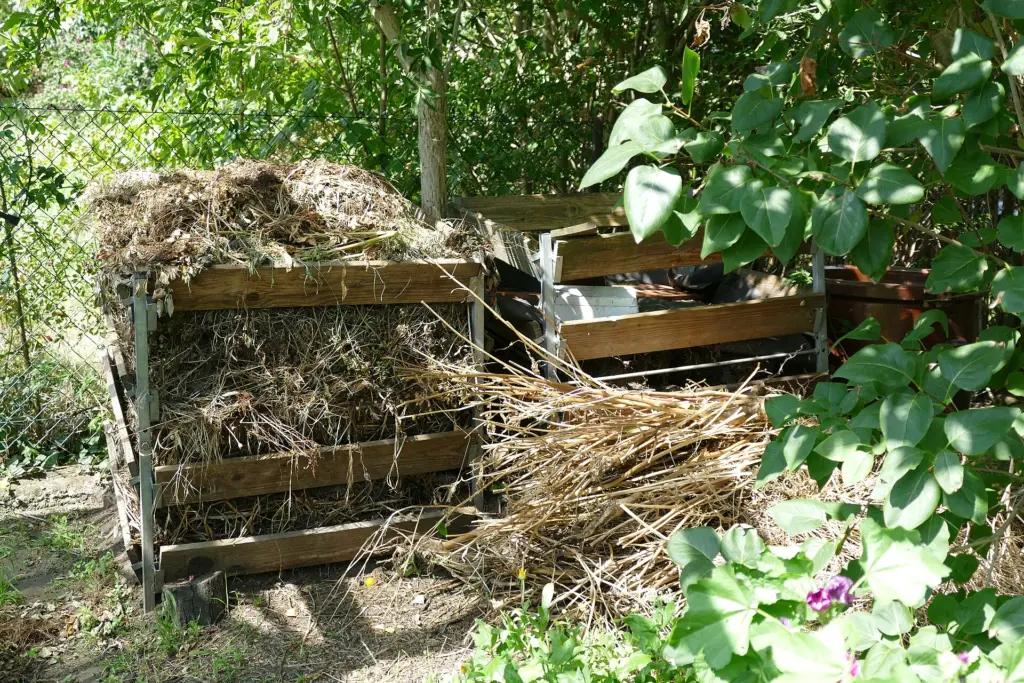
A slatted wooden composter is open. The UBA recommends setting up two or three such bins right away so the material can be turned from one into the other. According to the guide, there should be 1 to 3 centimeters of space between the boards. Larger gaps and wire mesh let the material dry out.
The worm bin is a world of its own. Here, compost worms eat the kitchen waste, in a box that can stand in the kitchen or on the balcony. It’s too small for garden waste.
How much composter does a household need?
The question starts with the garden. According to the UBA, home composting only makes sense if the compost is actually used. If you want to be exempted from the organic waste bin in Germany, the composting guide’s criteria call for around 50 square meters of garden area per resident. According to the UBA, a bed with heavy feeders can take about 3 liters of compost per square meter and crop, a lawn about 2 liters.
For a single-family home with a lawn, a few beds and two to four people, we consider 400 to 600 liters suitable. Lots of fall leaves change the calculation.
What can go in, and what attracts rats?
Fruit and vegetable scraps, coffee grounds and tea leaves, eggshells, leaves, wilted grass clippings in thin layers, shredded shrub cuttings. According to the UBA, meat, sausage, fish, bones and cooked food leftovers don’t belong on the garden compost. They attract rodents and vermin, and composting in the garden usually doesn’t reach the temperature needed for reliable sanitization for long enough. The UBA cites 55 to 60 degrees Celsius over an extended period. Diseased plants, seed weeds and root weeds should therefore go in the organic waste bin.
A wire mesh under the bin helps against rats and voles, as the guide also states. At Graf, it’s an accessory; the Thermo-King and Thermo-Wood come without a bottom mesh. The matching mesh for the 400 and 600 liter sizes measures 80 × 80 centimeters. If you want to shred shrub cuttings first, you’ll find suitable devices in our guide to garden shredders (in German).
Where can the compost bin stand?
On open soil. Never on concrete, paving or asphalt, otherwise earthworms can’t get in and water builds up at the bottom. The UBA recommends a shady to partially shaded, sheltered spot. Graf also advises in its manual loosening the soil beforehand. Juwel requires level garden soil in partial shade.
And the neighbors? A fixed minimum distance doesn’t exist everywhere in Germany. The Ministry of Justice of the German state of Mecklenburg-Western Pomerania writes in its brochure on neighbor law that the neighbor initially has no claim to a specific distance from the boundary, as long as the compost is managed properly. Whether it may stand directly on the boundary depends on the individual case. The Bavarian Ministry of Justice points out that a compost heap on the boundary can be an unreasonable nuisance, and that garden waste may only be composted if a significant odor nuisance for the neighbors is ruled out. In the Thermo-King manual, Graf recommends a distance of at least 0.5 meters. Our advice: plan more generously and talk to your neighbors beforehand. If in doubt, your municipality will know what applies locally.
5 compost bins compared
| Model | Type | Capacity and dimensions | Best for |
|---|---|---|---|
| Garantia Thermo-King 600 | Thermo composter, recycled plastic | 600 l, 80 × 80 × 104 cm, 15.1 kg | Home gardens with kitchen and garden waste |
| Juwel Aeroquick 420 | Thermo composter, weather-resistant plastic | approx. 80 × 80 × 106 cm | Anyone looking for an alternative to the Thermo-King |
| Garantia Thermo-Wood 600 | Thermo composter with wood look | 600 l, 80 × 80 × 100 cm, 17.1 kg | Visible spot in the garden |
| Gartenwelt Riegelsberger Modern Composter Single | Wooden plug-in system, larch | approx. 100 × 100 × 100 cm | Lots of leaves and shrub cuttings |
| wurmkiste.at WurmBox | Worm composter, recycled plastic | 2 × 15 l, 38 × 38 × 38 cm | Balcony, kitchen, no garden |
Garantia Thermo-King 600
Our favorite for a typical home garden. Graf makes the walls from foamed recycled polypropylene, which the manufacturer calls Thermolen. Two large filling flaps, a lid that can be adjusted for summer and winter operation, and a tool-free plug-in system. The footprint is 80 × 80 centimeters and the height 104 centimeters. The bottom mesh is available as an accessory. The Thermo-King also comes in 400 and 900 liter versions.
Juwel Aeroquick 420
The Tyrolean manufacturer Juwel makes the Aeroquick from weather-resistant plastic, about 80 × 80 centimeters wide and 106 centimeters high according to the manual. That gives it almost the same footprint as the Thermo-King 600. According to Juwel, a garden hose is enough for cleaning. One sentence from the manual belongs on every composter: don’t put in hot ash or embers. According to the UBA, ash from coal stoves doesn’t belong in there anyway, and ash from untreated wood only in small amounts.
Garantia Thermo-Wood 600
Technically a thermo composter made of the same foamed recycled plastic as the Thermo-King, but with a wood finish on the outside. Graf hides the ventilation slots under the cladding. Add to that two removal flaps. At 17.1 kilograms, it’s heavier than the Thermo-King 600. If you have to put it next to the patio, this gives you the calmer look.
Gartenwelt Riegelsberger Modern Composter Single
A box made of solid larch in a plug-in system, which according to the manufacturer can be assembled without tools and is built open so air can reach the compost. It comes in several sizes with a height of 80 or 100 centimeters. For large amounts of leaves and perennial remains, we consider this the better design. Ideally, buy two right away, as the UBA suggests. Kitchen waste should always be well covered in an open box.
wurmkiste.at WurmBox
A 38-centimeter cube made of recycled plastic, with 15 liters per tier. According to the manufacturer, one tier is enough for the organic waste of one person, and up to four can be stacked. According to the manufacturer, the worms feel comfortable at 10 to 25 degrees Celsius, out of direct sunlight. Meat and dairy products don’t belong in it. According to the manufacturer, the bottom tier can be harvested after four to six months. Compost worms don’t like it hot, by the way: according to the UBA, they flee a thermo composter from about 25 degrees Celsius.
How we would decide
- Garden with lawn, beds and kitchen scraps: Garantia Thermo-King 600 with bottom mesh.
- Small garden or townhouse: the Thermo-King in the 400 liter size, 74 × 74 centimeters wide and 84 centimeters high.
- Visible spot next to the patio: Garantia Thermo-Wood 600.
- Many trees, lots of cuttings: two wooden bins side by side, possibly plus a thermo composter just for the kitchen.
- No garden: WurmBox on the balcony or in the kitchen.
And patience is part of it. According to the UBA, fresh compost for mulching takes about three to four months, mature compost four to six months in the summer half of the year, otherwise six to twelve months. It then smells like forest soil. If you want to put it in a raised bed (in German), it’s best to plan a year ahead.
How quickly a large thermo composter goes up is shown in our review of the 450-liter thermo composter Made in Austria: twelve minutes, no tools.
Frequently asked questions
Does a thermo composter compost faster?
Not automatically. According to the composting guide of the German Environment Agency (UBA), a clear influence of the type of composter on the duration of decomposition has not yet been proven; the mix is what matters. But the insulation keeps heat in the bin, so the process can continue in winter.
How big should a compost bin be?
For a single-family home with a lawn, a few beds and two to four people, we consider 400 to 600 liters suitable. Lots of fall leaves change the calculation; then two wooden bins for turning make sense.
What shouldn't go on the compost?
According to the UBA, meat, sausage, fish, bones and cooked food leftovers don't belong on the garden compost, as they attract rodents. Diseased plants and seed and root weeds go in the organic waste bin, because the required 55 to 60 degrees Celsius is usually not reached for long enough in the garden.
How do I protect the compost bin from rats?
With a wire mesh under the bin, as the composting guide also mentions. The Thermo-King and Thermo-Wood come without a bottom mesh; Graf offers it as an accessory. For the 400 and 600 liter sizes, it measures 80 × 80 centimeters.
Where can the compost bin stand?
Always on open soil, never on concrete, paving or asphalt. The UBA recommends a shady to partially shaded, sheltered spot. There isn't a fixed distance to the neighbors everywhere in Germany; Graf recommends at least 0.5 meters, and if in doubt, your municipality will know.
How long does it take for compost to be ready?
According to the UBA, fresh compost for mulching takes about three to four months. Mature compost takes four to six months in the summer half of the year, otherwise six to twelve months. So for the raised bed, it's best to plan a year ahead.
Sources
- German Environment Agency: Kompostfibel, guide to composting properly (German)
- Bavarian State Ministry of Justice: All about the garden boundary (as of April 2025, German)
- Ministry of Justice of Mecklenburg-Western Pomerania: Neighbor law in Mecklenburg-Western Pomerania (as of July 2017, German)
- Garantia: Thermo-King composter
- Garantia: Thermo-King manual
- Garantia: Thermo-Wood composter
- Juwel: Aeroquick 290/420 manual
- Gartenwelt Riegelsberger: Modern Composter Single
- wurmkiste.at: WurmBox
Where to buy
- Garantia Thermo-King 600Check price at Amazon.de
- Juwel Aeroquick 420Check price at Amazon.de
- Garantia Thermo-Wood 600Check price at Amazon.de
- Gartenwelt Riegelsberger Moderner Komposter SingleCheck price at Amazon.de
- wurmkiste.at WurmBoxCheck price at Amazon.de