This review was first published in German on handgetestet.de.
For eleven years, several Eberle room thermostats have been hanging on the walls of our house. The house was built in 2015, and the main heating is a heat pump. The thermostats control an electric supplementary heater: an element at the top of the ceiling that warms the air. Not a single unit has failed in that time. But operating them has never been fun either. This is not a review after a few weeks, but a report after eleven winters.
Which model exactly?
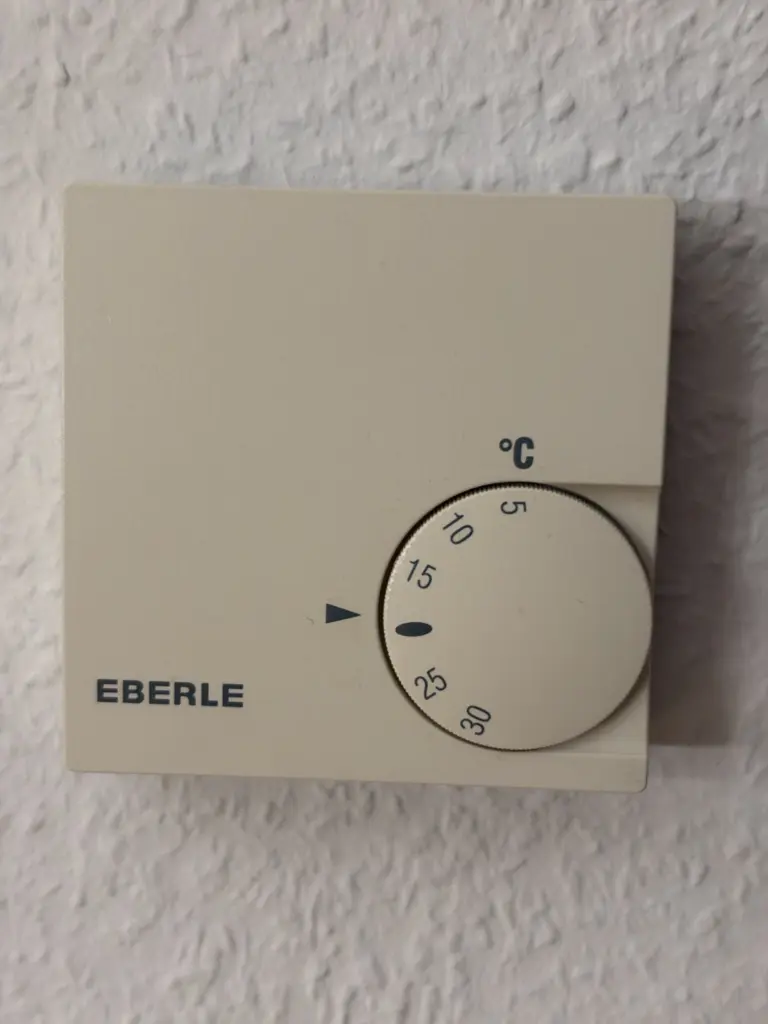
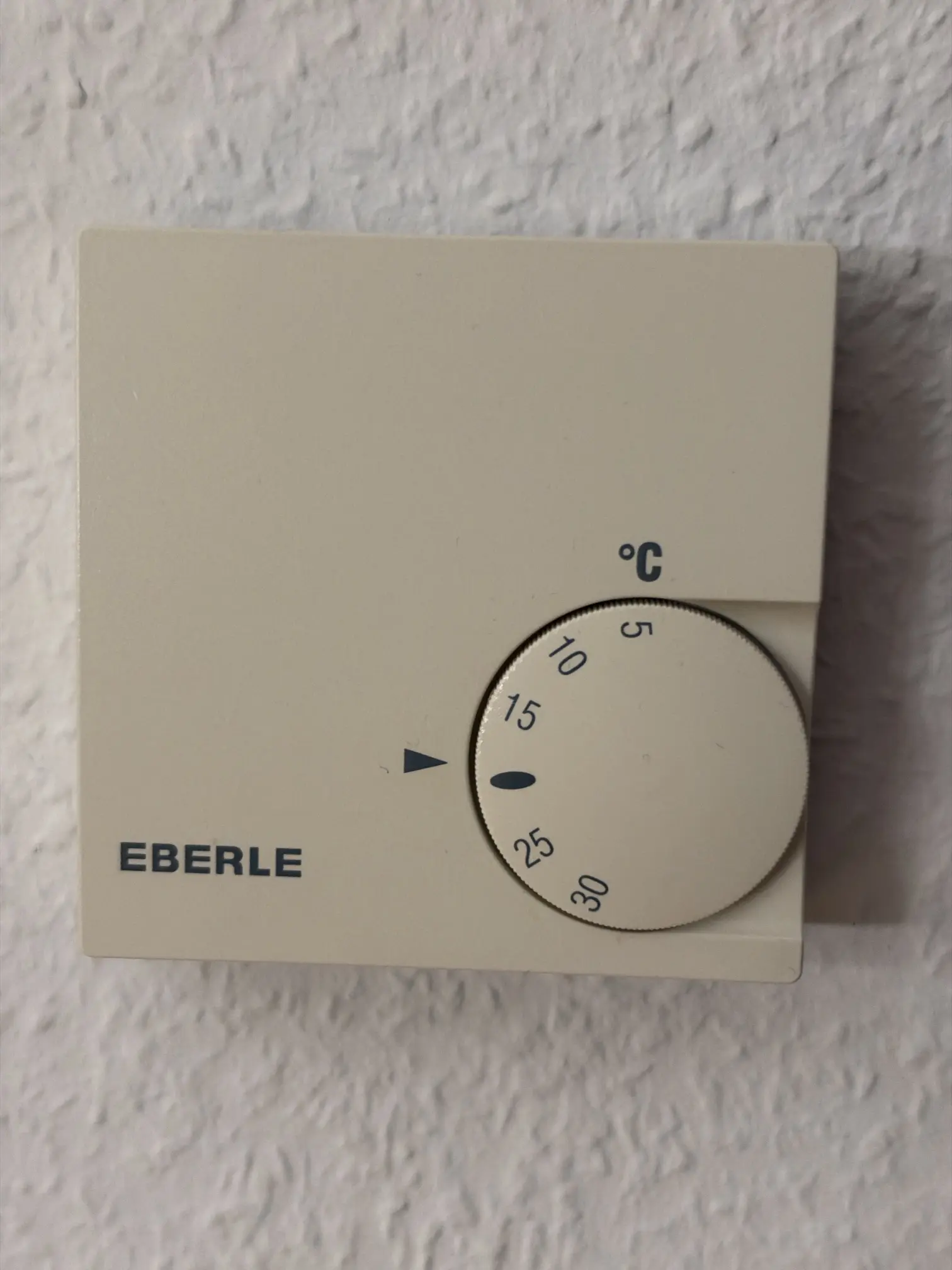
The front shows only the EBERLE lettering, a scale from 5 to 30 °C and an arrow. There is no switch and no indicator light. That matches Eberle’s RTR-E 6000 series, most likely the RTR-E 6121 or the RTR-E 6124. We did not check the rating plate, as we would have had to remove a unit from the wall. All technical data below therefore comes from the Eberle catalog and, according to the manufacturer, applies to the RTR-E 6121, not verifiably to our unit.
What the series can do, according to the manufacturer
The RTR-E 6121 is a bimetal controller with thermal feedback. It controls between 5 and 30 °C, switches via an NC (normally closed) contact at 230 volts and, according to Eberle, handles a switching current of 10 (4) A. Eberle specifies the switching differential as about 0.5 kelvin. The housing measures 75 × 75 × 25.5 mm, is double-insulated and rated IP 30. It is screwed onto the wall or directly onto a flush-mounted box. The main difference of the RTR-E 6124 is an input for a temperature setback via an external timer.
The thermal feedback is a small heating resistor next to the bimetal strip. It slightly preheats the sensor as soon as the controller calls for heat, so the heating does not overshoot. According to Eberle, it needs the neutral conductor for this. Without it, the temperature fluctuates considerably.
Operation: one dial, pure guesswork
The thermostat is operated with a single dial. That is simple. Everyone in the house understands it immediately; nobody needs a manual. But it is completely analog. You can only read the temperature roughly from the marks on the scale; it is pure guesswork. You cannot tell whether the dial is set to 19 or 21 degrees.
If you turn the dial past the temperature the thermostat is currently measuring in the room, you have to overcome some resistance – a noticeable detent. That is exactly the switching point at which the thermostat turns the heater on. It feels coarse and not very well made.
Eberle also states that the switching point is only accurate after one to two hours of operation and is initially lower after turning the knob. So if you adjust it, do not turn it again after ten minutes.
In everyday use: does what it should
The thermostat does its basic job. It heats until the set temperature is reached and then holds it. Together with the heat pump, this has worked reliably for eleven years. There is not much that can break, and nothing has broken.
What is missing: display, schedules, numbers
There is nothing smart about this thermostat. It shows neither the set nor the current temperature. There are no schedules, and no data or statistics either. If you want to know how often and for how long the supplementary heater runs, you are left completely in the dark. The thermostat works, but it is no fun. Thoroughly old-school.
After eleven years: the housing turns yellow
The light plastic housing has yellowed over time. Eberle specifies the housing color of the current series as polar white, similar to RAL 9010. Ours has turned a cream color; the plastic is apparently not lightfast or UV-resistant. That is normal after so many years, but it is not pretty.
Who the dial is enough for
If you are looking for a thermostat you set once and then forget, the Eberle will serve you well. It is robust, simple and reliably switches a supplementary heater. If, on the other hand, you want to see numbers, use schedules or control the heating via an app, you need something else. Which thermostats can safely switch an electric supplementary heater, from a simple dial to a digital programmable thermostat to Matter for Apple Home, is covered in our guide Room thermostats for electric supplementary heating: digital, smart or dial? (in German)
Technical data
Manufacturer’s specifications from the technical documentation for the RTR-E 6000 series, as of November 14, 2026. We have not verified them ourselves. Because we did not check the rating plate, both possible models are shown side by side.
| Model | RTR-E 6121 | RTR-E 6124 |
|---|---|---|
| Item number | 111 1101 51 100 | 111 1102 51 100 |
| Temperature range | 5 to 30 °C | 5 to 30 °C |
| Technology | Bimetal with thermal feedback | Bimetal with thermal feedback |
| Contact | 1 NC contact | 1 NC contact |
| Operating voltage | 230 V AC, 50/60 Hz | 230 V AC, 50/60 Hz |
| Switching current | AC 10 mA to 10 (4) A; DC 100 W | AC 10 mA to 10 (4) A; DC 100 W |
| Temperature setback | no | approx. 5 K, via external timer |
| Switching differential | approx. 0.5 K | approx. 0.5 K |
| Switch, indicator lamp | no | no |
| Protection rating, protection class | IP 30, double-insulated | IP 30, double-insulated |
| Dimensions | 75 × 75 × 25.5 mm | 75 × 75 × 25.5 mm |
| Housing color | pure white, similar to RAL 9010 | pure white, similar to RAL 9010 |
| Mounting | surface-mounted, on a flush-mounted box or snap-on DIN rail mounting | surface-mounted, on a flush-mounted box or snap-on DIN rail mounting |
Our verdict: 3 out of 5 stars
Reliable and robust: in eleven years not a single thermostat has failed, and the set temperature is maintained. But that is all. No display, a scale you can only guess from, a coarse detent, no schedules, no data and a housing that turns yellow. For a device that works but offers no comfort and no data, we give three out of five stars. Whether that is enough is up to you.
Important before replacing it
A room thermostat for an electric heater is hard-wired to 230 volts. Work on the home’s electrical installation should only be done by a licensed electrician. Before opening it, the circuit must be switched off and checked to make sure it is de-energized.
Frequently asked questions
Which Eberle model is this?
The front without a switch or indicator light matches the RTR-E 6000 series, most likely the RTR-E 6121 or 6124. We did not check the rating plate; the technical data comes from the Eberle catalog for the RTR-E 6121.
How precisely can you set the temperature?
Only roughly. The scale has marks from 5 to 30 °C, and there is no display. According to Eberle, the switching point is only accurate after one to two hours of operation, so be patient after turning the dial.
Can the thermostat switch an electric heater directly?
According to the manufacturer, the RTR-E 6121 switches up to 10 (4) A at 230 volts via an NC contact. Whether that is enough for your heater depends on its power rating; the connection should be made by an electrician.
Can you still buy this thermostat?
Yes, Eberle lists the RTR-E 6121 in its 2026 price list. If you want a display, schedules or Apple Home, you will find alternatives in our guide to room thermostats for electric supplementary heating (in German).
Why has the housing turned yellow?
The light-colored plastic yellows over the years; it is apparently not lightfast or UV-resistant. This does not affect how it works.
Sources
- Eberle: Technical documentation for RTR-E 6000 series room temperature controllers (PDF, hosted by a specialist retailer)
- Eberle: RTR-E 6000, product page
Are you a manufacturer or retailer and would like us to review your product? Offer a product for review (in German).
Conclusion
Reliable and robust: in eleven years not a single thermostat has failed, the set temperature is maintained, and anyone can operate it.
But that is all: no display, a scale you can only guess from, a coarse detent, no schedules, no data and a housing that turns yellow. It works, but it is no fun. Three out of five stars. Whether that is enough is up to you.
Where to buy
- Eberle RTR-E 6121Check price at Amazon.de
- Eberle RTR-E 6124Check price at Amazon.de