Contents14 sections
This guide was first published in German on handgetestet.de.
Healthy teeth rarely come down to the device. What matters is two minutes, gentle pressure and whether the brush really reached every surface. That is why, for most households, a mid-range brush with a pressure sensor and long battery life is the right fit, such as the Philips Sonicare 7100. If you want to spend little, the Oral-B iO 2 will serve you well, and if you want to be coached by your smartphone or charging station, the Oral-B iO 10 is currently the most complete package.
More expensive does not mean cleaner. Oral-B itself states that every iO uses the same cleaning technology and that higher-end models mainly offer more guidance, more modes and more convenience. At the top end, you are paying for the coaching. Whether it does any good is something we look at further below, using the studies that exist on the subject.
What research knows about electric toothbrushes
The most important analysis is a Cochrane review by Yaacob and colleagues, published on June 17, 2014 (Cochrane Database of Systematic Reviews, CD002281.pub3). It summarizes 56 randomized studies, 51 of which, with 4,624 participants, were included in the calculation. The result: with electric brushes, around 11 percent less plaque remained on the teeth in the short term, that is, after one to three months, and around 21 percent less after more than three months. Gum inflammation decreased by 6 and 11 percent more, respectively, than with a manual toothbrush. The authors rate the quality of the evidence as moderate; most studies had an unclear risk of bias. They explicitly left open how much this means clinically. Side effects were rare, localized and temporary.
In March 2025, the German consumer advice center Verbraucherzentrale put this into sober perspective. Electric brushes remove somewhat more plaque, but the difference is not large, and long-term evidence of less tooth decay and periodontitis is lacking. They do no harm. Those who benefit most are people who find the right brushing technique difficult.
The SHIP population study from Greifswald, Germany, offers a view across many years. In 2019, Pitchika and colleagues followed 2,819 adults over eleven years in the Journal of Clinical Periodontology. Those who brushed electrically had less progression of gum pockets, 17.7 percent less progression of tooth decay and kept 19.5 percent more teeth. This is an observational study. It shows a correlation, not proof, because those who brushed electrically were younger on average.
And which technology cleans best? A second Cochrane review from 2010 found too few comparable studies to reach a verdict. A network meta-analysis by Luo and colleagues (Clinical Oral Investigations, 2026) covering 19 studies ranks oscillating-rotating brushes first for plaque and gums, narrowly ahead of sonic brushes. Stiftung Warentest, the German consumer testing organization, sees it differently in its test of 48 brushes from November 18, 2025: none of the systems has a clear advantage. Both can be true. Rankings in meta-analyses are probabilities, not large gaps.
Round, oscillating or ultrasonic: the three designs
Oscillating-rotating brushes have a small round head that turns back and forth rapidly. That is Oral-B’s principle. In stores, the electric Oral-B models carry the addition „Designed by Braun“; both brands belong to Procter & Gamble. According to the manufacturer, the iO series adds gentle micro-vibrations to the rotating movement; Oral-B does not give a vibration count for the iO online. With the round head, you brush each tooth individually, chewing surface, outside, inside, a few seconds each with gentle pressure. That is how the German dental information initiative proDente describes it.
Sonic toothbrushes like the Philips Sonicare work with an elongated head whose bristle field vibrates sideways. For many models, Philips states up to 62,000 brush head movements per minute. You place it at an angle of about 45 degrees to the gum line and move the brush slowly onward without scrubbing. Because the head covers several teeth at once, brushing feels more like using a manual toothbrush. Oral-B also offers sonic brushes with its Pulsonic line, but its focus is clearly on the round head.
True ultrasonic brushes are rare. Their movements cannot be seen with the naked eye, and according to proDente, clinical studies mostly show no advantage over manual toothbrushes. There are also hybrid forms. The Silk’n ToothWave, for example, combines vibration with radio frequency energy, according to its clearance filing with the US Food and Drug Administration (FDA). We are not aware of robust independent comparative studies on such special approaches.
Our position: buy the design you enjoy brushing with. If you find the round head ticklish and loud, you will be happier with sonic. If you like working tooth by tooth, stick with Oral-B. The better technology is the one you use for two minutes every evening.
Pressure, timer, modes: what matters
Too much pressure harms the gums and the necks of the teeth. That is why pressure control is the most important feature, more important than a display or app. The implementation differs. The Oral-B iO 2 slows down and lights up red when you press too hard. From the iO 5 upward, a light ring also shows whether you are brushing too gently or just right. With Philips, the vibration changes; on the Prestige model, a purple light also flashes, and the intensity automatically drops one level if you press too hard for longer.
By now, practically all devices have the two-minute timer. Oral-B signals every 30 seconds to move on to the next quadrant of the mouth, and the Philips Prestige model divides the time into six sections. That sounds like a small thing. For people who would otherwise stop after 50 seconds, it is half the battle.
As for modes: three are enough. A gentle setting for sensitive gums makes sense, such as „Sensitive“ or „Super Sensitive“ on Oral-B or a low intensity on Philips. In the manuals of newer models, Philips recommends starting with a low intensity for the first one to two weeks. Modes like „Whitening“ or „Tongue Clean“ are a convenience, not a must.
Brush heads: the bill nobody does the math on
Oral-B, Philips and proDente all recommend changing the brush head about every three months, sooner if the bristles are splayed. That makes four heads per person per year. What that costs depends almost entirely on the head, not the handle. We calculated with pack prices at Coolblue (German retailer), as of November 15, 2026, rounded in each case.
- Oral-B Pro Cross Action for the Pro models, in a ten-pack: around ten euros per person per year.
- Oral-B iO Gentle Care, in a six-pack: around twenty euros.
- Oral-B iO Ultimate Clean, in an eight-pack: a good twenty euros.
- Philips Sonicare Optimal White, in a nine-pack: a good twenty euros.
- Philips Sonicare Premium Plaque Defense, in a five-pack: just under forty euros.
- Philips Sonicare Premium All-in-One (A3), in a two-pack: a good sixty euros.
With the A3 head of the Prestige brush, a couple therefore pays around six times as much as with the cheapest Oral-B head. Over five years, that gap is larger than the price difference between many handles. Two things help. With Oral-B, every iO head fits every iO handle, but not older Pro or Vitality models. With Philips, you do not have to stick with the premium head that came in the box; before buying replacements, ask which less expensive heads fit your handle. The replacement reminder via a chip in the head (BrushSync at Philips) is practical, but it tends to shorten the service life rather than save money.
Battery, charging and travel
Manufacturer specifications range from two to four weeks. Oral-B states up to four weeks for the iO 2, Philips at least two weeks for the Prestige model and, according to the product data, 21 days for the 7100. These figures assume two minutes twice a day. If you brush longer or share the brush with family members, you will get correspondingly less.
There are differences in charging that you notice in everyday use. According to the manufacturer, Oral-B charges from the Series 7 upward in three hours via a magnetic fast-charging station; smaller models should stand overnight. Philips states up to 16 hours for a full charge for the Prestige model. According to the manual, you should charge, use and store the Philips brushes between 5 and 40 degrees Celsius, so not in the car in summer.
According to Oral-B, the brushes can go in your carry-on luggage without any problem. For frequent travelers, a charging travel case with a USB connection is worth its weight in gold, because then the power adapter stays at home. Oral-B includes one with the iO 9 and iO 10, Philips with the Prestige models. Stiftung Warentest also checks whether the battery can be replaced. That is difficult with most brushes; with the new 2026 Prestige model, Philips explicitly advertises a housing designed to make battery replacement easier.
Sensitive gums, implants, braces
With sensitive gums, what counts is a gentle setting, a soft head like the iO Gentle Care and a clear pressure warning. If your gums bleed heavily after switching or for longer than a week, or if you are in pain, the Philips manual says you should stop using the brush and ask your dentist or doctor. Anyone who has had surgery in the mouth or on the gums in the past two months should check with their practice first. If you have a pacemaker or another implant, Philips recommends asking your doctor or the implant manufacturer before use.
According to Philips, braces, fillings, crowns and veneers are not an obstacle; Sonicare brushes may be used on them. For dental implants, proDente above all recommends thorough cleaning of the surrounding area and the spaces between the teeth, once a day with interdental brushes. So the toothbrush alone is not enough there, whichever one you use. A water flosser can supplement it but does not replace the interdental brush, as our water flosser guide (in German) explains.
The 2026 meta-analysis found the advantage of electric brushes to be particularly pronounced in children and in people with fixed braces. For the youngest, there are dedicated models with smaller heads and kids‘ apps; Oral-B does not recommend its adult brushes for children under three. You can read more about this in our guide to electric toothbrushes for kids (in German). And if you have dentures, periodontitis or ongoing treatment: ask your practice which brush and which head are right for you.
What the apps measure and what they don’t
Both major manufacturers connect their better brushes via Bluetooth to a free app. The brush measures, the phone displays. At their core, three things are measured: how long, how hard and where in your mouth you brush. Everything else is analysis based on that.
Oral-B app
The Oral-B app guides you through the brushing session in real time. According to the manufacturer, an AI-supported recognition of brushing technique knows more than 1,000 human brushing behaviors, available on the iO series and Genius X. The 3D tooth surface tracking, which distinguishes outer, inner and chewing surfaces, is only available on the top models iO 9 and iO 10. According to Oral-B, the iO 5 and iO 6 recognize six brushing zones. After each guided session, the app shows a brushing score, a coverage map and an overview of where you apply a lot of pressure, filtered by week, month and year. A gum bleeding tracker is intended to help you notice changes. The data can be shared with Apple Health.
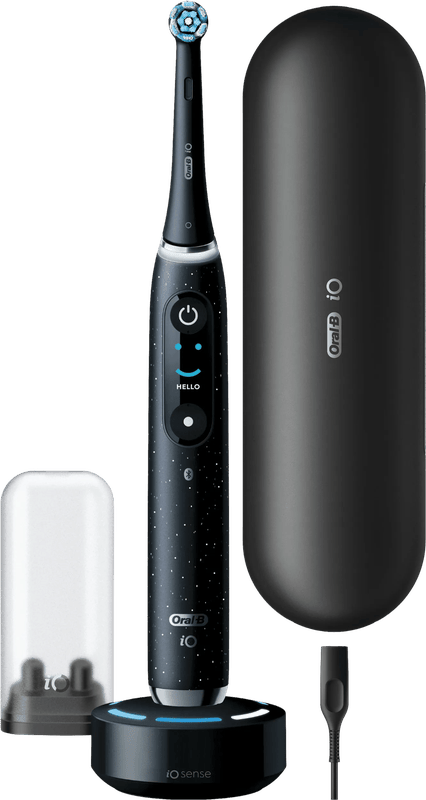
With the iO 10, the iO Sense charging station takes over part of this. According to Oral-B, it shows coverage, time and pressure while you brush, without your phone having to be in the bathroom. That is the real difference from the iO 9; the cleaning is the same. Since spring 2026, according to the manufacturer, the iO 9 and iO 10 in Smart Adapt mode adjust the intensity ten times per second to brushing behavior and pressure.
Philips Sonicare app
With Philips, the range of functions depends heavily on the model, and the app description says so too. The top tier with SenseIQ, mouth map and personal guidance is available on the Prestige models and the new DiamondClean 8000 to 9000 series. DiamondClean Smart and FlexCare Platinum Connected show a mouth map with hints about missed areas. The Sonicare 6500 and 7100, as well as the older DiamondClean 9000 and ExpertClean, only get basic functions such as a timer and brushing instructions. If you buy a mid-range model because of the app, you should know that.
According to Philips, SenseIQ measures pressure, motion and brushing area up to 100 times per second. The brush warns you if you press too hard, signals with a yellow light on request when you scrub, and lowers the intensity by itself. The app shows progress reports by day, week, month and year, keeps a diary that also covers floss and mouthwash, and in Germany can automatically reorder brush heads. With the new 2026 Prestige model, according to Philips, the analysis runs directly in the brush, and a light ring and a map with twelve sections show missed areas while you brush.
The limits of measurement
None of these apps can see your teeth. They calculate from the movement and position of the handle where the head probably was. None of them detects plaque, tartar, tooth decay or gum pockets, and the spaces between the teeth remain invisible. Oral-B’s gum bleeding tracker depends on you entering what you see yourself. Even a brushing score of 100 only says that you met the app’s targets.
Privacy and accounts
Both apps are health apps in the App Store sense. According to the privacy information the manufacturers have provided there, the Oral-B app from P&G Health Care links, among other things, your email address, name, health data, approximate location and usage data to your identity. Identifiers may also be used for tracking across other companies‘ apps and websites. Philips likewise lists name, email and user ID as linked to you, and according to its information, health data only without personal reference for analytics. For the Prestige model, the manual provides for an account in the app during setup. Since November 2026, according to the App Store listing, there is also a guest user option. Automatic syncing requires location access.
The good news: you do not have to use the app. Oral-B states explicitly that every iO works without the app; timer, pressure control and modes are built into the handle. With Philips, the same applies to the pressure warning and timer. Only the mode selection on the Prestige model takes place via the app.
Does the app help, or is it a gimmick?
The honest answer is: it can help, but the evidence is thin. Read briefly and critically, the situation looks like this.
In a South Korean study (Kim and colleagues, Journal of Medical Internet Research 2025), 150 participants brushed for six months with a manual toothbrush, with an electric brush plus app guidance, or with a connected brush whose data was evaluated every week by dental staff. The connected group had significantly less plaque at the end. But it also had weekly feedback from professionals. What part of that the technology accomplished cannot be separated out.
A Belgian study of patients after periodontitis treatment (Tytgat and colleagues, Journal of Clinical Medicine 2025, supported by Oral-B) compared a manual toothbrush, an electric brush and an electric brush with daily feedback over twelve weeks. Plaque dropped significantly in all three groups, from around 64 to 26 to 33 percent. The researchers found no measurable difference between the groups, not even from the feedback. What mattered was consistent brushing.
A 2026 review (Bahamdan, Dentistry Journal) summarizes 18 studies. Sensor and app systems mostly improved plaque, gum bleeding and brushing behavior over two weeks to six months. Most studies, however, cannot distinguish what the electric brush, the feedback and the automatic analysis each achieve. Long-term evidence is lacking. Another study with 80 participants (Gomez and colleagues, BMC Oral Health 2025, funded by Colgate) mainly shows that users rate their brushing better with an app. Manufacturer figures in the app descriptions, such as an Oral-B field test with 52 participants, are no substitute for an independent study.
Our take: the app is a training tool, not a medical device. If you regularly forget the same molars or brush too briefly, you can learn a lot about yourself in the first few weeks. After that, for many people it turns into statistics they no longer open. If you brush conscientiously, with the top models you are mainly paying for feedback you do not need. And if you do not like being measured, you lose nothing by skipping the app.
Who else makes toothbrushes
Oral-B and Philips share most of the shelf, but the selection is broader. Panasonic sells sonic brushes in Germany such as the EW-DM81, with around 31,000 vibrations per minute according to retailer information. happybrush offers inexpensive sonic brushes like the Eco VIBE 3, with up to 40,000 vibrations and up to six weeks of battery life according to retailer information. Oclean offers sonic brushes with an app and display; the Oclean X Ultra S was tested by Stiftung Warentest. In Germany, Waterpik is known mainly for water flossers; the Sonic-Fusion combines a sonic brush and water flosser in one device. For brands such as Suri or Quip, we were unable to reliably establish German distribution with a warranty and replacement heads.
According to Stiftung Warentest, good brushes are available for very little money. If you buy from a small brand, check beforehand whether replacement heads will be permanently available from retailers in Germany. A brush without heads is a paperweight after three months.
Premium class from the €200 mark: coaching and features
Here you get position detection, a color display or light ring, a charging travel case and the full app. You do not get a cleaner basic clean. Current prices are shown on the buy buttons.
| Model | Technology | Modes and pressure | App and feedback | Battery and travel |
|---|---|---|---|---|
| Oral-B iO 10 | round, oscillating-rotating with micro-vibrations | 7 modes incl. Smart Adapt, pressure control shows too hard, too gentle, just right | 3D tooth tracking, AI-supported brushing recognition, iO Sense charging station with live coaching, Apple Health | Fast-charging station 3 hrs, charging travel case |
| Philips Sonicare Next-Generation DiamondClean 9900 Prestige | Sonic | 8 modes, 3 intensities, SenseIQ lowers intensity under pressure | Analysis in the brush, light ring, mouth map with 12 sections | Charging travel case, charging glass, housing for battery replacement |
| Philips Sonicare 9900 Prestige | Sonic, up to 62,000 movements/min | Modes via app, 3 intensities, pressure and scrubbing warning, adaptive intensity | SenseIQ, app with 3D mouth map and reports | at least 2 weeks, USB charging case |
Our pick in the premium class: Oral-B iO 10
According to Oral-B, the iO 10 is the most advanced model in the series and remains the top of the line even after the 2026 refresh. Two things speak for it. The round head has the broadest body of evidence in the studies. And the iO Sense charging station shows coverage, time and pressure at the sink without you having to pick up your phone. On top of that come seven modes, the color display and a charging travel case. The downside is obvious. For considerably less money, the iO 9 cleans just as well, only without the station. If you use the app on your phone anyway, you can save the money.
Philips Sonicare 9900 Prestige: for everyone who wants sonic
The Prestige model is slim, measures pressure and motion with SenseIQ and also warns against scrubbing, a habit many people bring with them from a manual toothbrush. In July 2026, Philips introduced a new generation that does the analysis directly in the brush and shows gaps via a light ring and mouth map. Pay attention to the exact name when buying, because both generations are on sale. Also consider the ongoing costs. With the included A3 head, you pay many times what Oral-B heads cost each year.
Mid-range between the €80 and €200 marks: where most people buy
In this class, you get several intensities, a visible pressure sensor and usually an app with simple functions. Position detection across all tooth surfaces is often missing.
| Model | Technology | Modes and pressure | App and feedback | Battery and travel |
|---|---|---|---|---|
| Philips Sonicare 7100 | Sonic, 62,000 movements/min | 4 modes, 3 intensities, pressure sensor with light ring | App with basic functions (timer, brushing instructions) | 21 days according to Philips, case depending on set |
| Oral-B iO 5 | round, oscillating-rotating with micro-vibrations | 5 modes incl. Super Sensitive, smart pressure control | interactive display, app with 6 brushing zones | Travel case |
Our pick in the mid-range: Philips Sonicare 7100
The 7100 delivers what matters in everyday use, without a surcharge for coaching. Four modes with three intensities add up to twelve settings, including a gentle one for sensitive gums. The pressure sensor signals via a light ring, and according to Philips, the battery lasts three weeks. Stiftung Warentest included the 7100 in its test in November 2025. One limitation: according to Philips, the app can only provide basic functions for this model. If you want position detection, you have to go up a class.
Oral-B iO 5: the round head with a display
The iO 5 has five modes, including Super Sensitive, an interactive display and pressure control that also indicates brushing too gently. According to Oral-B, it recognizes six brushing zones via the app. If you want a dedicated gum care mode, take a look at the iO 6. For many people, the iO 5 is the sensible Oral-B, because it delivers the same cleaning as the iO 10.
Entry-level class below the €80 mark: the solid switch
Here you get a timer, pressure control and one, at most three, settings. A display and app are usually missing, and that is no loss.
| Model | Technology | Modes and pressure | App and feedback | Battery and travel |
|---|---|---|---|---|
| Oral-B iO 2 | round, oscillating-rotating with micro-vibrations | 3 intensities, pressure control slows down and lights up red | no app, timer with 30-second signal | up to 4 weeks, travel case |
| Philips Sonicare 4100 | Sonic | Pressure sensor, two-minute timer in four sections | no app | up to 3 weeks according to retailer information |
| Oral-B Pro 3 3500 | round, oscillating-rotating | 3 modes, 360-degree pressure control slows down and lights up red | no app | over 2 weeks, travel case |
Our pick in the entry-level class: Oral-B iO 2
The iO 2 is the most affordable way into iO technology. It has one button, three intensity levels and automatic pressure control that slows the brush down and lights up red. According to Oral-B, a charge lasts up to four weeks. And the heads will later also fit any higher-end iO. What is missing is a display, brushing modes and an app. Very few people will miss them.
Philips Sonicare 4100 and Oral-B Pro 3 3500
The new Sonicare 4100 (for example HX4044) is the entry point into sonic technology, with four brushing settings and up to three weeks of battery life according to the listing. For the 4100 series, Philips mentions a pressure sensor that warns you and reduces the vibration. The Pro 3 3500 is the older Oral-B generation with three modes, 360-degree pressure control and a travel case. Its advantage is the cheapest heads in the list above. Its drawback: the heads do not fit iO models, so a later switch starts from scratch.
How we would decide
You brush properly and simply want to go electric? Oral-B iO 2 or Sonicare 4100, depending on whether you prefer round or oscillating. You have sensitive gums or share the bathroom with people who like to press hard? Then the Philips Sonicare 7100 or the Oral-B iO 5, because both have a gentle setting and a clearly visible pressure warning. You regularly miss the same spots, or your dental practice has told you so? Then the coaching of the premium class is worth it, most conveniently with the charging station of the Oral-B iO 10. And in any case: factor in the brush heads before you decide.
Frequently asked questions
Does an electric toothbrush clean better than a manual toothbrush?
Somewhat. A 2014 Cochrane review of 56 studies found around 11 percent less plaque with electric brushes after one to three months and around 21 percent after more than three months, as well as 6 and 11 percent less gum inflammation, respectively. The authors left open how much that means clinically. The German consumer advice center Verbraucherzentrale says the difference is not large; long-term evidence on tooth decay and periodontitis is lacking.
Which is better, Oral-B or Philips Sonicare?
Neither technology is clearly superior. A 2026 network meta-analysis puts oscillating-rotating brushes like Oral-B narrowly ahead of sonic brushes like Philips Sonicare, while Stiftung Warentest found no clear advantage for either system in 2025. What matters is which brushing feel keeps you going for two minutes every day.
What does an electric toothbrush app do?
It shows brushing time, pressure and, depending on the model, which areas you miss. That can help you spot bad habits. Studies show better results in the short term, but they usually cannot separate the effect of the app from that of the electric brush. In a 2025 study, daily feedback brought no measurable advantage. All brushes also work without the app.
What does the Oral-B app measure?
According to Oral-B, brushing time, pressure and coverage, with 3D tooth surface tracking on the iO 9 and iO 10 and six zones on the iO 5 and iO 6. There is also a brushing score, trends by week, month and year, a gum bleeding tracker and a connection to Apple Health. The app cannot detect plaque or tooth decay.
What is SenseIQ on Philips Sonicare?
According to Philips, SenseIQ records pressure, motion and brushing area up to 100 times per second. The brush warns you if you press too hard, and on request also if you scrub, and lowers the intensity by itself. The full analysis with a mouth map is only available on the Prestige models and the new DiamondClean 8000 to 9000; the Sonicare 7100 only gets basic functions in the app.
How often do you need to change the brush head, and what does it cost?
Oral-B, Philips and proDente recommend about every three months, so four heads per person per year. Based on pack prices at Coolblue (German retailer) on November 15, 2026, that comes to around ten euros with Oral-B Pro Cross Action, a good twenty euros with iO or Optimal White heads and a good sixty euros with the Philips A3 Premium All-in-One head.
Do iO brush heads fit older Oral-B models?
No. According to Oral-B, every iO head fits every iO handle, but not Pro or Vitality models. If you start with a Pro 3 and later switch to the iO, you will need new heads.
Can you use an electric toothbrush with braces or implants?
According to Philips, Sonicare brushes are suitable for braces, fillings, crowns and veneers. For implants, proDente also recommends daily interdental brushes. According to Philips, anyone who has had oral surgery in the past two months should ask their dental practice first, and anyone with a pacemaker should ask their doctor or the implant manufacturer.
What should you do if your gums bleed after switching?
Start with a low intensity, use a gentle head and do not press. In its manuals, Philips recommends that you stop using the brush and ask your dentist or doctor if bleeding is heavy, lasts longer than a week, or if you have pain.
How long does an electric toothbrush battery last?
According to the manufacturers, two to four weeks at two minutes twice a day: Oral-B iO 2 up to four weeks, Philips Sonicare 7100 21 days, Sonicare 9900 Prestige at least two weeks. From the Series 7 upward, Oral-B charges in three hours; according to Philips, the Prestige needs up to 16 hours.
Sources
- Cochrane: Yaacob M et al., Powered versus manual toothbrushing for oral health, 2014, CD002281.pub3
- Cochrane: Deacon SA et al., Different powered toothbrushes for plaque control and gingival health, 2010
- Pitchika V et al., Long-term impact of powered toothbrush on oral health: 11-year cohort study, J Clin Periodontol 2019
- Luo C et al., Comparative efficacy of electric toothbrush technologies: a network meta-analysis, Clin Oral Investig 2026
- Kim J et al., Smartphone-Based Telemonitoring for Better Oral Health With Toothbrushes, J Med Internet Res 2025
- Tytgat M et al., The Effect of Visual Feedback on Plaque Control, J Clin Med 2025
- Gomez J et al., Impact of connected toothbrushes on patient perceptions, BMC Oral Health 2025
- Bahamdan GK, Smart Toothbrushes and AI-Assisted Oral Hygiene Monitoring, Dent J 2026
- Verbraucherzentrale: Do you brush better with an electric toothbrush? (in German)
- Stiftung Warentest: Electric toothbrushes tested, November 18, 2025 (in German)
- proDente: Electric toothbrushes, which types are there? (in German)
- proDente: How to care for dentures and implants (in German)
- Oral-B: Which iO toothbrush is right for you?
- Oral-B: iO 10
- Oral-B: iO 2
- Oral-B: iO 5
- Oral-B: Pro 3 3500
- Oral-B: Oral-B app
- ZWP online: Oral-B presents revised iO portfolio, January 20, 2026 (in German)
- App Store: Oral-B app with privacy information
- App Store: Philips Sonicare with privacy information
- Philips: Sonicare 9900 Prestige HX9992 data sheet
- Philips: Sonicare 9900 Prestige user manual
- Philips: Press release Next-Generation DiamondClean 9900 Prestige, July 7, 2026
- Philips: Sonicare 7100 HX7420/01
- Philips: Sonicare 4100
- FDA 510(k) K214078: Silk’n ToothWave
Where to buy
- Philips Sonicare 7100View at CoolblueCheck price at Amazon.de
- Oral-B iO 10View at CoolblueCheck price at Amazon.de
- Oral-B iO 2View at CoolblueCheck price at Amazon.de
- Philips Sonicare Next-Generation DiamondClean 9900 PrestigeCheck price at Amazon.de
- Philips Sonicare 9900 PrestigeView at Coolblue
- Oral-B iO 5 (Matt Black)Check price at Amazon.de
- Philips Sonicare 4100 (Marineblau)View at Coolblue
- Philips Sonicare 4100Check price at Amazon.de
- Oral-B Pro 3 3500 (schwarz)Check price at Amazon.de