Contents11 sections
This guide was first published in German on handgetestet.de.
With hair straighteners, the highest printed temperature is usually the wrong yardstick. What matters is how finely the heat can be adjusted. A model that tops out at 230 degrees Celsius and offers many settings in between is enough for almost any hair, such as the Remington PROluxe You S9880. Cheaper and with a similar range: the Philips 7000 Series BHS732.
What heat does to keratin
Hair is a protein fiber. Protein can only tolerate so much heat. A laboratory study in the Journal of Cosmetic Dermatology (Lima and colleagues, 2019) examined tresses treated with a flat iron: from about 200 degrees Celsius, gases were released that indicate breaking-down keratin, denaturation occurred at 237 degrees, and under the electron microscope the outer cuticle layer showed damage. An older study in the Journal of Cosmetic Science (Zhou and colleagues, 2011) found that heat-stressed hair breaks considerably more often when combed. In the lab, certain pretreatments reduced breakage.
Both are tests on hair tresses, not studies on people. The direction is clear nonetheless. If 180 degrees is enough, 230 is too much. And one slow pass is better than five quick ones.
Control, plates, shut-off: the technology behind it
Fine or colored hair needs less heat than thick, frizzy hair. Remington itself recommends in its manual 150 to 170 degrees Celsius for fine hair and 210 to 230 degrees only for very thick hair. At least as important as the setting is the control. Sensors keep the heat constant, even when a thick section cools the plates. Without that control, people tend to turn the setting up and then overheat the next, thinner section.
For plate width, there’s a simple rule of thumb. Narrow plates of around 25 millimeters are suitable for short to medium-length hair and for waves; wide plates over 35 millimeters save time with long, thick hair.
Automatic shut-off is appreciated by anyone who rushes out of the bathroom in the morning; shut-off times range between 10 and 30 minutes. And cordless? Sounds tempting, but it costs a lot and, according to the manufacturers, only runs for half an hour.
Heat protectant spray is part of the routine. A lower setting doesn’t replace it. Wet hair has no place between hot plates, so dry it completely beforehand, gently, for example with a dryer from our hair dryer guide.
Six straighteners, soberly compared
| Model | Temperature according to manufacturer | Special feature | Best for |
|---|---|---|---|
| Remington PROluxe You S9880 | 150 to 230 °C, 9 settings | StyleAdapt automatic adjustment, 110 mm long plates | Most people who straighten regularly |
| Philips 7000 Series BHS732 | 120 to 230 °C | ThermoShield temperature sensor, ions | Budget-conscious users with fine to normal hair |
| ghd chronos | fixed 185 °C | No setting selection, 26 mm plates | Those who don’t want to adjust anything |
| Cloud Nine The Original Iron | 100 to 200 °C, 11 settings | Plates with the mineral sericite | Fine, sensitive hair |
| Dyson Corrale | 165, 185 or 210 °C | Flexing plates, battery up to 30 minutes | Frequent travelers with a big budget |
| BaByliss Steam Lustre Styler ST595E | 170 to 210 °C, 5 settings | Steam, 36 mm wide ceramic plates | Thick, frizzy hair |
Remington PROluxe You S9880
In manual mode, the Remington offers nine settings from 150 to 230 degrees Celsius. According to the manufacturer, in StyleAdapt mode it learns how your hair responds and adjusts the temperature itself. Two user profiles save the settings, which is handy in a shared bathroom. The plates are 110 millimeters long and spring-mounted, and the cord is three meters long. In our view, control and price are in the most sensible balance here. We currently can’t find a listing of the S9880 itself on Amazon (as of November 9, 2026). Available there is the Philips 7000 Series BHS732, also adjustable up to 230 degrees and with a temperature sensor, but without automatic adjustment.
Philips 7000 Series BHS732
At Philips, a sensor called ThermoShield is meant to keep the temperature even. The range runs from 120 to 230 degrees Celsius, going lower than the Remington. According to Philips, the device achieves the same result at 180 degrees as an older model of the brand at 210 degrees. That’s what the manufacturer says. Automatic adjustment to the hair is missing, but the device sits in a cheaper price class.
ghd chronos
Temperature selection? Not at ghd. According to the manufacturer, the chronos maintains a constant 185 degrees Celsius and adjusts its power to your movement instead. For normal hair, that’s a sensible middle value; for very fine hair it can be too high, for unruly hair too low. For long, thick hair, the chronos max is an option, a version with considerably wider plates. It’s still a lot of money, though, for a device without any adjustment options.
Cloud Nine The Original Iron
Cloud Nine states eleven settings between 100 and 200 degrees Celsius. No other device here is more restrained. According to the manufacturer, the plates contain the mineral sericite; we’re not aware of solid evidence for a conditioning effect. For very fine or bleached hair, the low upper limit is a good fit. For frizzy hair, it may not be enough.
Dyson Corrale
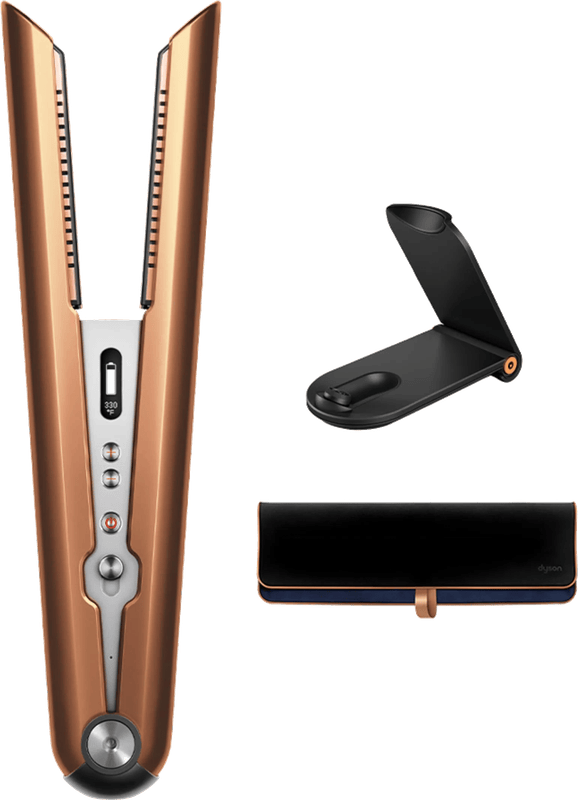
No cordless straightener is better known. The plates, made of a manganese-copper alloy, flex and wrap around the section so that, according to Dyson, less heat is needed. There are three settings to choose from: 165, 185 and 210 degrees Celsius. According to the manufacturer, the battery lasts a maximum of 30 minutes, a full charge takes 70 minutes, and the device also runs with a cord. Dyson states a weight of 0.56 kilograms, with the battery inside the device. The Corrale only makes sense if you travel a lot and budget plays no role.
BaByliss Steam Lustre Styler ST595E
A steam straightener. While straightening, a small water tank releases steam, with two steam settings to choose from. The ceramic plates are 36 millimeters wide, and the heat ranges from 170 to 210 degrees Celsius in five settings. On Amazon, buyer reviews are mixed; some describe barely noticeable steam or early defects. Worth a look for thick hair, less so for fine hair.
Which straightener suits which hair
- Regular straightening, normal hair: Remington PROluxe You S9880, because it’s finely adjustable and regulates itself if you want. If it isn’t available on Amazon, the Philips 7000 Series BHS732.
- Smaller budget: Philips 7000 Series BHS732, with a sensor but without automatic adjustment.
- Fine or bleached hair: Cloud Nine The Original Iron with an upper limit of 200 degrees Celsius.
- No interest in settings: ghd chronos, provided 185 degrees suits your hair.
- Frequent travel: Dyson Corrale, bearing in mind that the battery only lasts half an hour.
If you also want curls and volume besides straight lengths, a hot air styler is worth considering. Our multistyler guide (in German) sorts these devices, and care for stressed hair is covered in the hair care guide (in German).
Drying, brushing and curling with one handle: how that holds up over the years is shown in our long-term test of the Dyson Airwrap.
Frequently asked questions
What temperature is gentle on hair with a straightener?
Fine or colored hair needs less heat than thick, frizzy hair. In its manual, Remington recommends 150 to 170 degrees Celsius for fine hair and 210 to 230 degrees only for very thick hair. If 180 degrees is enough, 230 is too much, and one slow pass is better than five quick ones.
Does too much heat damage hair?
In a laboratory study on hair tresses, gases indicating breaking-down keratin were released from about 200 degrees Celsius, with denaturation at 237 degrees. An older lab study found that heat-stressed hair breaks more often when combed. These are tests on tresses, not studies on people, but the direction is clear.
Which plate width suits my hair?
Narrow plates of around 25 millimeters are suitable for short to medium-length hair and for waves. Wide plates over 35 millimeters save time with long, thick hair. The BaByliss Steam Lustre Styler ST595E has 36-millimeter-wide ceramic plates and is designed for thick, frizzy hair.
Is a cordless hair straightener worth it?
Cordless costs a lot and, according to the manufacturers, runs for only half an hour. According to Dyson, the Corrale's battery lasts a maximum of 30 minutes, a full charge takes 70 minutes, and it also runs with a cord. It mainly makes sense if you travel a lot.
Do I still need heat protectant spray on a low setting?
Heat protectant spray is part of the routine; a lower setting doesn't replace it. Wet hair has no place between hot plates, so dry your hair completely beforehand. Temperature control with sensors also helps, because it keeps the heat constant even when a thick section cools the plates.
What's different about the ghd chronos?
There's no temperature selection; according to the manufacturer, the ghd chronos maintains a constant 185 degrees Celsius and adjusts its power to your movement. For normal hair, that's a sensible middle value; for very fine hair it can be too high, for unruly hair too low.
Sources
- Remington: PROluxe You S9880
- Remington: S9880 user manual
- Philips: 7000 Series straightener BHS732/00
- ghd: chronos
- Cloud Nine: The Original Iron
- Dyson: Corrale straightener
- BaByliss: Steam Lustre Styler ST595E
- Lima et al.: Heat-damaged evaluation of virgin hair, J Cosmet Dermatol 2019
- Zhou et al.: Protecting hair from thermal damage by hot flat ironing, J Cosmet Sci 2011
Where to buy
- Philips 7000 Series BHS732Check price at Amazon.de
- Remington PROluxe You S9880Check price at Amazon.de
- ghd chronos (schwarz)Check price at Amazon.de
- Cloud Nine The Original IronCheck price at Amazon.de
- Dyson CorraleCheck price at Amazon.deView at Coolblue
- BaByliss Steam Lustre Styler ST595ECheck price at Amazon.de