Contents11 sections
This guide was first published in German on handgetestet.de.
A straightening brush does not protect your hair by itself. What makes the difference is the temperature you choose and whether your hair is really dry. For straight to wavy hair, we recommend the Remington CB7400: three settings from 150 °C, a documented auto shut-off and no extras whose benefits the manufacturer does not substantiate.
Brush or iron: what heat does to your hair
A flat iron clamps the section between two hot plates. A straightening brush pulls it through heated bristles or over a heated core, with less pressure and usually a less flat result. That sounds gentle, and the manufacturers advertise it that way too. What is actually documented is something else.
Researchers at the University of São Paulo heated untreated hair in the lab (2019). Up to about 170 °C, mainly water escaped. From 200 °C, decomposition products such as carbon dioxide and hydrogen sulfide formed, and at 237 °C the keratin denatured. A second laboratory study (2011) describes how flat irons above 200 °C can significantly damage hair keratin and that hair treated this way broke more often when combed. Both are experiments on hair samples, not observations from the bathroom. Still, the direction is clear.
That gives us our rule of thumb. Fine, bleached or already damaged hair starts at 150 to 160 °C, and only goes higher if the section does not get straight after two slow passes. Remington grades it the same way in the CB7480 manual: 150 °C for fine, damaged or lightened hair, 190 °C for normal hair, 230 °C for thick and hard-to-manage hair. If you choose the highest setting out of habit, you have bought a flat iron with bristles.
Five models, two designs
Flat paddle brushes from Philips and Remington straighten wide sections in one pass. BaByliss’s round hot brushes tend to shape bounce, ends and roots. If you want to dry and style your hair in one step, you are not looking for a straightening brush but a hot air styler; more on that in our guide to multistylers and Airwrap alternatives (in German).
| Model | Design | Temperature according to manufacturer | Special features | Best for |
|---|---|---|---|---|
| Remington Straight Brush CB7400 | flat brush | 150, 190, 230 °C | Ceramic with anti-static, shut-off after 60 min | straight to wavy hair, fine hair too |
| Philips StyleCare Essential BHH880/00 | flat brush | 170 and 200 °C | Tourmaline ceramic, ThermoProtect | normal to thick hair, little adjusting |
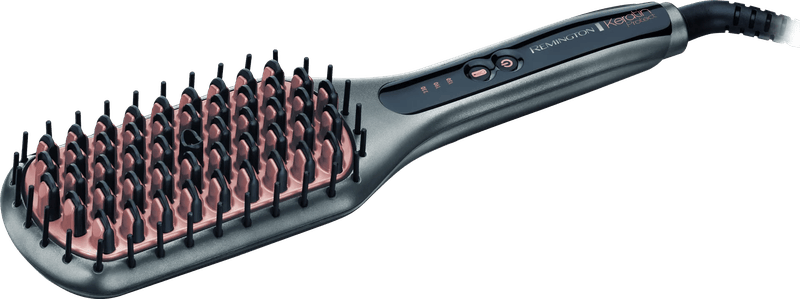
| Remington Keratin Protect CB7480 | flat brush | 150, 190, 230 °C | Ion generator, 3 m cable | long way to the outlet; not with a nut allergy |
| BaByliss Smooth Hot Brush HSB500E | round hot brush, rotating | 5 settings, 150 to 200 °C | Ions, silicone bristles, display | Lengths and ends, refreshing on day two |
| BaByliss Volume Boost HSB200E | round hot brush, 38 mm | 145, 160, 175, 190 °C | Ions, heat-resistant mat | Volume at the roots, fine hair |
Remington CB7400: three settings, no frills
Ceramic-coated bristles with anti-static, three settings (150, 190 and 230 °C), heated up in about 30 seconds according to the manufacturer. According to the manual, the brush switches off if no button has been pressed for 60 minutes. The bristle tips stay cool, and the 1.8 m cable swivels. If you are looking for a single brush for everyday use and really do use the low setting, it will serve you well.
Philips StyleCare Essential BHH880/00: two settings, little adjusting
Philips states 170 and 200 °C, a tourmaline-ceramic coating and ThermoProtect technology, which according to the manufacturer is intended to keep the temperature constant and prevent overheating. Philips bases its promise of „naturally straight hair in 5 minutes“ on a measurement with 33 women with average hair length. The product page does not mention an auto shut-off. For very fine hair, a setting below 170 °C is missing.
Remington Keratin Protect CB7480: the sibling with a long cable
The same settings as the CB7400, the same shut-off after 60 minutes. On top of that come an ion generator and a three-meter cable with a swivel joint, practical in an old-building bathroom with the only outlet next to the door. According to Remington, the bristles are enriched with keratin and almond oil; the manufacturer does not substantiate what that changes for your hair. More concrete is a sentence from the manual: „Contains traces of nuts.“ So if you have a nut allergy, go for the CB7400 instead.
BaByliss Smooth Hot Brush HSB500E: it rotates, and only smooths the lengths
Not a paddle brush. The HSB500E is a round hot brush that rotates in both directions, with five settings from 150 to 200 °C, ions, a ceramic surface, silicone bristles and a digital display. BaByliss explicitly states that it is only intended for dry hair, because it works with contact heat rather than hot air. For lengths, ends and a hairstyle that should regain its shape on day two, that works. Frizzy hair will not get poker-straight with it, and the manufacturer does not promise that either.
BaByliss Volume Boost HSB200E: bounce instead of sleek
A 38 mm heated barrel with a ceramic coating, four settings from 145 to 190 °C, ions, an insulated tip, a 1.8 m swivel cable and a heat-resistant mat in the box. At 190 °C, the maximum stays below the mark at which decomposition products formed in the lab test. Fine hair that needs volume more than sleekness is in good hands here.
Ions, keratin, tourmaline: what counts
Less frizz from ions, more shine from tourmaline, care from keratin: these are manufacturer claims, and the manufacturers do not cite evidence for them on their product pages. We would not base the purchase on them. A display of the selected setting, on the other hand, helps every morning. And a documented auto shut-off is worth more than any coating.
Wet hair, small children, beards
All manuals require clean, dry hair. There is a medical reason for that. A review of dermatological case reports (2023) describes so-called bubble hair deformity, air bubbles in the hair shaft, usually as a result of heat. Most of those affected had dried or styled wet hair with a hot appliance.
It gets more serious with small children. A British pediatric burns unit counted 155 burns from hair straighteners over five years; the children were 19 months old on average, and the hand was usually affected (2014). The doctors recommend heat-resistant pouches. After styling, the brush therefore belongs on a heat-resistant surface, out of reach, with the plug pulled. Remington also prohibits any part of the device from touching the face, neck or scalp.
That very sentence answers the question about beards. Beard hair grows directly on the facial skin, and a straightening brush for head hair is not made for it. If you want to straighten your beard, only use a device whose manual explicitly mentions beards, start with the lowest setting and blow-dry first. Care tips can be found in our beard care guide (in German).
How we would decide
- Straight to wavy hair, one brush for everything: Remington CB7400, mostly at 150 or 190 °C.
- Normal to thick hair and no desire to choose settings: Philips BHH880/00.
- Outlet far from the mirror: Remington CB7480, unless you have a nut allergy.
- Volume at the roots instead of a sleek surface: BaByliss HSB200E. If you want to curl the lengths, take a look at the HSB500E.
- Very thick or frizzy hair that really needs to get straight: here a flat iron is the more honest choice, at a low temperature. Which models can do that is covered in our flat iron guide (in German).
To dry your hair before straightening, a good hair dryer is enough; which one suits fine, thick or curly hair is covered in our guide to hair dryers.
Frequently asked questions
What temperature is gentle when using a straightening brush?
Fine, bleached or damaged hair starts at 150 to 160 °C, and only goes higher if the section does not get straight after two slow passes. Remington grades the CB7480 similarly: 150 °C for fine, 190 °C for normal and 230 °C for thick hair. Laboratory tests show decomposition products in hair from 200 °C.
What is the difference between a straightening brush and a flat iron?
A flat iron clamps the section between two hot plates. A straightening brush pulls it through heated bristles or over a heated core, with less pressure and usually a less flat result. For very thick or frizzy hair that really needs to get straight, a flat iron at a low temperature is the more honest choice.
Do ions, keratin and tourmaline do anything?
Less frizz from ions, more shine from tourmaline and care from keratin are manufacturer claims; the manufacturers do not cite evidence on their product pages. You should not base your purchase on them. A display of the selected setting and a documented auto shut-off are worth more than any coating.
Can you use a straightening brush on wet hair?
No, all manuals require clean, dry hair. A review of dermatological case reports describes bubble hair deformity, air bubbles in the hair shaft, usually as a result of heat. Most of those affected had dried or styled wet hair with a hot appliance.
How do you prevent burns from straightening tools in children?
A British pediatric burns unit counted 155 burns from hair straighteners in young children over five years, mostly on the hand. The doctors recommend heat-resistant pouches. After styling, the brush belongs on a heat-resistant surface out of reach, with the plug pulled.
Can you straighten a beard with a straightening brush?
Remington prohibits any part of the device from touching the face, neck or scalp, and beard hair grows directly on the facial skin. A straightening brush for head hair is not made for this. For the beard, only use a device whose manual explicitly mentions it, start with the lowest setting and blow-dry first.
Sources
- Remington: Straightening brush CB7400
- Remington: Straight Brush CB7400, features
- Remington: CB7400 user manual (PDF)
- Remington: Keratin Protect straightening brush CB7480
- Remington: Keratin Protect Straight Brush CB7480, features
- Remington: CB7480 user manual (PDF)
- Philips: StyleCare Essential straightening brush BHH880/00
- BaByliss: Smooth Hot Brush HSB500E
- BaByliss: Volume Boost Hot Thermal Brush HSB200E
- Lima et al.: Heat-damaged evaluation of virgin hair, J Cosmet Dermatol 2019
- Zhou et al.: Protecting hair from thermal damage by hot flat ironing, J Cosmet Sci 2011
- Li et al.: A review of bubble hair deformity, Int J Dermatol 2023
- Sarginson et al.: 155 burns caused by hair straighteners in children, Burns 2014
Where to buy
- Remington Straight Brush CB7400Check price at Amazon.de
- Philips StyleCare Essential BHH880/00Check price at Amazon.de
- Remington Keratin Protect CB7480Check price at Amazon.deView at Coolblue
- BaByliss Smooth Hot Brush HSB500ECheck price at Amazon.de
- BaByliss Volume Boost HSB200ECheck price at Amazon.de