This review was first published in German on handgetestet.de.
We wanted to know: can the Shure SM7B, the supposed all-rounder, keep up in sound with large-diaphragm microphones? We compared it with the Neumann TLM 103 in the recording studio.
The US microphone maker Shure likes to keep alive the myth its flagship microphone, the Shure SM7B, acquired thanks to Michael Jackson in the 1980s. As is well known, the King of Pop recorded his hit album „Thriller“ in 1982 with its predecessor, the SM7. At €389 on Amazon and at Musikhaus Thomann (a large German music retailer), the Shure SM7B is also far more affordable than large-diaphragm microphones such as those from Neumann, which, depending on the model, cost well into four figures in euros.
The Shure SM7B eliminates ambient noise
Thanks to its electromagnetic shielding and cardioid pattern, the dynamic Shure SM7B consistently suppresses ambient noise. Even the room acoustics are largely eliminated. This makes it especially interesting for podcasters and anyone who does not have ideal recording conditions. At least in theory.
Comparison test with the Neumann TLM 103
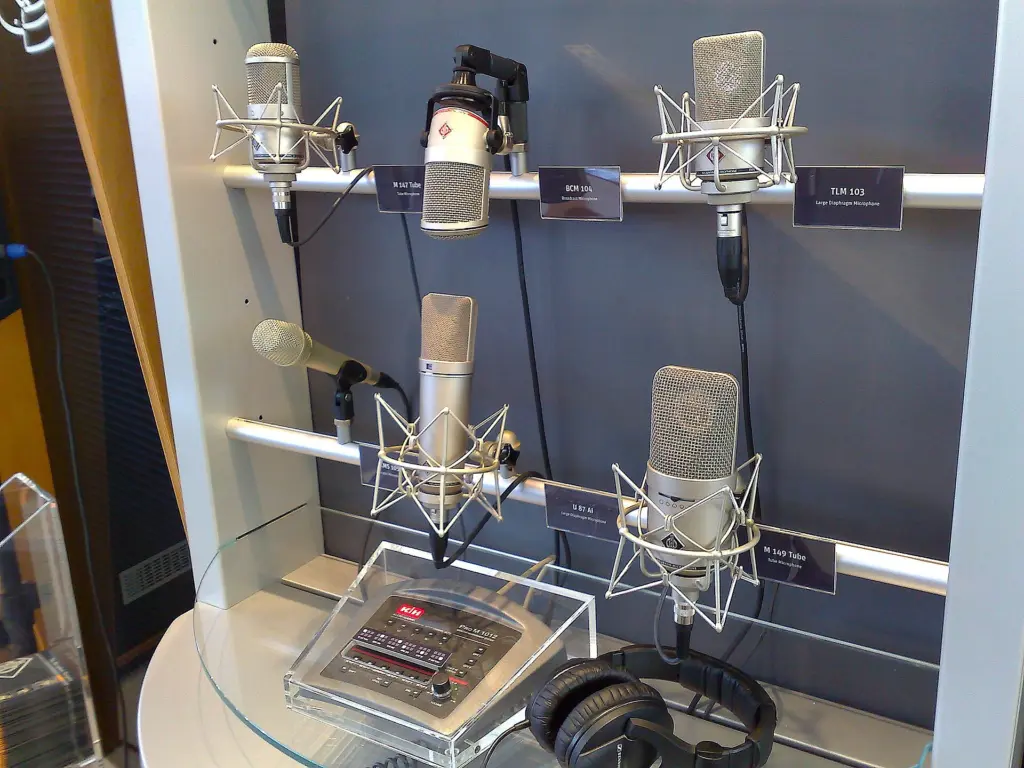
To find out, we compared the Shure SM7B with the Neumann TLM 103. Since the Neumann TLM 103, as a large-diaphragm condenser microphone, is known to be as extremely low-noise as it is sensitive, it absolutely has to be used in acoustically treated rooms or with a vocal booth such as the ones from Isovox or T-Akustik. That is because the Neumann TLM 103 also records the faintest background noise, such as computer fans, or outside noise such as birdsong, which impairs the recording quality.
The Shure SM7B fails to convince, but …
Both microphones are connected to the Apollo Twin audio interface from Universal Audio, which in turn brings a V76 preamp and a UA 1176AE limiting amplifier into the signal chain. In a direct comparison with the Neumann TLM 103, the Shure SM7B sounds hollow. And that is despite the Shure SM7B being tested with the „Presence Boost“ setting:
Shure SM7B:
Neumann TLM 103:
… it is superior as a podcast microphone without an acoustically treated room
Things look different, however, when – as mentioned – the Neumann TLM 103 has to do without an acoustically treated recording room. Especially when the room acoustics are contaminated by extreme reverb, the tables turn in favor of the Shure SM7B. In our case, the following test recording with the Neumann TLM 103 was made without any soundproofing measures in a furnished living space of around 13 square meters (with a wardrobe and desk), with a sloping ceiling and laminate flooring.
Neumann TLM 103 without an acoustically treated recording room:
Technical data
Manufacturers‘ specifications as of November 14, 2026. We have not verified them ourselves.
| Model | Shure SM7B | Neumann TLM 103 |
|---|---|---|
| Type | dynamic | large-diaphragm condenser (pressure gradient transducer) |
| Polar pattern | cardioid | cardioid |
| Frequency response | 50 Hz to 20 kHz | 20 Hz to 20 kHz |
| Sensitivity (1 kHz) | −59 dBV (1.12 mV/Pa) | 23 mV/Pa (−32.5 dBV ± 1 dB) |
| Impedance | 150 ohms | 50 ohms (rated load 1 kohm) |
| Equivalent noise level (A-weighted) | not specified | 7 dB-A |
| Maximum SPL (THD < 0.5%) | not specified | 138 dB |
| Signal-to-noise ratio (A-weighted) | not specified | 87 dB |
| Power supply | not specified | phantom power 48 V ± 4 V, 3 mA |
| Switches | bass roll-off and presence boost | not specified |
| Connector | XLR, 3-pin | XLR, 3-pin |
| Dimensions | not specified | Ø 60 mm, length 132 mm |
| Weight | 851.6 g (with cable, according to the data sheet) | approx. 450 g |
| Housing | aluminum and steel, dark gray | not specified |
| Mount | yoke with 5/8-inch stand thread | not specified |
Conclusion
The Shure SM7B is a good choice for anyone recording speech or vocals in rooms that are not acoustically treated. However, the low signal level of the Shure SM7B requires a good preamp. Shure has addressed this with a further development, the Shure SM7dB with a built-in preamp, which at €589 is, however, considerably more expensive than the standard model.
But if you have access to a large-diaphragm microphone such as the Neumann TLM 103 and an acoustically treated room, you should use them if possible. In our test setup, the differences in sound quality clearly favor the Neumann TLM 103. However, at €1,039 at the time of testing at Musikhaus Thomann, the Neumann TLM 103 is considerably more expensive than the Shure SM7B and the Shure SM7dB. In addition, an acoustically treated recording room is essential, at least in the form of a vocal booth such as the Vocal Head Booth from T-Akustik, which adds around €400.
Frequently asked questions
Shure SM7B or Neumann TLM 103?
With an acoustically treated room or a vocal booth, the Neumann TLM 103; in our test setup, the differences in sound clearly favored it. Without a treated room, the Shure SM7B is superior because it largely blocks out ambient noise and room acoustics.
Is the Shure SM7B good for podcasts?
Yes, especially when recording conditions are not ideal. Electromagnetic shielding and the cardioid pattern suppress ambient noise, and even the room acoustics are largely eliminated. With strong reverb, the tables turn in favor of the SM7B.
Does the Shure SM7B need a preamp?
Its low signal level requires a good preamp. As a further development, Shure offers the SM7dB with a built-in preamp, which is, however, considerably more expensive than the standard model.
Why does the Neumann TLM 103 need an acoustically treated room?
As a large-diaphragm condenser microphone, it is extremely low-noise and sensitive. It also records the faintest background noise, such as computer fans or birdsong. That is why it needs an acoustically treated room or at least a vocal booth.
Sources
Where to buy
- Shure SM7BCheck price at Amazon.de
- Shure SM7dB mit VorverstärkerCheck price at Amazon.de
- Neumann TLM 103Check price at Amazon.de