Contents12 sections
This guide was first published in German on handgetestet.de.
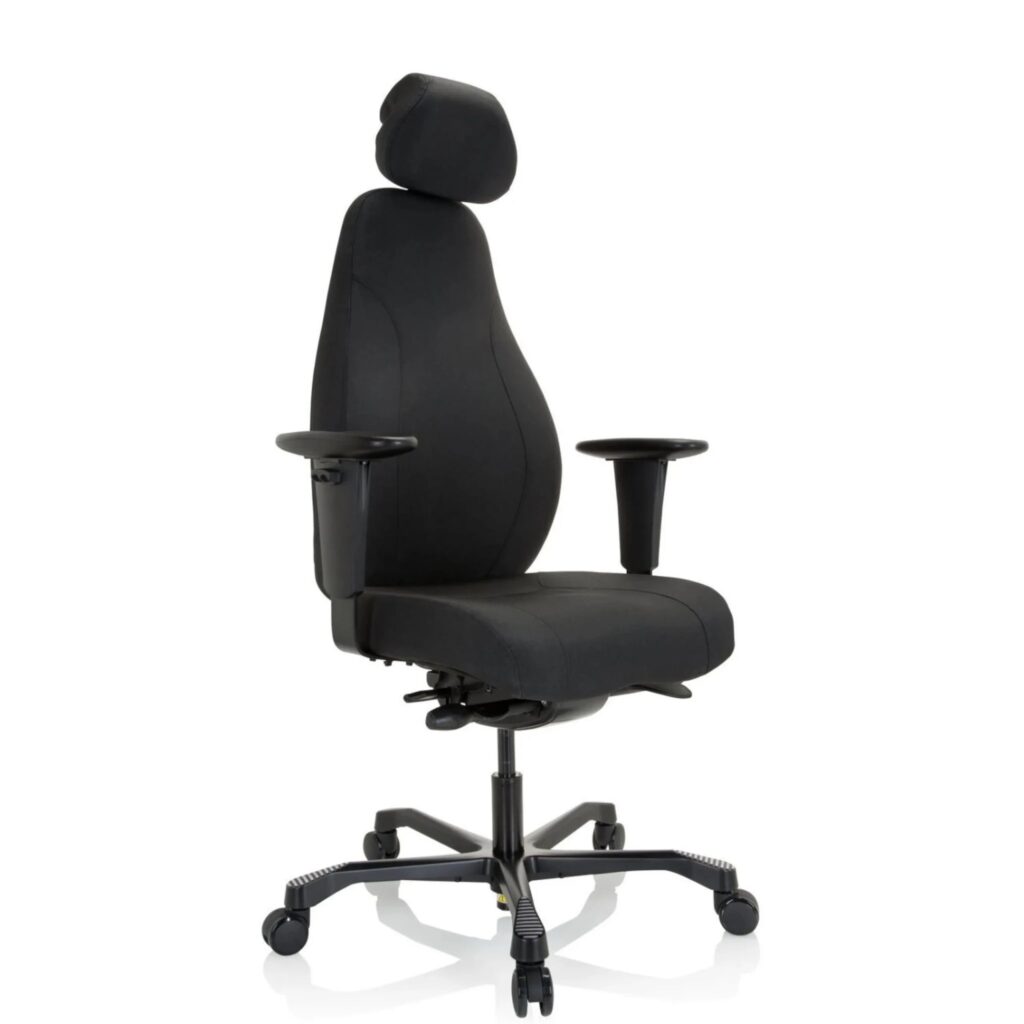
An office chair labeled „XXL“ does not automatically withstand more. What matters is the number the manufacturer gives as the maximum user weight, and for the models below it is either 150 or 200 kilograms. If you sit for eight hours or more every day and weigh over 120 kilograms, the RESISTIO XXL from hjh OFFICE is a good choice: 200 kilograms of weight capacity, synchronous mechanism, adjustable seat depth and casters that brake when unloaded. Up to 150 kilograms and on a smaller budget, the XXL G 100 is enough.
From what weight do I even need a big and tall chair?
There is no fixed limit. DGUV Principle 315-411 on office products, published by the German Social Accident Insurance, requires an office work chair to be stable in every sitting position and explicitly refers to the manufacturer’s stated maximum user weight. So look at this figure first, and buy with some reserve. A chair is loaded more heavily when you sit down, lean back and turn than when you sit still.
Weight is only half the calculation. Wide hips need a wide seat, long thighs a deep one. The principle specifies a minimum width of 45 centimeters. All six chairs here exceed that, at 49 to 57 centimeters.
What distinguishes a heavy-duty chair from a wide executive chair?
The mechanism. With a synchronous mechanism, the seat and backrest move in a coordinated ratio; the DGUV requires it for office work chairs. With a tilt mechanism, the seat and backrest tilt together. That is comfortable for leaning back. But the principle also requires that the front edge of the seat rises not at all or only imperceptibly when you lean back, so that it does not press into your thighs. Two of the six models use a knee-tilt mechanism. If you type and read rather than make phone calls, you are better off with a synchronous mechanism.
Also pay attention to the casters. The principle requires that a chair on casters is secured against rolling away unintentionally, for example by load-dependent braked casters. Especially when getting up with momentum on a smooth floor, that is not a detail. According to hjh, two models in our table have unbraked casters.
Six chairs with a high weight capacity
| Model | Weight capacity and daily use | Mechanism | Seat height / seat width | Best for |
|---|---|---|---|---|
| hjh RESISTIO XXL | 200 kg, 24 hours | Synchronous, adjustable seat depth and seat tilt | 46–57 cm / 52 cm | Shift work, very tall and heavy people |
| hjh Titanor Ergo | 200 kg, 24 hours | Synchronous, seat depth, 3D armrests | 50–59 cm / 57 cm | Mesh back, wide seat |
| hjh Maxaron XXL | 200 kg, 8 hours | Synchronous, seat depth, 4D armrests | 49–61 cm / 54 cm | Home office with lots of adjustment |
| hjh PRO-TEC XXL fabric | 150 kg, 8 hours | Synchronous, seat depth, lumbar support | 50–61 cm / 49 cm | Tall people up to 2 m |
| hjh XXL Pullmann Gen2 fabric | 150 kg, 8 hours | Knee-tilt mechanism | 48–53 cm / 57 cm | Lots of padding, more for leaning back |
| hjh XXL G 100 | 150 kg, 8 hours | Knee-tilt mechanism | 47–56 cm / 52 cm | Entry level, faux leather |
All figures according to hjh OFFICE. „Daily use“ is the daily usage time for which the manufacturer designs the model.
hjh RESISTIO XXL
The most expensive chair on the list is built for continuous use in control rooms and multi-shift operations. hjh specifies a weight capacity of 200 kilograms, an aluminum base with a diameter of 72 centimeters and a fabric rated for 500,000 rub cycles. Seat depth, seat tilt, backrest height and headrest are adjustable, and the synchronous mechanism adjusts the counterpressure to body weight. The casters brake when unloaded. At 27.3 kilograms, it is heavy. For the armrests, hjh only describes height adjustment.
hjh Titanor Ergo
Also 200 kilograms and designed for 24 hours, plus the widest seat in the comparison at 57 centimeters. The backrest is made of mesh, which suits people who run warm on long days. The armrests adjust in height, depth and width. A minus point from the DGUV’s perspective: according to the manufacturer, the casters are unbraked. On hard floors, we would plan for a floor protection mat (in German) or retrofit braked casters.
hjh Maxaron XXL
Same weight capacity, but designed for eight hours a day. In return, it offers plenty of adjustability: 4D armrests, seat depth, headrest adjustable in height and tilt, backrest in five height positions. The base is made of nylon instead of aluminum, and here too the casters are unbraked. For a home office with one person weighing up to 200 kilograms, it is a sensible choice below the RESISTIO.
hjh PRO-TEC XXL
The PRO-TEC XXL is aimed more at tall than at heavy people. hjh specifies a body height of up to 200 centimeters and 150 kilograms; the backrest measures 77 centimeters and has lumbar support. The seat height starts at 50 centimeters. Shorter people can then no longer place their feet flat on the floor. According to the data sheet, the model is intended for carpeted floors.
hjh XXL Pullmann Gen2
Lots of room and thick padding, 57 centimeters of seat width, 3D armrests. The seat height, however, can only be adjusted by five centimeters, and instead of the synchronous mechanism that the principle calls for in office work chairs, it uses a knee-tilt mechanism. We see it as a chair for meetings and phone calls.
hjh XXL G 100
The cheapest route to a 150-kilogram weight capacity. Faux leather upholstery, chrome-plated steel base, load-dependent braked casters, Kniematic knee-tilt mechanism with adjustable spring tension. hjh does not mention seat depth adjustment. For a few hours a day, that is enough; for a full-time workstation, not really.
Do you sit too high on big and tall chairs?
Often, yes. For office work chairs, the DGUV principle requires a seat height adjustment range of 40 to 52 centimeters, which is 13 centimeters of leeway. According to the manufacturer, none of the six chairs goes that low, and the ranges are between 5 and 12 centimeters. The measuring methods do differ, but the direction is clear: heavy-duty chairs sit higher. If you are on the shorter side, check the lowest seat height particularly carefully and plan for a footrest if necessary.
A second point that is often overlooked. The padding of a big and tall chair is thicker, and the armrests sit farther out. Measure whether the chair with armrests still fits under your desktop. Otherwise, the armrests bump into it and you sit too far from the screen.
Which chair for which situation?
- Full time, shift work or over 150 kilograms: RESISTIO XXL; it is the most thoroughly built for continuous load.
- Wide hips and warm days: Titanor Ergo with a mesh back and 57 centimeters of seat width, with a mat on hard floors.
- Home office up to 200 kilograms with lots of adjustment options: Maxaron XXL.
- Very tall, but under 150 kilograms: PRO-TEC XXL.
- Occasional sitting or a tight budget: XXL G 100.
We would only choose the XXL Pullmann Gen2 if it is not your main work chair. General setup tips for any office chair are in our guide to the ergonomic office chair, and more representative models in our guide to the executive chair (in German).
Frequently asked questions
From what weight do I need a big and tall office chair?
There is no fixed limit. The German DGUV Principle 315-411 refers to the manufacturer's stated maximum user weight. Buy with some reserve, because a chair is loaded more heavily when you sit down, lean back and turn than when you sit still. Wide hips also need a wide seat, and long thighs a deep one.
Synchronous or tilt mechanism for a heavy-duty chair?
With a synchronous mechanism, the seat and backrest move in a coordinated ratio; the DGUV requires it for office work chairs. With a tilt mechanism, both tilt together, which is comfortable for leaning back, but the front edge of the seat can press into the thighs. If you type and read, go for the synchronous mechanism.
Why are braked casters important on a big and tall chair?
The principle requires that a chair is secured against rolling away unintentionally, for example by load-dependent braked casters. When getting up with momentum on a smooth floor, that is not a detail. According to hjh, the Titanor Ergo and Maxaron XXL have unbraked casters; on hard floors, we would plan for a mat there.
Do you sit too high on big and tall chairs?
Often, yes. The DGUV requires an adjustment range of 40 to 52 centimeters, and according to the manufacturer none of the six chairs goes that low. If you are on the shorter side, check the lowest seat height carefully and plan for a footrest if necessary. Also measure whether the armrests fit under the desktop.
Which big and tall office chair suits very tall people?
The hjh PRO-TEC XXL is aimed more at tall than at heavy people: body height up to 200 centimeters, 150 kilograms, a 77-centimeter-high backrest with lumbar support. The seat height starts at 50 centimeters, and according to the data sheet the model is intended for carpeted floors.
Sources
- DGUV Principle 315-411: quality criteria for office workstations, July 2022 (in German)
- hjh OFFICE: RESISTIO XXL
- hjh OFFICE: Titanor Ergo
- hjh OFFICE: Maxaron XXL
- hjh OFFICE: PRO-TEC XXL fabric
- hjh OFFICE: XXL Pullmann Gen2 fabric
- hjh OFFICE: XXL G 100
Where to buy
- hjh RESISTIO XXLView at buerostuhl24Available in Germany: buerostuhl24
- hjh Titanor ErgoView at buerostuhl24Available in Germany: buerostuhl24
- hjh Maxaron XXLView at buerostuhl24Available in Germany: buerostuhl24
- hjh PRO-TEC XXL StoffView at buerostuhl24Available in Germany: buerostuhl24
- hjh XXL Pullmann Gen2 StoffView at buerostuhl24Available in Germany: buerostuhl24
- hjh XXL G 100View at buerostuhl24Available in Germany: buerostuhl24