Contents13 sections
This guide was first published in German on handgetestet.de.
Expensive does not mean right for you. If you are buying an office chair, you should first know two measurements, your own lower leg length and the height of your desk, and only then look at the price tag. For most people between 1.60 and 2.00 meters, we consider the hjh VENUS ONE the sensible choice in the mid-range, because it combines a synchronous mechanism, adjustable seat depth and load-dependently braked casters. If you want to stay below the €300 mark, the Topstar P91 AL.G3 gives you the cleanest basic equipment. And if you sit for ten hours a day or more, you will find the high-end class above the €800 mark with the hjh ERGOHUMAN GEN2, Steelcase Gesture and Herman Miller Aeron.
Below, we explain what the standard actually requires, how to tell the three classes apart and where the limits of each model lie. All dimensions come from the manufacturers. They vary depending on the version.
What a work chair must be able to do according to the standard
The word ergonomic is not protected. The most reliable yardstick in Germany comes from the German Social Accident Insurance (DGUV) with its DGUV Principle 315-411, „Quality criteria for office workplaces.“ It explicitly also applies to remote work at home and bases its dimensions on the standard DIN EN 1335-1 for office work chairs. The safety requirements are in part 2 of the same standard.
The principle is not law. In its Annex 6, the German Workplace Ordinance (Arbeitsstättenverordnung) only requires in general terms that the principles of ergonomics be applied to computer workstations and that there be enough room for changing postures. At the employee’s request, the employer must also provide a footrest if a favorable posture cannot be achieved otherwise. What that means for the chair in detail is set out in the accident insurance principle. That is exactly why it works as a shopping list.
The mandatory points can be summarized briefly. Seat and backrest move synchronously, that is, in a coordinated ratio. The backrest resistance must match the body weight, either via a control you can reach while seated or via an automatic system with fine adjustment. When you lean back, the front edge of the seat must hardly rise, because otherwise it presses against the back of your thighs. A lumbar support must hit the lumbar region at every body height, via its own height adjustment or via the height of the entire backrest. The backrest reaches up to the shoulder area. Armrests must be height-adjustable, and they should be replaceable and retrofittable.
Optional, but helpful: an adjustable seat depth, a seat that tilts forward, a lumbar support adjustable in depth and a headrest. Add to that the GS mark for tested safety (a German certification), casters secured against unintentional rolling, for example by load-dependent brakes according to DIN EN 12529, and a spare parts catalog from the supplier. Hardly any offer for private customers mentions the GS mark. Ask about it.
The numbers behind DIN EN 1335
If you compare data sheets, you need the minimum dimensions. Here are the values that the DGUV principle adopts from the 2020 version of DIN EN 1335-1.
- Seat height: adjustable, range 400 to 520 mm (130 mm travel). If a chair only starts at 47 cm, shorter people cannot put their feet flat.
- Adjustable seat depth: at least 50 mm of travel, covering the range 425 to 450 mm. Important for long or short thighs.
- Fixed seat depth: 425 to 485 mm. Fixed seats only suit some users.
- Seat width: at least 450 mm. Narrow seats press against the thighs.
- Backrest: top edge at least 480 mm above the seat. Support up to the shoulder area.
- Lumbar support: at least 70 mm of adjustment travel in the range 170 to 300 mm above the seat. The curve sits at the height of the lumbar vertebrae.
- Backrest tilt: at least 15 degrees of movement. Leaning back without tipping.
- Armrests: at least 100 mm of height travel, range 200 to 290 mm above the seat, clear width 460 to 510 mm. Forearms rest at the height of the desktop.
One value stands out immediately when shopping. According to the standard, the chair should be usable from a seat height of 40 centimeters, but many offers for private customers start at 45, 47 or 48 centimeters. For someone who is 1.65 meters tall, that is often too high; the feet then dangle or only touch the floor with the toes. The measurement is simple: shoes on, measure from the floor to the back of the knee. If the lowest seat height is above that, you need a footrest; models for that are shown in our guide to office footrests (in German).
Be careful when comparing. Not all manufacturers measure the same way, and the standard itself has two measuring methods from the 2002 and 2020 versions, which can produce different figures for the same requirement. A centimeter more or less is therefore no reason to buy.
Mechanism, lumbar support, armrests: where the money goes
What is under the seat determines whether a chair is fit for work. A rocking mechanism tilts seat and backrest together as a rigid unit. With a synchronous mechanism, the seat follows the backrest in a fixed ratio, so your pelvis stays in place better when you lean back.
The counter-pressure is decisive. A person weighing 55 kilos and one weighing 110 kilos need completely different spring tension. If it is too soft, the backrest falls away and you end up sitting on the front edge. If it is too hard, it pushes into your lower back. Usually you turn a hand wheel under the seat. Some chairs adjust themselves, the hjh VITORO ECO, for example, with automatic weight adjustment. Both meet the principle as long as they can be finely readjusted.
The lumbar support is the curve at the bottom of the backrest. It has to be positioned at the height where the lumbar spine curves forward. Some chairs adjust a pad for this, others the entire backrest. Both are permitted. All that matters is that it is possible at all, because a tall person and a short person have the lumbar curve in different places.
For armrests, „2D,“ „3D“ or „4D“ stands for the number of directions: height, width, depth, rotation. Only height is mandatory. In practice, width mainly helps slim people who would otherwise splay their arms outward. Depth matters if the chair needs to go close to the desk. The DGUV also recommends using the armrests while working, because it relieves the neck and shoulders.
Casters, weight, sitting time
This is where most bad purchases lie that only become apparent after weeks. The caster rule is simple and is stated this way in the DGUV’s CHECK-UP Homeoffice too: hard floor such as parquet or tiles, soft caster, usually two-tone. Carpet, hard caster, usually single-color. According to the data sheet, Topstar supplies the P91, Sitness Life 50 and New Aluart with casters for carpet; hard floor casters cost extra. hjh includes multi-purpose casters for all floors and also recommends a floor protection mat on hard floors. Suitable mats are shown in our guide to floor protection mats (in German).
There is one detail you should not overlook. The DGUV principle requires casters that are secured against unintentional rolling. On the VENUS ONE and PROFONDO, according to hjh, they brake depending on load; on the ERGOHUMAN GEN2, they are explicitly unbraked. On a smooth floor, the chair then rolls away easily when you stand up.
For load capacity, manufacturers usually state 110 to 150 kilos. If you are heavier, you need a chair built and tested for a higher user weight. There is a separate standard for that, DIN 4573, and we have a separate guide to the XXL office chair (in German). The figure „8 hours“ or „24 hours“ of sitting time, on the other hand, is a manufacturer classification. It says how many hours a day the chair is designed for, not how healthy it is. For shift work, our guide to the 24-hour office chair (in German) is worth a look.
High-end above the €800 mark: for the long working day
In this class, you mainly pay for three things. A long warranty, finer mechanics and armrests that move in every direction. If you sit in your home office two days a week, you will notice little of that. If you spend nine or ten hours a day in front of a screen, more so.
| Model | Seat height and seat depth | Mechanism and armrests | Load and warranty | Best for |
|---|---|---|---|---|
| hjh ERGOHUMAN GEN2 mesh | 48–59 cm, depth 42–46 cm | Point-synchronous, 5 positions; 4D armrests; headrest | 150 kg; 10 years, 5 years on armrests, gas spring, casters | 160–185 cm, very long days |
| Steelcase Gesture | not stated on the German manufacturer site | 3D LiveBack; 360-degree armrests; lumbar support and headrest optional | not stated on the German manufacturer site | Working with tablet, phone and laptop in rotation |
| Herman Miller Aeron | Depth via three sizes: around 41, 43, 47 cm | 8Z Pellicle suspension; PostureFit SL; armrests depending on version | 12-year warranty | anyone who knows their size and likes mesh |
hjh ERGOHUMAN GEN2: our pick in the high-end class
On the data sheet, the ERGOHUMAN GEN2 leaves little out. Seat height, seat depth, armrest height and angle, backrest tilt and firmness, and headrest height and tilt are all adjustable. The point-synchronous mechanism adapts to body weight and can be locked in five positions; according to hjh, the maximum opening angle is 141 degrees. The backrest moves up 65 millimeters via a ratchet, which also shifts the flexible lumbar support. There is also a position in which backrest and seat remain slightly tilted forward, for upright writing.
Why do we rank it ahead of Steelcase and Herman Miller despite the lower price? For this chair, the manufacturer states seat dimensions, load, body height and warranty in full; at Steelcase, exactly these details are missing on the German site. The figures are 150 kilos, 24 hours of sitting time, ten years of warranty and five on armrests, gas spring and casters. According to hjh, it meets the dimensional requirements of DIN EN 1335-1. The limits are just as clear. At 48 centimeters, the seat height starts high, hjh recommends it for 1.60 to 1.85 meters, and the casters are unbraked. Under 1.70 meters, we would only buy it with a footrest.
A note on the version. According to hjh, the leather version of the ERGOHUMAN GEN2 has different dimensions than the mesh version, namely a seat height of 46 to 56 centimeters and a seat depth of only 39 to 44 centimeters. That is tight for long legs. More on chairs with leather upholstery can be found in our guide to the executive chair (in German).
Steelcase Gesture: armrests that move with you
Steelcase built the Gesture around an observation: today we no longer just sit in front of a keyboard and screen, but hold phones and tablets. According to the manufacturer, the armrests move 360 degrees like a human arm and can be brought up and toward the body, so that your head tilts forward less when you look at your phone. The backrest uses 3D LiveBack technology, which is meant to follow the movement of the spine. The headrest is vertically adjustable, tiltable and rotates 90 degrees.
There are two points you should know. Steelcase lists the adjustable lumbar support as an option, as is the aluminum base. So check in the offer what is fitted, because without an adjustable lumbar support, a mandatory point of the principle is missing. And the German product page does not state seat dimensions, load capacity or warranty, only the overall dimensions of 104 by 66 by 62.5 centimeters. Before buying, it is therefore worth asking a specialist dealer.
Herman Miller Aeron: size replaces seat depth
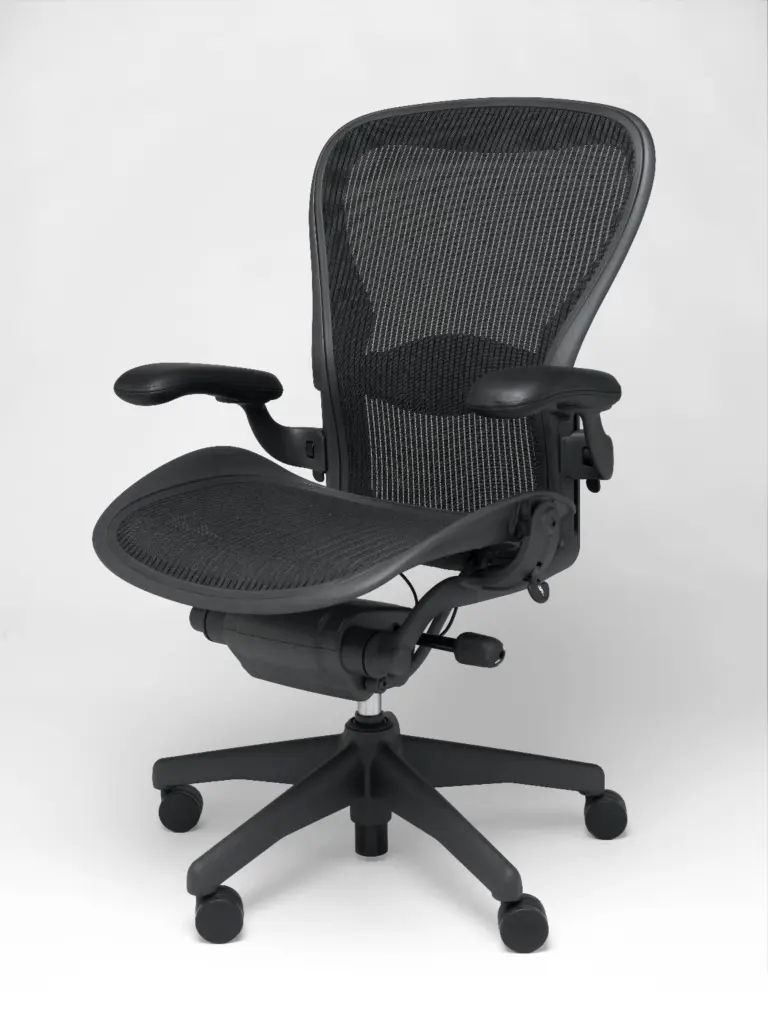
Three sizes, and there is a reason for that. Herman Miller does not list a sliding seat; the seat depth results from the size: according to the data sheet, around 41, 43 or 47 centimeters. If you order the wrong one, nothing can be readjusted. Seat and back are covered with the elastic „8Z Pellicle“ fabric, and according to the manufacturer, the PostureFit SL support holds the sacrum and lumbar region. Herman Miller offers a 12-year warranty.
If you fall between two sizes or want an upholstered seat, you are better off with a chair with adjustable seat depth.
Mid-range between the €300 and €800 marks: where most people buy
In this range, you get everything the principle requires, and usually adjustable seat depth too. Compromises come in the warranty and the armrests. A mid-range chair that is set up correctly helps your back more than a high-end model whose spring tension nobody has ever adjusted.
| Model | Seat height and seat depth | Mechanism and armrests | Load and warranty | Best for |
|---|---|---|---|---|
| hjh VENUS ONE | 47–58 cm, depth 43–48 cm | Point-synchronous, lockable in 4 positions; armrests adjustable in height and horizontally; headrest | 120 kg; 4 years | 160–200 cm, eight hours at the desk |
| Topstar Sitness Life 50 | 43–50 cm, depth 48 cm fixed | Synchronous with spring tension, three-dimensionally moving seat; armrests depending on version | not stated in the data sheet | anyone who wants to keep moving while seated |
| Ergotopia NextBack | Depth 43–51 cm | Synchronous, five tilt levels; armrests adjustable in height, width, angle; headrest | not stated in the data sheet | Home office with a liking for adjusting |
hjh VENUS ONE: the sensible choice for most people
The VENUS ONE covers the mandatory points and adds seat depth and a headrest. The point-synchronous mechanism adjusts to body weight and can be locked in four positions. The backrest is height-adjustable, and the flexible lumbar support moves with it. According to hjh, it suits body heights from 1.60 to 2.00 meters and carries 120 kilos. The casters brake depending on load, so they only roll when someone is sitting.
Its weakness is the same as with many chairs of this type. The seat height starts at 47 centimeters. Below about 1.65 meters, that gets tight. The armrests adjust in height and horizontally, but not in width. hjh states 8 hours of sitting time and a 4-year warranty. That is enough for a normal office day. Not for shift work.
Topstar Sitness Life 50: movement instead of sitting still
Under the Sitness series, Topstar builds a joint that lets the seat move in all directions. Add to that a synchronous mechanism with a large opening angle and spring tension matched to body weight, as well as a mesh backrest that can be adjusted in height and tilt. At 43 to 50 centimeters, the seat height starts lower than on the hjh chairs. Shorter people are better off here.
When buying, pay attention to two lines in the data sheet. The armrests come fixed or height-adjustable; only the second version meets the principle. And the seat depth is fixed at 48 centimeters; Topstar does not mention a separate lumbar support, and the curve is created via the height and tilt of the backrest. If you want to adjust a lot, you are better served elsewhere. If you like to rock and tilt on your chair, here.
Ergotopia NextBack: lots of adjustment, one gap
According to the data sheet, the NextBack has a synchronous mechanism with adjustable tilt resistance and five tilt levels. Seat height and seat depth (43 to 51 centimeters) can be adjusted continuously, the lumbar support in height, the headrest in height and angle. The armrests adjust in height, width and angle. Only depth is missing.
Two more names that come up often in this class. The Interstuhl EVERY Active works with the Flextech synchronous mechanism, which according to Interstuhl allows considerably more lateral movement; the weight adjustment covers 45 to 120 kilograms. As standard, it only has 2D armrests; the 4D version is an accessory. The Steelcase Series 2 comes with either a weight-activated or a finely adjustable mechanism and 4D armrests. With both, it pays to read the offer carefully to see which features are fitted.
Entry level below the €300 mark: what you can expect
At entry level, things get tight, but not hopeless. A synchronous mechanism with adjustable counter-pressure, an adjustable backrest or lumbar support and height-adjustable armrests are available here too. What is usually missing is a long warranty, spare parts over many years and a headrest worth anything. For a laptop at the kitchen table, that is enough. For 40 hours a week, it is the lower limit.
| Model | Seat height and seat depth | Mechanism and armrests | Load and warranty | Best for |
|---|---|---|---|---|
| Topstar P91 AL.G3 | 42–54 cm, depth 45–51 cm | Point-synchronous with spring tension; armrests adjustable in height and width, pad in depth | not stated in the data sheet | Entry level with the largest seat height range |
| hjh PROFONDO | 47–57 cm, depth 46–51 cm | Synchronous, lockable in 3 positions, adjustable counter-pressure; armrests height only | 120 kg; 24 months | 155–195 cm, mesh back, long legs |
Topstar P91 AL.G3: the entry-level chair we would choose
The P91 is not a beautiful chair. It is a sensible one. With a seat height of 42 to 54 centimeters, it comes closest to the range in the standard among the chairs in this guide, and the seat depth can be set from 45 to 51 centimeters. The point-synchronous mechanism has spring tension matched to body weight and can be locked in several positions, and the backrest adjusts in height. The „G3“ armrests adjust in height and width, and the pad additionally in depth. There is also an aluminum base.
What is missing: information on load capacity and warranty in the data sheet, a separate lumbar support and soft casters. It comes with casters for carpet as standard; for parquet, you order hard floor casters separately. At 21.4 kilos, it is heavily built for its class.
hjh PROFONDO: for tall people on a small budget
Synchronous mechanism with counter-pressure matched to body weight, mesh back, continuously height-adjustable lumbar support. You set the seat depth with a dedicated lever between 46 and 51 centimeters. The armrests only adjust in height. According to hjh, the chair carries up to 120 kilograms, is designed for eight hours of sitting time and body heights from 1.55 to 1.95 meters, meets DIN EN 1335 parts 1 and 2 and has a 24-month warranty.
At 47 centimeters, however, the seat height starts high. We therefore only consider the 1.55-meter figure realistic with a footrest. If you are tall with long thighs, on the other hand, the PROFONDO gives you a lot of seat for little money. The PROFONDO PRO version comes with a headrest and, according to hjh, starts at 45 centimeters.
Warranty, spare parts, trial sitting
With good care, an office chair lasts many years if the wear parts can be replaced. The gas spring, casters and armrest pads go first. That is why the DGUV principle requires suppliers to offer a spare parts catalog and deliver standard parts within a few days. Before buying, ask whether the gas spring and casters are available individually. Sitwell Steifensand, for example, offers bases, gas springs, casters and seat cushions as spare parts in its own shop.
Warranty and statutory liability for defects are two different things. In Germany, the statutory liability applies to the retailer in any case; the manufacturer’s warranty is added voluntarily and has its own conditions. At hjh, for example, the ten-year warranty of the ERGOHUMAN GEN2 does not apply in full to the armrests, gas spring and casters. Read such sentences before comparing years of warranty.
Trial sitting beats any data sheet. If you buy online in Germany, under Section 355 of the German Civil Code (BGB) you generally have a 14-day right of withdrawal. Use the period: set up the chair completely on the first evening and then work on it for a few full days. Keep the box until then; according to the manufacturers, the chairs here weigh between around 15 and 23 kilos without packaging. Some manufacturers also offer their own trial sitting; Sitwell Steifensand, for example, according to its own website, 14 days at home, with a full refund if you are not satisfied when paying in advance.
Set up correctly in ten minutes
The most expensive chair does no good if it stays the way it came out of the box. The DGUV’s CHECK-UP Homeoffice sets out a simple order.
- Set the seat height so that your feet are flat on the floor and your thighs and lower legs form an angle of slightly more than 90 degrees.
- Choose the seat depth so that there is about a hand’s width of space between the front edge of the seat and the back of your knee.
- Set the backrest counter-pressure to your body weight until the backrest moves with you when you lean back, without falling away.
- Bring the lumbar support or backrest to the height of your lumbar spine.
- Armrests at the height of the desktop, with your forearms resting on them.
- Only now adjust the desk. If it is fixed, the chair has to be set to match it, and shorter people will then need a footrest.
Both chair and desk adjustable? Then the chair first, the desk afterwards. Models for this are presented in our guide to the height-adjustable desk (in German). If you work a lot on a laptop, a laptop stand (in German) brings the screen up to eye level, and an ergonomic mouse (in German) relieves your wrist. Different dimensions apply to children; for that, there is our guide to the kids‘ desk chair (in German).
To be honest: a chair replaces neither exercise nor medical advice if you have complaints. The accident insurance principle names dynamic sitting and frequent changes of posture as the goal, and the German Workplace Ordinance requires breaks from screen work. So standing up is part of it.
Gaming chair, executive chair or office chair?
The question comes up often. A gaming chair (in German) looks like a racing seat. Check carefully whether a synchronous mechanism is fitted or just a rocker, and whether the lumbar support is more than a loose cushion. An executive chair has a high backrest and often leather, but the seat height frequently starts high. For the working day, the mandatory points above are what count, whatever the chair is called. A chair with a synchronous mechanism, lumbar support, height-adjustable armrests and a suitable seat height is a good work chair, even if it does not look like one.
And taxes?
Under German tax law, if you use the chair for work, it is a work tool within the meaning of Section 9(1) sentence 3 no. 6 of the German Income Tax Act (EStG). For depreciation, the law refers to Section 6(2) EStG: if the amount excluding the input VAT it contains stays within the €800 limit, it can be deducted in full in the year of purchase; above that, it is spread over its useful life. The daily flat rate of six euros for working from home is set out separately in Section 4(5) no. 6c EStG. How that fits together in your case can be clarified by a tax advisor or an income tax assistance association.
How we would decide
Under 1.70 meters, the seat height is decisive. Here the Topstar P91 AL.G3 at entry level and the Topstar Sitness Life 50 in the mid-range are a good fit, because they start low. With all other chairs, plan for a footrest.
Average height and eight hours at the desk? The hjh VENUS ONE covers everything the principle requires, plus seat depth and a headrest. For people over 1.85 meters, it is the obvious choice among the chairs here, because hjh specifies it up to 2.00 meters.
Very long days, shift work, a wish for a ten-year warranty: hjh ERGOHUMAN GEN2, provided you are between 1.60 and 1.85 meters. If you work a lot with a phone and tablet, take a look at the Steelcase Gesture and make sure it has the adjustable lumbar support. Only buy the Herman Miller Aeron if you know your size for sure.
Tight budget and long legs: hjh PROFONDO. And no matter how much you spend, use the return period. An expensive model that is set up wrong helps less than an inexpensive one that fits right.
Frequently asked questions
What seat height does an office chair need?
According to DGUV Principle 315-411 of the German Social Accident Insurance and DIN EN 1335-1, the seat height should cover at least the range of 40 to 52 centimeters, with 13 centimeters of adjustment travel. Measure with shoes on from the floor to the back of your knee. If the chair starts higher, you need a footrest. Many offers only start at 45 to 48 centimeters.
What dimensions does DIN EN 1335 specify for seat depth?
If the seat depth is adjustable, it should have at least 5 centimeters of travel and cover the range of 42.5 to 45 centimeters. A fixed seat depth should be between 42.5 and 48.5 centimeters. The seat width is at least 45 centimeters, and the backrest extends at least 48 centimeters above the seat.
How can you recognize an ergonomic office chair?
By a synchronous mechanism with counter-pressure matched to body weight, a lumbar support or backrest that can be adjusted in height, and height-adjustable armrests. These are mandatory points in DGUV Principle 315-411. Adjustable seat depth, a headrest and a forward-tilting seat are considered optional there.
What distinguishes high-end, mid-range and entry level?
Below the €300 mark, you get the mandatory points, usually with a short warranty and simple armrests. Between €300 and €800, adjustable seat depth and better mechanics are added. Above that, you mainly pay for a long warranty, 4D or 360-degree armrests and a design for very long sitting times.
Which casters do I need for hardwood floors?
Soft casters for hard floors such as parquet and tiles, hard casters for carpet. Soft casters are usually two-tone. Topstar supplies the P91 and Sitness Life 50 with carpet casters; hard floor casters cost extra. The casters should be load-dependently braked, as on the hjh VENUS ONE and PROFONDO.
What do 8 hours or 24 hours of sitting time mean?
It is a manufacturer classification of how many hours a day a chair is designed for. hjh rates the VENUS ONE and PROFONDO at 8 hours and the ERGOHUMAN GEN2 at 24 hours. The figure says nothing about ergonomics.
How do you set up an office chair correctly?
Feet flat on the floor, thighs and lower legs at slightly more than 90 degrees, a hand's width of space to the front edge of the seat. Then set the counter-pressure to your body weight, the lumbar support at the height of your lumbar vertebrae and the armrests at desk height. Only then adjust the desk.
Can you deduct an office chair from your taxes?
Under German tax law, if used for work, it counts as a work tool under Section 9 of the German Income Tax Act (EStG). If the amount excluding input VAT stays within the €800 limit under Section 6(2) EStG, it can be deducted in full in the year of purchase; otherwise it is spread over its useful life. A tax advisor can clarify the details.
Why does the Herman Miller Aeron not have an adjustable seat depth?
With the Aeron, the seat depth depends on the size: according to the data sheet, it is around 41, 43 or 47 centimeters in sizes A, B and C. If you order the wrong size, nothing can be readjusted. Herman Miller offers a 12-year warranty.
Can I return an office chair?
When buying online in Germany, Section 355 of the German Civil Code (BGB) generally grants a 14-day right of withdrawal. Set up the chair completely right away and work on it for a few full days. Some manufacturers, such as Sitwell Steifensand, offer their own home trial.
Sources
- DGUV Principle 315-411: Quality criteria for office workplaces (July 2022, in German)
- DGUV: CHECK-UP Homeoffice (in German)
- German Workplace Ordinance, Annex 6: Computer workstations (in German)
- Section 355 BGB: Right of withdrawal (in German)
- Section 9 EStG: Income-related expenses, Section 6 EStG, Section 4 EStG
- hjh OFFICE: ERGOHUMAN GEN2 mesh
- hjh OFFICE: ERGOHUMAN GEN2 leather
- Steelcase: Gesture
- Herman Miller: Aeron – specifications
- hjh OFFICE: VENUS ONE
- Topstar: Sitness Life 50 data sheet
- Ergotopia: NextBack data sheet
- Interstuhl: EVERY Active
- Steelcase: Series 2
- Topstar: P91 data sheet
- hjh OFFICE: PROFONDO
- hjh OFFICE: PROFONDO PRO
- Topstar: New Alu Art data sheet
- Sitwell Steifensand: Test an office chair (in German)
Where to buy
- hjh VENUS ONEView at buerostuhl24
- Topstar P91 AL.G3View at buerostuhl24
- hjh ERGOHUMAN GEN2 NetzView at buerostuhl24
- Steelcase GestureCheck price at Amazon.de
- Herman Miller AeronCheck price at Amazon.de
- Topstar Sitness Life 50View at buerostuhl24
- Ergotopia NextBackCheck price at Amazon.de
- hjh PROFONDOView at buerostuhl24