Contents13 sections
This guide was first published in German on handgetestet.de.
The strap that comes in the camera box often stays on for years, even though it is precisely the strap that decides whether the camera comes along or stays in the closet. For a mirrorless camera with a standard zoom, we recommend the Peak Design Slide Lite: narrow enough for small bodies, removed in seconds and, according to the manufacturer, with anchors that each hold more than 90 kg. If you carry heavier gear all day, look at a sling strap with wide padding instead.
Sounds like a minor detail? It isn’t.
Neck, shoulder or across the body?
Around the neck, the camera dangles in front of your stomach and pulls noticeably on your neck after an hour. Over the shoulder, it tends to slip off as soon as the jacket is smooth. Worn across the upper body, it hangs at the hip, your hands stay free, and bringing it up is quick. For longer outings, we therefore prefer the sling strap. For a stroll through town with a small camera, on the other hand, a wrist strap is often enough.
Clarify these points before you buy:
- Where does it attach? To the camera’s two strap lugs or to the tripod socket on the bottom. The latter changes how the camera hangs and blocks the socket for the tripod plate.
- Width and padding: 19 mm webbing is enough for a light camera; from around one kilogram including the lens, padding of 3.5 cm or more is kinder to your shoulder.
- Length: for wearing across the body, the strap should adjust well beyond 130 cm, especially over a winter jacket.
- Quick release or sewn on? A connector lets you take the strap off for the tripod, but it is one more part you need to check now and then.
Seven straps and wrist straps side by side
| Model | Type and attachment | Length, width, weight (manufacturer specs) | Best for |
|---|---|---|---|
| Peak Design Slide | neck, shoulder or sling strap; anchors on the strap lugs or Anchor Mount on the bottom | 99–145 cm, 45 mm, 148 g | DSLRs and large mirrorless cameras |
| Peak Design Slide Lite | like the Slide, narrower | 99–145 cm, 32 mm, 104 g | mirrorless cameras with a standard zoom |
| Peak Design Leash | neck, sling or safety strap, no padding | 83–145 cm, 19 mm, 86 g | small cameras, travelers short on space |
| Peak Design Cuff | wrist strap with two anchors | 20–29 cm, 50 g | compact cameras, city, second strap |
| BlackRapid Cross Shot | sling strap, screw in the tripod socket (FR-5) | 160 cm, webbing 2.5 cm, rubber pad, around 176 g | hiking, cycling, smooth jackets |
| BlackRapid RS-4 Classic Retro | sling strap, screw in the tripod socket (FR-5), zip pocket | 167 cm, pad 7.3 cm wide, around 167 g | long days with a heavy camera |
| OP/TECH Super Classic Strap 3/8″ | neck or shoulder strap, neoprene pad, interchangeable connectors | 63.5–129.5 cm, pad 5 × 38.1 cm, recommended load up to 6.8 kg | heavy DSLR with a secure fit around the neck |
Peak Design Slide
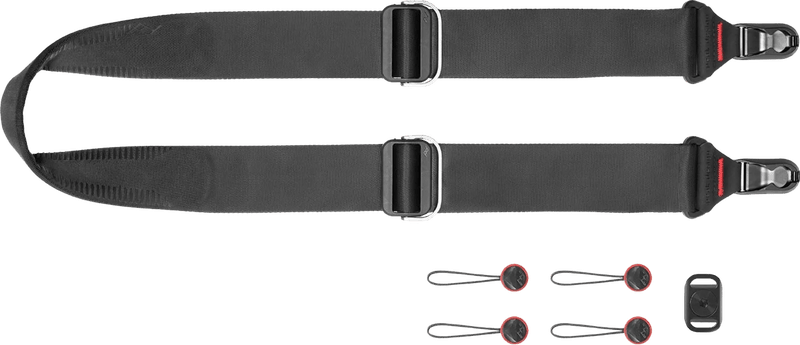
Peak Design’s widest strap has a smooth side that glides over clothing when worn as a sling, and a grippy side that stays put on the shoulder. Two quick adjusters change the length between 99 and 145 cm. The box contains four anchors and an Anchor Mount that lets one end attach to the bottom of the camera. With a small mirrorless camera, the 4.5 cm webbing is simply too much strap.
Peak Design Slide Lite
Same length, same anchors, but 3.2 cm wide and 104 g light. Peak Design explicitly targets the strap at mirrorless cameras. For a camera of around 700 to 900 g with a zoom, we consider this the right size. Wide enough that nothing digs in, narrow enough that it does not look like a backpack strap.
Peak Design Leash
No padding, a narrow 19 mm, and 86 g. Rolled up, the Leash fits in a jacket pocket and, according to the manufacturer, can be used as a sling strap, neck strap or safety tether. It is not for a heavy DSLR; the narrow webbing presses over time. As a second strap for vacations, though, it is very useful.
Peak Design Cuff
A wrist strap that adjusts between 20 and 29 cm and either locks open or cinches around the wrist. A magnet holds the loose end. Because it uses the same anchors, you can switch between the Cuff and one of the straps in seconds without rethreading the lugs.
BlackRapid Cross Shot
A pure sling strap with a shoulder pad made of TPR rubber that, according to the manufacturer, does not slip even on nylon and fleece jackets. It can be worn on the left or right. The camera hangs upside down from a carabiner that attaches via the FR-5 screw in the tripod socket and slides along the strap. BlackRapid also includes a safety tether and the LockStar, a cap that prevents the carabiner’s lock from opening on the move.
BlackRapid RS-4 Classic Retro
Same principle, but with a pad 34 cm long and 7.3 cm wide made of honeycomb nylon, foam and air mesh. A small zip pocket holds memory cards or an ID. This is the strap for someone carrying a full-frame camera with a telephoto zoom for eight hours at a wedding.
OP/TECH Super Classic Strap 3/8″
A 5 × 38.1 cm neoprene pad with a non-slip back, and inside the manufacturer’s stretchy Control Stretch System. OP/TECH gives a recommended load of up to 6.8 kg, and according to the data sheet each connector withstands 66 kg of pull. The connectors can be separated. At a maximum of 129.5 cm, the strap is too short to wear comfortably across the body.
Can the tripod socket handle a hanging camera?
The two designs distribute the load differently. Lug straps pull at two points on top of the body. BlackRapid, by contrast, attaches its sling straps to a single screw in the tripod socket because, according to the manufacturer, the camera then hangs at its center of gravity and does not slide off the shoulder. BlackRapid does not state a load rating for the socket or the screw online. The included safety tether connects the camera or lens to the carabiner as a second point. With heavy lenses, we would always attach it.
Peak Design takes a middle path: one anchor goes on the lug, the other on the bottom via the Anchor Mount, and the camera then hangs lens down. According to the manufacturer, this is more stable with long lenses. The Anchor Mount does not fit on a tripod. So if you often switch between strap and tripod, expect to unscrew and rescrew each time with a sling strap. Our travel tripod guide (in German) helps here.
Leather or nylon?
Nylon webbing is light, dries quickly and copes with rain. Leather looks more fitting on a small rangefinder camera but needs care and should dry slowly after a downpour. Peak Design combines both: the colors Ash, Sage and Midnight have leather trim that, according to the manufacturer, is rated Gold by the Leather Working Group; the other colors use Hypalon. Sand and salt take a toll on every strap, so after a day at the beach it belongs in the cleaning routine from our camera cleaning guide (in German).
Which strap for which camera?
- Mirrorless camera with a standard zoom, everyday use and travel: Peak Design Slide Lite.
- DSLR or large mirrorless camera, switching between neck and shoulder: Peak Design Slide.
- A whole day with a heavy telephoto zoom, hands free: BlackRapid RS-4 Classic Retro; for climbing or cycling, rather the Cross Shot with its rubber pad.
- A fixed neck strap with soft padding for a heavy DSLR: OP/TECH Super Classic Strap.
- Small camera in a jacket pocket: Leash or Cuff, ideally both with the same anchors.
And the strap has to work with your bag. Wide padding gets in the way under backpack straps, and a sling strap crosses the chest strap. If you mostly carry the camera in a backpack anyway, the camera backpack guide (in German) covers models with side access, and then a wrist strap is often enough.
Frequently asked questions
Neck strap, shoulder strap or sling strap: which is most comfortable?
Around the neck, the camera pulls noticeably on your neck after an hour; over the shoulder, it tends to slip off smooth jackets. Worn across the body, it hangs at the hip, your hands stay free and bringing it up is quick. For longer outings, the guide therefore prefers the sling strap.
How wide should a camera strap be?
For a light camera, 19 mm webbing is enough. From around one kilogram including the lens, padding of 3.5 cm or more is kinder to your shoulder. At 4.5 cm, the Peak Design Slide is simply too much strap for small mirrorless cameras; the Slide Lite at 3.2 cm is aimed at mirrorless cameras.
How long does a sling strap need to be?
For wearing across the body, the strap should adjust well beyond 130 cm, especially over a winter jacket. Peak Design's straps reach up to 145 cm, BlackRapid lists 160 and 167 cm. At a maximum of 129.5 cm, the OP/TECH Super Classic is too short for this.
Can the tripod socket handle a hanging camera?
BlackRapid attaches its sling straps with a screw in the tripod socket so that, according to the manufacturer, the camera hangs at its center of gravity. BlackRapid does not state a load rating for the socket or the screw online. The included safety tether connects the camera or lens to the carabiner as a second point; with heavy lenses it should always be used.
What are the drawbacks of a strap on the tripod socket?
It blocks the socket for the tripod plate, and Peak Design's Anchor Mount does not fit on a tripod either. If you often switch between strap and tripod, expect to unscrew and rescrew each time with a sling strap. Strap-lug straps, by contrast, pull at two points on top of the body.
Leather or nylon for a camera strap?
Nylon webbing is light, dries quickly and copes with rain. Leather looks more fitting on a small rangefinder camera but needs care and should dry slowly after a downpour. Peak Design combines both: the colors Ash, Sage and Midnight have leather trim, the other colors Hypalon.
Sources
- Peak Design: Slide
- Peak Design: Slide Lite
- Peak Design: Leash
- Peak Design: Cuff
- Peak Design: Anchor Mount
- BlackRapid: Cross Shot
- BlackRapid: RS-4 Classic Retro
- BlackRapid: FastenR FR-5
- BlackRapid: LockStar
- BlackRapid: Camera Safety Tether II
- Novoflex (OP/TECH distributor): Super Classic Strap 3/8″
Where to buy
- Peak Design Slide LiteCheck price at Amazon.deView at Coolblue
- Peak Design SlideCheck price at Amazon.deView at Coolblue
- Peak Design LeashCheck price at Amazon.deView at Coolblue
- Peak Design CuffCheck price at Amazon.deView at Coolblue
- BlackRapid Cross ShotCheck price at Amazon.de
- BlackRapid RS-4 Classic RetroCheck price at Amazon.de
- OP/TECH Super Classic Strap 3/8"Check price at Amazon.de