Contents15 sections
This guide was first published in German on handgetestet.de.
The machine makes the espresso, many people say. Wrong: without a good grinder, it will not be any good, no matter how heavy the machine sitting on the countertop. If you want to get started without a separate grinder, take a machine with a built-in grinder such as the Sage Barista Express, the Sage Barista Pro or the De’Longhi La Specialista Arte Evo.
If you mainly drink espresso and enjoy the craft, a single-boiler machine like the Gaggia Classic E24 or the Lelit Anna PL41EM plus a good grinder is the right combination. If several cappuccinos are made back to back in the morning, there is hardly any way around a dual boiler like the Sage the Dual Boiler or the Sage the Oracle Dual Boiler.
You can also go a size smaller. If you buy pre-ground coffee or already own a grinder, a slim machine without a grinder will do, such as the De’Longhi Dedica Style or the Sage Bambino. A Dedica has been in our kitchen for years; how it holds up in everyday use is described in our long-term review of the De’Longhi Dedica.
An honest warning up front. A portafilter machine takes more practice than a bean-to-cup machine, because you grind, dose, tamp and froth the milk yourself. If that is too much for you, our guide buying a bean-to-cup coffee machine (in German) covers the more convenient alternative.
What do thermoblock, single boiler and dual boiler mean?
Thermoblock and thermocoil machines heat the water as it flows through. Ready quickly, but with less steam power. A single-boiler machine has one boiler for coffee and steam, so you switch temperatures between espresso and milk foam. No big deal. But annoying with four cappuccinos in a row.
In a heat exchanger machine, a heat exchanger inside the steam boiler heats the brewing water. A dual boiler has two separate boilers and controls both temperatures independently of each other. And PID? This control keeps the brewing temperature stable electronically, while simple machines work with a thermostat, where the temperature fluctuates more.
Built-in grinder or your own?
A built-in grinder saves space and the money for a second appliance. A separate grinder, on the other hand, can be upgraded on its own later. Both have their place; just do not skimp on the grinder.
Which details are often overlooked?
The basket size, for example. 58 mm is the size of many professional machines, and there are plenty of accessories for it; Sage machines, on the other hand, use 54 mm according to the manufacturer. If you buy additional tampers and baskets, check the exact size beforehand. Flow heaters are ready within seconds, while large boiler machines need several minutes up to a quarter of an hour, which a timer switch or a quick-start mode helps with.
There is little leeway when it comes to maintenance. Limescale is the biggest enemy of any machine, so use soft or filtered water and descale according to the manufacturer’s instructions. On many models, backflushing with a blind basket is part of the routine.
And the space? Boiler machines easily weigh 15 to 30 kg. Measure the height under the wall cabinet and leave room for refilling the tank.
Nine machines from the slim entry level to the dual boiler
| Model | Type according to the manufacturer | Key data according to the manufacturer | Who it’s for |
|---|---|---|---|
| De’Longhi Dedica Style EC685.M | Thermoblock, no grinder | 15 bar, 1.1 l tank, 15 cm wide, also E.S.E. pods | Beginners with little space |
| Sage the Bambino | ThermoJet, no grinder | approx. 3 s heat-up time, 54 mm, pre-infusion, 18 g dose | Beginners with their own grinder |
| Sage Barista Express | Thermocoil, built-in grinder | 16 grind settings, PID, 54 mm portafilter | Beginners on a small budget |
| Sage Barista Pro | ThermoJet, built-in grinder | 30 grind settings, approx. 3 s heat-up time, 54 mm | Beginners in a hurry |
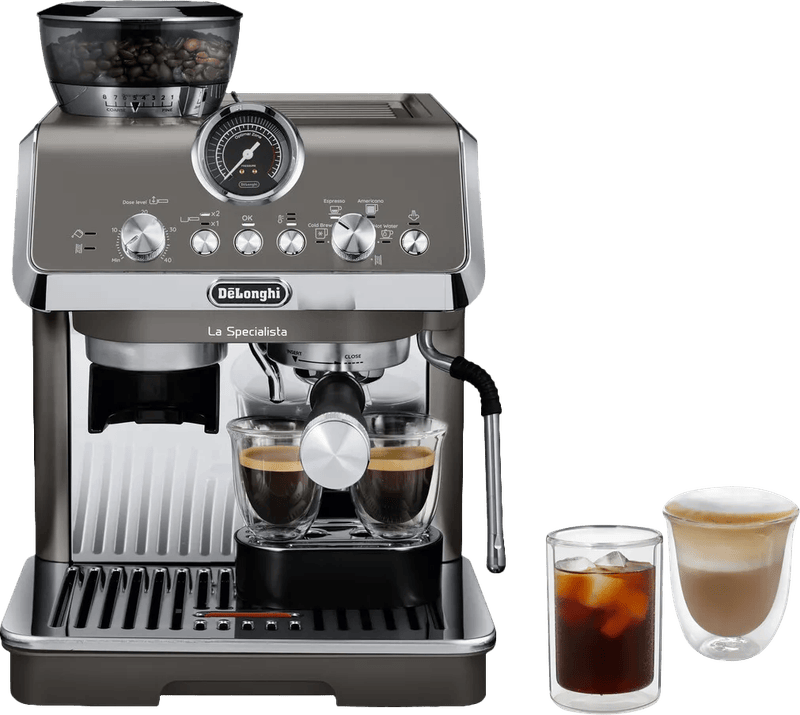
| De’Longhi La Specialista Arte Evo | Thermoblock, built-in grinder | 15 bar, 3 temperature settings, 1.7 l tank, cold brew | Beginners who like cold drinks |
| Gaggia Classic E24 | Single boiler | Brass boiler, three-way valve, 2.1 l tank | Espresso purists with their own grinder |
| Lelit Anna PL41EM | Single boiler | 250 ml brass boiler, LELIT57 group, pressure gauge, 2.7 l tank | A durable entry into the craft |
| Sage the Dual Boiler | Dual boiler | two stainless steel boilers, PID, heated group head, 2.5 l tank | Milk coffee fans with their own grinder |
| Sage the Oracle Dual Boiler | Dual boiler, built-in grinder | grinds, doses and tamps automatically, 45 grind settings | Heavy drinkers who want to hand off the manual work |
De’Longhi Dedica: slim and in use in our kitchen for years
According to De’Longhi, the Dedica Style is only 15 centimeters wide. Behind that are a thermoblock, a 15-bar pump and a 1.1-liter tank. There is no grinder. Instead, the portafilter takes E.S.E. pods as well as ground coffee, and on the steam wand you switch between hot milk and firm cappuccino foam. According to the manufacturer, cups may be up to 12 centimeters tall.
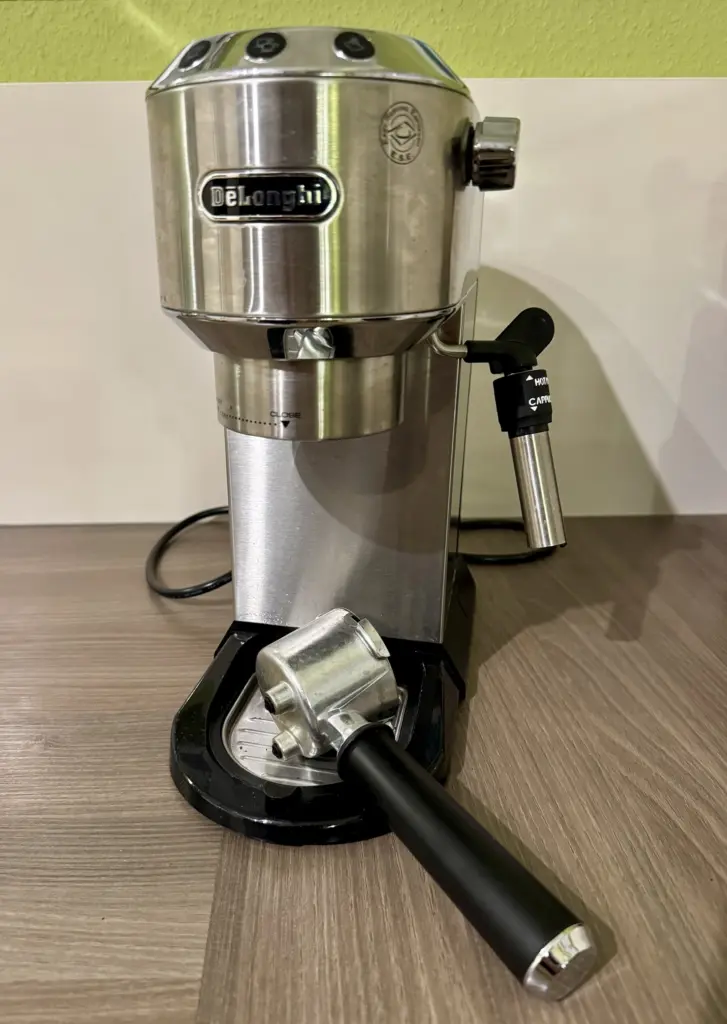
We have been using an older Dedica for espresso and cappuccino for years. It runs robustly and reliably, earning five out of five stars in our long-term review. The bigger machines further down offer more control over temperature and pressure. But if you simply want good espresso without a lot of technology, this is the right place.
Sage Bambino: ready in three seconds
According to Sage, the small Bambino heats up in about three seconds with ThermoJet. After a low-pressure pre-infusion, it extracts at 9 bar, and the 54 mm portafilter holds 18 grams of coffee. You froth the milk yourself on the steam wand. The Bambino Plus takes over that job: according to Sage, it textures milk automatically, with three settings each for temperature and foam. Both need a grinder in addition, or you buy freshly ground coffee.
Sage Barista Express: the widespread entry point
For many people, it has been their first portafilter machine for years, with a built-in conical burr grinder. Sage specifies thermocoil heating, PID temperature control and 16 grind settings. Before extraction at 9 bar comes a low-pressure pre-infusion. The Barista Express Impress additionally helps with dosing and tamping.
Sage Barista Pro: ready fast
According to the manufacturer, the ThermoJet heating system needs about three seconds to reach brewing temperature. According to Sage, the built-in conical burr grinder offers 30 grind settings. If you would rather not froth the milk yourself, there is the sister model Sage Barista Touch with a touchscreen and automatic steam wand, whose milk temperature can be set between 40 and 75 °C, according to Sage.
De’Longhi La Specialista Arte Evo: with cold brew
Thermoblock, built-in grinder, manual steam wand. De’Longhi specifies 15 bar of pump pressure, three temperature settings and a 1.7-liter tank. The cold brew function is unusual. It is said to deliver cold-extracted coffee in under five minutes. A dosing and tamping aid is included.
Gaggia Classic E24: an institution among single boilers
In stores, it often goes by Classic Evo Pro. Gaggia specifies a brass boiler, a chrome-plated brass group head and a three-way valve that dries the coffee puck after the shot. You remove the 2.1-liter tank from the front. A separate grinder is needed, and you should not skimp on it.
Lelit Anna PL41EM: simple and solid
A 250 ml brass boiler, the LELIT57 group, a three-way valve that dries the coffee puck, and a pressure gauge: that is how Lelit describes the Anna PL41EM. Add a 2.7-liter tank with a side sight glass and a cup warmer. It has no PID control; Lelit only offers that in the sister model PL41TEM. Purist, and it takes a bit of feel.
Sage the Dual Boiler: two boilers, your own grinder
Two stainless steel boilers, one for espresso, one for steam, so espresso and milk foam are made at the same time. Sage specifies digital PID control for the espresso boiler and a heated group head that is also PID-controlled, plus a 2.5-liter tank. It has no grinder; a good separate grinder is part of the package.
Sage the Oracle Dual Boiler: premium class with automation
Here too, two boilers are at work, plus a grinder with Baratza burrs and 45 grind settings. According to Sage, the machine grinds, doses and tamps each coffee puck itself and adjusts the grind setting after every shot. If you prefer to make the adjustments yourself, you can switch this off in the settings, according to the manual.
That is a lot of automation and is priced accordingly, but it takes most of the manual work off your hands in the morning.
Which machine suits me?
Little space, small budget and pre-ground coffee: De’Longhi Dedica Style. With your own grinder and a wish for more speed: Sage Bambino, or the Bambino Plus for automatic milk foam. Getting started without a second grinder: Sage Barista Express or De’Longhi La Specialista Arte Evo. If mornings have to be quick, take the Sage Barista Pro, or the Sage Barista Touch for automatic milk foam. Pure espresso and enjoyment of the craft point to the Gaggia Classic E24 or the Lelit Anna PL41EM, each with a good separate grinder. The Sage the Dual Boiler handles lots of milk drinks in a row. The Sage the Oracle Dual Boiler is the premium class for heavy drinkers who want to hand off grinding and tamping. And if you have no interest in tamping, a bean-to-cup coffee machine (in German) is usually the smarter choice.
On the question of price: slim machines without a grinder like the Dedica and Bambino are the cheapest way into portafilter espresso. Machines with a thermoblock and built-in grinder as well as simple single boilers are usually in the entry to mid-range class, while dual boilers belong to the premium class. With single boilers, the budget for a good grinder is part of the deal from the start.
Still undecided between the two routes? Our guide bean-to-cup machine or portafilter (in German) does the math on time, beans and cleaning effort.
Frequently asked questions
What is the difference between a single boiler, heat exchanger and dual boiler?
A single-boiler machine has one boiler for coffee and steam, so the temperature switches between espresso and milk foam. In a heat exchanger machine, a heat exchanger in the steam boiler heats the brewing water. A dual boiler has two separate boilers and controls both temperatures independently, so espresso and milk foam are made at the same time.
What does PID control do?
PID keeps the brewing temperature stable electronically. Simple machines work with a thermostat, where the temperature fluctuates more. The Lelit Anna PL41EM, for example, uses a thermostat, while the Sage Barista Express and the Sage the Dual Boiler use PID control, according to the manufacturer.
Built-in grinder or separate grinder?
A built-in grinder saves space and the money for a second appliance. A separate grinder can be upgraded on its own later. Both have their place; just do not skimp on the grinder, because without a good grinder the espresso will not be any good.
Which basket size should you keep in mind for accessories?
58 mm is the size of many professional machines, and there are plenty of accessories for it. The smaller Sage machines such as the Barista Express and Bambino, on the other hand, use 54 mm according to the manufacturer. Before buying a tamper and baskets, check the exact size of your own machine.
How long does an espresso machine take to heat up?
Flow heaters are ready within seconds, the Sage Barista Pro after about three seconds according to the manufacturer. Large boiler machines need several minutes up to a quarter of an hour. A timer switch or a quick-start mode helps.
Is a portafilter machine harder than a bean-to-cup machine?
Yes, it takes more practice, because you grind, dose, tamp and froth the milk yourself. Then there is maintenance: soft or filtered water, descaling according to the manufacturer and, on many models, backflushing with a blind basket. If you have no interest in tamping, a fully automatic bean-to-cup machine is usually the better choice.
Sources
- De’Longhi: Dedica Style EC685.M
- Sage: the Bambino
- Sage: the Bambino Plus
- Sage: the Barista Express
- Sage: the Barista Pro
- Sage: the Barista Touch
- De’Longhi: La Specialista Arte Evo EC9255.M
- Gaggia: Classic E24
- Lelit: Anna PL41EM
- Sage: the Dual Boiler
- Sage: the Oracle Dual Boiler
Where to buy
- Sage Barista ExpressView at CoolblueCheck price at Amazon.de
- De'Longhi Dedica Style EC685.MView at CoolblueCheck price at Amazon.de
- Sage the BambinoView at Coolblue
- Sage the Bambino PlusView at Coolblue
- Sage Barista ProView at Coolblue
- De'Longhi La Specialista Arte EvoView at Coolblue
- Gaggia Classic E24Check price at Amazon.de
- Lelit Anna PL41EMCheck price at Amazon.de
- Sage the Dual BoilerCheck price at Amazon.de
- Sage the Oracle Dual BoilerView at Coolblue