Contents15 sections
This guide was first published in German on handgetestet.de.
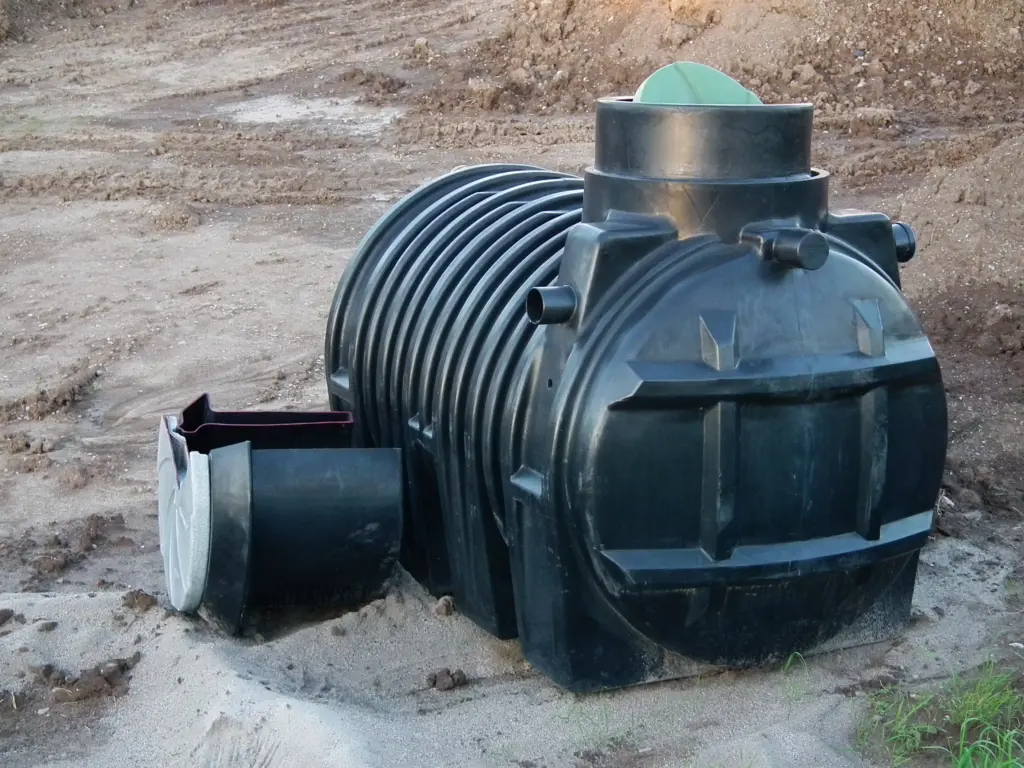
How big does the tank need to be? The answer depends on what it is supposed to do. According to the German standard DIN 1989, a tank of 5,000 to 6,500 liters is enough for a 400 to 500 m² garden, designed for about three weeks without rain. But if you want to get a long hedge through the entire heat of July and August, you are much better served with 10,000 liters. Our pick in this class is the Graf Carat XL with 10,000 liters in the Garden Comfort package. If you have access for a crane and prefer concrete, go for Mall’s Fontana garden package.
What the standard says
Sizing according to DIN 1989 compares two numbers: what the roof delivers in a year and what the garden needs in a year. The smaller value is decisive, and you take 6 percent of it. That gives a supply for about three weeks. That’s how the rainwater fact sheet of the Bavarian municipality of Aidenbach, which is based on the standard, explains it. For demand, it assumes 80 to 200 liters per square meter of garden per year. For yield, it gives a usable storage volume of 25 to 50 liters per square meter of hard roof at 600 to 1,200 mm of annual precipitation.
An example: a plot of just under 740 m², around 450 m² of it garden with a hedge of more than a hundred thujas and several perennial beds, plus a 200 m² tiled roof. At a demand of 150 to 200 liters per square meter, the calculation comes to 4,050 to 5,400 liters. The next common size would be 6,500 liters.
Is that enough for July and August?
Three weeks is an average. A hot summer lasts longer. For Braunschweig, the German Weather Service (Deutscher Wetterdienst) gives an average of exactly 70.6 mm of rain in July and 66.6 mm in August for the years 1991 to 2020. Together that’s only a little over 137 mm, often in just a few thunderstorms.
One millimeter of rain equals one liter per square meter. So with 10 mm of rain, the 200 m² roof delivers around 2,000 liters, minus evaporation. Over a year, at 600 mm of precipitation, more than 100,000 liters come off the roof. A 10,000-liter tank is therefore full at the start of summer and refills a little with every rainy day. It overflows regularly in winter, and that keeps the water fresh.
And consumption? The Bavarian Garden Academy (Bayerische Gartenakademie) is clear on this. It advises watering rarely but thoroughly. Most roots sit at a depth of around 15 cm and only get water once 15 liters per square meter have arrived. We calculate 20 liters per week for a hedge strip of around 60 m² and 100 m² of perennials. That’s 3,200 liters per week, almost 29,000 liters over nine weeks. We deliberately leave the lawn out of this calculation.
- No rain at all: 6,500 liters last 2 weeks, 10,000 liters 3 weeks.
- Half the usual rainfall, i.e., around 1,400 liters of inflow per week: 6,500 liters last a good 3½ weeks, 10,000 liters a good 5½ weeks.
- Average summer with around 2,800 liters per week: both sizes get through, the large one with reserves.
Clear-cut. In a dry summer, the larger tank buys you around two extra weeks. Those are often exactly what decides whether a thuja hedge gets brown patches. Without any rain, even a 10,000-liter tank won’t last nine weeks. The Garden Academy therefore recommends a top-up with mains water via an air gap, so that irrigation stays secure during long dry periods. Going even bigger brings little with a 200 m² roof. In dry weeks the inflow is missing, and the last reserve comes from the tap anyway.
Incidentally, thujas need water in winter too. The Garden Academy points out that, as evergreens, they also lose water through evaporation in sunny, dry weather then.
And with a small roof?
Often only part of the roof is connected to the tank, for example one side with 40 m². Then the calculation looks different. According to the Weather Service averages for Braunschweig, around 478 mm falls from September to June. On 40 m², that’s a good 19,000 liters. A 10,000-liter tank is therefore reliably full by summer, even if it was empty in the fall.
In July and August, on the other hand, only around 5,500 liters come off the roof, about 600 liters per week. The tank then works mainly as a reserve stored over winter. At 3,200 liters of irrigation water per week, 10,000 liters last around four weeks, 6,500 liters only a good two and a half. With a small roof in particular, every liter stored beforehand counts. Going even bigger brings little with 40 m². After losses at the filter and through evaporation, such a tank would often not be full in spring.
More water only comes from more surface area. A garage, carport or garden shed can often be connected too. The Bavarian Garden Academy also names paths without pollutant input as a source. A top-up with mains water takes care of the rest. In addition, drip hoses directly at the hedge and a layer of mulch, which the Garden Academy explicitly recommends for thujas, save a noticeable amount of water.
No room for a crane?
Graf delivers curbside, not unloaded. Depending on the size, you need help unloading on site, but according to the manufacturer no heavy equipment. The decisive factor is the route to the pit. The 10,000-liter Carat XL is 2.24 m wide at its narrowest side. The Platin XL flat tank is only 1.25 m high and can be brought through a much narrower access on its side, though at 4.90 m long and 460 kg. If you only have a narrow garden path, measure the tightest spot and the bends beforehand.
Two smaller flat tanks in a row are even easier to handle. Roth explicitly allows this for its Twinbloc: according to the installation instructions, several tanks can be linked with the Roth connection set and a DN 100 sewer pipe. A 5,000-liter Twinbloc is 2.44 m long, 1.35 m high and weighs 170 kg. Two of them make 10,000 liters, and each one fits through an access where a 4.90 m tank fails.
Concrete or plastic?
Quality first? Then two types of construction remain. Mall builds concrete tanks from reinforced concrete of strength class C35/45, cast seamlessly, with a 30-year warranty on the material. The pit may be backfilled with the excavated soil and compacted by machine; no sand or gravel is needed. On the other hand, an 11,000-liter tank weighs over 8 tonnes. Mall sets it in place with its own crane truck, which needs access right up to the pit. In an established garden with a hedge, that is often exactly the sticking point.
Graf makes plastic tanks. The 10,000-liter Carat XL weighs 455 kg and goes into the pit with a small excavator. It can carry up to 2 m of soil above the tank shoulder and is stable in groundwater up to the middle of the tank. Graf offers up to 30 years of warranty on its products. With plastic, careful installation is what matters: bedding and backfilling according to the instructions are mandatory.
Five plastic tanks compared
| Model | Volume and dimensions | Installation according to manufacturer | For whom |
|---|---|---|---|
| Graf Carat XL 10,000 l, Garden Comfort complete package | 10,000 l, 2.24 × 3.52 × 2.29 m, 455 kg | up to 2 m of soil above the shoulder, groundwater-stable up to tank center | Hedge and beds through the whole hot spell |
| Roth Twinbloc 5,000 l, two linked | 2 × 5,000 l, each 2.44 × 2.30 × 1.35 m, each 170 kg | up to 1.2 m of soil above the tank, linked with Roth connection set | Narrow access, no crane |
| Graf Platin XL 10,000 l, flat tank | 10,000 l, 2.25 × 4.90 × 1.25 m, 460 kg | up to 1.75 m of soil above the shoulder | Rock, high groundwater, shallow pit |
| Graf Carat XL 8,500 l, Garden Comfort complete package | 8,500 l, 2.04 × 3.50 × 2.09 m, 380 kg | same as Carat XL 10,000 | Smaller roof, around 150 m² |
| Graf Carat 6,500 l, Garden Comfort complete package | 6,500 l, 2.19 × 2.39 × 2.10 m, 220 kg | up to 2 m of soil above the shoulder, groundwater-stable up to tank center | Sizing according to the standard, three weeks of supply |
Graf Carat XL 10,000 l with Garden Comfort
The underground tank for the goal of getting through the entire hot spell. The Garden Comfort package includes the NiRo 40 automatic submersible pump. According to Graf, it switches itself on and off, has dry-run protection and delivers up to 5,700 liters per hour at a maximum of 4.5 bar. A floating intake with a fine filter draws the water from just below the surface; 10 m of pressure hose is included. A basket filter in the tank holds back leaves, and Graf states a water yield of 100 percent. You connect the hose to a water outlet in the lid or to a second outlet that can be placed anywhere. The inlet is DN 160. With a car-rated cover, the tank can be driven over.
The concrete alternative: Mall Fontana 11000
The concrete tank with 11,000 liters, 2.50 m diameter and 3 m overall height is for people who only want to build once. According to Mall, the garden package always includes the tank, a trapezoidal filter for roof areas up to 325 m² and the Fontana submersible motor pump with connection set. It switches on when the pressure drops and off when there is no flow, and it has dry-run protection. According to the data sheet, it pumps up to 6 m³ per hour at a maximum of 3.0 bar. If you run several sprinklers or a long drip line, the Fontana Rain with 4.5 bar and floating intake is the better choice. You choose the draw-off point as well: a tap in the ground, a connection in the lid, a stainless steel column or an aluminum column with two taps. The cover can be swapped up to load class D, i.e., for trucks too. The package is not sold by mail order; Mall delivers directly, and you order via the manufacturer’s website (in German). Clarify beforehand: can a truck with a crane get right up to the pit? If not, concrete is out.
Graf Platin XL 10,000 l
Flat but long. The tank is only 1.25 m high, 1.91 m with the dome. In return it is almost five meters long. It fits where you can’t dig deep, for example because of rock or high groundwater. Graf offers it with the Comfort and Jet garden packages. For a garden with little open space, though, the length is a problem.
Roth Twinbloc 5,000 l, linked
Roth builds the Twinbloc as an ultra-flat rainwater tank made of polyethylene. A filter basket sits in the dome shaft, along with a calmed inlet and an overflow siphon. A pump is not included; you buy a suitable one separately, for example an automatic submersible pressure pump. According to the instructions, the pit needs 60 cm of working space on each side and at least 1.20 m of distance from buildings. Groundwater may reach no higher than half the tank height. Roth requires installation by a specialist company.
Retention tank: only if your municipality requires it
Roth also offers the same tanks as retention tanks, with 3,500 to 10,000 liters. Here part of the water deliberately drains away slowly, via a floating throttle at 0.07 to 0.5 liters per second into the sewer. As standard, 50 percent of the volume is retention. So of a 10,000-liter retention tank, only 5,000 liters remain for the garden. That pays off if the local development plan requires retention or the municipality lowers its stormwater fee in return. If you just want to water, you’re better off buying a pure storage tank.
Graf Carat XL 8,500 l with Garden Comfort
Same technology, smaller. Makes sense if the roof measures more like 150 m². Then a quarter less flows in per rainy day in summer, and an even larger tank won’t make up for that.
Graf Carat 6,500 l with Garden Comfort
This is the size that a calculation according to the standard gives for the example. It is plenty for lawn, beds and a short hedge. If you want to get a long thuja hedge through a dry August, you’ll notice the difference from 10,000 liters after about three weeks.
How we would decide
- Long hedge, goal is the whole hot spell, roof from 200 m²: Graf Carat XL 10,000 l with Garden Comfort.
- Same goal, a crane can reach the pit, service life matters most: Mall Fontana 11000 in concrete, with the more powerful Fontana Rain pump.
- Rock, high groundwater or only shallow digging possible: Graf Platin XL 10,000 l.
- Very narrow access without a crane: two linked Roth Twinbloc tanks of 5,000 liters each, plus a submersible pressure pump.
- Municipality requires stormwater retention: retention tank, for example from Roth.
- Smaller roof around 150 m²: Graf Carat XL 8,500 l.
- Lawn and beds without large woody plants: Graf Carat 6,500 l is enough.
Before buying, clarify two things: the groundwater level and access for an excavator or crane. If you want to run several sprinklers at once, check the pressure in the pump’s data sheet. A top-up with mains water should be planned in right away. How to get the water to the roots economically is covered in our guide Drip irrigation in the garden (in German). Advice on the pump is in our guide Submersible pump (in German).
How reliably a pump for wells and gardens works is shown in our review of the T.I.P. WPF S multifunction pump.
Frequently asked questions
How do I calculate the size of a rainwater tank for the garden?
You compare the roof's annual yield with the garden's annual demand and multiply the smaller figure by 0.06. That gives a supply for about three weeks.
Is one tank enough for the whole summer?
Only partly. At 3,200 liters of irrigation water per week, 10,000 liters last a good five and a half weeks in a summer with half the usual rainfall, 6,500 liters a good three and a half. For the rest, a top-up with mains water is advisable.
Does a 10,000-liter tank actually fill up?
Yes, if the roof is large enough. One millimeter of rain delivers one liter per square meter. A 200 m² roof supplies over 100,000 liters a year at 600 mm of precipitation.
Concrete or plastic?
Mall's concrete tanks weigh over 8 tonnes and need crane access, but the pit may be backfilled with the excavated soil. Plastic tanks such as the Graf Carat XL weigh under 500 kg and fit into established gardens with a small excavator.
Does a thuja hedge need watering in winter too?
Yes, during longer sunny and dry spells. According to the Bavarian Garden Academy, evergreen thuja also lose water through evaporation in winter.
Sources
- Graf: Rainwater harvesting for your home 2026 (catalog, in German)
- Mall: Rainwater harvesting 2026 (brochure, in German)
- Mall: Fontana garden package
- Graf: NiRo 40 submersible pressure pump (data sheet)
- Mall: Fontana Rain submersible motor pump (data sheet)
- Mall: Fontana submersible motor pump (data sheet)
- Roth: Twinbloc installation instructions
- Roth: retention tanks
- Municipality of Aidenbach: notes on rainwater harvesting (in German)
- German Weather Service: precipitation, long-term averages 1991–2020
- Bavarian Garden Academy: irrigation in home and allotment gardens (in German)
- Bavarian Garden Academy: Thuja – arborvitae (in German)
Where to buy
- Graf Carat XL 10.000 l Komplettpaket Garten-KomfortCheck price at Amazon.deAvailable in Germany: Amazon.de
- Graf Platin XL 10.000 l, FlachtankCheck price at Amazon.deAvailable in Germany: Amazon.de
- Graf Carat XL 8.500 l Komplettpaket Garten-KomfortCheck price at Amazon.deAvailable in Germany: Amazon.de
- Roth Twinbloc 5.000 l, zwei Stück gekoppeltCheck price at Amazon.deAvailable in Germany: Amazon.de
- Graf Carat 6.500 l Komplettpaket Garten-KomfortCheck price at Amazon.deAvailable in Germany: Amazon.de