Contents13 sections
This guide was first published in German on handgetestet.de.
At a garden shed without an outlet and without a router, two things decide the purchase: whether there’s enough cell signal at the fence, and what the camera is allowed to see. Only after that does the brand matter. On a narrow plot, we consider a fixed camera like the Reolink Go Ultra the calmest route, because a fixed view is the most reliable way to limit what it sees to your own property. The Imou AOV PT 4G and the EZVIZ EB8 4G Solar Kit, on the other hand, pan and tilt and are better suited to large properties. We don’t name a winner, because we don’t have independent tests of these models.
First fork: does the Wi-Fi from the house reach after all?
If the shed is in your own yard, 40 or 60 meters behind the house, you usually don’t need a SIM card. All that’s missing is range. EZVIZ solves this with the HB3 system using Wi-Fi HaLow, which in Europe transmits at around 865 megahertz and sends the recordings to a base station in the house. What that looks like is described in the guide to the camera for a vacation home. A regular solar camera on extended Wi-Fi is covered in the article on the security camera with solar panel (in German).
In an allotment garden, this option doesn’t exist. No house, no router. That leaves cellular.
Second fork: is there enough signal at the fence?
The cellular monitoring map in Germany’s Gigabit-Grundbuch gives a first indication, nothing more. The Federal Network Agency (Bundesnetzagentur) itself points out that it shows a forecast for outdoor areas and is based on operator data. Walls, low-E glass, valleys and dense forest can weaken the signal considerably. So stand at the exact mounting point with your phone, using a SIM card from the network you plan to use. The agency’s Mobilfunk-Check app helps with this. If you want to hang the camera behind the shed window, measure there separately as well.
Data volume is rarely the biggest risk. For the eufy S330, Anker states about 700 megabytes per month, with ten live streams and 25 short clips a day. Extrapolated, that’s a good 8 gigabytes a year, so a small data plan is fine, as long as nobody looks at the flower beds in the evening just to pass the time. More on this, including types of plans, is in the guide to the security camera with SIM card. The model comparison there applies equally to construction sites and vacation homes. Here, it’s about the garden plot.
Third fork: what is the camera allowed to see?
This is the question that causes trouble fastest in an allotment garden. Let’s assume a plot of 15 by 20 meters, with neighbors on the left and right and the shared path in front. A lens with a field of view of just over 80 degrees covers a width of about 26 meters at a distance of 15 meters; with the 105 degrees of the Reolink Go Ultra, it’s almost 40. So the neighbor is almost always in the picture unless you aim diagonally at your own shed.
The German consumer advice center Verbraucherzentrale is clear: you may only film your own property. Neighboring properties and public paths are generally off-limits, and the same applies to shared driveways. We see an association path similarly. According to the Verbraucherzentrale, the most reliable way to limit the view is with fixed cameras, because a rotating one could be re-aimed at any time, and that alone can trigger injunction claims in individual cases. Even dummy cameras can cause trouble.
That’s exactly why the fixed camera comes first here, even though five of the six models below pan and tilt. On two hectares of orchard meadow, things look different. According to the Verbraucherzentrale, a warning sign is required even when you only monitor your own property. Also check with the association’s board whether the garden rules say anything about cameras. Where and how high to mount the camera is explained in the guide mounting a security camera (in German).
Fourth fork: is there enough sun between hedge and shed?
In December, probably not, and that’s not a flaw of the camera. A rough calculation with Anker’s figures: 9,400 milliamp-hours at an assumed 3.6 volts is about 34 watt-hours. If the battery lasts a month on that, the camera uses a good 1 watt-hour per day. If a 6-watt panel in partial shade delivers only 5 percent of its output for two hours, which we assume for an overcast winter day, 0.6 watt-hours come back. So about half a watt-hour is missing every day, and the reserve lasts about two months.
That leads to a simple rule. The panel belongs on the shed roof or on the open south side, even if the camera hangs somewhere else entirely. EZVIZ includes 4 meters of cable with the panel for this. Bigger batteries buy you time, nothing more. How the yield differs by orientation is calculated in the solar guide (in German). And if you’re considering a permanent connection: the article on power in the garden shed (in German) shows what that means in terms of planning.
Six cameras for the shed compared
| Model | Connection | Battery and solar | View | Suits |
|---|---|---|---|---|
| Reolink Go Ultra | 4G only, nano SIM | 28 Wh, 6 W panel in the set | fixed, 4K, 105° | Narrow plot |
| Imou AOV PT 4G | 4G and 2.4 GHz Wi-Fi | 10,000 mAh, panel in the kit | 330° pan, 90° tilt, 3K | Large property, Wi-Fi later |
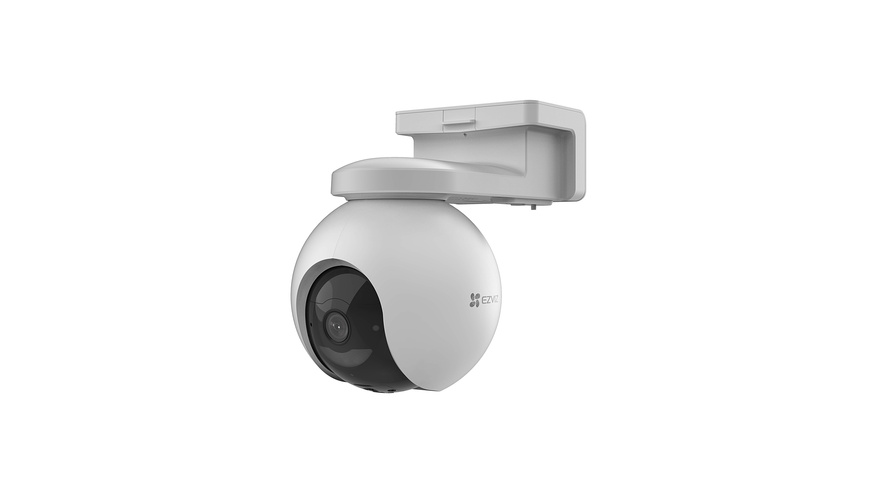
| EZVIZ EB8 4G Solar Kit | 4G only, micro SIM | 10,400 mAh, 6.18 W panel | 340° pan, 2K | Property without neighbors in view |
| eufy 4G LTE Cam S330 | 4G and Wi-Fi, SIM included | 9,400 mAh, panel | pan and tilt, 4K | Existing eufy users |
| Tapo C665G KIT | 4G and Wi-Fi, SIM sold separately | 10,000 mAh according to listing, panel in the kit | 360°, 4K | Large property, Wi-Fi later |
| Reolink Go PT Ultra | 4G only, nano SIM | 21.6 Wh, 6 W panel | pan and tilt, 4K | Very sharp image, less reserve |
Reolink Go Ultra
It doesn’t pan, and that’s exactly what makes it interesting for a garden plot. According to Reolink, it records in 4K, starts via a motion sensor with a range of up to 10 meters and takes a nano SIM, which you need to buy separately. The battery holds 28 watt-hours, noticeably more than the Go PT Ultra. At Reolink, the 6-watt panel isn’t included with the camera; in the set on Amazon it is. So check the exact version carefully.
Imou AOV PT 4G
It connects via 4G or 2.4 GHz Wi-Fi and can therefore save you the data plan once a router does come within range. In AOV mode, it continuously produces time-lapse images and switches to full recording when an alarm is triggered, which Imou describes as power-saving. On a postage-stamp plot, though, the pan-and-tilt head remains the problem from the third fork. It makes more sense for a yard on the edge of town than for an allotment garden complex.
EZVIZ EB8 4G Solar Kit
No Wi-Fi, only cellular via a micro SIM. The kit includes the panel with 4 meters of cable. According to EZVIZ, the camera currently only works with the company’s own solar panels with a USB-C connection. According to the data sheet, it operates from minus 20 to plus 50 degrees Celsius and is rated IP65. The GPS sounds like theft protection, but according to EZVIZ it only works reliably under open sky, not inside the shed. At ELV (German retailer), the kit currently costs no more than the camera alone.
eufy 4G LTE Cam S330
Anker provides the most concrete figures: about one month with ten clips and five live views a day, plus the 700 megabytes from the calculation above. The SIM is included; other nano SIMs can reportedly be checked in advance. It only works with the HomeBase S380 over Wi-Fi, so that advantage is of no use in an allotment garden.
Tapo C665G KIT
TP-Link’s newcomer connects via 4G or dual-band Wi-Fi, pans all the way around and records in 4K. The manufacturer states 70 days of runtime in 4G mode, determined according to its own test pattern; on Wi-Fi it would be 270. That says little about your shed in December. The battery isn’t replaceable, and according to the listing on Amazon, no SIM is included. For garden plots, the same applies to the pan-and-tilt head as with Imou and EZVIZ.
Reolink Go PT Ultra
4K with pan-and-tilt head, 4G only. At 21.6 watt-hours, the battery is smaller than the Imou’s or the EZVIZ’s, assuming 3.6 volts for those, and the housing is rated IP64. In winter, this difference matters more than image sharpness. In our view, the 6-watt panel is a must.
How to decide at the garden fence
- Shed in your own yard, Wi-Fi just barely out of reach: solve the range first, don’t buy a SIM.
- Plot with neighbors on both sides: a fixed camera like the Reolink Go Ultra, aimed at your own shed.
- Large, open property without neighbors in view: Imou AOV PT 4G or EZVIZ EB8 4G Solar Kit.
- No stable signal at the mounting point: steer clear of all six.
One thing remains: the memory card is inside the camera and disappears with it if it’s stolen. The alternatives are shown in the guide to storage for security cameras (in German).
Wi-Fi for the garden shed doesn’t always come via a wireless repeater: our review of the FRITZ!Repeater 1610 Outdoor shows why it needs a LAN cable outdoors.
Frequently asked questions
Which security camera works without power or Wi-Fi?
A battery camera with a solar panel and 4G that connects via a SIM card. If the shed is in your own yard within range of the house, though, a solution for more wireless range is often enough, such as the EZVIZ HB3 system using Wi-Fi HaLow. In an allotment garden without a router, cellular is the only option.
How do you check the cell reception at a garden shed?
The cellular coverage map of the German Federal Network Agency (Bundesnetzagentur) only gives a first indication; it shows a forecast for outdoor areas. Stand at the exact mounting point with your phone, using a SIM card from the network you plan to use. The agency's Mobilfunk-Check app helps with this.
What may a security camera film in an allotment garden?
According to the German consumer advice center Verbraucherzentrale, only your own property. Neighboring plots, public paths and shared driveways are generally off-limits. Fixed cameras are the most reliable to restrict. A warning sign is part of it, and ask the association's board about the garden rules.
How much data does a 4G camera use?
For the eufy S330, Anker states about 700 megabytes per month with ten live streams and 25 short clips a day, which extrapolates to a good 8 gigabytes per year. So a small data plan is fine, as long as nobody watches live often just to pass the time.
Is a solar panel enough for the camera in winter?
In December, probably not. By a rough calculation using Anker's figures, on overcast days in partial shade about half a watt-hour is missing each day, and the reserve lasts about two months. That's why the panel belongs on the shed roof or on the open south side; EZVIZ includes 4 meters of cable for this.
What happens to the recordings if the camera is stolen?
The memory card is inside the camera and disappears with it if it's stolen. According to the manufacturer, the GPS of the EZVIZ EB8 only works reliably under open sky, not inside the shed. Alternatives for storage are shown in the guide to storage for security cameras.
Sources
- Verbraucherzentrale: Only film your own property with security cameras
- Bundesnetzagentur: Questions and answers on cellular coverage
- EZVIZ: EB8 4G Kit
- ELV: Data sheet EZVIZ EB8 4G with solar panel
- EZVIZ: HB3 Add-On
- Imou: AOV PT data sheet
- Anker: eufy 4G LTE Cam S330
- Reolink: Go Ultra
- TP-Link Tapo: C665G KIT
- Reolink: Go PT Ultra
Where to buy
- Reolink Go UltraCheck price at Amazon.de
- Imou AOV PT 4GView at ImouCheck price at Amazon.de
- EZVIZ EB8 4G Solar-KitView at ELVCheck price at Amazon.de
- eufy 4G LTE Cam S330View at CoolblueCheck price at Amazon.de
- Tapo C665G KITCheck price at Amazon.de
- Reolink Go PT UltraCheck price at Amazon.de