Contents13 sections
This guide was first published in German on handgetestet.de.
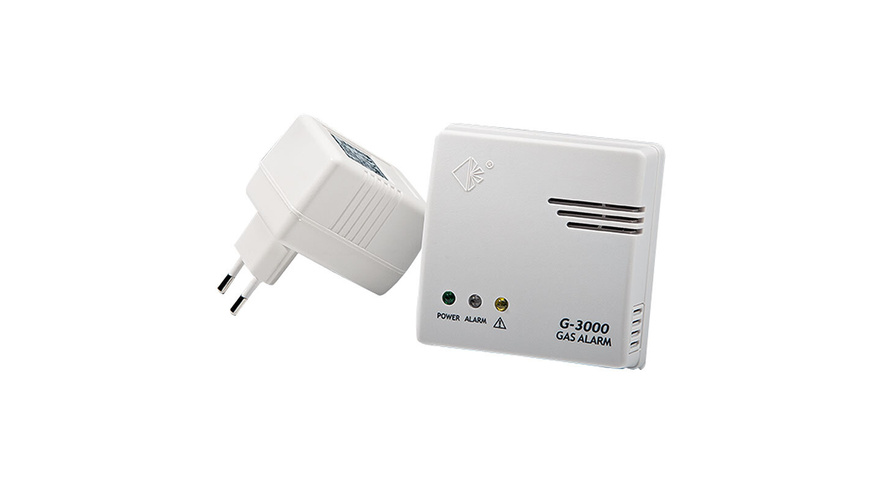
A gas detector is only as good as the spot where it hangs. Natural gas rises, propane and butane sink to the floor, and a detector at the wrong height notices too late in an emergency. For most households with a gas boiler or gas stove, we recommend the Cordes CC-3000, because it detects both types of gas and can be mounted up high or down low depending on the gas.
Natural gas or LPG: which detector recognizes what?
Natural gas consists mainly of methane. It comes from the pipeline and supplies the boiler and stove. LPG is propane or butane from a cylinder, as you know it from gas grills, patio heaters or motorhomes. Some detectors can only handle methane, others only LPG, and some both. A glance at the packaging isn’t always enough. What matters is which gases the manual lists as detected.
The Cordes CC-3000 states the density right in its manual. Methane is at 0.554, significantly lighter than air. Propane comes to 1.552 and butane to 2.006. Everything else follows from that.
How high does the gas detector need to hang?
For natural gas, up high. Cordes requires the top edge to be no more than 30 centimeters below the ceiling. ABUS also states about 30 centimeters from the ceiling for the GWM100ME, and around 50 centimeters from the ridge under sloped ceilings. For propane and butane, the opposite applies: at Cordes, the bottom edge may be no more than 30 centimeters above the floor; in a motorhome, Thitronik recommends 10 to 20 centimeters above the floor, below the sleeping areas.
The distance to the appliance also matters. Cordes states a maximum of four or six meters to the gas appliance, depending on the location. ABUS advises against spots directly above the stove or cooktop (at least about one meter), as well as places next to the range hood, above the sink, at windows and doors, or behind curtains.
Four gas detectors compared
| Model | Detects according to manufacturer | Power, alarm, installation | Best for |
|---|---|---|---|
| Cordes gas detector CC-3000 12/230 V | Methane, natural and town gas, propane, butane | 230 V via power supply or 12 V, 85 dB at 3 m, wall bracket, replace after 5 years | Homes with a gas boiler, gas stove or gas cylinder, also caravans |
| Alecto GA11 methane gas detector | methane only (natural gas) | plugs directly into the outlet, over 70 dB, red LED ring, test button | Natural gas households with a high outlet near the boiler |
| ABUS GWM100ME | methane only (natural gas) | 230 V, cable around 2 m, at least 85 dB at 1 m, wall mounting, 5 years | Natural gas households, mounting near the ceiling |
| Thitronik G.A.S.-pro III | Propane, butane, anesthetic gases | 12/24 V onboard power, 94 dB, 10 to 20 cm above the floor | Motorhomes, caravans, boats |
Cordes gas detector CC-3000 12/230 V
Our recommendation, because it doesn’t leave the question of the gas type open. According to the manual, it triggers at six percent of the ignition limit, so for methane from 0.25 percent by volume, for propane from 0.11 percent. It runs on the included power supply or on the 12-volt onboard power of caravans and boats. According to ELV, a German retailer, it’s tested to EN 50194, and the data sheet names TÜV Süd. Cordes describes the function test with a little lighter gas at the sensor opening, weekly.
One drawback follows from its versatility. A device can only hang in one place. If you have natural gas for heating and a propane cylinder in the basement, you need two detectors, one up high and one down low. An outlet also needs to be no more than 2.5 meters away.
Alecto GA11 methane gas detector
Plug it in, done. The GA11 sits directly in the outlet, warns according to ELV with more than 70 decibels and a red light ring, and complies with EN 50194. Alecto recommends testing it weekly with the test button. It only detects methane.
Here lies the limitation. Because natural gas rises but many outlets sit just above the floor, the GA11 only works well where an outlet is mounted high, for example above the countertop next to the boiler. If it’s plugged in at baseboard height, we’d rather go for a wall-mounted device.
ABUS GWM100ME
The clean wall-mounted solution for natural gas-only households. The detector hangs on a bracket around 30 centimeters below the ceiling; the cable is about two meters long, and ABUS rules out extensions. According to the manual, it warms up for around three minutes after being plugged in. It’s supposed to trigger at six percent of the lower explosive limit. ABUS recommends a test alarm once a month and replacement after five years. It doesn’t detect LPG.
Thitronik G.A.S.-pro III
A device for vehicles, not for the home. The G.A.S.-pro III is hardwired to the 12 or 24-volt onboard power and detects propane, butane and anesthetic gases. According to Thitronik, the siren reaches 94 decibels, and an additional sensor can be connected if curtains or sliding doors divide the living space. Thitronik is running a voluntary recall with a free update for some of the devices; you can check on the manufacturer’s website whether a device is affected.
Mains or battery: what happens during a power outage?
All four detectors here need mains or onboard power. ABUS states openly that the GWM100ME doesn’t work during a power outage. With Thitronik and with the Cordes on the 12-volt connection, the supply depends on the vehicle battery. If you keep an eye on the green power light regularly, you’ll notice in time when a plug has been pulled.
Does a gas detector replace a CO alarm?
No. A gas detector responds to the fuel gas itself escaping unburned. Carbon monoxide is a different gas. ABUS explicitly limits the GWM100ME to methane; Thitronik offers separate sensors for carbon monoxide, which, unlike gas sensors, hang as close to the ceiling as possible. If you run a boiler or a stove, you need both. Which devices are suitable is covered in our guide to carbon monoxide alarms (in German); against fire, in turn, only a smoke alarm protects, see smart smoke alarms (in German).
What to do if you smell gas or the detector goes off?
Stay calm. The DVGW, the German Technical and Scientific Association for Gas and Water, advises in this order:
- no flames, no cigarettes, no lighter
- don’t operate light or appliance switches, don’t pull plugs, don’t make phone calls inside the house
- open windows and doors wide, but don’t switch on a range hood or fan
- close the shut-off valve of the gas line
- warn other residents, knocking rather than ringing the doorbell, and leave the house
- from outside, call the grid operator’s emergency service, or the fire department if you don’t have its number
A small detail with weight follows from this. Don’t pull the detector itself out of the outlet either; ABUS states this explicitly. According to the DVGW, the emergency service call-out costs nothing, even for a false alarm. The number is often right on the gas meter.
Does the gas installation still need maintenance?
Yes, absolutely. A detector reports a leak; it doesn’t prevent one. The DVGW recommends regular inspection of gas appliances and gas lines, and Cordes makes clear in its manual that the detector can prevent neither fire nor explosion. If anything is unclear, Cordes explicitly calls for a professional licensed for gas appliances.
Which detector suits which household?
- Gas boiler or gas stove, perhaps plus a propane cylinder: Cordes CC-3000, two units if both gases are present.
- Natural gas only, outlet high above the countertop: Alecto GA11.
- Natural gas only, mounting on the wall near the ceiling: ABUS GWM100ME.
- Motorhome, caravan or boat with a gas cylinder: Thitronik G.A.S.-pro III, or the Cordes on the 12-volt supply.
If you’d rather integrate detectors into a networked system, our guide to smart home sirens (in German) shows ways to make alarms audible throughout the house. And where water is the bigger danger in the basement, a water leak detector (in German) helps.
Frequently asked questions
How high does a gas detector need to hang?
For natural gas, up high: Cordes requires the top edge to be no more than 30 centimeters below the ceiling. For propane and butane, down low, at Cordes no more than 30 centimeters above the floor. In a motorhome, Thitronik recommends 10 to 20 centimeters above the floor, below the sleeping areas.
What is the difference between a natural gas and an LPG detector?
Natural gas consists mainly of methane and is lighter than air; LPG is propane or butane from a cylinder and is heavier. Some detectors only recognize methane, others only LPG, and some both. What matters is which gases the manual lists as detected.
Where shouldn't a gas detector hang?
ABUS advises against spots directly above the stove or cooktop, with a distance of at least about one meter, as well as places next to the range hood, above the sink, at windows and doors, or behind curtains. For the distance to the gas appliance, Cordes states a maximum of four or six meters depending on the location.
Does a gas detector work during a power outage?
The four detectors compared need mains or onboard power. ABUS states openly that the GWM100ME doesn't work during a power outage. With the Cordes on the 12-volt connection and with Thitronik, the supply depends on the vehicle battery. The green power light shows whether a plug has been pulled.
Does a gas detector replace a CO alarm?
No. A gas detector responds to unburned fuel gas; carbon monoxide is a different gas. Thitronik offers separate sensors for it, which, unlike gas sensors, hang as close to the ceiling as possible. With a boiler or stove, you need both.
What should you do when the gas detector goes off?
The DVGW (German Technical and Scientific Association for Gas and Water) advises: no flames, don't operate switches or plugs, don't make phone calls inside the house, open windows and doors, close the shut-off valve, warn other residents by knocking and leave the house. From outside, call the grid operator's emergency service, which according to the DVGW is free of charge even for a false alarm.
Sources
- DVGW: What to do if you smell gas (German)
- ELV: Cordes gas detector CC-3000 12/230 V
- Cordes: CC-3000 gas detector operating manual (PDF)
- Cordes: CC-3000 data sheet (PDF)
- ELV: Alecto GA11 methane gas detector
- Alecto: GA11 operating manual (PDF)
- ABUS: GWM100ME gas alarm operating manual (PDF)
- Thitronik: G.A.S.-pro III
- Thitronik: G.A.S.-pro III manual (PDF)
Where to buy
- Cordes Gasmelder CC-3000 12-/230 VView at ELV
- Alecto GA11 Methan GasmelderView at ELV
- ABUS GWM100MECheck price at Amazon.de
- Thitronik G.A.S.-pro IIICheck price at Amazon.de