Contents14 sections
This guide was first published in German on handgetestet.de.
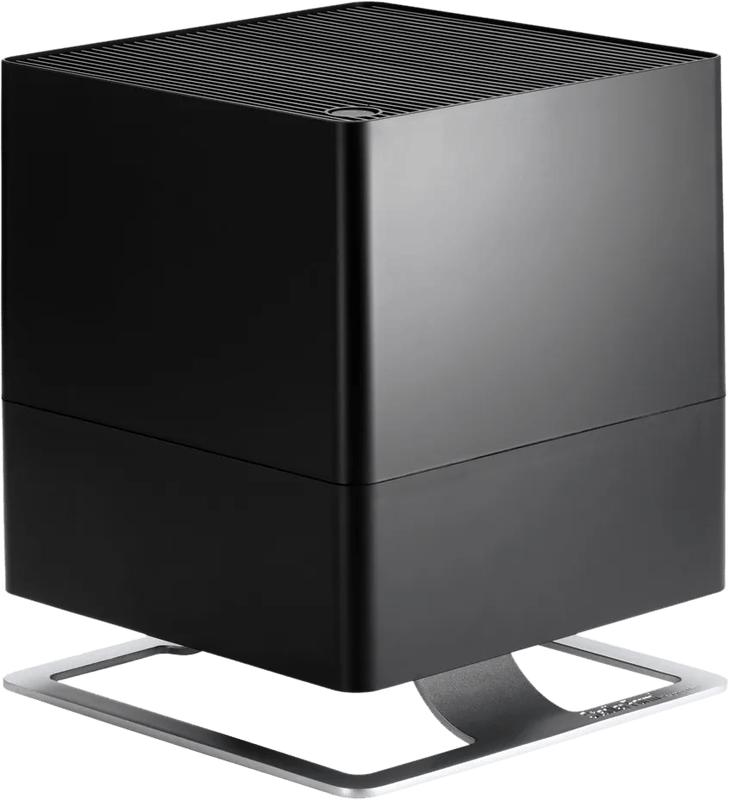
When you buy a humidifier, you’re mainly buying a cleaning job. It’s that simple. In most homes, an evaporative humidifier with a built-in humidistat is the most sensible choice, such as the Stadler Form Oskar for the living room. According to Philips, ultrasonic units are smaller and cheaper but require more discipline when it comes to changing the water.
Is my air actually too dry?
A humidifier only makes sense if the air really is too dry. The German Environment Agency (Umweltbundesamt, UBA) recommends relative humidity between 40 and 60 percent for living spaces; according to the UBA, a simple hygrometer is enough to keep an eye on the value (UBA page as of December 13, 2024). If your home is permanently below that in winter, a unit can help. If it’s above, you need the opposite: more ventilation or a dehumidifier (in German).
This is exactly where many purchases go wrong. A unit without control keeps running stubbornly until the window recesses fog up. Permanently damp corners are a mold risk that can be avoided with a humidistat.
Evaporative, steam or ultrasonic: what’s the difference?
- Evaporative humidifiers draw room air through a wet wick or a stack of discs. Only water vapor enters the room, no droplets. They work quietly and economically, but wicks or filters have to be changed regularly.
- Steam humidifiers heat the water. That takes considerably more electricity, but manufacturers describe the steam as low in germs. Limescale builds up in the unit and has to be removed.
- Ultrasonic humidifiers atomize water into a fine mist. Small, quiet, usually inexpensive. But everything that’s in the water travels into the air with the mist.
How big is the problem with germs and white dust?
In issue 10/2025 (published September 17, 2025), Stiftung Warentest, the German consumer testing organization, tested eight humidifiers with a humidistat: five evaporative units and three misting units. According to test.de, some models can release bacteria into the room air; with many others, this risk did not exist. In addition, minerals can enter the room with the mist and leave a film of limescale on furniture. Which units are affected is in the paywalled part; what is freely readable is that germ release and limescale were factored into the rating.
In a statement dated April 1, 2025, Philips describes the same pattern for its own units: with ultrasonic technology, germs from the water can get into the room air, and minerals in the mist leave white residue on nearby surfaces. Demineralization cartridges are said to reduce this. A manufacturer’s claim, not a free pass.
And the costs? According to Stiftung Warentest, electricity and water hardly matter. Filters, spare parts and hygiene products, however, can push running costs to a low three-figure euro amount per year. What the consumables cost therefore often says more than the purchase price.
How useful are room size figures and humidistats?
Manufacturers‘ room size figures refer to ideal conditions. Venta, for example, measures according to the American AHAM method at 21 degrees Celsius and 30 percent humidity, and assumes a ceiling height of 2.5 meters. In a poorly insulated older building with a lot of air exchange, the same unit covers noticeably less space. So plan for a reserve and compare the humidification output in grams or milliliters per hour instead.
A built-in humidistat measures right at the unit. There, the air is more humid than in the corner of the room. A separate hygrometer elsewhere shows whether the set value actually reaches the room.
Which units are worth considering?
| Model | Principle | Room / output (manufacturer) | Best for |
|---|---|---|---|
| Philips HU5710/03 (5000 Series) | Evaporative (NanoCloud) | up to 56 m², 400 ml/h, 4.5 l tank | Living rooms, app users |
| Stadler Form Oskar | Evaporative | up to 50 m², 370 g/h, 3.5 l tank | Those who like it simple |
| Venta LW25 Comfort Plus | Cold evaporation with disc stack | up to 49 m², 339 ml/h, 7 l tank | No filter wicks, quiet |
| Boneco S250 | Steam | up to 50 m², 300 g/h, 3 l tank | Those who put hygiene before power consumption |
| Boneco U250 | Ultrasonic | up to 50 m², 340 g/h, 3.5 l tank | Compact, with demineralization cartridge |
| Levoit Dual 200S Pro | Ultrasonic | 3 l tank, up to 25 h runtime | Small bedrooms |
Philips HU5710/03: lots of output, quiet
For this 5000 Series unit, Philips states 400 ml per hour and rooms up to 56 m², plus 12 dB(A) in its quietest mode and an app. According to the manufacturer, the NanoCloud technology works by evaporation, so without the mist of an ultrasonic unit. In return, you pay with regular filter changes and a higher purchase price than with small misting units. On Amazon, the HU5710/03 is currently unavailable (as of November 9, 2026).
Stadler Form Oskar: the classic without an app
The Oskar has been on sale for years and was also part of the Stiftung Warentest lineup. According to the data sheet, it humidifies rooms up to 50 m² with up to 370 g/h and draws 6 to 18 watts. It switches off when the tank is empty. Need more space? Then the larger Oskar Big is an option.
Venta LW25 Comfort Plus: discs instead of wicks
Venta works with a rotating stack of discs. According to the manufacturer, it needs no humidifier wicks or filters. The tank holds 7 liters, consumption is 2 to 6.5 watts according to Venta, and the automatic mode regulates to 40 to 60 percent. It’s expensive too: upper price range, plus a hygiene additive on an ongoing basis. If you don’t want to keep buying wicks, you still get a well-thought-out solution.
Boneco S250: heat against germs, electricity as the price
The S250 heats the water and, according to the manufacturer, releases lukewarm steam. Boneco states rooms up to 50 m², 300 g/h and a humidistat that can be set between 30 and 70 percent. The power consumption of 145 to 285 watts is far higher than that of an evaporative unit. In a child’s room, the unit should be placed so that nobody can reach the steam outlet.
Boneco U250: ultrasonic with a cartridge
For the U250, Boneco states 340 g/h, rooms up to 50 m² and an automatic mode via the built-in humidistat. A demineralization cartridge is said to keep limescale out of the mist, and a silver stick is included. The cartridge is a consumable. If your tap water is hard, factor in its cost beforehand.
Levoit Dual 200S Pro: small and connected
The Dual 200S Pro is a 3-liter misting unit with Wi-Fi and a demineralization cartridge. Runtime according to Levoit: up to 25 hours. Intended for small rooms. Not for an open-plan living room. The ultrasonic rule applies here in particular: change the water daily, clean the tank regularly.
What about combination units like Dyson?
In the Purifier Humidify+Cool, Dyson combines an air purifier, a fan and a humidifier. According to Dyson, UV light is said to kill bacteria in the water. Such a combination unit makes sense if you’re looking for an air purifier anyway, and it sits at the top end in terms of price. How air purifiers compare is explained in our article on buying an air purifier (in German).
So which unit suits me?
For a living room up to about 50 m², we’d take the Stadler Form Oskar, an evaporative unit with a humidistat. The Philips HU5710/03 with app would be the alternative, but it is currently unavailable on Amazon (as of November 9, 2026). Without filter wicks, the Venta LW25 Comfort Plus does the job, provided the budget stretches to the upper price range. If hygiene comes first and electricity doesn’t matter, the Boneco S250 remains.
Little space, small room: Levoit Dual 200S Pro or Boneco U250, but only with daily water changes and regular cleaning.
And if the air rarely drops below 40 percent in winter? Then no unit. A hygrometer is enough.
Frequently asked questions
What humidity level is right for living spaces?
The German Environment Agency (UBA) recommends relative humidity between 40 and 60 percent for living spaces. A simple hygrometer is enough to keep an eye on it. If your home is permanently below that in winter, a humidifier can help; if it rarely falls below 40 percent, you don't need one.
What is the difference between evaporative, steam and ultrasonic humidifiers?
Evaporative humidifiers draw room air through a wet wick or a stack of discs, so only water vapor enters the room. Steam humidifiers heat the water and need considerably more electricity. Ultrasonic humidifiers atomize water into a fine mist, which carries everything that's in the water into the air.
Do ultrasonic humidifiers release germs?
According to Stiftung Warentest, the German consumer testing organization, some models can release bacteria into the room air, while many others posed no such risk. Minerals can also enter the room with the mist and leave a film of limescale. Philips describes the same pattern; demineralization cartridges are said to reduce it. With ultrasonic units: change the water daily.
Why does a humidifier need a humidistat?
A unit without control keeps running stubbornly until the window recesses fog up, and permanently damp corners are a mold risk. A built-in humidistat, however, measures right at the unit, where the air is more humid. A separate hygrometer elsewhere shows whether the value actually reaches the room.
How reliable are the manufacturers' room size figures?
They apply under test conditions; Venta, for example, measures at 21 degrees Celsius, 30 percent humidity and a ceiling height of 2.5 meters. In a poorly insulated older building, the same unit covers noticeably less space. Plan for a reserve and compare the humidification output in grams or milliliters per hour instead.
What does it cost to run a humidifier?
According to Stiftung Warentest, electricity and water hardly matter, with the exception of steam units such as the Boneco S250. Filters, spare parts and hygiene products, however, can push running costs to a low three-figure euro amount per year. The cost of consumables therefore often says more than the purchase price.
Sources
- German Environment Agency (UBA): how to ventilate properly (as of Dec. 13, 2024, German)
- Stiftung Warentest: humidifiers tested, test 10/2025 (Sept. 17, 2025, German)
- Philips: humidifiers with or without ultrasound (April 1, 2025, German)
- Stadler Form Oskar: product data sheet
- Venta: LW25 Comfort Plus
- Boneco: S250
- Boneco: U250
- Levoit: Dual Series
- Dyson: air purifiers and humidifiers
Where to buy
- Stadler Form OskarCheck price at Amazon.deView at Coolblue
- Philips HU5710/03 5000 SeriesView at CoolblueCheck price at Amazon.de
- Venta LW25 Comfort PlusCheck price at Amazon.de
- Boneco S250Check price at Amazon.de
- Boneco U250Check price at Amazon.de
- Levoit Dual 200S ProCheck price at Amazon.de