Contents16 sections
This guide was first published in German on handgetestet.de.
Whether a wood-burning stove goes into your living room is not decided by the brochure but by your district chimney sweep. In Germany, this is the officially appointed sweep (Bezirksschornsteinfeger) responsible for your property. So call them before you order. For an average living room, our starting point after that is the Fireplace Santa Fe soapstone stove with 6 kW, because its declaration of performance shows by far the lowest carbon monoxide and dust values among the five stoves. How stoves differ in output, heat-storing stone and water heating is covered in our wood-burning stove guide (in German). Here, the focus is on the time before the first fire.
One preliminary remark belongs here. For health and climate reasons, the German Environment Agency (Umweltbundesamt) advises against heating a house with wood in a stove and names individual stoves as the heat generators with the highest particulate emissions. You will therefore not find any promise of savings here.
What approval does a new stove need?
Two questions, two answers. The first concerns the 1. BImSchV, Germany’s ordinance on small combustion installations: room heaters with a flat firebox installed after December 31, 2014 must meet Stage 2, i.e. at most 0.04 g/m³ of dust and 1.25 g/m³ of carbon monoxide at an efficiency of at least 73 percent. This is proven by the manufacturer’s type test (Section 4 (3)). The second question is: according to which standard? EN 16510-2-1 has replaced the old EN 13240; according to EU Implementing Decision 2023/2461, the transition period ended on November 9, 2025.
Many stoves on the market still carry the old standard, often with confirmed Stage 2. Whether a single stock unit may still lawfully be sold with it is something we cannot judge, so we did not include such models in our selection.
You can check this yourself. The stove database of the German industry association HKI lists the test standard, the test year and a check mark with the number 2 for each model. Read the line for each fuel: for the Prunus II and the Santa Fe, the confirmation only applies to split logs; lignite briquettes are not permitted there. If a stove is missing from the database, ask for the manufacturer’s certificate. The HKI advises getting compliance confirmed in writing when you buy anyway, and points out that the ordinance is due to be revised.
A check mark in the database is no substitute for looking at the numbers. Some declarations of performance under the new standard state more carbon monoxide than the ordinance’s 1.25 g/m³, even though the manufacturer and HKI confirm Stage 2. For the Kaya 7, it is 1,273 mg/m³ with split logs; for the Lara with lignite briquettes, 1,500 mg/m³. In its testing principles, the HKI lists the 1,250 mg/m³ only for room heaters under the old EN 13240; for EN 16510, it cites the 1,500 mg/m³ of the EU Ecodesign Regulation. We were unable to reliably clarify how your chimney sweep will assess this. Both figures refer to 13 percent oxygen in the flue gas (Section 4 (2)). So show them the declaration of performance before you order.
Who approves the stove?
The authorized district chimney sweep, and you do not get to choose them. According to the HKI, after connection they check the safe discharge of flue gases and the distances between the stove and connecting pipe and any combustible building components and furniture. In Bavaria, under Art. 78 (3) of the Bavarian Building Code (BayBO), fireplaces may only be put into operation once the sweep has certified that the flue system is suitable and safe to use. In North Rhine-Westphalia (NRW), Section 42 (7) of the state building code (BauO NRW) requires a certificate on the condition and suitability of the flue system upon connection. The other German states have their own regulations, so ask about the procedure in the same phone call.
It makes sense to have this conversation before buying. The sweep can tell you whether your chimney is suitable for the model you want or what a new one would need to look like. In addition, Section 4 (8) of the 1. BImSchV requires a consultation on operation and fuel within one year of installation.
How many kilowatts can the room handle?
More is not better here. The German Environment Agency requires the heat output to match the room it is installed in, because only then can a stove be operated with low emissions. Offers, on the other hand, advertise room heating capacity. For the Santa Fe, Fireplace states 6 kW for rooms up to 108 m³, which corresponds to around 43 m² with a 2.50 m ceiling. Such figures go back to the German standard DIN 18893, which has since been withdrawn, and they know nothing about your insulation. In a new, airtight house, the same stove can quickly be too big. So have your needs assessed on site.
There is also a lower limit. In Bavaria and NRW, the combustion air supply for room-air-dependent fireplaces up to 35 kW is considered proven, among other things, if the room has a door to the outside or a window that can be opened and measures at least 4 m³ per kW. For 6.5 kW, that is 26 m³. Other states may differ.
Does the chimney match the stove?
Haas+Sohn requires a chimney calculation according to the standard before installation. The input values are in the documentation: according to the manufacturer, the Treviso III has a flue gas mass flow of 5.8 g/s, 301 °C and a draft of 12 Pa. All five models in our selection state twelve pascals. Also check whether another fireplace is already connected to the chimney, because the data sheet must show suitability for multiple connections.
If a new chimney is built, Section 19 of the 1. BImSchV has applied since 2022: the outlet must be close to the ridge and extend at least 40 cm above it.
Then the installation spot. In Bavaria and NRW, combustible building components may not exceed 85 °C at nominal output. This is considered met if the manufacturer’s clearances are observed; without such information, the clearance is 40 cm. The values really do differ: the Lara and Kaya 7 each require 20 cm to the rear and side walls, but 30 and 40 cm in the radiation zone; at the front, the Kaya 7 requires 50 cm on the floor, the Lara nothing. In NRW, a combustible floor in front of the firebox opening must be covered 50 cm to the front and 30 cm to the side unless the manufacturer states otherwise. Also consider the weight: Haas+Sohn states 152 kg for the Treviso III and requires a load-bearing surface.
Is an outside air connection enough for „room-air-independent“?
No. Under the NRW combustion ordinance (Feuerungsverordnung), only a fireplace that draws its air through ducts directly from outside and from which no flue gas can escape into the room in dangerous quantities counts as room-air-independent. This requires a building authority approval; at the German Institute for Building Technology (DIBt), such approvals are filed under Z-43.12. The German Environment Agency considers a separate air supply absolutely essential in very well-insulated houses or with central ventilation.
We were unable to verify this approval for any of the five models below. The HKI database explicitly says „No“ for the Santa Fe, and there is no value for the other four. The Kaya 7 is offered with external combustion air, and the Treviso III device sheet describes an outside air connection. That is air routing, not proof. For operation using room air, Haas+Sohn even writes that the stove must not be run together with controlled mechanical ventilation. So if you have a ventilation system, only choose after talking to the chimney sweep and ask for the approval number. Your range hood (in German) counts here too.
Five stoves and their test values
| Model | Nominal output | CO and dust with split logs according to the manufacturer | Stage 2 according to HKI | Best for |
|---|---|---|---|---|
| Fireplace Santa Fe Speckstein 2025 | 6 kW, declaration of performance 6.5 kW | 340 and 18 mg/m³ | Split logs only | Stone cladding, medium-sized rooms |
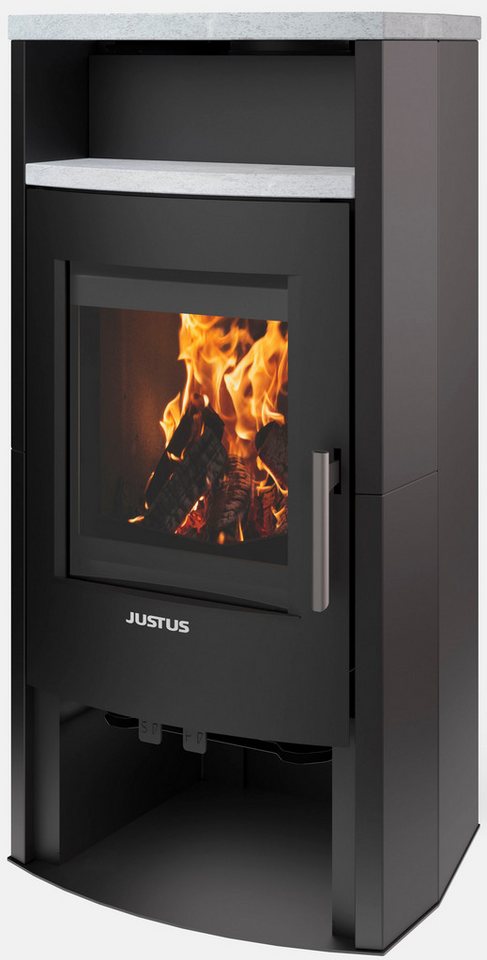
| Justus Lara | 6.5 kW | 1,127 and 40 mg/m³ | Split logs, lignite briquettes | Slim steel stove with stone top |
| Justus Kaya 7 | 7 kW | 1,273 and 40 mg/m³ | Split logs, lignite briquettes | Larger, older rooms |
| Haas+Sohn Prunus II | 6.4 kW | No declaration of performance published | Split logs only | Tight budget, wood only |
| Haas+Sohn Treviso III | 6.3 kW | At most 1,500 and 40 mg/m³ | Split logs only | Classic ceramic |
Fireplace Santa Fe Speckstein 2025
The declaration of performance for the soapstone model K7120 states 340 mg/m³ of carbon monoxide and 18 mg/m³ of dust with split logs, plus 82.9 percent efficiency and class A+. No other stove here comes close. On output, however, the documents contradict each other: the data sheet and product page state 6 kW for up to 108 m³, the declaration of performance 6.5 kW. The rating plate is what counts, so ask before buying. Fireplace requires 35 cm each to the rear and side walls, more than Justus. Lignite briquettes are not intended.
Justus Lara
The declaration of performance from September 2026 states 80.2 percent efficiency, class A and, with split logs, 1,127 mg/m³ of carbon monoxide and 40 mg/m³ of dust; the product data sheet says 38 mg/m³. With split logs, it therefore stays within the Stage 2 limits. For lignite briquettes, the same declaration shows 1,500 mg/m³. If you want to burn briquettes, clarify this beforehand. According to Justus, the floor in front of the stove needs no clearance. We were unable to verify a Blue Angel (Blauer Engel) eco-label for it.
Justus Kaya 7
The Kaya 7 has the same efficiency as the Lara, but 40 mg/m³ of dust, which is exactly the limit. For carbon monoxide, the declaration of performance shows 1,273 mg/m³ with split logs, i.e. more than the 1.25 g/m³ in the text of the ordinance, and 1,088 mg/m³ with lignite briquettes. Justus nevertheless ticks Stage 2 in the product data sheet, and the HKI database confirms it as well. Have the chimney sweep assess this for you before you order. The 7 kW only make sense anyway if the room needs them.
Haas+Sohn Prunus II
According to the manufacturer, the cheapest stove in this selection weighs 91 kg, has a log compartment and a 150 mm flue pipe. Haas+Sohn no longer carries it in its own range. In its place is the Primo, also with 6.4 kW and 91 kg, whose data sheet states 1,308 mg/m³ of carbon monoxide. The manufacturer no longer provides a declaration of performance for the Prunus II online. Only buy it if the retailer supplies one. Lignite briquettes are ruled out.
Haas+Sohn Treviso III
Ceramic cladding, 152 kg, 150 mm flue pipe, manufacturer’s efficiency figure above 75 percent. For carbon monoxide, the data sheet only states an upper limit of 1,500 mg/m³, not an exact value. The most expensive stove here is aimed at country-style interiors. At 1,100 mm high and 746 mm wide, it will not fit into a tight alcove.
Wood: drier than the law requires
Section 3 of the 1. BImSchV permits untreated firewood with less than 25 percent moisture, based on dry weight. The German Environment Agency recommends 15 to 20 percent after one to two years of storage; Haas+Sohn specifies at most 17 percent and two to three years. Stick to the strictest value in your manual and measure on a freshly split log with a moisture meter (in German). Stack the wood with good airflow, protected from rain and off the ground; our firewood rack guide (in German) can help.
Particleboard, paint residue and treated wood stay out. Open the door slowly when adding wood, first two centimeters, then further; the German Environment Agency recommends this to prevent smoke in the room. Once cooled, the ash goes in the general waste bin.
Premium class, mid-range, entry level
With these five stoves, the price depends on cladding and mass, not on the test values. Hence three classes, each with our pick.
- Premium class: Haas+Sohn Treviso III. Ceramic cladding, 152 kg and a 150 mm flue pipe. The extra cost buys cladding and mass; for carbon monoxide, the data sheet only states an upper limit. For rooms that suit a classic tiled stove look.
- Mid-range: Fireplace Santa Fe Speckstein 2025. Soapstone cladding and the lowest carbon monoxide and dust values among the five stoves. Suits most living rooms, provided your chimney sweep agrees.
- Entry level: Haas+Sohn Prunus II. Steel stove with log compartment, 91 kg, split logs only. Only buy it if the retailer supplies the declaration of performance, because the manufacturer no longer provides it online.
How we would decide
- Normal living room, suitable chimney: Fireplace Santa Fe Speckstein, provided your chimney sweep agrees.
- Slim steel stove, split logs only: Justus Lara.
- Small budget, split logs only: Haas+Sohn Prunus II, but only with a declaration of performance from the retailer.
- Ventilation system or very airtight house: none of these five without a documented approval.
- Stove as the main heating system: together with the German Environment Agency, we advise against it.
Black Friday: first the chimney sweep, then the deal
Wood-burning stoves are also on sale around Black Friday on November 27, and the temptation is great before winter. Even so, only order once the district chimney sweep knows your chimney and the model you want. A discounted stove that does not suit the chimney or lacks the required documentation stays cold. When comparing deals, check the full model name, because versions with heat-storing stone, different cladding or an outside air connection often have their own names and prices.
If you want to heat at Christmas, factor in the inspection. In Bavaria, for example, a new fireplace may only be put into operation after the chimney sweep’s certification. If a retailer advertises a price reduction, it must state the lowest price of the last 30 days (Section 11 of the German Price Indication Ordinance, PAngV). For our pick, the Fireplace Santa Fe Speckstein, you can set a price alert above. Deals from our partner retailers are collected on the Black Friday 2026 (in German) page.
If you want the new stove to hold its heat longer, our guide to the soapstone stove (in German) explains how much stone a model really contains.
Frequently asked questions
What approval does a new wood-burning stove need?
It must meet Stage 2 of Germany's 1. BImSchV, i.e. at most 0.04 g/m³ of dust and 1.25 g/m³ of carbon monoxide at an efficiency of at least 73 percent. The test standard EN 16510-2-1 has replaced the old EN 13240. The test standard and stage are listed for each model in the stove database of the German industry association HKI.
Who approves the wood-burning stove?
The authorized district chimney sweep (Bezirksschornsteinfeger), whom you do not get to choose. After connection, they check the safe discharge of flue gases and the distances to combustible building components. Talk to them before you buy; they can tell you whether your chimney is suitable for the model you want.
How many kW does my wood-burning stove need?
More is not better; the output must match the room, otherwise the stove will not burn with low emissions. Room heating capacity figures know nothing about your insulation, and in an airtight new build the same stove can quickly be too big. Have your needs assessed on site.
Can I run a wood-burning stove with a ventilation system?
Only with a stove that is approved as room-air-independent. An outside air connection alone is not enough. This approval is not documented for any of the five models presented. Ask for the approval number and clarify this with the chimney sweep beforehand; your range hood counts too.
How dry does firewood have to be?
Firewood with less than 25 percent moisture is permitted. The German Environment Agency recommends 15 to 20 percent after one to two years of storage, and Haas+Sohn specifies at most 17 percent. Measure on a freshly split log and stick to the strictest value in your manual.
What clearance does a wood-burning stove need from walls and furniture?
The manufacturer's clearances are what count; without such information, it is 40 cm. The Lara and Kaya 7 each require 20 cm to the rear and side walls, more in the radiation zone. In North Rhine-Westphalia, a combustible floor in front of the firebox opening must be covered 50 cm to the front unless stated otherwise.
When can I light a new wood-burning stove for the first time?
Only once the responsible district chimney sweep has inspected the connection and, where state law requires it, certified the flue system. In Bavaria, under Art. 78 (3) of the Bavarian Building Code (BayBO), fireplaces may only be put into operation afterwards; in North Rhine-Westphalia, Section 42 (7) of BauO NRW requires a certificate upon connection. It is best to clarify the procedure before you buy.
Sources
- 1. BImSchV (German ordinance on small combustion installations)
- EU Implementing Decision 2023/2461
- HKI stove database
- HKI: installation
- German Environment Agency: wood-burning stoves
- German Environment Agency: wood heating
- NRW combustion ordinance (Feuerungsverordnung NRW)
- Bavarian combustion ordinance (Feuerungsverordnung Bayern)
- Art. 78 BayBO (Bavarian Building Code)
- BauO NRW (NRW state building code)
- Haas+Sohn: product data, device sheet, manual
- Fireplace: Santa Fe Speckstein, declaration of performance and data sheet
- Justus: Lara, declaration of performance and product data sheet
- Justus: Kaya, declaration of performance and product data sheet
- Haas+Sohn: Primo
- HKI: principles of the stove database
- German Price Indication Ordinance, Section 11: price reductions
Where to buy
- Haas+Sohn Treviso IIIView at OTTO
- Fireplace Santa Fe Speckstein 2025View at OTTO
- Haas+Sohn Prunus IIView at OTTO
- Justus LaraView at OTTO
- Justus Kaya 7View at OTTO