Contents11 sections
This guide was first published in German on handgetestet.de.
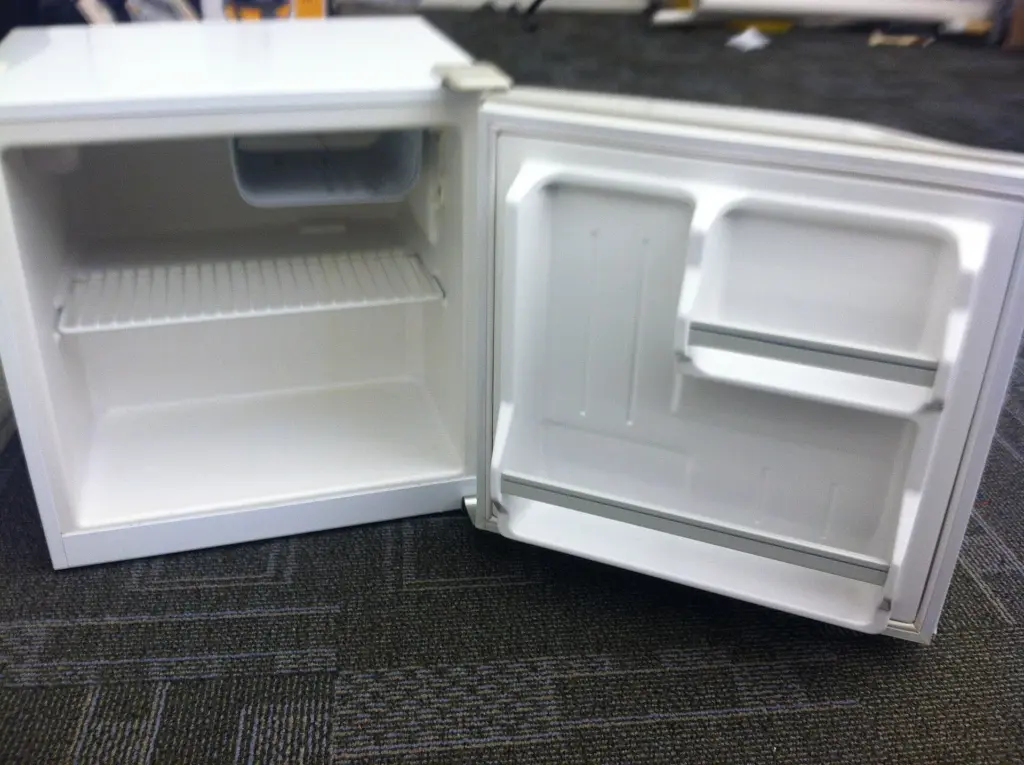
A mini fridge is rarely bought for what goes in it, but for where it goes. In an office, different things matter than next to the bed, and in a hobby room, other rules apply again. Our clear line: for the office, drinks and a hobby room, get a 45-liter compressor unit like the Severin KB 8877. If you sleep right next to it, you need a much quieter unit and pay for it in electricity.
All values in this article come from the manufacturers‘ product data sheets and from the European product database EPREL. That’s also where the QR code on every new energy label leads.
Compressor or Peltier: the fundamental question first
Almost all mini fridges of around 40 liters work with a compressor, like a full-size fridge. It runs in cycles, is audible while running and silent in between. Thermoelectric units, on the other hand, use a Peltier element: current flows through a semiconductor junction, one side gets cold, the other warm. Fans and heat exchangers amplify the effect, as Dometic describes it in its cooler guide.
One limitation is decisive. The cooling capacity of a Peltier unit depends on the room temperature, while a compressor works largely independently of it. For one of its own thermoelectric units, Dometic states up to 27 degrees Celsius below ambient temperature. At 32 degrees in an attic room, that leaves at best 5 degrees inside.
And then there’s the electricity. The thermoelectric Klarstein Secret Cool with 13 liters is listed in EPREL at 120 kWh a year, class G. The same manufacturer’s Snoopy Eco with compressor and 41 liters needs 79 kWh according to the data sheet. Three times the space for two-thirds of the consumption. More on the technology of portable units is in our guide to compressor coolers (in German).
What the decibels on the energy label mean
Since March 1, 2021, refrigeration appliances have carried the new EU label with the A to G scale. It shows annual consumption in kWh, the volumes and the airborne noise emission with a class. The figure is given in dB(A) re 1 pW, that is, as the unit’s sound power. What reaches your pillow also depends on distance, room and surface.
The scale is logarithmic, so a few decibels of difference weigh more than the number suggests. In EPREL, the usual 39 to 41 dB of the small units land in class C, 22 dB in class A. For the bedroom, this value is more important than the energy class.
The freezer compartment missing from the data sheet
Many listings advertise a freezer compartment, ice compartment or frost compartment. A look at EPREL is sobering. For the Snoopy Eco, Klarstein describes a 4-liter freezer compartment, but the data sheet only lists a 41-liter fridge compartment at 4 degrees Celsius. It’s the same with the Bomann KS 7349 and its 8-liter frost compartment. A compartment with stars is missing.
For ice cubes, such a cold zone can be enough in everyday life. If you want to store frozen pizza or supplies for weeks, you need a four-star compartment at minus 18 degrees Celsius. You only get that with tabletop fridges around 85 cm tall, such as the Liebherr Rc 1401 with 15 liters at four stars according to the data sheet. Before buying, the QR code on the label therefore says more than any product headline.
Five mini fridges by label values
| Model | Technology and capacity | Noise, class, consumption | Best for |
|---|---|---|---|
| Severin KB 8877 | Compressor, 45 l, 50 cm tall | 39 dB, class E, 80 kWh/year | Hobby room, drinks, office |
| Bomann KB 7346 | Compressor, 42 l, automatic defrost, 51 cm tall | 39 dB, class E, 80 kWh/year | Office, those who don’t want to defrost |
| Exquisit KB05-V-040E | Compressor, 40 l, no freezer compartment, 51 cm tall | 39 dB, class E, 79 kWh/year | Office |
| Klarstein Snoopy Eco | Compressor, 41 l, 52 cm tall | 39 dB, class E, 79 kWh/year | Office, dorm |
| Klarstein Secret Cool | Thermoelectric, 13 l, 45 cm tall | 22 dB, class G, 120 kWh/year | Nightstand for drinks |
Bedroom: Klarstein Secret Cool
22 dB and listed in EPREL as a low-noise appliance. The compressor units on this list are all at 39 dB. The price is a consumption of 120 kWh for 13 liters, class G, and an interior that the data sheet lists as a cellar compartment with a recommended 8 degrees Celsius. Klarstein itself states 5 to 8 degrees. That’s enough for water, juice and cosmetics, but we wouldn’t use it for milk and cold cuts. According to the data sheet, the unit isn’t designed for room temperatures above 32 degrees.
Hobby room, drinks and office: Severin KB 8877
In a cool basement or workshop, many small appliances fail because of their climate class. According to EPREL, the Severin is designed for ambient temperatures of 10 to 43 degrees Celsius, the Klarstein and Exquisit units only from 16 degrees. It holds 45 liters at 39 dB, class E and 80 kWh a year. Severin honestly calls the unit a cool box with a chiller compartment, and EPREL also lists only a fridge compartment at 4 degrees. Defrosting is done by hand. At 50 cm tall, it fits under a desk just as well, which is why we recommend it for most locations. On Amazon, the white KB 8877 is currently unavailable (as of November 9, 2026); the black KB 8879 from the same series is offered instead, also with 45 liters and a chiller compartment according to the listing.
Office: Exquisit KB05-V-040E
Nobody needs a freezer compartment under the desk. The Exquisit does without one and offers 40 liters at 39 dB, class E and 79 kWh, all according to EPREL. At 51 cm tall, it fits under most desks. That’s enough for lunch and water bottles for two colleagues, but not for the drinks supply of the whole floor.
Office without defrosting: Bomann KB 7346
Ice layer on the back wall? With most small units, you have to remove it by hand. According to the manufacturer, the Bomann KB 7346 defrosts automatically, and its fridge compartment is listed that way in EPREL too. That makes it the only one of the five units here. Otherwise, everything stays within the usual range: 42 liters, 39 dB, class E, 80 kWh, climate class N/ST from 16 degrees Celsius. There’s no freezer compartment.
Office or dorm: Klarstein Snoopy Eco
Same size range, same label values as the Exquisit: 41 liters, 39 dB, 79 kWh. Klarstein advertises a 4-liter freezer compartment, which the data sheet doesn’t recognize as a freezer compartment. Impractical for some spots is the thermostat on the back, which Klarstein itself describes. If the unit stands in a niche, you have to pull it out to adjust it.
How we would decide
- Only drinks by the bed, noise matters more than power consumption: Klarstein Secret Cool, knowing it’s class G.
- Basement, garage or workshop below 16 degrees Celsius: Severin KB 8877, designed for ambient temperatures from 10 degrees according to EPREL.
- Office without defrosting: Bomann KB 7346.
- Office and dorm otherwise: Exquisit KB05-V-040E or Klarstein Snoopy Eco; the values are almost identical, so decide by height and controls.
- Real frozen supplies over weeks: not a 50 cm cube, but a tabletop unit with a four-star compartment like the Liebherr Rc 1401.
If the unit is meant to replace your main fridge, you’re better off with a freestanding model. What matters there is covered in our refrigerator guide (in German).
Frequently asked questions
What is the difference between compressor and Peltier cooling?
A compressor works in cycles like in a full-size fridge and largely independently of room temperature. According to Dometic, a thermoelectric Peltier unit only cools up to 27 degrees Celsius below ambient temperature. In addition, the 13-liter Klarstein Secret Cool needs 120 kWh, while the 41-liter Snoopy Eco with compressor needs 79 kWh.
How quiet is a mini fridge?
The compressor units in the comparison are all at 39 dB, class C in EPREL. The thermoelectric Klarstein Secret Cool comes in at 22 dB, class A. The figure on the label is the unit's sound power; what reaches your pillow depends on distance, room and surface.
Does a mini fridge have a real freezer compartment?
Usually not. Klarstein advertises a 4-liter freezer compartment for the Snoopy Eco, but the data sheet only lists a fridge compartment at 4 degrees Celsius. For frozen supplies over weeks, you need a four-star compartment at minus 18 degrees Celsius, as in the Liebherr Rc 1401 tabletop fridge. The QR code on the label shows the real figures.
Which mini fridge is suitable for a basement or garage?
The climate class is what matters. According to EPREL, the Severin KB 8877 is designed for ambient temperatures of 10 to 43 degrees Celsius, the Klarstein and Exquisit units only from 16 degrees. So in a workshop or garage below 16 degrees, the Severin is the right fit.
Are there mini fridges that don't need defrosting?
Among the five units in the comparison, only the Bomann KB 7346 defrosts automatically, according to the manufacturer. It holds 42 liters and comes in at 39 dB, class E and 80 kWh a year. With the other units, the ice layer on the back wall has to be removed by hand.
Is a thermoelectric fridge enough for food?
For water, juice and cosmetics, the Klarstein Secret Cool is sufficient; Klarstein states 5 to 8 degrees Celsius. We don't consider it suitable for milk and cold cuts. According to the data sheet, the unit isn't designed for room temperatures above 32 degrees.
Sources
- Liebherr: Rc 1401 data sheet (PDF, via retailer)
- EPREL: Severin KB 8877
- Bomann: KS 7349 refrigerator and EPREL entry
- Bomann: KB 7346 cool box and EPREL entry
- EPREL: Exquisit KB05-V-040E
- Klarstein: Snoopy Eco and EPREL entry
- Klarstein: Secret Cool and EPREL entry
- European Commission: energy label for refrigerators and freezers
- Dometic: cooler guide, cooling systems compared (PDF, German)
Where to buy
- Severin KB 8879 (schwarz)Check price at Amazon.de
- Severin KB 8877Check price at Amazon.de
- Bomann KB 7346 (weiß)Check price at Amazon.de
- Exquisit KB05-V-040ECheck price at Amazon.de
- Klarstein Snoopy EcoCheck price at Amazon.de
- Klarstein Secret CoolCheck price at Amazon.de