Contents14 sections
This guide was first published in German on handgetestet.de.
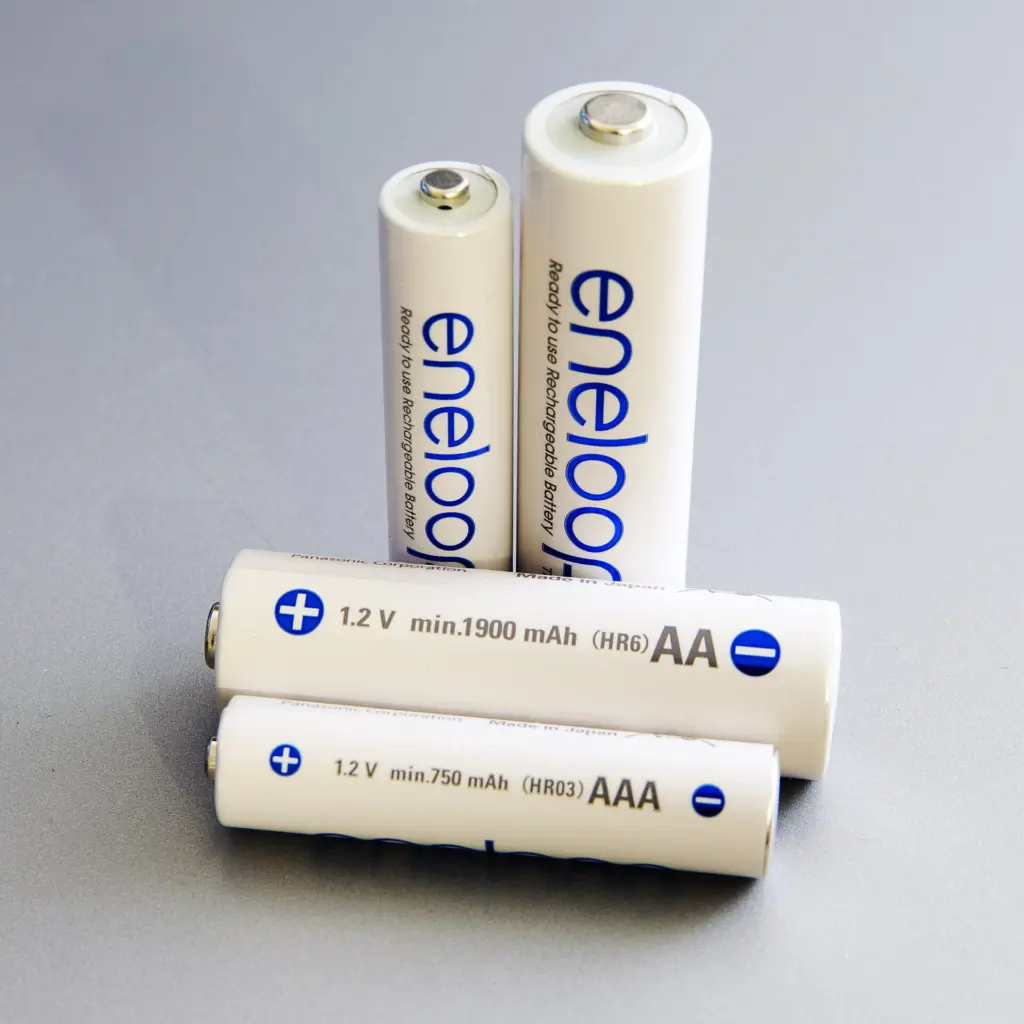
People who want to replace disposable batteries with rechargeables usually buy the wrong thing first: lots of capacity, a cheap plug-in charger. It is smarter the other way around. For remote controls, wireless mice and wall clocks, low self-discharge NiMH batteries such as Panasonic eneloop are all you need, together with a charger that monitors each slot individually. 1.5-volt lithium rechargeables are the exception for devices that can’t cope with 1.2 volts.
1.2 or 1.5 volts: what is behind the difference?
A fresh alkaline battery starts at 1.5 volts and then loses voltage steadily. A NiMH battery has a nominal voltage of only 1.2 volts, but holds that voltage for a long time and only drops shortly before it is empty. In a statement on the eneloop, Panasonic points out that many devices shut off or report an empty battery below about 1.1 volts, and that the eneloop stays above that for most of its discharge. In practice, most everyday devices therefore run on NiMH without any problems.
Lithium rechargeables in AA or AAA format work differently. Inside sits a lithium-ion cell, and a small circuit steps the output voltage down to 1.5 volts. XTAR is open about the consequence in its answers to customer questions: with cells that have no warning stage, a device can suddenly switch off without notice, because the voltage stays the same until the very end. With its cells that have a voltage warning, the voltage drops to about 1.1 volts before the end so the device warns you in time.
Which devices have trouble with 1.2 volts?
Trouble mainly occurs where the device estimates the charge level from the voltage. A battery gauge calibrated for alkaline cells quickly takes a full NiMH battery for half empty. If a device with freshly charged NiMH cells reports „battery low“ after just a few days, that estimate is usually the reason. Some devices let you switch the battery type in the menu; it’s worth checking the manual. If that doesn’t help, 1.5-volt lithium rechargeables are the way out.
Conversely, be careful with very high current draw. XTAR specifies a limit of 2.5 amps peak current for its cells with a voltage warning, and the manufacturer cites headlamps and flashlights without regulated drivers as examples of excessive draw. Which flashlight takes which cells is covered in our flashlight guide (in German).
High capacity or low self-discharge?
You can’t have both at once. Panasonic offers three tiers: according to its product overview, the eneloop pro offers at least 2500 mAh but only handles up to 500 charges, and holds 85 percent after one year in storage. The standard eneloop comes in at around 2000 mAh, manages up to 2100 charges and still retains 70 percent after ten years in storage. That is the figure that counts in everyday use.
Why? A remote control draws on the same two cells for a whole year. According to the German Environment Agency (Umweltbundesamt), conventional NiMH batteries lose around 25 percent of their charge per month, while low self-discharge (LSD) batteries lose about 4 percent. The pro cell only pays off in a camera flash, a remote-control toy or a game controller, where the battery is charged often and has to deliver a lot of current.
What does a good charger need to do?
Individual slot monitoring comes first. Cheap chargers charge cells in pairs and switch off when the pair seems full. If one cell is weaker, the other gets overcharged and ages faster. A charger with individual slots measures each cell on its own, detects defective batteries and rejects alkaline batteries. Add to that cutoff via minus delta V or a timer, reverse polarity protection and an indicator for each slot.
A second point is often overlooked. 1.5-volt lithium rechargeables need a charger built specifically for them. XTAR advises against regular NiMH or lithium chargers. So if you use both types, you need a mixed charger or cells with their own USB-C port. For USB chargers, the power adapter has to supply enough current. Ansmann specifies at least 2.1 amps for the Comfort Smart; otherwise individual slots pause. Which power adapter fits is explained in our USB-C charger guide (in German).
Six batteries and chargers compared
| Model | Type | Key specs according to the manufacturer | Best for |
|---|---|---|---|
| Panasonic eneloop AA (BK-3MCDE) | NiMH, 1.2 V | around 2000 mAh, up to 2100 charges, 70% after 10 years | Remote control, mouse, clock, toys |
| Panasonic eneloop pro AA (BK-3HCDE) | NiMH, 1.2 V | at least 2500 mAh, up to 500 charges, 85% after 1 year | Flash, controller, remote-control toys |
| Varta Eco Charger Pro Recycled with 4 × AA 2100 mAh | NiMH charger with batteries | 4 individual slots, USB-C, up to 2000 mA, batteries with 25% recycled content | Beginners who want everything in one box |
| Ansmann Comfort Smart | NiMH charger | 4 individual slots, USB, 800 mA (AA), defect detection | Gentle charging at home |
| XTAR L4 Pro | Mixed charger, NiMH and 1.5 V lithium | 4 individual slots, USB-C, 0.5 A per cell, refresh function | Households with both battery types |
| XTAR AA 1.5 V 4150 mWh | Lithium-ion, 1.5 V | 2500 mAh, more than 1200 charges, low-voltage detection | Devices that don’t like 1.2 V |
Panasonic eneloop AA
The benchmark for everyday rechargeables. The data sheet for the current version, BK-3MCDE, lists 1.2 volts, 28 grams and manufacturing in Japan, and the cells come precharged out of the package. For devices that sit unused for months, low self-discharge matters more than any capacity figure. According to its data sheet, the AAA sibling BK-4MCDE delivers at least 800 mAh.
Panasonic eneloop pro AA
More runtime per charge, but significantly fewer charge cycles. Panasonic itself recommends the pro for power-hungry devices such as flashes, remote-control toys and wireless keyboards. In a wall clock it would be wasted.
Varta Eco Charger Pro Recycled
A complete package of charger and four AA batteries with 2100 mAh. The charger charges each slot individually, detects alkaline batteries and damaged cells, and runs on USB-C. Varta quotes around one hour for two 1600 mAh cells. On self-discharge, Varta is more cautious than Panasonic and states about 70 percent remaining charge after twelve months for the Recycled batteries.
Ansmann Comfort Smart
An unfussy charger for one to four NiMH cells. According to the manual, it checks the remaining charge before charging, pre-charges deeply discharged batteries with low current first and reports defective cells via an indicator light for each slot. At 800 mA, a 2100 mAh cell takes about three hours. Slow, but gentle.
XTAR L4 Pro
The solution for mixed drawers. The L4 Pro charges AA and AAA, NiMH and 1.5-volt lithium in any combination and detects the type itself. For older NiMH cells, there is a discharge-then-charge mode and a multi-stage refresh. Non-rechargeable batteries are met with an error message.
XTAR AA 1.5 V 4150 mWh
The choice for devices that refuse to work on 1.2 volts. XTAR states 2500 mAh, a charging time of just under three hours and more than 1200 charge cycles, plus built-in protection circuitry with low-voltage detection. They may only be charged in a suitable lithium charger, such as the L4 Pro. If you would rather charge directly via cable, XTAR, Paleblue and EBL also offer cells with their own USB-C port.
Which battery for which device?
- Remote control, clock, wireless mouse: eneloop AA or AAA, with the Ansmann Comfort Smart. Suitable devices are in our universal remote guide (in German).
- Flash, controller, remote-control car: eneloop pro.
- A first start without overthinking it: the Varta bundle with charger and four cells.
- Thermostat or lock that warns too early on NiMH: XTAR 1.5 V with the L4 Pro.
Where do old rechargeable batteries go?
Not in household trash; in Germany that is prohibited. According to the German Environment Agency, retailers that sell batteries must take back old batteries of this type free of charge, including leaking or swollen ones. There are also other collection points. The rules are set out in Germany’s Battery Act (Batteriegesetz) and in the EU Batteries Regulation (EU) 2023/1542, large parts of which have applied since February 2024. For lithium batteries, the agency advises taping over the terminals first to prevent a short circuit. The agency also recommends unplugging the charger after charging.
Watches, key fobs and scales use button cells, which must not be recharged; our guide to button cells (in German) sorts out the types.
Cordless phones have their own rules on form factor and capacity. More on that in our guide Replacing the battery in a cordless phone (in German).
Frequently asked questions
Do 1.2-volt rechargeables work in place of 1.5-volt batteries?
In most everyday devices, yes. An alkaline battery starts at 1.5 volts and loses voltage steadily, while a NiMH battery holds its 1.2 volts for a long time and only drops shortly before it is empty. According to Panasonic, many devices only shut off below about 1.1 volts, and the eneloop stays above that for most of its discharge.
Why does a device with fully charged batteries show "battery low"?
Usually the device estimates the charge level from the voltage and is calibrated for alkaline cells. It then quickly takes a full NiMH battery for half empty. Some devices let you switch the battery type in the menu, so check the manual. Otherwise, 1.5-volt lithium rechargeables are the way out.
What matters more in rechargeable batteries, capacity or low self-discharge?
For devices that draw on the same cells for a long time, low self-discharge. According to the German Environment Agency (Umweltbundesamt), conventional NiMH batteries lose around 25 percent of their charge per month, low self-discharge (LSD) batteries about 4 percent. The eneloop pro offers more capacity but only handles up to 500 charges and is better suited to flashes, controllers or remote-control toys.
What should you look for in a battery charger?
Individual slot monitoring comes first. Cheap chargers charge in pairs; if one cell is weaker, the other gets overcharged. A charger with individual slots measures each cell on its own, detects defective batteries and rejects alkaline batteries. With USB chargers, the power adapter has to supply enough current; Ansmann specifies at least 2.1 amps for the Comfort Smart.
Can I charge 1.5-volt lithium rechargeables in a regular charger?
No, they need a charger built specifically for them. XTAR advises against regular NiMH or lithium chargers. If you use both types, you need a mixed charger such as the XTAR L4 Pro, which detects the type itself, or cells with their own USB-C port.
Where do old rechargeable batteries go?
Not in household trash; in Germany that is prohibited. According to the German Environment Agency, retailers that sell batteries must take back old batteries of this type free of charge, including leaking or swollen ones. For lithium batteries, the agency advises taping over the terminals first to prevent a short circuit.
Sources
- Panasonic: eneloop product overview (PDF)
- Panasonic Energy Europe: press release „10 years of eneloop“ (PDF)
- Panasonic: eneloop BK-3MCDE data sheet (PDF)
- eneloop AAA BK-4MCDE data sheet (PDF)
- Varta: Eco Charger Pro Recycled
- Varta: Recharge Accu Recycled AA 2100 mAh
- Ansmann: Comfort Smart user manual (PDF)
- XTAR: L4 Pro
- XTAR: AA 1.5 V 4150 mWh
- XTAR: questions and answers on 1.5 V lithium rechargeables
- German Environment Agency: using and disposing of batteries correctly (in German)
- German Environment Agency: proper handling of lithium batteries (in German)
Where to buy
- Panasonic eneloop AA BK-3MCDECheck price at Amazon.deAvailable in Germany: Amazon.de
- Panasonic eneloop pro AA BK-3HCDECheck price at Amazon.deAvailable in Germany: Amazon.de
- Varta Eco Charger Pro Recycled mit 4 × AA 2100 mAhCheck price at Amazon.deAvailable in Germany: Amazon.de
- Ansmann Comfort SmartCheck price at Amazon.deAvailable in Germany: Amazon.de
- XTAR L4 ProCheck price at Amazon.deAvailable in Germany: Amazon.de
- XTAR AA 1,5 V 4150 mWhCheck price at Amazon.deAvailable in Germany: Amazon.de
- Panasonic eneloop AA (BK-3MCDE) (2er-Pack)View at AkkuweltAvailable in Germany: Akkuwelt