Contents13 sections
This guide was first published in German on handgetestet.de.
Hundreds of decorative stitches, of which three end up being used. That’s how buying a sewing machine most often goes wrong, more often in any case than with a machine that’s too cheap. To start out, a clean straight stitch, a zigzag, a stretch stitch and a buttonhole sewn in one step are enough. For beginners, we consider the Brother FS40s the most sensible machine: speed limiter, needle threader and five one-step buttonholes are included. Prefer dials to buttons? Then the mechanical W6 N 1235/61 is a better fit. A serger only comes in once you regularly sew jersey.
Mechanical or with a display, which is better?
Less of a matter of faith than it seems. A mechanical machine sets stitch, length and width via dials. That’s robust and quick to grasp. A computerized machine selects stitches by button, shows them on the display and can limit the speed electronically. That limiter in particular helps more at the start than any extra stitch, because puckered seams usually come from pressing the foot pedal too hard.
Which features really make a difference in everyday use?
First, the buttonhole. With a one-step buttonhole, you put the button in the foot and the machine measures the length itself. With a four-step buttonhole, you turn the selector dial in between. That works, but takes practice.
A needle threader sounds like a convenience. But it often decides whether the machine still comes out of the cupboard after work. Without a free arm, meaning without a removable extension table, pant legs and sleeves can hardly be shortened; all the models below have one. For stitch width, 5 mm is enough for everyday seams; with 6 to 7 mm, zigzag and decorative stitches stand out more. That leaves warranty and spare parts. The range here is wide: Brother states a three-year manufacturer’s warranty, Janome five years for the M30A, W6 ten years for its serger after registration.
Can a household machine handle jeans and canvas?
A jeans hem is the acid test. At the side seam, several layers of denim lie on top of each other, and that’s exactly where the needle breaks or the machine stalls. Three things help. A denim needle instead of a universal needle. A presser foot that lifts high enough. And slow speed over the thickest spot, using the handwheel if necessary.
With its Heavy Duty line, Singer builds machines specifically for heavy fabrics, with a metal frame and an extra-high presser foot lifter. However, Singer currently lists the 4423 and 4432 models as sold out in its German shop, which is why they’re missing below. For the occasional jeans hem, a normal household machine with the right needle is enough. If, on the other hand, you sew canvas bags every week, look specifically for a heavy-duty model.
Six models from entry level to serger
| Model | Type | Key specs according to the manufacturer | Best for |
|---|---|---|---|
| Brother FS40s | Computerized | 40 stitches, five one-step buttonholes, needle threader, speed control, start/stop button | Beginners who want some room to grow right away |
| W6 N 1235/61 | Mechanical | Needle threader, free arm, up to 860 stitches per minute | Beginners who like dials |
| Pfaff Smarter 160s | Entry-level machine | 23 stitches, one-step buttonhole, 6 mm stitch width, threader, hard cover | Anyone who values a sturdy cover and brand-name service |
| Janome M30A | Computerized | 30 programs, memorized buttonhole, start/stop, 5-year warranty | Occasional sewers with little space |
| Brother M343D | Serger (overlock) | 3 or 4 threads, differential feed, free arm, rolled hem without changing the foot | Anyone who sews a lot of jersey and sweatshirt fabric |
| W6 N 454D Pro | Serger (overlock) | Differential feed, cutting width 3 to 9 mm, knife can be disengaged | Getting started with a serger, long warranty |
Brother FS40s
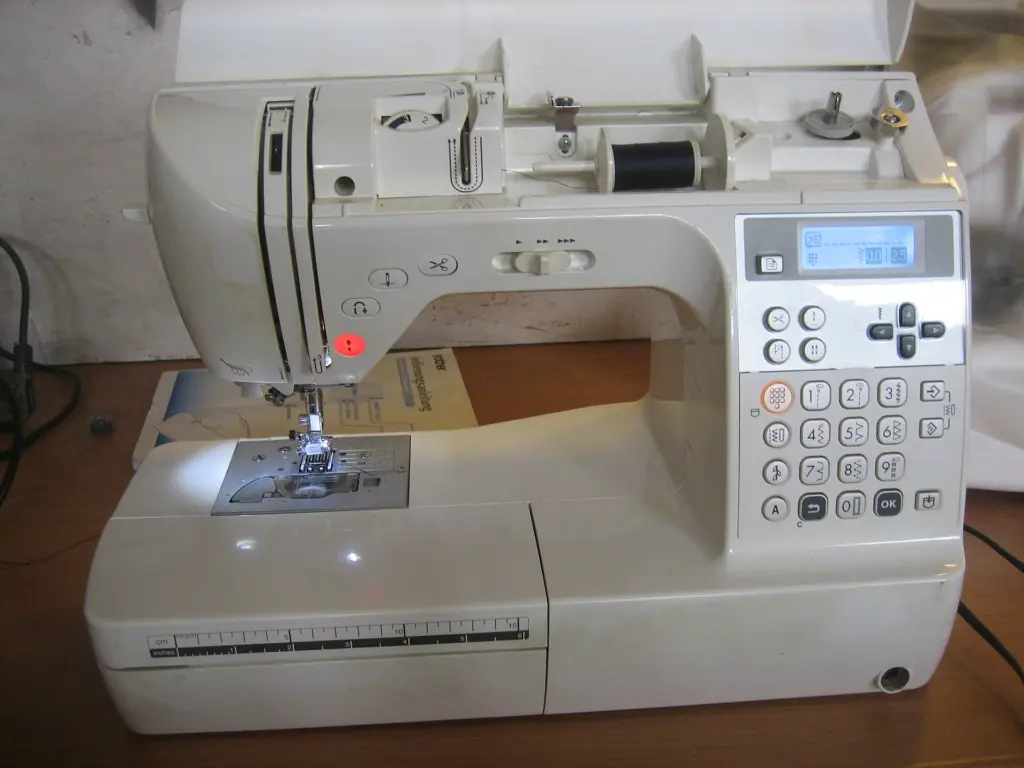
A computerized machine with 40 utility and decorative stitches, an LC display and five buttonholes, all of which, according to Brother, are sewn in one step. What helps beginners most is the speed control. It limits the top speed even if your foot presses the pedal too hard. With the start/stop button, you can even sew without the foot pedal entirely. According to Brother, the housing is made of aluminum, and the feed dogs can be lowered for free-motion sewing.
W6 N 1235/61
Purely mechanical, with a needle threader and free arm: this is W6’s classic entry-level machine. W6 states a maximum speed of 860 stitches per minute. The manufacturer’s pages contradict each other on the number of programs, citing anywhere from 23 to 29. According to W6, Stiftung Warentest, Germany’s leading consumer testing organization, rated it „good“ (2.5) in its 11/2019 issue. An older verdict. But nothing fundamental about its design has changed since then.
Pfaff Smarter 160s
For the 160s, Pfaff lists 23 stitches, a 6 mm stitch width, a built-in threader and a one-step buttonhole. The hard protective cover is practical if the machine sits on a shelf or travels often. At no more than 750 stitches per minute, it’s not the fastest according to the manufacturer. For beginners, that’s no drawback.
Janome M30A
Janome’s compact computerized machine has 30 programs, a memorized buttonhole and a start/stop button. At around 5 kg, it goes into the cupboard and back out again easily. The stitch width tops out at 5 mm, which is tight for decorative stitches. Janome gives a five-year warranty. For mending, shortening and the occasional cushion, it serves you well.
Brother M343D
A serger doesn’t replace a sewing machine. It trims the edge, sews and finishes it in one pass, but it can’t do zippers or buttonholes. The M343D works with three or four threads. Against wavy jersey seams, it has a continuously adjustable differential feed, plus a threading aid for the lower looper. According to Brother, it sews a rolled hem without changing the foot or needle plate, and the upper knife can be disengaged.
W6 N 454D Pro
W6’s serger also has a continuously adjustable differential feed. According to the manufacturer, the cutting width ranges from 3 to 9 mm. The ten-year warranty stands out; W6 ties it to registration on its own website. Replacement knives are standard. According to buyer reports, the original knives last between one and two years, depending on use.
What helps more at the start than a more expensive model?
Accessories. A needle assortment with universal, jersey and denim needles costs little and prevents most skipped stitches. Only buy bobbins that match your machine; Singer, for example, specifies class 15 bobbins for its Heavy Duty models. Presser feet with a snap-on holder often fit several brands, but you should still check them against your own machine’s specifications before ordering. Add good fabric scissors, pins and a seam ripper.
And an iron. If you press seam allowances flat after every step, you’ll sew more neatly than with any extra feature. We present suitable models in our steam iron guide (in German).
Which machine suits me?
For a first machine for making clothes and home decor, we’d take the Brother FS40s. The speed limiter and one-step buttonholes clear the typical beginner hurdles out of the way. If you’d rather turn a dial than look at a display, the W6 N 1235/61 gives you fewer stitches but a clear, simple machine. If the machine is often stored away or carried around, the hard cover speaks for the Pfaff Smarter 160s, and the low weight for the Janome M30A. Lots of jersey, T-shirts, leggings? Then add a serger, the Brother M343D or the W6 N 454D Pro. We advise against one as your only machine. And if you regularly sew canvas and leather, look specifically for a heavy-duty model that is currently available.
Frequently asked questions
Mechanical or computerized sewing machine?
A mechanical machine sets stitch, length and width via dials, which is robust and quick to grasp. A computerized machine selects stitches by button and can limit the speed electronically. That limiter in particular helps more at the start than any extra stitch, because puckered seams usually come from too much speed.
What is the difference between a one-step and a four-step buttonhole?
With a one-step buttonhole, you put the button in the foot and the machine measures the length itself. With a four-step buttonhole, you turn the selector dial in between. That works too, but takes practice. The Brother FS40s offers five buttonholes, all sewn in one step.
Can a regular sewing machine handle jeans?
For the occasional jeans hem, a household machine with the right needle is enough. Three things help: a denim needle instead of a universal needle, a presser foot that lifts high enough, and slow speed over the thickest spot, using the handwheel if necessary. For weekly canvas bags, a heavy-duty model is better suited.
Do I need a serger in addition to a sewing machine?
Only if you sew a lot of jersey and sweatshirt fabric. A serger trims the edge, sews and finishes it in one pass, but it can't do zippers or buttonholes. It doesn't replace a sewing machine, and we advise against it as your only machine. Options include the Brother M343D or the W6 N 454D Pro.
Which features make a difference in everyday use?
Besides the buttonhole, the needle threader, which often decides whether the machine still comes out of the cupboard after work. A free arm is necessary for shortening pant legs and sleeves. For stitch width, 5 mm is enough for everyday seams; with 6 to 7 mm, decorative stitches stand out more.
Which accessories are worth it at the start?
A needle assortment with universal, jersey and denim needles costs little and prevents most skipped stitches. Only buy bobbins that match your machine. Add fabric scissors, pins, a seam ripper and an iron: if you press seam allowances flat after every step, you'll sew more neatly than with any extra feature.
Sources
- Brother: FS40s data sheet (PDF)
- Brother: M343D data sheet (PDF)
- Brother: 3-year manufacturer’s warranty (in German)
- W6 Wertarbeit: N 1235/61
- W6 Wertarbeit: N 454D Pro serger
- Pfaff: Smarter by Pfaff 160s
- Janome Germany: M30A
- Singer: Heavy Duty 4423
- Singer: Heavy Duty 4432
Where to buy
- Brother FS40sCheck price at Amazon.de
- W6 N 1235/61Check price at Amazon.de
- Pfaff Smarter 160sCheck price at Amazon.de
- Janome M30ACheck price at Amazon.de
- Brother M343DCheck price at Amazon.de
- W6 N 454D ProCheck price at Amazon.de