Contents14 sections
This guide was first published in German on handgetestet.de.
„1200x“ is printed on a surprising number of boxes, and that very number is what leads people astray when buying a digital microscope. It doesn’t describe a lens; it describes a ratio between the screen and the field of view. If you solder circuit boards, what you need above all is room under the lens and a stable stand: for that, we consider the Andonstar AD409 with its 10.1-inch display and a minimum focus distance of 5 cm the most well-rounded choice. For coins, stamps and the occasional look at a solder joint, you need considerably less than the advertising suggests.
What’s behind „1200x“
With a classic light microscope, you multiply the objective and the eyepiece. A digital microscope has no eyepiece. A sensor captures a small field of view, a screen shows it large, and the magnification results from the two together.
Bresser spells this out for its DST-1028 USB microscope. The 280x magnification applies to a full-screen image on a 27-inch monitor, where the field of view measures 1.6 by 1.2 mm. Let’s check: a 27-inch monitor in 16:9 format is around 336 mm tall, and 336 divided by 1.2 gives almost exactly 280. The same image on a 7-inch display would come to about 73x. Nothing about the microscope has changed.
That gives you a simple test. If a device with a 7-inch screen really showed 1200x, its field of view would be only about 0.07 mm tall. For soldering, that would be pointlessly small. Koolertron and Tomlov give no reference size for their 7-inch models, so we read the number there as an upper limit under the most favorable assumptions, not as a working value.
It can be done more honestly. Andonstar states up to 300x for the AD409, explicitly referring to a 27-inch monitor. For the 2L Wi-Fi microscope, Bresser lists only 2x to 44x on the built-in display, plus a digital zoom. For the AM4113ZT, Dino-Lite distinguishes optical levels from 20x to 50x and 200x, and provides a table with the field of view and working distance for each level. These figures are smaller, but you can plan with them.
Megapixels are a similar story. According to Andonstar, the AD409 uses a 4 MP sensor but saves photos at 4032 by 3024 pixels, i.e., 12 MP. For the 2L, Bresser openly writes „16 MP interpolated“. Upscaled pixels contain no additional detail. Where the manufacturer gives only a big MP number and no sensor specification, it remains unclear how much of it is real.
When soldering, distance matters, not zoom
The soldering iron, tweezers and solder wire all have to fit between the lens and the board, plus the smoke rising up. According to its manual, the Tomlov DM9 focuses between 10 and 40 mm. That leaves at most four centimeters of working space under the lens, and the lower the device sits, the higher the magnification. That’s enough for checking a finished solder joint. For soldering under the microscope, it gets tight.
The Andonstar AD409 starts where the DM9 leaves off: the shortest focus distance is 5 cm. A UV filter sits in front of the lens from the factory. On the Bresser 2L, the working distance ranges from 22 to 195 mm; on the Andonstar AD246S-M with lens A, from 12 to 320 mm. The Dino-Lite is something you’d rather hold in your hand for inspection: at 20x, there are just under 49 mm between the tip and the object, at 50x only 1.9 mm.
A microscope doesn’t replace a good station. If you are still looking for one, our guide to soldering stations (in German) covers the differences in temperature control and tips, and for the rest of your precision tools, there’s the guide to model-making tools (in German).
Built-in display, monitor or computer?
A built-in screen makes the device independent. You switch it on and immediately see an image, without drivers and without a laptop on the workbench. From 10 inches, that becomes comfortable at the workbench; 7 inches is enough for a quick look. If you solder for longer stretches, you’re better off connecting a monitor via HDMI. The AD409, AD246S-M and Bresser 2L can do that; on the AD246S-M, according to the manufacturer, the built-in display and monitor work simultaneously.
The rest connect to a computer. The Bresser DST-1028 has no display at all and needs Windows 10 or 11; the free BresserCamLabLite software measures distances in the image. The Dino-Lite works with Windows and Mac, and the free DinoCapture 2.0 for Windows measures lines, circles, arcs and angles and saves calibrations. A calibration target is included. Without calibration, every on-screen measurement is an estimate.
Wi-Fi sounds convenient but is rarely the reason to buy. Andonstar advertises a Wi-Fi connection to phone and tablet for the AD409; Bresser lists a Wi-Fi output for the 2L without naming a specific app. Before buying, check whether the app for your phone is still maintained.
Coins, stamps, slides
Collectors usually underestimate how large the field of view needs to be. At 10x, the DST-1028 shows around 42 by 32 mm, so a whole euro coin fits easily. At 20x, the Dino-Lite captures 19.6 by 15.6 mm, a section showing a minting error, the year or the mint mark. Its adjustable polarizing filter reduces reflections on shiny metal, which does more for polished pieces than any additional magnification.
Specimens on a slide need light from below. For this, the AD246S-M comes with a holder with bottom lighting and lens D, which is rated at 1800x to 2040x at a distance of only 4 to 5 mm. That lens has nothing to do with coins. Koolertron explicitly states that its 7-inch model is not suitable for cells.
Seven digital microscopes and their key specs
| Model | Image on | Magnification according to the manufacturer | Working distance according to the manufacturer | Best for |
|---|---|---|---|---|
| Andonstar AD409 | 10.1-inch display, HDMI, Wi-Fi, PC (Windows) | up to 300x on a 27-inch monitor | from 5 cm | Soldering and repair on circuit boards |
| Andonstar AD246S-M | 7-inch display, HDMI in parallel, PC (Windows) | Lens A 18 to 720x, L 60 to 240x, D 1800 to 2040x | A 12 to 320 mm, D 4 to 5 mm | Coins, electronics, plus slides |
| Bresser Wi-Fi microscope 2L | 7-inch display, HDMI, USB, Wi-Fi | 2 to 44x on the display, digital zoom 1 to 8x | 22 to 195 mm | Workbench, collections, school |
| Bresser DST-1028 5MP | PC only (Windows 10/11) | 10 to 280x on a 27-inch monitor | 110 mm to 10 mm | Documenting and measuring on a PC |
| Dino-Lite AM4113ZT | PC (Windows, Mac) | optical 20 to 50x and 200x | 48.7 mm (20x) to 1.9 mm (50x) | Inspection, measuring, shiny surfaces |
| Koolertron 7-inch, 12 MP | 7-inch display, battery | 1 to 1200x, no reference size | about 10 mm to infinity | Portable viewing |
| Tomlov DM9 | 7-inch display, battery, PC as a camera | 50 to 1200x, no reference size | 10 to 40 mm | Checking solder joints and coin details |
Andonstar AD409
The AD409 is built for the workbench: 10.1-inch display, metal stand, two side LEDs on the stand, remote control, storage on microSD up to 32 GB. According to Andonstar, it records video at 2880 by 2160 pixels at 24 frames per second, and in Full HD at 60. Amazon offers it in several versions, such as Pro and Max with different accessories; compare the contents of the box carefully.
Andonstar AD246S-M
Three interchangeable lenses make the AD246S-M a device for people who put more than one hobby under the lens. Lens A covers coins and electronics, lens L works at a particularly long distance of 90 to 300 mm, and lens D is intended for slides. According to Andonstar, the software for measuring on a PC is only available for Windows. More parts also mean more swapping.
Bresser Wi-Fi microscope 2L
Bresser doesn’t promise much here, and that is exactly what we like. The 7-inch display is adjustable, and lighting comes from a ring of six dimmable LEDs and two gooseneck lights that cast angled light on embossed details. Video is available at 1080p with 30 or 720p with 60 frames per second. Optionally, the device runs on an 18650 battery, which is not included.
Bresser DST-1028 5MP
A microscope without a screen, with a 5 MP sensor (2592 by 1944 pixels), a metal stand with coarse focus and eight LEDs in a ring. If you document on a Windows computer anyway, you get the clearest specifications on this list: field of view, working distance and reference size are all provided by the manufacturer. On a Mac or phone, it’s no use.
Dino-Lite AM4113ZT
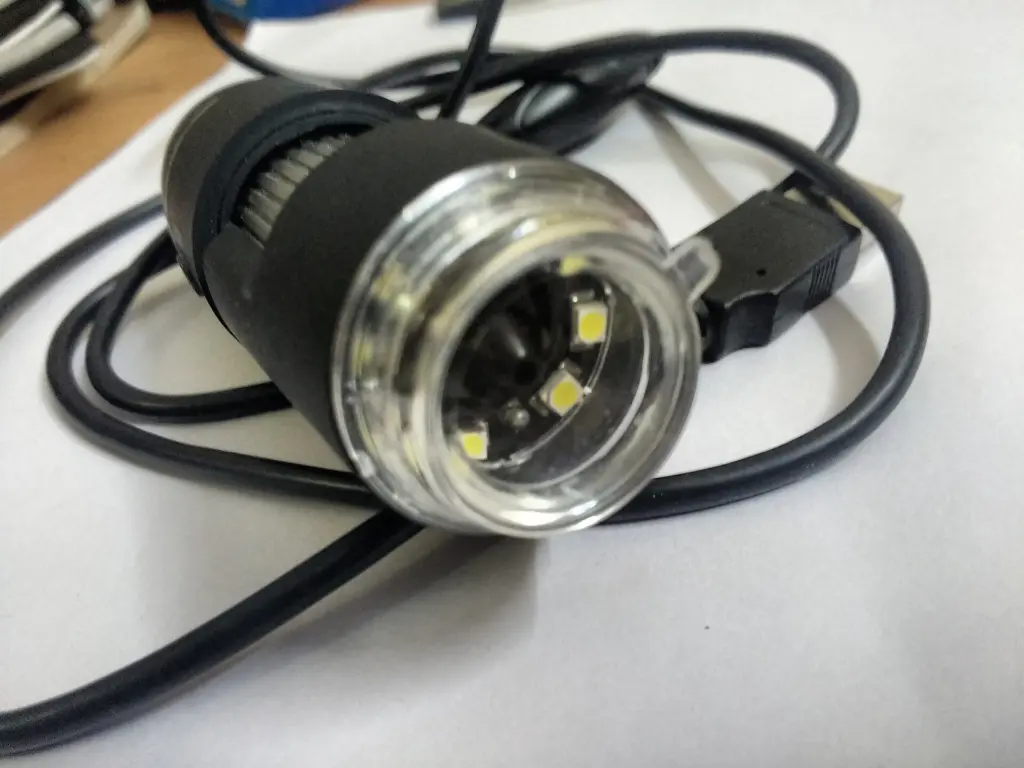
The handheld wand from Taiwan weighs 105 g and has 1.3 MP at 30 frames per second, eight white LEDs and the polarizing filter. On paper, the resolution looks modest. In return, the optics are cleanly documented, measuring and calibration are part of the concept, and Dino-Lite states a two-year warranty. For pure soldering it’s the wrong purchase; for inspecting and measuring it’s a solid tool.
Koolertron 7-inch with 12 MP
A battery-powered device with 3000 mAh, about four hours of runtime according to Koolertron, an aluminum stand and a microSD slot up to 64 GB. The manufacturer doesn’t describe the sensor, nor the 1200x. For looking at stamps, plants or a circuit board at the kitchen table, that may be enough. Koolertron doesn’t describe whether and how the image gets to a computer; the listings on Amazon differ on this. Check before you buy.
Tomlov DM9
According to the manual, the DM9 has a 1/4-inch sensor with Full HD video; focusing is done with a wheel, and eight LEDs and a light shield for micro-soldering are included. On a PC, it shows up as a camera. The short focus range of up to 40 mm is the real limit. If you mostly inspect and rarely solder under the lens, you’ll get by with it.
How we would decide
- You regularly solder SMD components or repair electronics: Andonstar AD409, ideally with an additional monitor.
- Coin collection, occasional electronics and slides for the family: Andonstar AD246S-M or, with less swapping, the Bresser 2L.
- You measure and document on a Windows computer: Bresser DST-1028.
- Shiny surfaces, quality inspection, a Mac in the house: Dino-Lite AM4113ZT.
- An occasional look without cables: Koolertron or Tomlov DM9, knowing that the 1200x is not the measure of all things.
Frequently asked questions
What does 1200x mean on a USB microscope?
The number doesn't describe a lens; it describes the ratio between the screen and the field of view. Bresser states 280x on a 27-inch monitor for the DST-1028; on a 7-inch display it would be about 73x. Nothing changes on the microscope itself. Without a reference size, the figure is only an upper limit.
Which digital microscope is suitable for soldering?
Working distance is what matters, because the soldering iron, tweezers and solder wire have to fit under the lens. The Andonstar AD409 focuses from 5 cm, the Tomlov DM9 only between 10 and 40 mm. The DM9 is enough for checking a finished solder joint; for soldering underneath it, things get tight.
How many megapixels does a USB microscope need?
The number on the box is often upscaled. According to Andonstar, the AD409 uses a 4 MP sensor but saves photos at 12 MP; Bresser openly states 16 MP interpolated for the 2L. Upscaled pixels contain no additional detail.
Is a microscope with its own display or one for the computer more useful?
A built-in screen makes you independent; from 10 inches it becomes comfortable at the workbench, while 7 inches is enough for a quick look. For longer soldering sessions, a monitor via HDMI is the better fit. For measuring on a computer, the Bresser DST-1028 under Windows and the Dino-Lite with its calibration target are suitable.
Which microscope is suitable for coins?
A large enough field of view is important. At 10x, the DST-1028 shows around 42 by 32 mm, so a whole coin fits. At 20x, the Dino-Lite AM4113ZT captures a section with a minting error or the year, and its polarizing filter reduces reflections on shiny metal.
Can you look at cells with a USB microscope?
That requires light from below. The Andonstar AD246S-M comes with a holder with bottom lighting and lens D, rated at 1800x to 2040x at a distance of only 4 to 5 mm. Koolertron explicitly states that its 7-inch model is not suitable for cells.
Sources
- Andonstar: AD409 Digital Microscope
- Andonstar: AD246S-M/AD249S-M
- Bresser: Wi-Fi 1080p digital microscope 2L
- Bresser: USB digital microscope DST-1028 5MP
- Dino-Lite: AM4113ZT
- Dino-Lite: DinoCapture 2.0
- Koolertron: 7-inch LCD digital microscope 12 MP
- Tomlov: TM-DM9 user manual
Where to buy
- Andonstar AD409Check price at Amazon.de
- Andonstar AD246S-MCheck price at Amazon.de
- Bresser WLAN-Mikroskop 2LCheck price at Amazon.de
- Bresser DST-1028 5MPCheck price at Amazon.de
- Dino-Lite AM4113ZTCheck price at Amazon.de
- Koolertron 7 Zoll 12 MPCheck price at Amazon.de
- Tomlov DM9Check price at Amazon.de