Contents15 sections
This guide was first published in German on handgetestet.de.
Twelve years old, a birthday coming up, and an e-scooter on the wish list. The honest answer for parents: your child may only ride one on the sidewalk, bike path or road in Germany from age 14, and even then only on a scooter that has an operating permit and an insurance sticker. Kids‘ e-scooters with 10 to 16 km/h, such as the NAVEE K100, are play equipment for the yard, the garden or a closed-off area. For teenagers from 14, a compact scooter such as the NIU KQi 200P is our pick, rated „good“ in the current test by the German automobile club ADAC. Larger models are often only approved from 16.
Why this split? Because the law and the manufacturers do not say the same thing. The models follow further down in two tables, three classes each for kids and for teens. First the rules, because they changed in 2026 and will change again on March 1, 2027. This guide describes the legal situation in Germany.
At what age can my child ride an e-scooter?
From 14. Section 3 of the German regulation on small electric vehicles (Elektrokleinstfahrzeuge-Verordnung, eKFV) allows people who have reached the age of 14 to ride a small electric vehicle. The regulation has no exception for riding accompanied by adults, and a speed-limited version does not turn a twelve-year-old into a permitted rider. You do not need a driver’s license or a moped certificate, as the German Federal Ministry of Transport (BMV) confirms.
The German Road Safety Council (DVR) considers the limit too low. According to its analysis of the official figures, around 2,200 e-scooter riders or illegal passengers involved in accidents in 2025 were younger than 15. Four died, 211 were seriously injured. The DVR therefore calls for a minimum age of 15 and a proof of competence, similar to the moped certificate. That is not current law, but it is a useful benchmark for parents.
Then there are the manufacturers. According to the data sheet, Segway recommends its Ninebot F3 models only from 16, while Egret approves the X series from 14. What is allowed and what the manufacturer considers sensible can therefore differ. A look at the data sheet before buying saves trouble.
What applies to teenagers from 14 on the road?
Legally, an e-scooter in Germany is a motor vehicle. Almost everything else follows from that:
- The scooter needs a general operating permit (Allgemeine Betriebserlaubnis, ABE) or an individual operating permit. An EC declaration of conformity does not replace it. Keep the certificate and show it on request.
- Without a valid insurance sticker, it is not insured. The sticker is only available for models with an operating permit.
- By design, more than 6 and at most 20 km/h are allowed. Versions with 25 km/h from other EU countries are not allowed on the road in Germany.
- You ride on bike paths, bike lanes and bicycle streets, and only where there are none on the road. Sidewalks and pedestrian zones are off-limits unless the supplementary sign „small electric vehicles permitted“ allows them. According to the BMV, that also applies with the motor switched off.
- One person, no passenger, no trailer.
- Under 21 and during the probationary period, the limit is zero blood alcohol (Section 24c of the German Road Traffic Act). Older riders have the 0.5 per mille limit; according to the BMV, it can become a criminal offense from 0.3 per mille if someone is no longer riding safely.
One point affects parents directly. Under Section 2 (4) eKFV, the keeper must not allow a scooter without an operating permit or valid sticker to be ridden on public roads; that is an administrative offense. If the scooter is registered in your name, the sticker, which is due again every year on March 1, belongs in your calendar.
What does the 2026 and 2027 reform change?
The amending regulation dates from January 30, 2026, and was promulgated on February 6, 2026 (German Federal Law Gazette, BGBl. 2026 I No. 32). It takes effect in three stages.
Since April 1, 2026, new construction rules have applied. Front and rear turn signals are mandatory rather than merely allowed, scooters with a front and rear wheel need independent brakes on both wheels, and batteries must meet the standard DIN EN 50604-1. The regulation’s lower limit now reads „more than 6 km/h“ instead of „not less than 6 km/h.“
From January 1, 2027, the transition period ends for types already approved before April 2026. Anything placed on the market for the first time from then on must meet the new rules, turn signals included. The BMV sums it up this way: the new technology applies from model year 2027, and existing scooters with an operating permit do not have to be retrofitted.
From March 1, 2027, the rules of conduct move into the German Road Traffic Regulations (Straßenverkehrs-Ordnung, StVO) and are aligned with those for cyclists. The green arrow for cyclists then also applies to e-scooters, and „bicycles permitted“ also opens a sidewalk or pedestrian zone to them, at walking speed. Riding side by side becomes allowed as long as nobody is obstructed. In return, riding on the sidewalk and riding two-up get more expensive.
For buying, that simply means: only with built-in turn signals. All ten scooters in the current ADAC test already have them.
And what about e-scooters for kids under 14?
There are hardly any explicit rules. A kids‘ e-scooter with 14 or 16 km/h does fall within the eKFV’s speed range, but it has no operating permit and is therefore not allowed on public roads under Section 2 eKFV. In any case, nobody under 14 may ride such a vehicle. NAVEE itself states that the K100 is not approved for public road traffic, and Decathlon says the same about the Oxelo XSD100E. Sidewalk, bike path, play street: none of them.
And up to 6 km/h? For motorized scooters at that speed, there is no specific traffic rule. The eKFV does not apply to them, and Section 24 of the German Road Traffic Regulations, which treats kick scooters and children’s bicycles like pedestrians, explicitly mentions only non-motorized means of transport. So there is no clear permission for the sidewalk. In practice, the question rarely comes up: no kids‘ e-scooter in our selection goes only 6 km/h. The models from Decathlon, NAVEE and Segway reach 14 to 16 km/h and can at most be set slower via a mode or app. By design, the top speed is still whatever the motor can do.
That leaves private property: your own yard, a garden with a solid path, a closed-off area whose owner agrees. For a ten-year-old’s way to school, the kick scooter is the right choice. A child may ride it on the sidewalk, because legally it is not a vehicle.
Who pays if something happens?
With a scooter from 14, things are clear. Behind the sticker is motor vehicle liability insurance that pays for damage the rider causes to others. The family’s personal liability insurance does not step in, because it generally excludes motor vehicles.
With a kids‘ e-scooter in the yard, it gets tricky. In its model terms for personal liability insurance, as of March 2026, the German Insurance Association (GDV) provides for an extension: motor vehicles up to 6 km/h can be covered, faster ones only if they are used exclusively on non-public, enclosed property or property not accessible to the public. That has to be in the policy; it does not apply automatically. The consumer advice center of Lower Saxony warns, in the case of hoverboards, that even your own courtyard is not necessarily covered. So ask your insurer in writing before buying. What else a good policy includes is covered in the guide to personal liability insurance (in German).
And the parents? Under Section 832 of the German Civil Code (BGB), anyone who has to supervise a minor child is liable for damage the child causes to third parties, unless supervision was adequate or the damage would have happened anyway. Under Section 828 BGB, children under seven are not responsible themselves, and older minors depending on their understanding. How much supervision is enough is decided by courts based on age and circumstances.
Is a helmet a must?
It is not required in Germany, at any age. The ADAC, the DVR, the consumer advice centers and the German insurers‘ accident research unit (UDV) still recommend it. The UDV describes e-scooter riders as mostly young people who usually do not wear a helmet, and explicitly lists the helmet among its recommendations. The DVR strongly advises wearing one to reduce the risk of serious head injuries.
A bicycle helmet certified to the European standard EN 1078 is enough. More important than the model is the fit: level, one to two fingers above the eyebrows, the straps forming a V below the ears. How to measure the size is explained in the bike helmet guide (in German). After a fall, replace the helmet, even without a visible crack. And sturdy shoes instead of sandals, because the foot stands exposed on the deck.
In Austria, a helmet requirement for e-scooter riders under 16 has applied since May 1, 2026, as confirmed by the Austrian automobile club ÖAMTC and the Austrian Parliament’s press service. If you take the scooter on vacation there, you will pack the helmet anyway.
Kids‘ e-scooter, kick scooter or hoverboard?
Three devices, three legal situations. Under Section 24 StVO, the kick scooter is not a vehicle; children ride it like pedestrians on the sidewalk, including to school. The hoverboard has no handlebar, never falls under the eKFV and remains a device for private property at any age, as our hoverboard guide (in German) explains. The kids‘ e-scooter looks like a means of transport but belongs in the yard just the same.
Our position: for everyday use under 14, the kick scooter is the right choice. A kids‘ e-scooter is fun on your own property and builds a feel for throttle and brake. With enough space, you can buy one with a clear conscience. Without space, you are wasting money.
How do I recognize a child-friendly scooter?
By weight first. A child has to be able to get the scooter up the basement stairs alone. According to the manufacturers, the kids‘ models in our selection weigh 7.9 to 9.6 kg. Road scooters for teenagers weigh between a good 17 and almost 28 kg, and every fourteen-year-old notices that at the bus stop.
For brakes, kids‘ scooters usually use a drum on the rear wheel operated by a hand lever, often supplemented by the rear fender. Road scooters need two independent brakes, ideally mechanical discs front and rear. Kids‘ scooters roll on 7-inch solid tires, puncture-proof but with hardly any cushioning; road scooters on 10 to 12.5 inches, which handle curbs better.
For the battery, Section 7 eKFV requires the standard EN 50604-1 for road scooters; there is no such requirement for kids‘ scooters. Charge only with the supplied power adapter and never unattended overnight in the child’s room; more tips are in the hoverboard guide. A detail parents will likely appreciate: with NAVEE, parents set the top speed via an app, and Decathlon and Segway have a beginner mode at 10 km/h.
Kids‘ e-scooters for ages 6 to 13: three classes for private property
None of these models has road approval. We divide the classes by features and price; the price ranges come from retailer information, as of November 2026.
| Model | Class and price range | Age according to manufacturer | Speed | Weight | Range |
|---|---|---|---|---|---|
| NAVEE K100 | entry class, up to about €200 | 6 to 10 years, rider up to 50 kg | 12 or 16 km/h, can be limited via app | 8.6 kg | 14 km at 12 km/h |
| Segway Ninebot ZING E8 | mid class, about €200 to €250 | 6 to 12 years | 10 or 14 km/h | 7.9 kg | up to 10 km |
| NAVEE K100 Max | premium class, from about €250 | 6 to 14 years, rider up to 50 kg | 12 or 16 km/h, can be limited via app | 9.6 kg | 24 km at 12 km/h |
All data according to the manufacturers. NAVEE measures range with a 30 or 50 kg load on a flat course; in everyday use, less is realistic.
Our pick in the entry class: NAVEE K100
The app tips the balance. In it, parents set the top speed to match age and ability, and they can see the ride history. Without the app, the scooter switches between 12 and 16 km/h plus a mode that holds the speed after pushing off. NAVEE specifies 8.6 kg, 7-inch solid tires, a rear drum brake with a lever for small hands and a 55 Wh battery, intended for ages 6 to 10. The handlebar is not adjustable.
Even cheaper is the Oxelo XSD100E from Decathlon, intended for ages 6 to 9 according to Decathlon. Its motor only kicks in once the child has pushed off to about 3 km/h, and two modes limit it to 10 or 15 km/h. It weighs 9.5 kg, carries up to 50 kg and brakes with a drum and the fender on the rear wheel. It is available only from Decathlon.
Our pick in the mid class: Segway Ninebot ZING E8
At 7.9 kg, the lightest scooter in this selection, and with kids that counts more than any app. Segway lists three brakes, hand brake, fender brake and motor brake, a beginner mode at 10 km/h and a deck only 10 cm above the ground for a low center of gravity. Recommended for ages 6 to 12, up to 10 km of range. The German product page does not state a maximum rider weight, so ask the retailer.
The alternative is the NAVEE K100 Pro, essentially a K100 with a handlebar in three heights from 885 to 1,025 mm, for children from 115 to 170 cm according to NAVEE. If you start with a seven-year-old, the scooter will last longer.
Our pick in the premium class: NAVEE K100 Max
Twice the battery of the K100 and K100 Pro, 110 instead of 55 Wh, and according to NAVEE 24 km at 12 km/h. The handlebar grows with the child in three steps, and the stated age range is 6 to 14. Add Apple Find My with an alert when the scooter leaves a defined zone, and a Bluetooth speaker. To be honest: hardly any child needs 24 km in their own yard. The Max makes sense with a large property or regular access to a closed-off area. The 50 kg rider weight limit applies here too. If you prefer NIU, the KQi Youth is also a kids‘ scooter without road approval, for children up to 12.
E-scooters for teens from 14: three classes with road approval
Now the scooters with an operating permit under the eKFV, 20 km/h and turn signals. Price ranges according to manufacturer and retailer information, as of November 2026.
| Model | Class and price range | Weight | Rider up to | Brakes | Age according to manufacturer |
|---|---|---|---|---|---|
| NAVEE V25i Pro | entry class, up to €450 | 17.1 kg | 100 kg | electronic front, drum rear | n/a |
| NIU KQi 200P | mid class, €450 to €650 | 19.7 kg (measured by ADAC) | 120 kg | drum front, electronic rear | n/a |
| Segway Ninebot F3 D | mid class, €450 to €650 | 18.6 kg | 120 kg | disc front, electronic rear | from 16 |
| NAVEE GT3 | mid class, €450 to €650 | 21 kg | 110 kg | drum front, electronic rear | n/a |
| Egret Unit (SL) | premium class, from €650 | 27.7 kg | 130 kg | n/a | n/a |
Data according to the manufacturers, for the NIU from the data sheet of the ADAC test. All five have turn signals and do 20 km/h in the German version. „n/a“ means the manufacturer does not state a value online.
Our pick in the entry class: NAVEE V25i Pro
At 17.1 kg, the lightest road scooter in this selection, and for a fourteen-year-old with a stairwell, that is the strongest argument. NAVEE specifies 10-inch pneumatic tires, IPX5 splash protection, E-marked turn signals and 22 km of range at 20 km/h. Braking is electronic at the front and by drum at the rear; there is no mechanical front brake. Rider weight is limited to 100 kg, which is not an issue for most teenagers. That is enough for short, flat routes; for long commutes, the battery is tight.
Our pick in the mid class: NIU KQi 200P
In the 2026 ADAC test, the NIU received a „good“ (2.4, on the German school-grade scale where 1 is best). The ADAC praises it for being light, small and easy to transport, and criticizes its weak performance on inclines and the shortest deck in the test field. On the test bench it went 43.7 km; NIU states 54 km, with a 365 Wh battery. A drum brakes at the front, the motor at the rear. For school commutes in the city, it is a sensible, tested scooter; if you face a long climb every day, look at the alternatives.
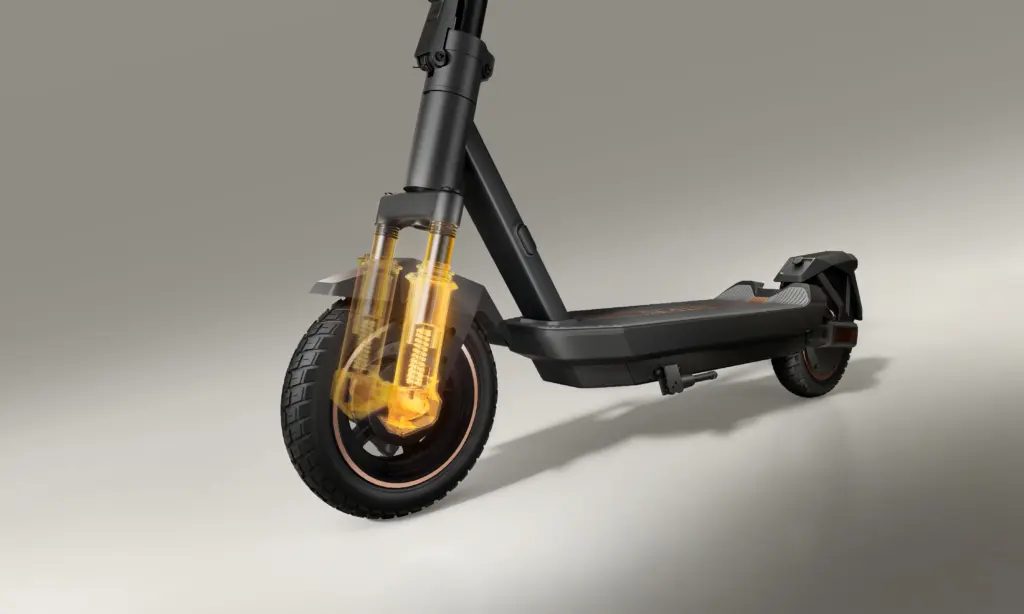
The best overall grade in the ADAC test (2.0) went to the Segway Ninebot F3 Pro D, and none in the field did better on safety and durability (1.6). According to Segway, its sibling, the F3 D, has the same 477 Wh battery, hydraulic suspension at the front and elastomer at the rear, but brakes only electronically at the rear instead of with a second disc. Segway recommends both only from age 16. For 16- and 17-year-olds, they are a good choice; for younger riders, we would follow the manufacturer’s recommendation. The NAVEE GT3 offers front and rear suspension at 21 kg; we are not yet aware of an independent test.
Our pick in the premium class: Egret Unit (SL)
Premium here means range and riding comfort, not lightness. According to Egret, the Unit from Hamburg has front and rear suspension, front and rear turn signals, up to 100 km of range, a 130 kg payload and handles 32 percent gradients; the SL version is the German one with 20 km/h. The counterargument weighs 27.7 kg. If you have to carry the scooter up to the third floor, try that beforehand. The ADAC has not tested the Unit.
Lighter and explicitly approved from 14 is the Egret X prime at 25.8 kg, with 12.5-inch pneumatic tires, a front suspension fork and, according to Egret, up to 65 km of range; so far it is available mainly from Egret itself. Its sibling, the X core, received a „good“ (2.3) from the ADAC, with praise for handling and brakes and criticism of its hill performance.
What the ADAC found out about safety
In 2026, the ADAC tested ten e-scooters in the lower and middle price range, seven of them „good.“ Two dropped to „adequate,“ the Navee N65 II and the Streetbooster Sirius: the handlebar broke in the endurance test. The ADAC loads each handlebar end dynamically with 15 kg, the way braking and steering act in everyday use, instead of only 10 kg in the center like the standard. It does not see a product defect in the legal sense, but does see a real risk after extended use. The N65 II is therefore not in our selection.
Two more findings: hardly any range claim held up on the test bench. And the turn signals of some models, including Segway and NIU, are hard to see from the side or give too quiet a signal. Kids‘ e-scooters were not part of the test.
Riding an e-scooter to school?
From 14, yes, with a sticker. The accident statistics still sharpen the view. Germany’s Federal Statistical Office (Destatis) counted 16,496 e-scooter accidents with personal injury in Germany in 2025, 38.1 percent more than the year before. 53.6 percent of the injured riders were younger than 25. The most common misconduct, at 21.6 percent: riding on the wrong path, meaning the sidewalk or the wrong side of the road. Around 30 percent were single-vehicle accidents with no one else involved.
Walk the route to school together once: where are there bike paths, and where is the road the only option? Practice turning with the turn signal in an empty parking lot. And sort out the bus. According to the consumer advice center of Lower Saxony, many transit associations have banned private e-scooters on board since 2023, including in Hamburg, Munich, Cologne, Frankfurt am Main and Leipzig, because of the fire risk of the batteries. If your child wants to switch to the bus when it rains, ask your local transit company first.
Can the scooter come along on vacation?
According to the BMV, there is no uniform rule in the EU. In Austria, since the amendment of May 1, 2026, the following applies according to the ÖAMTC: riding from age 12, from 10 or 9 with a cycling permit, helmet requirement under 16, 0.5 per mille, one person only, plus a mandatory bell, reflectors and turn signals at the ends of the handlebar grips. Check before the trip whether a German model has this equipment. Kids‘ e-scooters without approval remain devices for private property abroad as well.
How we would decide
Younger than 14 and on the way to school: a kick scooter instead of an e-scooter. For the yard and garden: NAVEE K100 if you want to limit the speed via app, Segway Ninebot ZING E8 if the child should carry the scooter alone, NAVEE K100 Max with plenty of space.
From 14: NIU KQi 200P; with the tightest budget or lots of stairs, NAVEE V25i Pro; for long routes, the Egret Unit. From 16, the Segway F3 series joins the list. What else matters with a road scooter, from the 25 km/h version trap to range, is in the e-scooter guide (in German).
For everyone: sticker before the first ride, helmet on the head.
Frequently asked questions
At what age can you ride an e-scooter in Germany?
From age 14. That is what Section 3 of the German regulation on small electric vehicles (Elektrokleinstfahrzeuge-Verordnung, eKFV) says. You do not need a driver's license or a moped certificate, and there is no exception for riding accompanied by an adult. Some manufacturers only recommend their models from 16, such as Segway for the Ninebot F3 series.
Can my 12-year-old ride a kids' e-scooter on the sidewalk?
No. Kids' e-scooters with 10 to 16 km/h have no operating permit and, under the German eKFV, are not allowed on public roads or paths; in any case, nobody under 14 may ride a small electric vehicle. They belong on private property such as a yard, garden or a closed-off area. The sidewalk is for kick scooters.
Is there a helmet requirement for e-scooters?
Not in Germany, at any age. The ADAC, the DVR, the consumer advice centers and the German insurers' accident research unit still recommend a helmet. A bicycle helmet certified to EN 1078 is enough. In Austria, a helmet requirement for e-scooter riders under 16 has applied since May 1, 2026.
What blood alcohol limit applies to teenagers on an e-scooter?
Zero. For everyone under 21 and for new drivers in their probationary period, the alcohol ban under Section 24c of the German Road Traffic Act (Straßenverkehrsgesetz) applies, on an e-scooter too. For older riders, the 0.5 per mille limit applies.
Is an e-scooter covered by the family's liability insurance?
An e-scooter with road approval is not; it needs its own insurance sticker. Kids' e-scooters on private property may be covered by personal liability insurance if the policy includes the extension of the German Insurance Association (GDV) for vehicles not subject to mandatory insurance, up to 6 km/h or on enclosed, non-public property. Ask your insurer in writing.
Do e-scooters need turn signals from 2027?
Turn signals have been mandatory since April 1, 2026. For types approved earlier, a transition period runs until the end of 2026; scooters first placed on the market from 2027 must have them. According to the German Federal Ministry of Transport, existing scooters with an operating permit do not have to be retrofitted.
What changes for e-scooters on March 1, 2027?
The rules of conduct move from the eKFV into the German Road Traffic Regulations (Straßenverkehrs-Ordnung, StVO) and are aligned with those for cyclists. The green arrow for cyclists then also applies to e-scooters, the supplementary sign "bicycles permitted" also opens sidewalks to them, and riding side by side becomes allowed. Riding on the sidewalk and riding two-up get more expensive.
Are parents liable if their child has an accident on an e-scooter?
Under Section 832 of the German Civil Code (BGB), those with a duty of supervision are liable for damage their minor child causes to third parties if they breached that duty. As keepers, parents also must not allow a scooter without an operating permit or sticker to be ridden on public roads; that is an administrative offense under the eKFV.
Can you take an e-scooter on buses and trains?
There is no uniform nationwide rule in Germany. According to the consumer advice center of Lower Saxony, many transit associations have banned private e-scooters on board since 2023, for example in Hamburg, Munich, Cologne, Frankfurt am Main and Leipzig, because of the fire risk of the batteries. Ask your local transit company.
Sources
- German regulation on small electric vehicles (Elektrokleinstfahrzeuge-Verordnung, eKFV), gesetze-im-internet.de
- BGBl. 2026 I No. 32: regulation amending the eKFV and other road traffic provisions
- BMV: questions and answers on small electric vehicles
- BMV: questions and answers on the eKFV amendment
- Section 24c German Road Traffic Act (Straßenverkehrsgesetz)
- Section 24 German Road Traffic Regulations (Straßenverkehrs-Ordnung)
- Section 832 BGB and Section 828 BGB
- GDV: model clause for motor vehicles not subject to mandatory insurance (PDF, as of March 2026)
- Verbraucherzentrale Niedersachsen: rules for e-scooters
- Verbraucherzentrale Niedersachsen: hoverboards and insurance coverage
- Federal Statistical Office (Destatis): e-scooter accidents 2025
- DVR: proof of competence and minimum age of 15
- DVR: ride e-scooters, but safely
- UDV: traffic behavior of e-scooter riders
- ADAC: e-scooters, rules and helmets
- ADAC: e-scooter test 2026
- ÖAMTC: e-scooter rules in Austria
- Austrian Parliament: parliamentary press release No. 308/2026
- NAVEE: K100, K100 Pro, K100 Max
- NAVEE: V25i Pro and GT3
- Decathlon: Oxelo XSD100E
- Segway: Ninebot ZING E8 and Ninebot F3 Pro D
- Egret: X series and model overview including the Unit
Where to buy
- NIU KQi 200PCheck price at Amazon.deAvailable in Germany: Amazon.de
- NAVEE V25i ProCheck price at Amazon.deAvailable in Germany: Amazon.de
- Egret Unit (SL)Check price at Amazon.deAvailable in Germany: Amazon.de
- Segway Ninebot F3 DCheck price at Amazon.deAvailable in Germany: Amazon.de
- NAVEE GT3Check price at Amazon.deAvailable in Germany: Amazon.de
- NAVEE K100Check price at Amazon.deAvailable in Germany: Amazon.de
- Segway Ninebot ZING E8Check price at Amazon.deAvailable in Germany: Amazon.de
- NAVEE K100 MaxCheck price at Amazon.deAvailable in Germany: Amazon.de