Contents13 sections
This guide was first published in German on handgetestet.de.
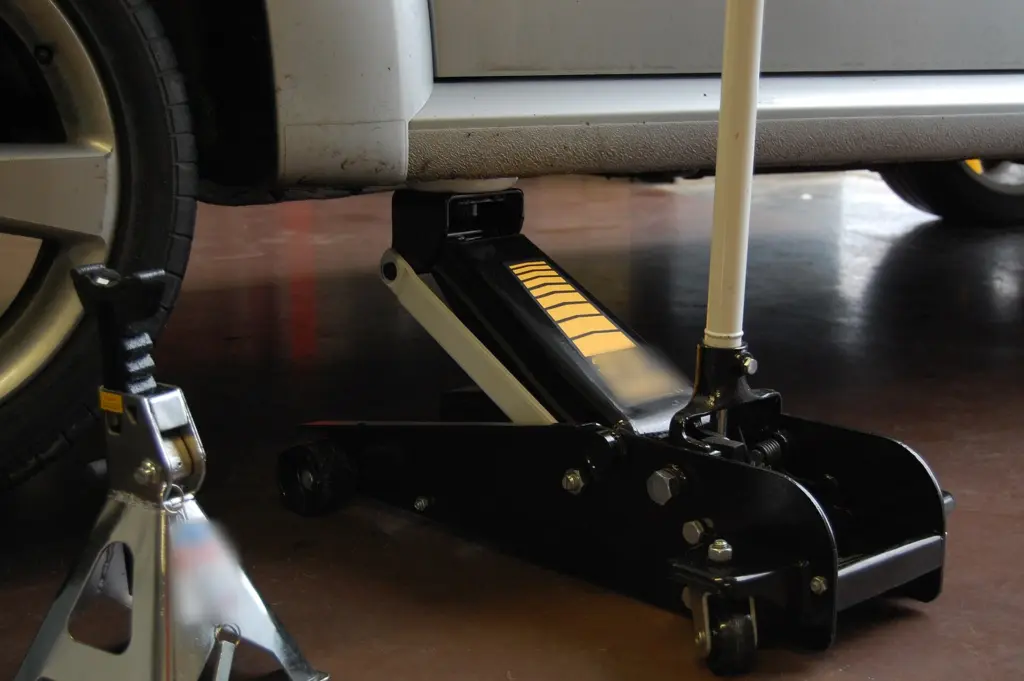
Twice a year, the wheels are stacked in the garage, and the car’s scissor jack cranks up sluggishly. If you’re tired of that, you need two things: a floor jack that fits under your own rocker panel and lifts high enough, and a pair of jack stands. For station wagons, compact cars and low cars, we consider the Güde GRH 2,5/510L the balanced choice. According to the manufacturer, it starts at 80 mm and reaches up to 508 mm. Add a pair of stands such as the 3 t Güde set.
Will the jack even fit under my car?
That is the first number that counts. The minimum height, often called the clearance height, describes how flat the lifting arm sits at rest. If the rocker panel of a lowered car is only 10 cm above the ground, a jack with a starting height of 135 mm won’t even reach the lifting point. Low-profile models start at 70 to 80 mm. In return, they are longer because the lifting arm has to reach far forward, and that means more space needed in the garage.
At the other end is the lift height. An SUV with plenty of ground clearance needs considerably more than 33 cm at the top, otherwise the wheel is still on the ground when the jack hits its stop. In our assessment, around 50 cm is enough for typical cars and SUVs. Measure it yourself beforehand: from the ground to the lifting point, then add about 5 cm until the wheel is clear.
How much capacity makes sense?
A floor jack never lifts the whole car, only one corner or one axle. That’s why a 2 t jack is enough for a small car. For a heavy electric SUV with a curb weight well over 2 t, we’d rather go for 2.5 or 3 t and have some reserve. More tons also means more kilos, though. According to the data sheet, the Bahco BH12000 weighs 42.7 kg, and you don’t just casually carry that down the basement stairs.
Two details help. A dual piston or a foot pedal bridges the idle travel until the saddle touches the car. A lowering speed control, as Bahco specifies, lets the car down evenly. Also look for the DIN EN 1494 standard for mobile lifting devices and a GS mark (the German „tested safety“ seal).
Is the jack enough on its own?
For a simple wheel change, yes; for anything underneath, no. Germany’s statutory accident insurance institutions regulate this quite clearly in DGUV Regel 109-009 on vehicle maintenance. Work on and under raised vehicles may only begin once they are secured against rolling away, sliding off, tipping over and sinking. Jack stands or blocks placed so they can’t slip, on firm ground, are considered sufficient. According to the same rule, special support can be dispensed with when changing a wheel. But if you check brakes or reach under the car, put stands underneath.
The manufacturers see it the same way. Güde writes in its instructions never to work under a load held only by the jack. Bahco requires placing the vehicle on stands immediately after lifting. According to the DGUV, every stand must permanently and legibly display its load capacity. Using other bolts as a replacement for the locking pin is not permitted.
How to change a wheel without risk
The German automobile club ADAC recommends a level, firm surface, the handbrake on and first gear or position „P“. The wheel nuts are loosened by about a quarter turn before lifting. Place the jack only at the points shown in the owner’s manual. On electric cars, according to the ADAC, a wrong point can in the worst case damage the traction battery. According to ADAC Nordbayern, the removed wheel goes under the vehicle. One more step.
After lowering, tighten the nuts crosswise to the specified torque, ideally with a suitable torque wrench (in German). If you loosen the nuts with an impact wrench for wheel nuts (in German), still finish with the torque wrench, because that is what the ADAC names for the specified torque. After about 50 km, check the bolts once more, according to the ADAC. According to the DGUV, wheel chocks are also required as soon as braked wheels are lifted.
Six jacks and stands with their key specs
| Model | Capacity | Lift range | Weight | Best for |
|---|---|---|---|---|
| Güde GRH 2,5/510L | 2.5 t | 80–508 mm | 29 kg | Station wagons, compacts, lowered cars |
| KS Tools performance 160.1020 | 3 t | 75–510 mm | 32.5 kg | Heavy cars and frequent wrenching |
| Bahco BH12000 | 2 t | 70–490 mm | 42.7 kg | Very low cars, fixed workshop spot |
| Güde GRH 3/470 | 3 t | 130–465 mm | 28 kg | SUVs and vans with ground clearance |
| Einhell CC-TJ 2000 | 2 t | 135–330 mm | 8.4 kg | Small cars, the trunk |
| Güde Unterstellbock-Set 3T (jack stand set) | 3 t each | 276–420 mm | 6.8 kg | A must for anyone working underneath |
All figures according to the manufacturer.
Güde GRH 2,5/510L
Our recommendation for the home garage. With a starting height of 80 mm, it fits under low rocker panels, and with 508 mm it reaches far enough even on taller station wagons. According to Güde, the dual-cylinder system lifts up to 50 percent faster, and the pump handle is padded with foam. A point for professional mechanics: according to the manual, the jack is not designed for commercial use.
KS Tools performance 160.1020
Almost the same range, but 3 t capacity. KS Tools states 75 to 510 mm, a foot pedal for the idle stroke and a pressure relief valve against overload. At 32.5 kg, it’s heavy. According to the manufacturer, the two swivel casters are solid steel and resistant to oil and acid. If you regularly work on heavy cars, this is the more solid foundation.
Bahco BH12000
At 70 mm, the Bahco sits the lowest. According to the data sheet, it complies with EN 1494, has a safety valve and a lowering speed control, and works between −20 and +50 °C. The catch: 42.7 kg for 2 t of capacity. This is a jack for a fixed spot in the workshop, not for the trunk.
Güde GRH 3/470
A powerful jack for tall vehicles. It only starts at 130 mm, so it’s unsuitable for low cars, but it lifts 3 t up to 465 mm. The large saddle measures 110 mm. According to Güde, lowering is done via the pump handle, and the two-piece handle can be stowed away in little space.
Einhell CC-TJ 2000
At 8.4 kg, it’s the lightweight among the jacks here and travels in the trunk without a problem. Einhell states 2 t, 135 to 330 mm, a carrying handle and a safety valve against overload. That’s enough for small cars. For SUVs, it’s too short at the top; for lowered cars, too high at the bottom.
Güde Unterstellbock-Set 3T
Two welded stands rated at 3 t each, adjustable from 276 to 420 mm, with wide feet and GS certification according to Güde. Check beforehand whether the range suits your car. On a tall SUV, the support point should not be above 420 mm when the car is raised.
How we would decide
- Station wagon, compact car or lowered car in your own garage: Güde GRH 2,5/510L plus a pair of stands.
- Heavy cars, frequent wrenching, room for a large jack: KS Tools performance 160.1020.
- Sports car with very little ground clearance and a fixed workshop spot: Bahco BH12000.
- SUV or van where low height doesn’t matter: Güde GRH 3/470.
- Only wheel changes on a small car and little storage space: Einhell CC-TJ 2000.
We wouldn’t buy any of these jacks without stands. And if you’re switching tires in October anyway, our guide to winter tires (in German) covers the question of the right tire.
Frequently asked questions
What minimum height does a floor jack need?
It has to fit under the rocker panel. If the panel on a lowered car is only 10 cm above the ground, a jack with a starting height of 135 mm won't reach the lifting point. Low-profile models start at 70 to 80 mm, but they are longer and take up more space in the garage.
How high does a jack need to lift?
Measure from the ground to the lifting point and add about 5 cm until the wheel is clear. An SUV with plenty of ground clearance needs considerably more than 33 cm. In our assessment, around 50 cm is enough for typical cars and SUVs.
How much capacity does a floor jack need?
It only lifts one corner or axle, so a 2 t jack is enough for a small car. For a heavy electric SUV with a curb weight well over 2 t, 2.5 or 3 t with some reserve makes sense. More tons also means more weight, though: the Bahco BH12000 weighs 42.7 kg.
Do I also need jack stands?
For a simple wheel change, according to the German accident insurance rule DGUV Regel 109-009, special support can be dispensed with. If you reach under the car or check the brakes, you need jack stands or blocks placed so they can't slip, on firm ground. Güde and Bahco also require this in their instructions.
What should I watch out for when changing a wheel with a jack?
The German automobile club ADAC recommends a level, firm surface, the handbrake on and first gear or position P. Loosen the wheel nuts by about a quarter turn before lifting, and place the jack only at the points shown in the owner's manual. On electric cars, a wrong point can damage the traction battery.
When do wheel nuts need to be retightened?
Right after lowering the car, crosswise to the specified torque with a torque wrench, even if an impact wrench loosened the nuts. After about 50 km, check the bolts once more, according to the ADAC.
Sources
- ADAC: changing tires or wheels yourself (German)
- ADAC Nordbayern: changing winter wheels yourself (German)
- DGUV Regel 109-009 vehicle maintenance, sections 4.8 and 4.9 (German)
- DGUV Regel 109-009, section 11.7 lifting equipment and jack stands (German)
- Güde: lifting equipment catalog
- Güde: floor jack operating manual
- Güde: GRH 2,5/510L
- KS Tools: performance steel floor jack 3000 kg
- Bahco: operating manual BH13000, BH12000, BH11500
- Einhell: CC-TJ 2000
Where to buy
- Güde GRH 2,5/510LCheck price at Amazon.de
- KS Tools performance 160.1020Check price at Amazon.de
- Bahco BH12000Check price at Amazon.de
- Güde GRH 3/470Check price at Amazon.de
- Einhell CC-TJ 2000Check price at Amazon.de
- Güde Unterstellbock-Set 3TCheck price at Amazon.de