Contents15 sections
This guide was first published in German on handgetestet.de.
A headphone amp won’t make bad headphones good. At most, it makes sure good headphones don’t fall short of what they can do. If you listen at a desk, a compact desktop unit such as the iFi ZEN DAC 3 is the most sensible choice; on the go, a USB dongle such as the FiiO KA17 is enough. Anything beyond that is for hard-to-drive headphones, for tools like an equalizer or for several sources on the same device.
Before we get to models, it is worth looking at the technology. Many bad purchases happen because two things that sit in one housing get mixed up.
Two components, two jobs
The DAC (digital-to-analog converter) converts the stream of numbers from a computer, smartphone or TV into a voltage. The amp adds enough current to that voltage to move the diaphragm in the headphones. Every device that plays music needs both. Your laptop also has a DAC and a small amp on board, usually built frugally and squeezed in next to the fan and graphics chip.
If you hear hiss there, clicks when scrolling, or it doesn’t get loud enough, the converter is rarely to blame. Usually it is the amplifier section or the power supply. An external device moves both out of the computer. That is the real benefit, not some extra bits.
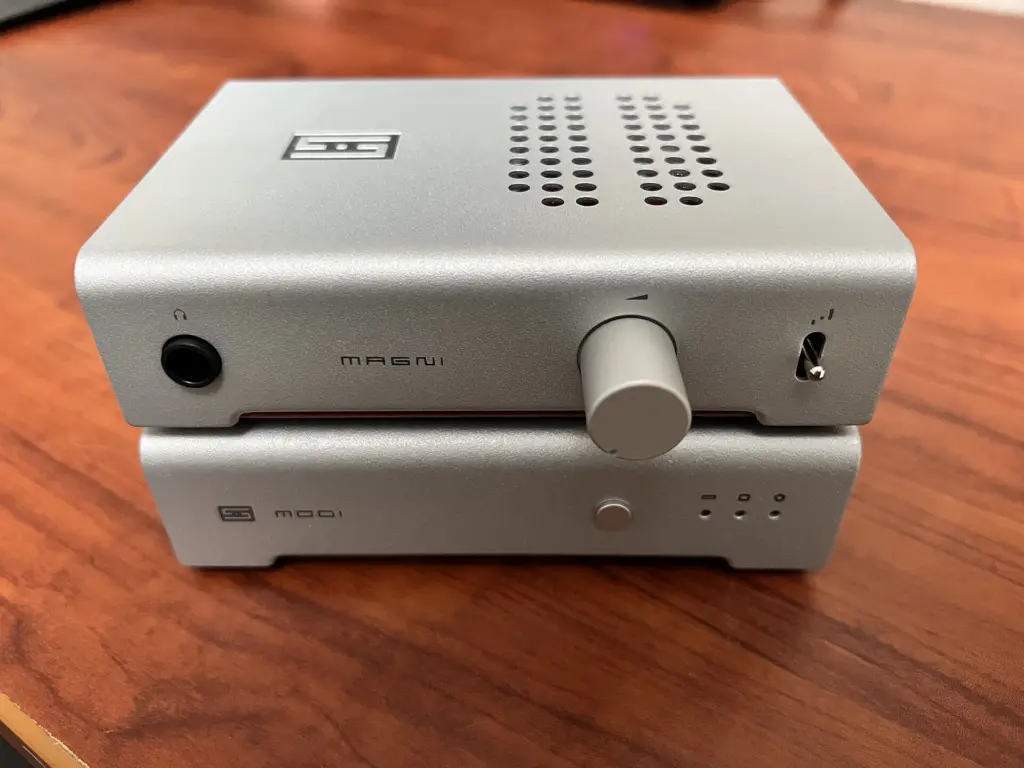
All the devices in this guide are combo units. Pure amps without a converter exist too, such as Schiit’s Magni series, which is just moving to its sixth generation. If you already own a good DAC, you can also use the analog RCA input on the FiiO K7 and run it as a pure amp.
Impedance and sensitivity: why ohms alone tell you nothing
Impedance in ohms is the number everyone knows. But it only tells half the story. Headphones rated at 300 Ω need a considerably higher voltage for the same power than ones at 32 Ω, but much less current. Sensitivity, stated in dB per milliwatt or dB per volt, is just as decisive.
A sample calculation makes it tangible. Headphones with 96 dB per milliwatt reach peaks of 110 dB with around 25 mW. At 300 Ω, that takes about 2.7 volts. Many smartphone outputs and cheap adapters deliver less. That doesn’t necessarily mean it stays quiet, but bass impulses flatten out as soon as the amp is working at its limit. Headphones at 32 Ω with the same sensitivity need just under 0.9 volts for the same level. Almost any output can manage that.
This leads to a simple rule. High-impedance studio models and many planar magnetic headphones benefit audibly from a powerful amp. In-ear monitors, on the other hand, almost never do. Which studio headphones demand how much voltage is covered in our guide to studio headphones (in German).
Output impedance: the underrated number
With in-ear monitors in particular, another figure matters more than power: the amp’s output impedance. If it is too high, it bends the frequency response of earphones with multiple drivers, because their impedance swings sharply across the frequency range. A rule of thumb among engineers is that it should be at most one eighth of the headphone impedance. For an in-ear rated at 16 Ω, that means under 2 Ω.
FiiO, iFi and RME state values between 0.1 and 1.5 Ω for their devices. With very sensitive in-ears, the noise floor comes into play as well. A device with several watts of headroom can still hiss audibly at its lowest gain setting. That is why good devices have switchable gain stages, and the RME ADI-2 DAC FS even has a dedicated low-level IEM output. You will find more on choosing suitable earphones in our guide to in-ear headphones.
Hi-res: what the numbers on the box mean
Almost every current DAC advertises 768 kHz and DSD512. Sounds like a lot. It is, just not for your ears. CD works at 16 bits and 44.1 kHz. That can reproduce frequencies up to just over 22 kHz, beyond the limit of human hearing, and a theoretical dynamic range of around 96 dB. For playing back finished music, that is generally enough. Higher rates make sense in the studio, where tracks are edited and mixed.
Our position on this is clear. Supported sample rates are no longer a differentiator today. What matters more is a clean amplifier, enough voltage for your headphones and the question of which sources you want to connect.
Dongle or desktop?
A dongle plugs into the USB-C port of a smartphone, tablet or laptop and draws its power from it. That limits output and drains the battery. The FiiO KA17 partly gets around this with a second USB-C port for a power supply and a desktop mode that, according to the manufacturer, more than doubles the power at the balanced output. On the go, it remains a compromise.
Desktop units have their own power supplies, bigger volume knobs and usually line outputs for powered speakers. That way they often replace a second device on the desk. If you also want to connect a microphone or record, you are better served by an audio interface, as described in our guide to audio interfaces for the home studio (in German).
Outputs: 3.5 mm, 6.35 mm, 4.4 mm and XLR
A 3.5 or 6.35 mm jack is the standard single-ended case. Balanced outputs (4.4 mm Pentaconn or four-pin XLR) drive each side with its own signal and return conductor. According to the data sheets, that usually brings considerably more power. On the Topping DX5 II, it is about 6,400 instead of 2,200 mW per channel into 32 Ω.
You can only take advantage of that with a suitable cable. Many headphones have a fixed or three-pole cable and cannot be run balanced at all. Check this before buying. Otherwise you are paying for a jack that stays empty.
Six devices, six concepts
| Model | Form factor and inputs | Headphone outputs, power into 32 Ω (according to manufacturer) | Best for |
|---|---|---|---|
| FiiO KA17 | USB-C dongle, second USB-C for power | 3.5 mm and 4.4 mm, up to 650 mW per channel balanced in desktop mode | Smartphone, tablet, laptop on the go |
| iFi ZEN DAC 3 | Desktop, USB-C | 6.35 mm and 4.4 mm, over 300 mW per channel balanced | Desk, normal to moderately demanding headphones |
| FiiO K11 R2R | Desktop, USB-C, optical, coaxial | 6.35 mm (460 mW) and 4.4 mm (1,300 mW) per channel | Desk with TV or console as a second source |
| FiiO K7 | Desktop, USB, optical, coaxial, analog RCA input | 6.35 mm (1,220 mW) and 4.4 mm (2,000 mW) per channel | High-impedance headphones, existing DAC or phono preamp |
| Topping DX5 II | Desktop, USB, optical, coaxial, Bluetooth | 6.35 mm (2,200 mW), 4.4 mm and XLR (6,400 mW) per channel | Hard-to-drive headphones, equalizer users |
| RME ADI-2 DAC FS | Desktop, USB, optical, coaxial | 6.35 mm (up to 1.5 W per channel) and IEM output | Demanding listeners with in-ears and full-size headphones |
FiiO KA17
A 33.5-gram dongle with two ES9069Q converter chips and a small display. FiiO states up to 650 mW per channel into 32 Ω at the balanced 4.4 mm output, but only in desktop mode with an adequate power supply; without it, it is around 300 mW. It also comes with a ten-band parametric equalizer. For high-impedance headphones on a phone, it is one of the more powerful solutions of this size.
iFi ZEN DAC 3
The desk classic, now with USB-C. According to the user manual, it delivers over 300 mW into 32 Ω at the balanced output and over 210 mW at the 6.35 mm output, with an output impedance of no more than 1 Ω. On top of that come an analog bass boost (XBass+), a two-stage gain called PowerMatch and line outputs in RCA and 4.4 mm that work as fixed or variable. The device runs on USB power or an optional 5-volt power supply. That is enough for headphones between 32 and 300 Ω with normal sensitivity.
FiiO K11 R2R
Instead of an off-the-shelf converter chip, a resistor network does the work here, as was common in older devices. It can be switched between NOS and OS modes. That is more a matter of taste than of measurements. The three digital inputs (USB, optical, coaxial) are practical, letting you connect a TV or game console without a USB detour. At the 4.4 mm output, FiiO states 1,300 mW per channel into 32 Ω, and still 220 mW into 300 Ω.
FiiO K7
More muscle for the desk. The K7 has no fewer than four inputs: USB, optical, coaxial and an analog RCA input through which it works as a pure amp. FiiO states 2,000 mW per channel into 32 Ω and 560 mW into 300 Ω at the 4.4 mm output, and 1,220 and 140 mW respectively at the 6.35 mm output, each with an output impedance of less than 1 Ω. That gives it noticeably more headroom for high-impedance studio headphones than the ZEN DAC 3. Gain can only be switched in two stages.
Topping DX5 II
A lot of device for the midrange. Two ES9039Q2M converters, Bluetooth with LDAC and aptX Adaptive, balanced outputs in 4.4 mm and XLR, and line outputs in XLR and RCA. Citing manufacturer data, the retailer Audiophonics lists 6,400 mW per channel into 32 Ω and 990 mW into 300 Ω balanced. A ten-band equalizer and a remote control are included. For 32 Ω headphones with good sensitivity, that is far more than you will ever need.
RME ADI-2 DAC FS
RME comes from studio technology, and it shows in the feature set. Besides the headphone output with up to 1.5 W per channel and 0.1 Ω output impedance, there is a dedicated IEM output for sensitive in-ears, a five-band parametric equalizer, crossfeed, loudness and a remote with freely assignable buttons. The menu is extensive. If you just want to listen to music, you don’t need this depth; if you switch between in-ears and full-size headphones, you get one device for both.
How we would decide
- Laptop at the desk, headphones up to 300 Ω: iFi ZEN DAC 3.
- Smartphone or tablet on the go: FiiO KA17, with desktop mode as a reserve at home.
- TV or console on the same device as well: FiiO K11 R2R for its optical and coaxial inputs.
- Very quiet, high-impedance or planar magnetic headphones with a balanced cable: Topping DX5 II.
- Existing DAC with only the amp missing, or studio headphones with 250 to 300 Ω: FiiO K7.
- Switching between in-ears and studio headphones, wanting precise sound correction: RME ADI-2 DAC FS.
And if your headphones already play loud enough and hiss-free on your laptop? Then you are better off saving your money for your next pair of headphones.
Frequently asked questions
What is the difference between a DAC and a headphone amp?
The DAC converts the stream of numbers from a computer, smartphone or TV into a voltage. The amp adds enough current to that voltage to move the driver's diaphragm. Hiss or a lack of volume on a laptop rarely comes from the converter, usually from the amplifier section or the power supply. An external device moves both out of the computer.
Do my headphones need an amp?
That depends on impedance and sensitivity. Headphones rated at 300 Ω need considerably more voltage for the same level than ones at 32 Ω, and many smartphone outputs deliver too little. High-impedance studio models and many planar magnetic headphones benefit audibly from a powerful amp; in-ear monitors almost never do.
What should I look for in an amp for in-ear monitors?
Output impedance. If it is too high, it bends the frequency response of earphones with multiple drivers. As a rule of thumb, it should be at most one eighth of the headphone impedance, so under 2 Ω for 16 Ω. Then there is the noise floor, which is why switchable gain stages or a dedicated IEM output, as on the RME ADI-2 DAC FS, help.
Do 768 kHz and DSD512 bring an audible improvement?
Hardly, for playing back finished music. CD at 16 bits and 44.1 kHz reproduces frequencies up to just over 22 kHz, beyond the limit of human hearing, with around 96 dB of dynamic range. Higher rates make sense in the studio for editing. A clean amplifier, enough voltage and the right inputs matter more.
Is a balanced headphone output worth it?
According to the data sheets, balanced outputs in 4.4 mm or XLR usually deliver considerably more power, on the Topping DX5 II about 6,400 instead of 2,200 mW per channel into 32 Ω. You can only take advantage of that with a suitable cable. Many headphones have a fixed or three-pole cable, so check before you buy.
Dongle or desktop DAC: which fits when?
A dongle plugs into the USB-C port of a smartphone or laptop, draws power from it and drains the battery, which limits output. Desktop units have their own power supplies, bigger knobs and usually line outputs for powered speakers. The FiiO KA17 eases the compromise with a second USB-C port for a power supply.
Sources
- FiiO KA17, product page and specifications
- FiiO K11 R2R, specifications
- iFi ZEN DAC 3, product page and user manual
- FiiO K7, specifications
- Topping DX5 II, specifications at the French retailer Audiophonics
- RME ADI-2 DAC FS, product page
Where to buy
- iFi ZEN DAC 3Check price at Amazon.deAvailable in Germany: Amazon.de
- FiiO KA17 (schwarz)Check price at Amazon.deAvailable in Germany: Amazon.de
- FiiO K11 R2R (schwarz)Check price at Amazon.deAvailable in Germany: Amazon.de
- FiiO K7Check price at Amazon.deAvailable in Germany: Amazon.de
- Topping DX5 II (schwarz)Check price at Amazon.deAvailable in Germany: Amazon.de
- RME ADI-2 DAC FSCheck price at Amazon.deAvailable in Germany: Amazon.de