Contents11 sections
This guide was first published in German on handgetestet.de.
On the shelf, the biggest model is tempting, and usually it is too much. For a home office or a guest room, 2,000 watts with three settings, a thermostat and an auto-off timer are enough, as the Güde OR 2000-9 DT offers according to the manufacturer. More watts do not heat more cheaply. Just faster. And if you are planning to use the radiator as your permanent heating, you should do the math first.
Step one: Does an oil-filled radiator fit the plan at all?
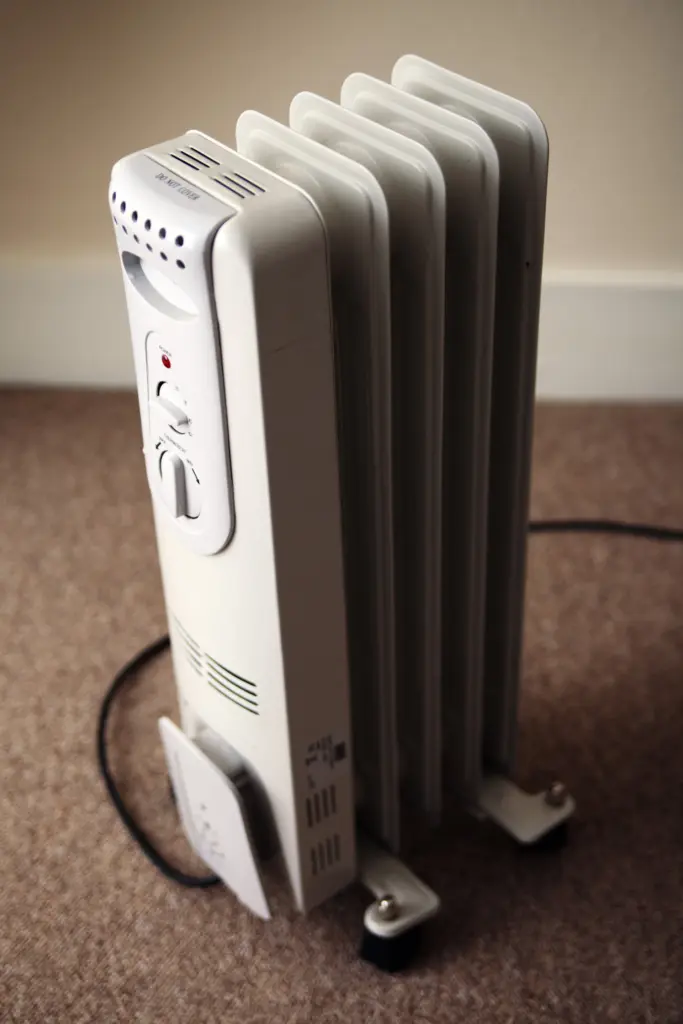
An oil-filled radiator is an electric heater. The heating element warms a permanently sealed special oil, which releases the heat via the fins. There is no fan, so it stays quiet, and after it is switched off, it keeps radiating for a while. De’Longhi cites exactly this as an advantage: oil-filled radiators store heat longer than other electric heaters. That does not change the efficiency. Every kilowatt-hour of electricity becomes one kilowatt-hour of heat, no matter how many fins the device has. The same applies to an electric fireplace (in German) with a fan heater that also displays a flame effect. We compare fan heaters and infrared panels under infrared heating and fan heaters (in German).
The costs are quickly calculated: power in kilowatts times hours times the electricity price. In its calculation example, the German consumer advice center Verbraucherzentrale assumes 40 cents per kilowatt-hour (as of July 2025). A radiator on the highest setting at 2 kilowatts therefore costs 80 cents per hour. If it runs for four hours in the evening and the thermostat switches it off about half of that time, you are left with an average of 1 kilowatt times 4 hours, so 4 kilowatt-hours or 160 cents a day. Over a month with 30 evenings, that is just under fifty euros. Half the running time is our assumption. It depends heavily on insulation and outdoor temperature, and you will find your actual price on your electricity bill.
That is why the Verbraucherzentrale classifies portable heaters clearly: use them only in limited spaces and for limited periods. For a home office in spring or fall, or a rarely used guest room, that fits. By the way, an oil-filled radiator does not belong in the bathroom: both manufacturers prohibit operation in the immediate vicinity of a bathtub or shower. As a replacement for central heating, it gets expensive.
You are more likely to save on your main heating; the Verbraucherzentrale cites around six percent less consumption per degree of room temperature. How this can be controlled automatically is shown in our guide to smart radiator thermostats (in German). And if it is really only you who is cold on the couch, an electric blanket (in German) warms your body instead of the whole room, at a fraction of the power.
Step two: Choose power and features to match the room
De’Longhi specifies rooms up to 60 cubic meters for 2,000 watts and up to 75 cubic meters for 2,500 watts. With a ceiling height of 2.50 meters, that corresponds to about 24 and 30 square meters. Older buildings with single-glazed windows need more.
More important than the maximum output, however, is the lowest setting. Güde’s 1,500-watt model starts at just 600 watts, while the 2,500-watt model only starts at 1,000 watts. More fins mean more surface area and more oil; the device takes longer to heat up and holds the heat longer.
Without a thermostat, the radiator heats until you switch it off. A mechanical rotary knob is enough; an electronic one with a temperature display is more precise. A built-in timer is the safe way to run the radiator on a schedule; the reason follows shortly. According to the manual, De’Longhi’s frost protection holds about 5 degrees Celsius. That makes sense for rarely used rooms that should not cool down completely.
Step three: Check tip-over switch, clearance and outlet
A tip-over switch cuts the power as soon as the device falls over. Güde describes it exactly this way in the manual for the OR series and advises letting the device cool down before setting it upright again. De’Longhi does not list a tip-over switch for the Dragon 4 Pro, but explicitly requires the radiator to be operated only in an upright position. If you have children or pets, you should look out for tip-over protection.
The placement rules are stricter than many people think. Güde requires 90 centimeters of clearance from furniture and flammable objects, no unattended operation and no placement directly below a wall outlet. Both manufacturers prohibit covering the device; De’Longhi also prohibits drying laundry on it and operating it in rooms smaller than 4 square meters. Güde rules out power strips. The R+V Infocenter, the information service of a German insurer, explains why: standard power strips are rated for 3,500 watts, so with a heater and another powerful appliance, overload is inevitable.
One point that hardly any buyer has on their list: both Güde and De’Longhi prohibit operation via an external timer switch in their manuals. That also applies to a smart plug (in German) if it is meant to switch the radiator on and off. The reason given is the overheating protection and the risk of fire if the device is set up incorrectly. So if you want timed heating, buy a model with a built-in timer.
Five oil-filled radiators with documented manufacturer data
| Model | Power (settings) | Fins | Timer / tip-over protection | Best for |
|---|---|---|---|---|
| Güde OR 2000-9 DT | 2,000 W (800/1,200/2,000) | 9 | Auto-off 1–24 h / yes | Home office and guest room |
| Güde OR 2000-9 | 2,000 W (800/1,200/2,000) | 9 | no / yes | Anyone who only wants rotary knobs |
| Güde OR 1500-7 | 1,500 W (600/900/1,500) | 7 | no / yes | Small rooms, supplementary heat |
| Güde OR 2500-11 DT | 2,500 W (1,000/1,500/2,500) | 11 | Auto-off 1–24 h / yes | Larger rooms |
| De’Longhi Dragon 4 Pro TRDX41025E | 2,500 W (3 settings, min. 1,100) | 10 | 24-h timer / not mentioned on the manufacturer’s site | Living spaces, frost protection, eco |
Güde OR 2000-9 DT
Nine fins, 2,000 watts spread over three settings, a display with electronic temperature control and an auto-off time between 1 and 24 hours. According to the manual, tip-over and overheating protection are built in. Based on De’Longhi’s rule of thumb for 2,000 watts, that is enough for rooms of up to a good 20 square meters, and that is the size people search for most often. The timer only switches off. It cannot switch on at a fixed time, so if you want a warm home office in the morning, you have to do it yourself.
Güde OR 2000-9
Technically the same radiator without a display and timer, but with two setting switches and a continuously variable thermostat knob. If you only use it when you are in the room anyway, you lose little. If you forget it in the evening, you will regret the missing timer.
Güde OR 1500-7
The smallest model in the series: seven fins, 7.3 kilograms, settings from 600 watts. According to Güde, a thermostat and tip-over switch are on board, but no timer. It can handle a small room or some supplementary heat, but hardly a living room in January.
Güde OR 2500-11 DT
Eleven fins, 2,500 watts, display and auto-off time like the smaller DT model. Güde states a noise level of 30 dB. At 12.4 kilograms, it relies on casters, which have to be fitted before first use. Small rooms? It is oversized for those, because the lowest setting is already 1,000 watts.
De’Longhi Dragon 4 Pro TRDX41025E
Ten fins, 2,500 watts, a timer with start and stop times in a 24-hour grid, eco function, frost protection and child lock, according to the manufacturer’s website. So this timer can also switch on. That is the biggest difference from the Güde models. De’Longhi does not list a tip-over switch. Price-wise, the device is one of the expensive ones, but for rooms that need to be pre-warmed regularly on a schedule, the premium can be justified.
Which radiator for which room?
For home offices and guest rooms of up to around 20 m², the Güde OR 2000-9 DT is the right fit, with reserves for poorly insulated rooms: timer and tip-over protection, without paying for power the room does not need. If the device only runs while you are present and can do without electronics, the Güde OR 2000-9 is enough. For a small room or supplementary heat, there is the Güde OR 1500-7.
From about 25 m², the Güde OR 2500-11 DT is an option, provided the 90 centimeters of clearance are feasible. The De’Longhi Dragon 4 Pro offers timed pre-heating and frost protection, but it lacks the tip-over switch. And as permanent heating for your home? None of them. That gets expensive.
When a convector is suitable as emergency heating and when the math stops working is covered in our guide to convector heaters (in German).
Frequently asked questions
How many watts does an oil-filled radiator need for my room?
De'Longhi specifies rooms up to 60 cubic meters for 2,000 watts and up to 75 cubic meters for 2,500 watts. With a ceiling height of 2.50 meters, that corresponds to about 24 and 30 square meters; older buildings with single-glazed windows need more. The lowest setting matters too: Güde's 1,500-watt model starts at 600 watts, the 2,500-watt model only at 1,000 watts.
Does an oil-filled radiator heat more economically than a fan heater?
No. Every kilowatt-hour of electricity becomes one kilowatt-hour of heat, no matter how many fins the device has. An oil-filled radiator just stores the heat longer and keeps radiating after it is switched off. The German consumer advice center Verbraucherzentrale advises using portable heaters only in limited spaces and for limited periods.
How do you calculate the electricity costs of an oil-filled radiator?
Power in kilowatts times hours times the electricity price. At 2 kilowatts on the highest setting, four hours in the evening and a thermostat that switches off about half the time, that leaves around 4 kilowatt-hours a day. The actual running time depends heavily on insulation and outdoor temperature; you will find your price on your electricity bill.
Can you plug an oil-filled radiator into a timer switch or smart plug?
Güde and De'Longhi prohibit operation via an external timer switch in their manuals, and that also applies to a smart plug. The reason given is the overheating protection and the risk of fire. If you want timed heating, buy a model with a built-in timer, such as the De'Longhi Dragon 4 Pro, which can also switch on.
What safety rules apply to oil-filled radiators?
Güde requires 90 centimeters of clearance from furniture and flammable objects, no unattended operation and no power strip. Both manufacturers prohibit covering the device and operating it near a bathtub or shower. A tip-over switch shuts it off if the device falls over; with children or pets, you should look out for this feature.
Sources
- Güde: Original operating manual OR 1500-7, OR 2000-9, OR 2000-9 DT, OR 2500-11 DT
- De’Longhi: Dragon 4 Pro TRDX41025E
- De’Longhi: Oil-filled radiator user manual (German)
- De’Longhi: How much does it cost to run a heater? (in German)
- Verbraucherzentrale: Saving energy on a small budget (calculation example 40 cents/kWh, in German)
- Verbraucherzentrale: Fan heaters only in limited spaces and for limited periods (in German)
- R+V Infocenter: Power strips, the underestimated fire hazard (in German)
Where to buy
- Güde OR 2000-9 DTCheck price at Amazon.de
- Güde OR 2000-9Check price at Amazon.de
- Güde OR 1500-7Check price at Amazon.de
- Güde OR 2500-11 DTCheck price at Amazon.de
- De'Longhi Dragon 4 Pro TRDX41025ECheck price at Amazon.de