Contents12 sections
This guide was first published in German on handgetestet.de.
If you buy open-back headphones, you buy them for use at home. That sounds trivial, but it decides almost everything. The ear cups are closed off at the back with nothing but a grille, so music leaks out and outside noise gets in. For quiet evenings at the desk or in an armchair, we consider the Sennheiser HD 600 the most sensible place to start, provided you have an amplifier with enough voltage. Without an additional device, the Beyerdynamic DT 1990 PRO MKII copes more easily with its 30 ohms.
On the train, in an open-plan office or next to someone who wants to sleep, an open-back model is out of place. Clarify that beforehand and you avoid a bad purchase that no accessory can fix.
What „open“ changes when you listen
Open means there is no closed shell behind the driver, just a grille. Sennheiser describes the ear cups of the HD 600 as acoustically transparent so that every sound wave can spread freely, and promises a natural, spacious sound.
Soundstage refers to how wide and how precisely instruments appear to be placed inside your head. None of the data sheets in this comparison gives a figure for it. A lot depends on the recording and on how the pads sit. So read manufacturer terms such as „spacious“ or „wide“ as a direction, not a promise.
And the bass? Here, too, a look at the data sheet pays off. AKG advertises bass reproduction improved by three decibels for the K712 PRO, and Sennheiser specifies a frequency response starting at 8 Hz for the HD 660S2. Such figures are only comparable to a limited extent: for the HD 660S2, Sennheiser measures the limit at the point where the level has dropped by 10 dB.
Dynamic or planar?
A dynamic driver works like a small loudspeaker. A voice coil at the magnet moves the diaphragm; according to HiFiMan, only part of the surface is driven directly. Sennheiser, AKG and Beyerdynamic build their models in this guide this way.
With planar magnetic headphones, on the other hand, the conductive traces are spread wafer-thin across the entire film, with magnets in front of it. In the manual for the Edition XS, HiFiMan explains that this drives the diaphragm evenly and with less distortion. That is a manufacturer claim. What can be read off clearly, by contrast, is the weight: the Edition XS weighs 405 grams, an HD 600 260 grams according to Sennheiser. On evenings with full-length operas, that is no minor detail.
It shouldn’t become a matter of faith. Beyerdynamic shows how much even small things matter: the DT 1990 PRO MKII comes with two sets of ear pads that, according to the manufacturer, sound different.
Impedance, voltage and the question of the amplifier
This is where it gets technical. A 300-ohm headphone won’t necessarily sound quiet on a laptop. But it may not get enough voltage for strong peaks, and then the amplifier hits its limit before the headphone does. Sensitivity referenced to one volt says more than the ohm rating.
A worked example using the manufacturer specifications. According to Sennheiser, the HD 600 reaches 97 dB at 1 volt. So for 100 dB it needs around 1.4 volts, and for peaks of 110 dB about 4.5 volts. At 104 dB per volt, the HD 660S2 is considerably more sensitive and gets by with around 2 volts for the same 110 dB. The AKG K712 PRO is similar at 105 dB per volt. According to the manufacturer, the Beyerdynamic DT 1990 PRO MKII achieves 94 dB with one milliwatt; at 30 ohms, that corresponds to just over 109 dB per volt.
The HiFiMan Edition XS shows why the ohm rating alone is misleading. At 18 ohms, it seems easy to drive. It isn’t. Based on its rating of 92 dB, it needs around 6 milliwatts for 100 dB, a similar amount of power to the HD 600, just as current instead of voltage. An output that delivers little current can hit its limit even though the ohm figure looks harmless.
The practical rule: look at the data sheet of your DAC or amplifier and compare its output voltage and power at the matching impedance with the figures above. What desktop devices and USB DACs deliver, and what matters with output impedance, is explained in our guide to headphone amplifiers and DACs.
Volume and hearing
Open-back headphones let ambient noise through. In noisy rooms, it is tempting to turn up the volume. For portable players, the German Environment Agency (Umweltbundesamt) cites music levels of up to 110 dB(A) and recommends choosing a moderate volume. For comparison: in the workplace in Germany, the rated noise level over eight hours may not exceed 85 dB(A). The agency considers unusual ringing in the ears after listening a warning sign, and quiet periods below 70 dB(A) help with recovery. A powerful amplifier is therefore no license. Listening at lower volume protects your hearing.
Five open-back headphones compared
| Model | Driver | Impedance and sensitivity | Weight | Best for |
|---|---|---|---|---|
| Sennheiser HD 600 | dynamic, 42 mm | 300 Ω, 97 dB at 1 V | 260 g | Balanced starting point with an amplifier |
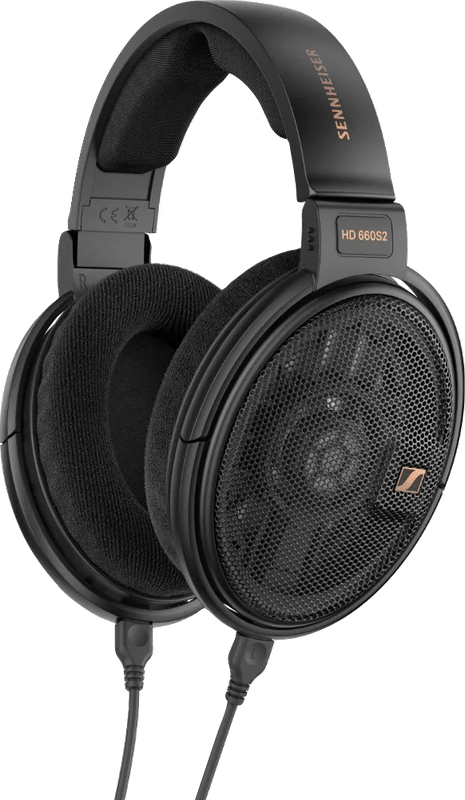
| Sennheiser HD 660S2 | dynamic | 300 Ω, 104 dB at 1 V | approx. 260 g | More sensitive, with 4.4 mm cable |
| Beyerdynamic DT 1990 PRO MKII | dynamic, 45 mm | 30 Ω, 94 dB at 1 mW | 376 g | Without an amplifier, also for mixing |
| AKG K712 PRO | dynamic | 62 Ω, 105 dB at 1 V | 235 g | Light, for long sessions |
| HiFiMan Edition XS | planar magnetic | 18 Ω, 92 dB | 405 g | Getting into planar with a powerful amplifier |
Sennheiser HD 600
According to Sennheiser, the HD 600 has been around for more than 20 years, and it is assembled in Ireland. The key specs are simple: 42-millimeter driver, 300 ohms, 97 dB at 1 volt, 260 grams, detachable three-meter cable with adapter. The manufacturer describes it as a headphone for analytical listening. If you are looking for neutrally tuned reproduction and own an amplifier with a few volts of headroom, you will find little reason to spend more. We would not buy it without an amplifier.
Sennheiser HD 660S2
Same impedance, higher sensitivity. And more accessories. According to the quick guide, the frequency response ranges from 8 to 41,500 Hz, sensitivity is 104 dB per volt and total harmonic distortion is at most 0.04 percent. The box contains two 1.8-meter cables, one with a 6.35 mm jack and one with a balanced 4.4 mm plug. So if you already own an amplifier with a 4.4 mm output, you don’t need any accessories. If you have weaker sources, you also benefit from the higher sensitivity. It is not a must-have upgrade from the HD 600.
Beyerdynamic DT 1990 PRO MKII
With 30 ohms and two sets of ear pads, this is the most flexible candidate. According to Beyerdynamic, the „Producing“ pads are meant to deliver a bit more bass, while the „Mixing & Mastering“ version sounds more analytical. Add to that a straight three-meter cable, a five-meter coiled cable, a hard-shell case and a locking mini XLR connector. It is made in Germany, and according to the manufacturer, the drivers come from Heilbronn. At 376 grams, however, it weighs a good 110 grams more than the two Sennheisers.
AKG K712 PRO
Light. At 235 grams without the cable, the K712 PRO is the lightest headphone in the comparison. AKG specifies 62 ohms, 105 dB per volt and a power handling of 200 milliwatts; on top of that come a mini XLR connector, a coiled cable and a pouch. For peaks of 110 dB, that works out to around 1.8 volts: the data sheet of your DAC or audio interface tells you whether it delivers that. AKG covers the headband in genuine leather; if you don’t want that, take a look at the other models.
HiFiMan Edition XS
The only planar headphone in this comparison. HiFiMan relies on specially shaped „Stealth“ magnets that are meant to obstruct the sound less, and a very thin diaphragm. According to the manual: 18 ohms, 92 dB, 8 Hz to 50 kHz, 405 grams, 1.5-meter cable with a 3.5 mm plug. The low sensitivity makes a high-current amplifier sensible. There is now a version with a new headband, so pay attention to the model name when buying.
How we would decide
- You already have a headphone amplifier or are planning to get one: Sennheiser HD 600, or the HD 660S2 if your device has a 4.4 mm output or delivers little voltage.
- You listen directly from your computer or audio interface: Beyerdynamic DT 1990 PRO MKII, because of its 30 ohms and the two sets of pads.
- You wear your headphones for hours: AKG K712 PRO as the lightest model.
- You want to listen planar: HiFiMan Edition XS, provided the 405 grams don’t bother you and a high-current amplifier is at hand.
If, on the other hand, you listen on the go or in a noisy environment, take a look at closed-back designs, for example in our guide to studio headphones (in German).
Frequently asked questions
What is the difference between open-back and closed-back headphones?
With open-back headphones, there is no closed shell behind the driver, just a grille. Music leaks out and outside noise gets in. On the train, in an open-plan office or next to someone sleeping, an open-back model is out of place; closed-back designs are the better fit there.
Which is better, planar or dynamic?
It shouldn't become a matter of faith. According to HiFiMan, planar drivers move the diaphragm more evenly; that is a manufacturer claim. Weight is easy to read off: the planar Edition XS weighs 405 grams, the dynamic HD 600 260 grams according to Sennheiser.
Do I need an amplifier for 300-ohm headphones?
Usually, yes. On a laptop, they won't necessarily sound quiet, but they may not get enough voltage for peaks. The HD 600 needs around 4.5 volts for 110 dB. Sensitivity referenced to one volt says more than the ohm rating.
Are low-impedance headphones automatically easy to drive?
Not necessarily. The HiFiMan Edition XS has only 18 ohms but needs around 6 milliwatts for 100 dB, a similar amount of power to the HD 600, just as current instead of voltage. An output with little current can hit its limit.
Which open-back headphones are suitable for long listening sessions?
At 235 grams without the cable, the AKG K712 PRO is the lightest headphone in the comparison. AKG specifies 62 ohms and 105 dB per volt. The data sheet of your DAC or audio interface tells you whether it delivers enough voltage. The headband is covered in genuine leather.
How loud can I listen through headphones?
The German Environment Agency recommends a moderate volume. In the workplace, the rated noise level over eight hours may not exceed 85 dB(A). Unusual ringing in the ears after listening is considered a warning sign. Because open-back models let ambient noise through, it is tempting to turn up the volume.
Sources
- Sennheiser: HD 600, product page with technical data
- Sennheiser: HD 660S2, quick guide with technical data (PDF)
- Beyerdynamic: DT 1990 PRO MKII
- AKG: K712 PRO, data sheet (PDF)
- HiFiMan: Edition XS, user manual (PDF)
- Pragmatic Audio: HiFiMan Edition XS, review with measurements (December 2024)
- German Environment Agency: Hearing damage
Where to buy
- Sennheiser HD 600Check price at Amazon.deAvailable in Germany: Amazon.de
- Beyerdynamic DT 1990 PRO MKIICheck price at Amazon.deAvailable in Germany: Amazon.de
- Sennheiser HD 660S2View at CoolblueAvailable in Germany: CoolblueCheck price at Amazon.deAvailable in Germany: Amazon.de
- AKG K712 PROCheck price at Amazon.deAvailable in Germany: Amazon.de
- HiFiMan Edition XS (mit Reiseetui)Check price at Amazon.deAvailable in Germany: Amazon.de