Contents15 sections
This guide was first published in German on handgetestet.de.
What works as backup power when the grid goes down? Not a cheap open-frame unit without an inverter, at least not once a laptop, router and heating control need to run on it. For backup power at home and in the workshop, a portable inverter with around 3 kW of continuous output, such as the Scheppach SG3500i, is usually enough. If you only need lights, a cooler and phones, the 2 kW class will do. And however quiet a unit may be, it only ever runs outdoors.
How much output do I really need?
Germany’s Federal Office of Civil Protection and Disaster Assistance (BBK) advises deciding before you buy which devices should run at the same time. Anything that produces heat eats power: according to the BBK, a kettle, fan heater or hot plate can easily draw 1,500 to 2,000 watts each. A kettle alone therefore pushes a 2 kW unit to its limit.
Calculate with the continuous output, not the peak. Manufacturers like to quote the highest number: Scheppach lists 3,500 watts peak for the SG3500i, while the rated output is 3,000 watts. Plan with the rated output.
Do I need an inverter?
As soon as electronics are connected, yes. According to the BBK, computers and heating controls need a generator that keeps voltage and frequency sufficiently stable. Inverters are built for exactly that. In its catalog, Güde explicitly warns against connecting laptops or smartphones to its simple open-frame units.
How heavy can it be, how long does it need to run?
Between 13 kg (Honda EU10i) and 32 kg (Güde ISG 3200-2) there is a world of difference when the unit has to come up from the basement into the yard. From about 30 kg, wheels help. The tank quickly becomes the bottleneck. According to Scheppach, the small tank of the SG2500i lasts around three hours at full load, so for a night of backup power you need spare fuel.
Carbon monoxide: why the generator belongs outside
The BBK is unambiguous here. Generators must not be operated indoors, because the exhaust fumes pose a risk of suffocation. A well-ventilated, dry spot outdoors is suitable. In the manual for the SG3500i, Scheppach calls the engine exhaust toxic and prohibits operation in unventilated rooms; even with an exhaust hose, toxic fumes could escape. The manual for the SG3200 is even clearer: the exhaust contains carbon monoxide, a toxic, odorless and colorless gas that can be fatal. Garage, basement and garden shed are therefore off limits, even with the door open. The BBK generally recommends certified carbon monoxide detectors that sound an alarm at critical concentrations.
A detail many people overlook: the cable has to get into the house. The BBK points out that this means open windows or doors, with consequences for heat and burglary protection. Plan the cable route before the power goes out.
Feeding the house wiring only through a licensed electrician
Plugging the generator into a wall outlet with an adapter to power the whole house is life-threatening. According to the BBK, work on the home’s electrical installation may only be carried out by licensed electricians. Power is fed in via a manual or automatic transfer switch, and the grid operator should be informed. If it is done wrong, there is a risk of death for the occupants and for line workers working on the grid outside. In the manual for its small inverters, Güde even states explicitly: do not connect to the house wiring. Without a transfer switch, power individual devices via extension cords.
Gasoline, gas and the question of storage
Almost all portable inverters run on gasoline. Dual-fuel units such as the Einhell TE-IG 1900 DF also take LPG, but deliver less on it: 1,600 instead of 1,800 watts of continuous output. Storage is often the deciding factor. According to the BBK, no more than 10 kg of gasoline may be kept in suitable cans in the basement, and gas may not be stored there at all. If you have no room for gas cans but already use a gas cylinder in the garden, dual fuel is a real advantage.
Noise: two numbers that don’t match
Hardly comparable, unfortunately. Some manufacturers state the sound power level (LWA), others the sound pressure at a distance of seven meters. For the SG2500i, both appear on the spec sheet: around 92 dB sound power and around 72 dB(A) sound pressure. Same unit, twenty decibels apart. So only compare like with like. For neighbors and apartment buildings, the BBK explicitly recommends a quiet model.
And if it has to run indoors? Then the answer is a portable power station, not a generator. It is quiet and emission-free, but its battery eventually runs flat. When each solution makes sense is covered in our guide to buying a power station (in German).
Five inverter generators side by side
| Model | Continuous / peak output | Weight | Fuel, noise | Best for |
|---|---|---|---|---|
| Scheppach SG3500i | 3,000 W / 3,200 W | 22.5 kg | Gasoline, 66 dB(A) at 7 m, LWA 96 dB | Backup power and workshop |
| Scheppach SG2500i | 1,600 to 1,800 W / 2,000 W | 18.5 kg | Gasoline, LWA 92 to 95 dB | Small needs, small budget |
| Güde ISG 3200-2 | 3,200 W / 3,500 W | 32 kg | Gasoline, LWA 92 dB | Long runtime, rolling instead of carrying |
| Einhell TE-IG 1900 DF | 1,800 W / 1,900 W (gas 1,600 / 1,700 W) | 23.7 kg | Gasoline or LPG | Anyone who doesn’t want to store gasoline |
| Honda EU10i | 1.0 kVA max. | 13 kg | Gasoline, LWA 83 to 87 dB | Camping, router, lights |
All figures according to the manufacturers, as of October 2026.
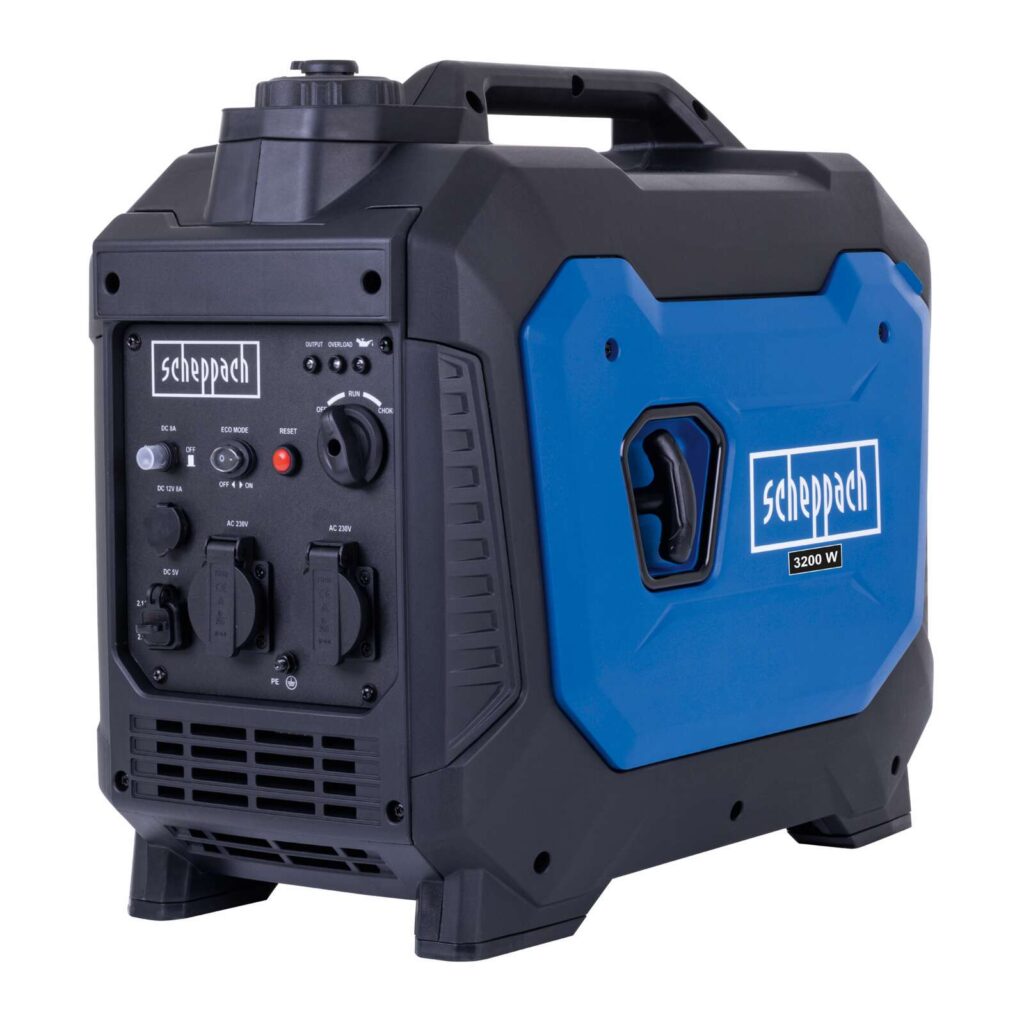
Scheppach SG3500i
Three kilowatts of rated output at 22.5 kg is a lot for a portable suitcase-style inverter. It runs a refrigerator, lights and router, with headroom for a power tool or a kettle for a moment. The tank holds 6.3 liters, which according to Scheppach is enough for 3.6 hours at full load or 14 hours with no load. Downsides: there is only a recoil starter, and the 66 dB(A) quoted in the shop applies at seven meters and a quarter load. The manual states a sound power level of 96 dB.
Scheppach SG2500i
In the manufacturer’s shop, the little brother costs significantly less than the SG3500i and weighs 18.5 kg. Annoyingly, Scheppach gives the continuous output once as 1,600 and once as 1,800 watts. Assume the lower figure. For tools with a high inrush current or for heaters, it is too tight.
Güde ISG 3200-2
With 3,200 watts of continuous output and a 7.8-liter tank, the Güde is built for endurance: 7.5 hours at half load according to the catalog. At 32 kg, nobody enjoys carrying it, but it has a trolley function. A parallel port lets you link two inverters, and a button restarts it after an overload.
Einhell TE-IG 1900 DF
It is the only inverter here that runs on two fuels. According to Einhell, it delivers 1,800 watts continuously on gasoline and 1,600 watts on gas. The 4.2-liter tank lasts 5.9 hours at two-thirds load. If you only ever fill up with gasoline anyway, you are paying for a feature you don’t need.
Honda EU10i
Honda is the most expensive brand in this comparison. According to Honda’s price list, even the small EU10i sits in a higher price bracket than the SG3500i, which has three times the output, in Scheppach’s shop. The EU10i delivers only 1 kVA, weighs 13 kg and, according to Honda, reaches 83 to 87 dB sound power. For backup power at home, that is not much. It handles camping, a router and a few lamps. Amazon.de currently does not carry the larger EU22i (2.2 kVA, 21.1 kg) as its own listing.
Which generator fits which need?
Backup power for refrigerator, lights and router, plus the workshop: Scheppach SG3500i. Few devices, little money: then the Scheppach SG2500i will do, as long as you keep its limited continuous output in mind. For long runtimes without refueling, the Güde ISG 3200-2 makes sense, provided the weight is not a problem.
If you have no room for gas cans, go for the Einhell TE-IG 1900 DF with LPG. And for camping and small stuff? Honda EU10i, or a power station instead.
If you keep working in the yard after dark, you will also need light. Suitable lamps are in our work light guide (in German).
Quiet and emission-free for indoor renovation work: see our guide Power stations for the job site (in German).
We weigh noise, exhaust and costs against each other in the guide Power station or generator (in German).
Torn between the two Scheppach inverters? How far apart their continuous output is becomes clear in the direct comparison Scheppach SG3500i or SG2500i (in German).
Frequently asked questions
How much output does a generator need for backup power?
According to Germany's Federal Office of Civil Protection and Disaster Assistance (BBK), decide beforehand which devices should run at the same time. A kettle, fan heater or hot plate can easily draw 1,500 to 2,000 watts each, and a kettle alone pushes a 2 kW unit to its limit. Plan with the rated output, not the peak figure manufacturers like to put up front.
Do I need an inverter generator?
As soon as electronics are connected, yes. According to the BBK, computers and heating controls need a generator that keeps voltage and frequency stable, and inverters are built for that. Güde explicitly warns against connecting laptops or smartphones to its simple open-frame units.
Can a generator run in the garage?
No. According to the BBK, generators must not be operated indoors because the exhaust fumes pose a risk of suffocation. The exhaust contains carbon monoxide, an odorless and colorless gas that can be fatal. Garage, basement and garden shed are off limits, even with the door open. The BBK also recommends certified carbon monoxide detectors.
Can a generator be connected to the house wiring?
Plugging it into a wall outlet with an adapter is life-threatening. According to the BBK, work on the home's electrical installation may only be carried out by a licensed electrician, power is fed in via a transfer switch, and the grid operator should be informed. Without a transfer switch, power individual devices via extension cords.
What is the advantage of a dual-fuel generator?
Units such as the Einhell TE-IG 1900 DF run on gasoline or LPG, but deliver less continuous output on gas. The advantage lies in storage: according to the BBK, no more than 10 kg of gasoline may be kept in suitable cans in the basement. If you have no room for cans and already use a gas cylinder in the garden, you benefit.
How do you compare generator noise levels?
Only compare like with like. Some manufacturers state the sound power level, others the sound pressure at a distance of seven meters. For the Scheppach SG2500i, both appear on the spec sheet, with a difference of around twenty decibels for the same unit. For neighbors and apartment buildings, the BBK recommends a quiet model.
Sources
- BBK: Power outages. Preparedness and self-help (in German)
- BBK: Self-sufficient backup power for the public (in German)
- BBK: Preparing for crises and disasters (in German)
- Scheppach: SG3500i
- Scheppach: SG2500i
- Scheppach: operating manual, SG3500i inverter generator
- Scheppach: user manual, SG3200 generator (carbon monoxide warning)
- Güde: generator catalog
- Güde: operating manual, ISG 1000 / ISG 2000
- Einhell: TE-IG 1900 DF
- Honda: generator price list 2024/2025 with technical data
Where to buy
- Scheppach SG3500iView at scheppachCheck price at Amazon.de
- Scheppach SG2500iView at scheppachCheck price at Amazon.de
- Güde ISG 3200-2Check price at Amazon.de
- Einhell TE-IG 1900 DFCheck price at Amazon.de
- Honda EU10iCheck price at Amazon.de