Contents22 sections
This guide was first published in German on handgetestet.de.
A sleek low-wing plane in fighter-jet style looks great in the box. As a first RC airplane, it lies in pieces on the grass after a few takeoffs. To learn to fly, you want a forgiving high-wing plane with stabilization, bought as a complete set with a transmitter: for example the HobbyZone Carbon Cub S 2 as RTF Basic or, with a club and instructor behind you, the E-flite Apprentice STS. If you want to start without registration on a big meadow behind the house, take the HobbyZone Apprentice STOL S at 157 grams. You need insurance in any case.
This guide explains the abbreviations on the box, covers stabilization, airframe types and batteries, what has to be done in Germany before the first takeoff, and seven current models plus a simulator. The technical specifications come from the manufacturers. If you would rather take off with a camera, you are better off starting with the guide buying a drone (in German).
RTF, BNF, PNP, ARF: what is missing from the box
Three or four letters on the box. They decide whether you fly this weekend or go shopping first.
- RTF (Ready to Fly): airplane, transmitter, receiver, usually battery and charger. Careful with „RTF Basic“ from E-flite and HobbyZone: according to the manufacturer, battery and charger are not included.
- BNF (Bind-N-Fly): The receiver is installed, the transmitter is missing. With Horizon Hobby, it has to be a Spektrum transmitter with DSMX.
- PNP (Plug-N-Play): Motor, speed controller and servos are installed. You get the transmitter, receiver, battery and charger yourself.
- RR (Ready for Radio), ARF or kit: common with Multiplex and with wooden models. Radio and battery, and with a kit often motor and servos too, have to be added.
For getting started, RTF is almost always right. BNF and PNP only pay off once you have a transmitter in the cupboard. That is not a detail: a good transmitter stays with you across many models, while the first airplane usually lasts only one season.
How much help do you need at the start?
More than you think. And less and less over time.
Horizon Hobby distinguishes two levels. AS3X dampens wind and gusts but does not level the model by itself. SAFE builds on that. The manual for the Apprentice STS describes exactly what the three flight modes do. In „Beginner“ mode, climb and bank angles are limited; let go of the sticks and the plane returns to level flight. „Intermediate“ allows larger angles but no longer levels itself; below about 30 meters altitude, the Apprentice STS automatically switches back to Beginner. „Experienced“ has no limits at all, loops and inverted flight included.
SAFE also has a panic switch. At the push of a button, the panic recovery brings the model into a safe attitude if you have lost orientation. It will not help against a tree. Against a model that suddenly hangs in an unfamiliar attitude, it certainly does.
Other manufacturers work similarly. At Amewi, the switch is called 6G for the stabilized beginner mode and 3D for aerobatics; Volantex calls its three-level system Xpilot, and FMS calls its stabilization Reflex V3. The learning effect always comes about the same way: you switch the assistance off step by step.
If you learn at a club, look for one more feature. According to the manuals, the Apprentice STS and the Carbon Cub S 2 can be linked to a trainer transmitter. The instructor holds the second transmitter, hands over control with a switch and takes over again immediately when things get tight. There is no faster way to learn.
High wing, low wing, nose wheel: why the wing should sit on top
With the wing on top, the fuselage hangs below it like a pendulum, and the model tends to right itself. A low-wing plane reacts more directly and is less forgiving. In aerobatics, that is intended. On your first landing, it is not.
The landing gear matters too. A nose wheel like the one on the Apprentice STS keeps the plane straight while taxiing and prevents it from tipping onto its nose on touchdown. On tall grass, a small model has trouble rolling for takeoff; then it is hand-launched or started from a mowed strip. Ask at the club what the runway is like.
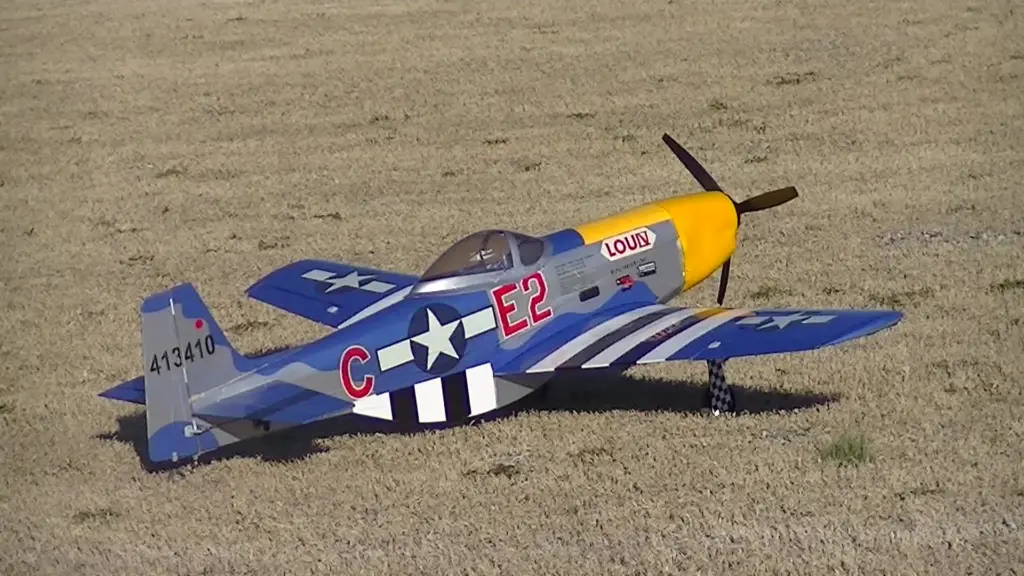
Warbirds, meaning replicas of fighter planes such as the T-28 or the Mustang, are almost always low-wing planes with high flying speeds. They belong in your second or third year, not in your first box.
Foam or wood?
Almost all beginner models today are made of foam. EPO and the similar Elapor from Multiplex can be repaired with super glue or special foam glue; EPP, as on the Amewi Skylark, is even tougher and absorbs impacts. A broken foam wing is no drama, and the manufacturers sell spare parts from the fuselage to the cowling.
Wooden models covered with film are lighter, often fly more beautifully and last for decades if you look after them. In return, they need tools, time and some experience to repair. As a second or third model they are a nice step, as a first one rather not.
Which wingspan?
Bigger flies more calmly. A plane with a 1.5-meter wingspan and a good 1.6 kilograms, like the Apprentice STS, is much more stable in wind than a 700-millimeter flyer at 157 grams. It also looks slower in the air and is easier to see, which helps while learning.
Small has other advantages. The Apprentice STOL S fits in the car without folding down the back seat and stays below the registration threshold. For the Skylark, Amewi specifies force 4 on the Beaufort scale as the maximum permissible wind. For most small foam flyers, that means calm evenings, not autumn storms.
Large models need a large field. Practicing with a 1.5-meter wingspan on a neighborhood soccer field between houses is not a good idea, neither legally nor practically.
Gliders and motor gliders
Gliding offers a path into the hobby of its own. Motor gliders such as the Multiplex EasyStar 3 have a motor that is switched off after the climb; then the model glides long and quietly. Multiplex specifies up to 40 minutes of flight time without thermals with the recommended 3S battery with 2200 mAh. The motor sits behind the wing and is well protected during rough landings.
The price for this calm is the setup. The EasyStar 3 comes as RR; you buy receiver, transmitter, battery and charger separately, and there is no mention of a gyro. With experienced help during setup, it is still one of the most forgiving models you can buy.
Practice on a simulator first
The manual for the Carbon Cub S 2 strongly recommends practicing on a simulator before the first flight, with the included DXS transmitter and a WS2000 wireless dongle on the computer. Horizon even includes a trial version of RealFlight with the Apprentice STOL S. This is not self-promotion. On screen, a crash costs nothing, and the hardest thing about learning to fly is especially easy to train there: the mental switch when the model flies toward you and left suddenly becomes right.
According to Horizon Hobby, RealFlight Evolution runs on Windows 10 and 11, and the software comes via Steam. The set with the InterLink DX simulator controller includes everything. If you already own a Spektrum transmitter, according to the manufacturer you can also practice with a wireless simulator dongle for DSM2 and DSMX. Two or three weeks on the simulator often save you the first replacement wing.
If you are interested in simulators with a joystick or yoke, you will find them in the guide to flight simulator controls (in German). For RC flying, though, what counts is the transmitter in your hands.
Batteries, charger, transmitter
Almost all models fly on lithium polymer batteries. The cell count must match the manufacturer’s specification exactly, and so must the connector. The Apprentice STOL S flies on a 2S battery with 300 mAh, which the included USB-C charger fills in about 45 to 60 minutes, according to Horizon. The Carbon Cub S 2 needs a 3S battery with 2200 mAh and an IC3 connector, the Apprentice STS a 3S battery with 3200 to 4000 mAh. With these two sets, neither battery nor charger is in the box.
For the first flight with the Apprentice STS, Horizon recommends a five-minute timer on the transmitter; after that, you adjust it to your battery. Better to land with reserve than to have the speed controller cut power on final approach. And a second battery extends your flying day more than any other accessory.
Never charge unattended; use a balancer and a fireproof bag. Which chargers can do that and what storage voltage means is covered in the guide to the LiPo charger (in German).
For the transmitter, it is worth asking at the club before you order. Which stick layout do they fly there, Mode 1 or Mode 2? That saves you relearning later and is a prerequisite for trainer-student flying.
Spare parts: check before you buy
A beginner airplane breaks. The only question is whether you can then order a spare part or need a new airplane. For Horizon Hobby and Multiplex models, retailers offer fuselage, wing, canopy, landing gear, speed controller and propellers individually. With no-name models from East Asia, that is often harder. Before buying, check whether there is a spare parts list for your model, and put two propellers in your bag right away.
What has to be done in Germany before the first takeoff?
Legally, a model airplane is an unmanned aircraft, a UAS under EU law. The Luftfahrt-Bundesamt (LBA), the German Federal Aviation Office, says so explicitly in its answers on model flying. This results in four obligations, graded by weight and location. The following describes the rules in Germany.
First, insurance. Under Section 43 of the German Aviation Act (Luftverkehrsgesetz), every keeper of an aircraft needs liability insurance, and that also applies to a small foam model. Standard personal liability insurance often does not cover model aircraft. Carry the proof in your pocket when flying. The DMFV, a German model flying association, lists keeper liability insurance as mandatory for its members and charges a higher rate for models over 1000 grams outside model flying fields.
From 250 grams takeoff mass or with a camera on board, registration as an operator with the LBA is added; only toys within the meaning of the EU Toy Safety Directive are exempt. Registration costs a fee and remains valid until you delete it. Your registration number, the e-ID, must be visibly attached to the model; a clearly legible QR code is also allowed. It applies to all models you operate.
Also from 250 grams, the A1/A3 proof of competency is mandatory in the open category. It involves a free online course from the LBA and an exam with 40 questions; the certificate is valid for five years. Below 250 grams, the LBA still recommends the course.
In the open category, you fly no higher than 120 meters above ground and always within line of sight. On top of that, there are areas where special rules apply under Section 21h of the German Air Traffic Regulations (Luftverkehrs-Ordnung). An excerpt:
- within 1.5 kilometers of airfields only with approval, and within 1000 meters of airports not at all in the open category
- over nature reserves and national parks only with the approval of the nature conservation authority or under state law
- over residential properties only with the consent of the owner or occupant, unless the model weighs no more than 250 grams and cannot record anything
- 100 meters from autobahns and federal highways, railway facilities, industrial plants, hospitals and accident sites, unless an exception applies
- not over outdoor pools and swimming beaches during swimming and opening hours
Where these areas are is shown on the map of dipul, the digital platform for unmanned aviation run by the German Federal Ministry of Transport. That makes your own meadow at the edge of town off-limits sooner than many people think.
Things are different if you are a member of one of the two nationwide model flying associations, the DMFV or the MFSD. For their members, the LBA has issued an operational authorization under Article 16 of EU Regulation 2019/947. Then the association’s rules apply, the association handles registration, and under certain conditions you may also fly higher than 120 meters. According to the LBA, you need an association proof of knowledge from 120 meters altitude or above 2 kilograms takeoff mass. Without membership, the open or specific category applies; the association authorization is valid only in Germany.
The DMFV also lists distances everyone should know: do not fly over people and animals below 25 meters, and keep 50 meters lateral distance from crowds. For models with combustion engines, a 1.5-kilometer distance from residential areas applies unless the state aviation authority has granted permission. From 12 kilograms, every model needs a flight permit.
Our opinion on this is clear. Join a model flying club. There you get an approved field and often an instructor, and someone who sets up your model properly in ten minutes prevents more crashes than any gyro.
Is there a test from Stiftung Warentest?
An obvious question. Stiftung Warentest, the German product-testing foundation, briefly tried out remote-controlled electric planes in November 2005, toy models at the time such as the Jamara Park Flyer and a Nikko helicopter. That is no longer useful for a buying decision in 2026. We have not found a more recent comparison of beginner airplanes from the foundation. The main buying aids are therefore the manufacturer data, spare parts availability and what experienced pilots at the club say.
Seven beginner airplanes compared by the numbers
| Model | Type | Wingspan | Flying weight | Stabilization | Best for |
|---|---|---|---|---|---|
| HobbyZone Apprentice STOL S 700mm RTF | high wing, foam | 700 mm | 157 g | SAFE, AS3X | first flights without registration |
| HobbyZone Carbon Cub S 2 1.3m RTF Basic | high wing, foam | 1300 mm | 1285 g | SAFE, three modes | getting started with space and a field |
| E-flite Apprentice STS 1.5m RTF Basic | high wing, nose wheel | 1500 mm | 1672 g with 3S 4000 mAh | SAFE, three modes, panic switch | learning at a club with an instructor |
| Multiplex EasyStar 3 RR | motor glider, Elapor | 1366 mm | 700 g | none | long, calm flights |
| Amewi Skylark | high wing, EPP | 650 mm | 168 g | 6G and 3D | small first taste of the hobby |
| FMS PA-18 Super Cub 1300mm | scale high wing | 1300 mm | about 1450 g | Reflex V3 | second model, scale looks |
| Volantex T28 Trojan | low wing, warbird | 400 mm | about 60 g | Xpilot, three levels | close to a toy, park in calm weather |
| Model | Length | Battery according to manufacturer | In the box | Registration from 250 g | Price class |
|---|---|---|---|---|---|
| HobbyZone Apprentice STOL S 700mm RTF | 490 mm | 2S 300 mAh | complete with transmitter, battery, USB-C charger | no, without camera | entry level |
| HobbyZone Carbon Cub S 2 1.3m RTF Basic | 865 mm | 3S 2200 mAh, IC3 | DXS transmitter, no battery or charger | yes | midrange |
| E-flite Apprentice STS 1.5m RTF Basic | 1080 mm | 3S 3200–4000 mAh | DXS transmitter, no battery or charger | yes | midrange |
| Multiplex EasyStar 3 RR | not specified | 3S 2200 mAh, up to 40 min without thermals | no receiver, transmitter, battery, charger | yes | entry level plus radio |
| Amewi Skylark | 460 mm | 2S 500 mAh, about 8.5 min | complete with transmitter | no, without camera | entry level |
| FMS PA-18 Super Cub 1300mm | not specified | 3S 2200 mAh, XT60, about 5 min | mostly PNP, no radio or battery | yes | midrange plus radio |
| Volantex T28 Trojan | not specified | two 1S batteries | complete with transmitter | no, without camera | entry level |
Registration as an operator in Germany, as of November 2026; as an association member, the association registers you. A camera on board makes registration mandatory at any size.
HobbyZone Apprentice STOL S 700mm RTF: everything in the box
No set is more complete. According to the manufacturer, it includes the SLT6 transmitter, a 2S battery with 300 mAh, a USB-C charger and a trial version of the RealFlight simulator. With the battery, the model weighs 157 grams and thus stays below the registration and exam threshold as long as no camera flies along. Horizon explicitly prohibits any added payload, because the takeoff weight equals the weight with battery.
The low weight has consequences. On windy days, the STOL S is simply too light. It is the plane for calm evenings on a big meadow, and very well made for exactly that.
HobbyZone Carbon Cub S 2 1.3m RTF Basic: the high-wing plane for getting started
1.3-meter wingspan, 865 millimeters long, 1285 grams with the recommended 3S battery. According to Horizon Hobby, motor, 30 A speed controller with telemetry, servos, flight controller and receiver are installed, and the DXS transmitter is in the box. SAFE offers the three modes Beginner, Intermediate and Experienced, and a GPS module for SAFE Plus is available as an accessory. Floats for water takeoffs are optional.
What is missing is the battery and charger. Plan right away for two 3S batteries with 2200 mAh and a balance charger. Horizon Hobby currently lists the set as in stock in Europe. For anyone looking for a full-fledged model with stabilization who has a flying field within reach, this is our suggestion.
E-flite Apprentice STS 1.5m RTF Basic: the trainer
Among trainer airplanes, it is the classic. According to Horizon Hobby, an 850 Kv motor, 30 A speed controller with telemetry, servos, flight controller and receiver come fully installed, and the RTF Basic set includes the DXS transmitter. Add a nose-wheel landing gear and the option of connecting a trainer transmitter. What is missing is a 3S battery with 3200 to 4000 mAh and a suitable charger.
If you already have a Spektrum transmitter, the BNF Basic version is enough. Horizon Hobby currently lists both versions as backordered in Europe, so check the delivery time with the retailer. With a 1.5-meter wingspan and a good 1.6 kilograms, it is calmer in wind than the smaller models, but needs a proper flying field.
Multiplex EasyStar 3 RR: the motor glider
A motor glider made of Elapor foam with a 1366-millimeter wingspan and 700 grams flying weight; the motor sits protected behind the wing. Without thermals, Multiplex specifies up to 40 minutes of flight time with a 3S battery with 2200 mAh, and the manufacturer rates it as a model for beginners. Power system and servos are installed; Multiplex puts the build time at 30 minutes. For the RR version, you still need to add receiver, transmitter, battery and charger. If you already have a transmitter, you get a lot of flight time for your money here.
Amewi Skylark: small, tough, under 250 grams
A small high-wing plane in the style of the Piper J-3, made of EPP foam, with a brushless motor. In the manual, Amewi specifies a 650-millimeter wingspan, 168 grams flying weight and 8.5 minutes of flight time with a 2S battery with 500 mAh. The 6G mode switches on stabilization; the 3D mode is intended for aerobatics. Amewi approves the model for children aged 14 and up under adult supervision, and for outdoor use only. Finding out cheaply whether the hobby sticks: that is what it is for. An identical model is also sold as the XK A160.
FMS PA-18 Super Cub 1300mm: the beautiful second model
A scale high-wing plane with Reflex V3 and about 1.45 kilograms flying weight. FMS recommends a 3S battery with 2200 mAh and an XT60 connector and expects about five minutes of flight time. On Amazon.de, mostly the PNP version is offered, so transmitter, receiver, battery and charger come extra. For the very first model, it is too heavy and too expensive when it breaks. As a second model, a very nice choice.
Volantex T28 Trojan: a toy with ailerons
A low-wing plane with a 400-millimeter wingspan and about 60 grams, in the RTF set with two 1S batteries according to Volantex. According to the seller, Xpilot has three assistance levels. A toy plane for the park in calm weather that is fun and costs little. Not a trainer.
The simulator is part of the package
| Model | System | Control | Best for |
|---|---|---|---|
| RealFlight Evolution with InterLink DX | Windows 10 and 11, via Steam | InterLink DX simulator controller via USB | anyone who wants to practice before the first flight |
Horizon Hobby also sells the software on its own. An existing Spektrum transmitter then serves as the controller, connected via a wireless simulator dongle.
So which airplane should it be?
If you want to learn the hobby seriously and have a flying field within reach, take the HobbyZone Carbon Cub S 2 as RTF Basic, plus two 3S batteries and a balance charger. With a club and an instructor, the E-flite Apprentice STS is the more classic school, provided it is available. Want to start without registration and exam? Then the HobbyZone Apprentice STOL S. You still need insurance.
The Multiplex EasyStar 3 offers long, calm flights, ideally with experienced help during setup. If the second model should look like a real airplane, the FMS PA-18 as PNP is a good fit. For simply trying it out, the Amewi Skylark is enough. We see the Volantex T28 more as a gift. And before anything else: a few evenings on the simulator.
Would you rather stay on the ground? The comparison of remote-control cars shows the down-to-earth way into model building, and the guide to RC boats (in German) the way onto the water. If you want vertical takeoff, read the guide to the RC helicopter (in German). And if the view from the cockpit appeals to you, move on to the guide on the FPV drone for beginners. For repairs after the first hard landing, the guide to model building tools (in German) helps.
Frequently asked questions
Which remote-control airplane is suitable for beginners?
A high-wing plane with stabilization as a complete set with a transmitter, such as the HobbyZone Carbon Cub S 2 RTF Basic or the E-flite Apprentice STS. With the wing on top, the model tends to right itself. In SAFE beginner mode, climb and bank angles are limited; let go of the sticks and the plane flies straight and level again.
What do RTF, BNF, PNP and ARF mean for RC airplanes?
RTF means Ready to Fly, with transmitter and receiver, but the RTF Basic sets from E-flite and HobbyZone come without battery and charger. With BNF, the receiver is installed and the transmitter is missing. PNP comes with motor, speed controller and servos; ARF and kits require more work of your own. For getting started, RTF is almost always right.
Has Stiftung Warentest tested RC airplanes?
Stiftung Warentest, the German product-testing foundation, briefly tried out remote-controlled electric planes in November 2005, toy models such as the Jamara Park Flyer at the time. We have not found a more recent comparison of beginner airplanes from the foundation (as of November 2026). Manufacturer data, spare parts availability and the advice of experienced pilots at a club are more reliable.
When do I have to register my RC airplane?
In Germany, from 250 g takeoff mass or with a camera on board, registration as an operator with the Luftfahrt-Bundesamt (LBA, the German Federal Aviation Office) is mandatory; toys are exempt. The e-ID must be visibly attached to the model and applies to all your models. For club members, the association handles registration. The HobbyZone Apprentice STOL S stays below that at 157 g.
Do I need a drone license for an RC airplane?
In the EU open category, the A1/A3 proof of competency is mandatory from 250 g: a free online course from the LBA, an exam with 40 questions, valid for five years. Below 250 g, the LBA still recommends the course. Members of the German model flying associations DMFV or MFSD fly under association rules and need an association proof of knowledge from 2 kg or above 120 m altitude.
Do I need insurance for an RC airplane?
Yes. Under Section 43 of the German Aviation Act (Luftverkehrsgesetz), every keeper needs liability insurance, even for a small foam model. Standard personal liability insurance often does not cover model aircraft. Carry the proof with you when flying; the DMFV has its own rates for model pilots.
Where can I fly my RC airplane?
In the open category, no higher than 120 m and within line of sight. Section 21h of the German Air Traffic Regulations (Luftverkehrs-Ordnung) restricts certain areas: 1.5 km around airfields, nature reserves, residential properties over 250 g or with a camera, 100 m from federal highways and railway facilities, outdoor pools during swimming hours. The map on dipul.de shows these areas. The easiest option is a club flying field.
Is a model flying club worth it for beginners?
We clearly recommend it. There you get an approved field and often an instructor with a trainer-student transmitter setup, and someone who sets up your model properly in ten minutes prevents more crashes than any gyro. Also ask there before buying a transmitter about the stick layout, Mode 1 or Mode 2.
Should I practice on a simulator before the first flight?
Yes. Horizon Hobby explicitly recommends it in the manual for the Carbon Cub S 2 and includes a trial version of RealFlight with the Apprentice STOL S. RealFlight Evolution runs on Windows 10 and 11, in a set with the InterLink DX simulator controller or with your own Spektrum transmitter via a wireless dongle.
What battery does an RC airplane need?
Almost all models fly on LiPo batteries. Cell count and connector must match the manufacturer's specification exactly, for example 2S 300 mAh for the Apprentice STOL S, 3S 2200 mAh with IC3 for the Carbon Cub S 2 and 3S 3200 to 4000 mAh for the Apprentice STS. RTF Basic sets come without battery and charger; a second battery extends your flying day the most.
Foam or wood for a first RC airplane?
Foam. EPO, Elapor and EPP can be repaired with glue, and individual spare parts are available for Horizon Hobby and Multiplex models. Wooden models often fly more beautifully and last a long time, but require tools and experience to repair.
Sources
- Horizon Hobby: HobbyZone Carbon Cub S 2 1.3m RTF Basic
- Horizon Hobby: Carbon Cub S 2 manual (PDF, German)
- Horizon Hobby: E-flite Apprentice STS 1.5m RTF Basic
- Horizon Hobby: E-flite Apprentice STS 1.5m BNF Basic
- Horizon Hobby: Apprentice STS manual (PDF, German)
- Horizon Hobby: HobbyZone Apprentice STOL S 700mm RTF
- Horizon Hobby: Apprentice STOL S manual (PDF, German)
- Horizon Hobby: SAFE technology
- Spektrum: AS3X
- Horizon Hobby: RealFlight Evolution
- Multiplex: RR EasyStar 3
- Amewi: Skylark 24087 manual (PDF)
- FMS: 1300mm PA-18 Super Cub with Reflex V3
- WLtoys: XK A160 Skylark
- Volantex RC: T-28 Trojan RTF
- Luftfahrt-Bundesamt: questions on model flying
- Luftfahrt-Bundesamt: operator registration (e-ID)
- Luftfahrt-Bundesamt: requirements for remote pilots
- German Air Traffic Regulations (Luftverkehrs-Ordnung), Section 21h geographical zones
- German Aviation Act (Luftverkehrsgesetz), Section 43 liability insurance
- dipul: digital platform for unmanned aviation
- DMFV: Einfach sicher fliegen (simply fly safely)
- Stiftung Warentest: mandatory insurance for model airplanes
- Stiftung Warentest: remote-controlled electric planes (2005)
Where to buy
- HobbyZone Carbon Cub S 2 1.3m RTF BasicCheck price at Amazon.deAvailable in Germany: Amazon.de
- HobbyZone Apprentice STOL S 700mm RTFCheck price at Amazon.deAvailable in Germany: Amazon.de
- E-flite Apprentice STS 1.5m RTF BasicCheck price at Amazon.deAvailable in Germany: Amazon.de
- Multiplex EasyStar 3 RRCheck price at Amazon.deAvailable in Germany: Amazon.de
- Amewi SkylarkCheck price at Amazon.deAvailable in Germany: Amazon.de
- FMS PA-18 Super Cub 1300mmCheck price at Amazon.deAvailable in Germany: Amazon.de
- Volantex T28 TrojanCheck price at Amazon.deAvailable in Germany: Amazon.de
- RealFlight Evolution mit InterLink DXCheck price at Amazon.deAvailable in Germany: Amazon.de