Contents14 sections
This guide was first published in German on handgetestet.de.
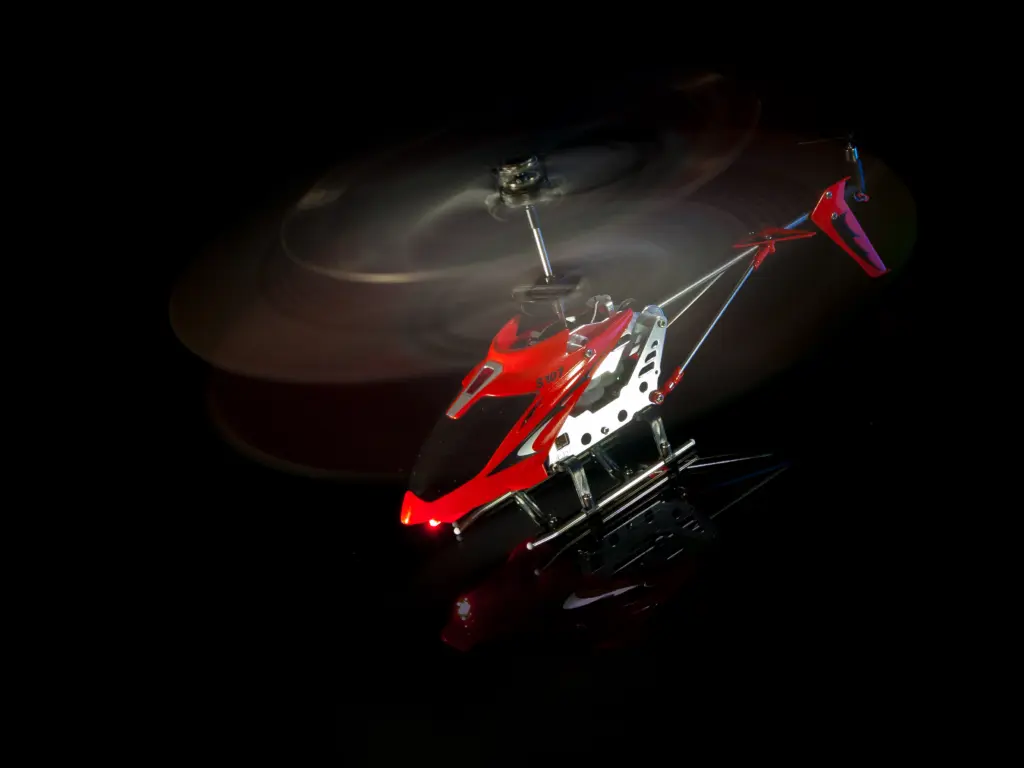
Almost everyone buys their first RC helicopter one level too high. The 3D model from the video ends up on the shelf after the first attempt at hovering, because it punishes every mistake instantly. For a child’s room, a small coaxial heli with altitude hold is enough. If you take the hobby seriously, start with a stabilized micro heli with collective pitch and learn on it what will matter later outdoors.
Below you will find the three designs, stabilization and six models currently offered on Amazon.de. Four propellers instead of a rotor head? The easier way into the air is described under buying a drone (in German).
Coaxial, fixed pitch or collective pitch: what is the difference?
Coaxial. Two main rotors spin in opposite directions, canceling out the torque. As a result, the heli hovers calmly, but flies sluggishly and only in still air. Indoors, that is enough. Outdoors, it is lost.
Fixed pitch (FP). One main rotor with fixed blades, plus a tail rotor. Climbing and descending are controlled by motor speed alone. Most have four channels; such models respond more directly than a coaxial heli and can handle a little air movement. They cannot fly inverted.
Collective pitch (CP). Here the rotor spins at an almost constant speed, and lift comes from the angle of the blades. Negative pitch becomes possible, which means inverted flight and 3D maneuvers. CP helis need six channels, are less forgiving and go through more spare parts. Even so, you only learn real helicopter flying with this design.
How much does the electronics do for me?
In the past, a paddle bar (flybar) stabilized the rotor head mechanically. Today, an electronic flybarless system with attitude sensors does that almost everywhere. A simple gyro only keeps the tail straight, while a 6-axis system also dampens pitching and rolling.
At Blade, the stages are called AS3X and SAFE. In stability mode, according to the manual, the electronics limit the bank angle and level the heli again as soon as you release the sticks. A panic button brings it back to level from almost any attitude, provided there is enough altitude.
Altitude hold via an air pressure sensor is found mainly in toy helis from Syma and XK. The altitude then stays the same. The heli still drifts sideways.
How do I get from hovering to inverted flight?
Step by step, and in this order: first hover with the tail toward you, then sideways, then with the nose toward you. Most crashes happen at the moment the heli turns and left suddenly becomes right. A helicopter simulator on your computer costs a fraction of a rotor head.
Switch off the assists gradually: first stability mode, then agility, and finally 3D. These transitions are exactly where the learning happens. Patience also applies to size. The class with a rotor diameter of around 200 to 300 millimeters is cheap to maintain. Large helis from the 450 class upward belong in the hands of pilots who have mastered hovering.
What breaks first?
Main rotor blades, tail rotor, blade grips and skids. A model without spare parts supply is electronic waste after the third crash. Blade, OMPHOBBY and XK offer spare parts under the model designation, and third-party suppliers also offer parts for the XK K110S and the K127. A second or third battery is part of the package anyway.
With RC cars it is no different, as our own reviews show: on the Hyper Go H16BM and the DEERC 300E, the body clips scratched the shell, and on the Hosim X08, the steering rods gave way quickly.
Do I need insurance, registration or a license?
Legally, an RC helicopter is an unmanned aircraft. According to Germany’s Federal Aviation Office (Luftfahrt-Bundesamt, LBA), the following applies:
- Liability insurance: Mandatory for every operator under § 43 of the German Aviation Act (Luftverkehrsgesetz), even with a mini heli. Flying without insurance is an administrative offense, and you must carry proof when flying. Private liability insurance often excludes model aircraft; model flying associations such as the German DMFV have their own policies.
- Registration: From a takeoff mass of 250 g, the operator must register with the LBA; below that only with a camera, unless it is a toy within the meaning of the EU Toy Safety Directive. The e-ID must be visibly attached to the model.
- Competency certificate: From 250 g, the online A1/A3 certificate from the LBA is required in the open category.
Of the models below, only the OMPHOBBY M2 EVO is above the 250-gram limit. If you join a club, you can sort out insurance and flying field directly there. How clubs and model airfields work is described in our article on model airplanes.
Six RC helicopters, sorted by experience
| Model | Design | Key data (manufacturer specifications) | For whom |
|---|---|---|---|
| Syma S107H | Coaxial, 3 channels | Gyro, barometric altitude hold, USB charging | Children, living room |
| XK K127 (WLtoys) | Single rotor, 4 channels | 6-axis gyro, altitude hold, one-button takeoff and landing | Teens, first single rotor |
| Blade Nano S3 BNF Basic | Collective pitch | 32 g, AS3X and SAFE, panic button, transmitter sold separately | Beginners with a Spektrum transmitter, indoors |
| XK K110S (WLtoys) | Collective pitch, brushless | 6G and 3D mode, around 60 g (retailer specification) | Tinkerers on a small budget |
| OMPHOBBY M1 EVO RTF | Collective pitch, direct drive | two brushless motors, attitude and 3D modes | Pilots moving into 3D, small spaces |
| OMPHOBBY M2 EVO BNF | Collective pitch, direct drive | 3S battery with 750 mAh, over 250 g | Advanced pilots, outdoors |
Syma S107H: the classic for the kids‘ room
The S107 series flies with two counter-rotating rotors. According to Syma, the H version adds altitude hold via an air pressure sensor and a gyro to keep it from spinning away. It charges via USB. It works as a first introduction to the hobby, not for serious learning. Retailers‘ age ratings vary; young children should only fly under supervision.
XK K127: a single rotor without a flybar
Main rotor with tail rotor, four channels, 6-axis gyro. According to the manual, the K127 holds its altitude via air pressure and takes off and lands at the push of a button.
Blade Nano S3: the living room instructor
At 32 g and just under 20 cm in length, the Nano S3 is a full-fledged CP heli in miniature. Blade describes stability and 3D modes as well as a panic button. Horizon Hobby lists the RTF version with transmitter as discontinued; the BNF Basic version is available. For it, you need a Spektrum transmitter with at least six channels, a battery and a charger. A solid learning path, especially if you are getting into the Spektrum system.
XK K110S: a lot of technology for little money
Brushless main motor, flybarless electronics, a stabilized 6G mode and a 3D mode. Retailers state around 60 g and a 245 mm rotor diameter. The transmitter is compatible with Futaba S-FHSS. Spare parts are cheap and easy to get.
OMPHOBBY M1 EVO: small 3D heli with direct drive
Two brushless motors drive the main and tail rotors directly, with no belt or gears. According to the manufacturer, the flight controller has three modes, from stabilized attitude to wild 3D, and switches back to attitude mode in flight. The RTF version comes with a compact transmitter. As a very first heli: too much power. As a second step after the Nano S3, it is a good fit.
OMPHOBBY M2 EVO: for outdoors and advanced pilots
According to OMPHOBBY, the bigger brother flies with a 3S battery with 750 mAh and a more powerful main motor. Retailers state a flying weight of around 345 g, which means registration and the competency certificate become mandatory. It is intended for pilots who have mastered hovering in all orientations.
And Align? The T-Rex series from Taiwan has stood for the large classes for years. According to Align, a T-REX 500X has a rotor diameter of just over one meter and flies on a 6S battery, as a Super Combo with a flybarless system. Recently, no current T-Rex complete package was available on Amazon.de, which is why Align is missing from the table.
Which heli suits me?
For the child, the living room, the gift: Syma S107H. You should not expect more than a good toy. Curious, but still unsure? Then the XK K127 as an affordable single rotor.
If you have made up your mind to learn to fly helicopters, we recommend the Blade Nano S3 plus a simulator. Without a Spektrum transmitter, the XK K110S is the alternative, with simpler build quality. Once hovering is second nature and 3D beckons, the OMPHOBBY M1 EVO comes next, later the M2 EVO for outdoors.
Flying from a first-person perspective is a topic of its own; more on that under FPV drones for beginners.
Prefer to stay on the ground? Our RC car guide (in German) explains scale, brushless drive and LiPo batteries from 2S to 6S.
If you would rather steer on the water than in the air, our RC boat guide (in German) covers hull shapes, drives and the question of where you are allowed to run boats in Germany.
Frequently asked questions
Coaxial, fixed pitch or collective pitch: what is the difference?
Coaxial helis have two counter-rotating rotors and hover calmly, but only fly in still air. Fixed pitch controls climbing and descending through motor speed; inverted flight is not possible. Collective pitch changes the angle of the blades, allows inverted flight and 3D, but is less forgiving. You only learn real helicopter flying with this design.
Which RC helicopter is suitable for children?
A small coaxial heli with altitude hold such as the Syma S107H with gyro and USB charging. It works as a first introduction to the hobby, not for serious learning, and outdoors it is lost. Young children should only fly under supervision.
How do you learn to fly an RC helicopter?
Step by step: first hover with the tail toward you, then sideways, then with the nose toward you. Switch off the assists gradually: first stability mode, then agility, and finally 3D. A helicopter simulator on your computer costs a fraction of a rotor head.
Do I need insurance for an RC helicopter?
Yes. Under § 43 of the German Aviation Act (Luftverkehrsgesetz), liability insurance is mandatory for every operator, even with a mini heli. Private liability insurance often excludes model aircraft. From 250 g, registration with the LBA (Germany's Federal Aviation Office) and the A1/A3 competency certificate are added; in this comparison, that only affects the OMPHOBBY M2 EVO.
What breaks first on an RC helicopter?
Main rotor blades, tail rotor, blade grips and skids. A model without spare parts supply is electronic waste after the third crash. Blade, OMPHOBBY and XK offer spare parts under the model designation. A second or third battery is part of the package anyway.
Sources
- Horizon Hobby: Blade Nano S3 BNF Basic
- Blade Nano S3: instruction manual
- OMPHOBBY: M1
- OMPHOBBY: M1 EVO RTF
- OMPHOBBY: M2 EVO
- Align: T-REX 500X Super Combo
- Syma: S107H
- XK K127 manual
- XK K110S manual
- LBA: Registration and e-ID
- LBA: Requirements for remote pilots
- DMFV: Flying safely made simple
Where to buy
- Syma S107HCheck price at Amazon.deAvailable in Germany: Amazon.de
- XK K127Check price at Amazon.deAvailable in Germany: Amazon.de
- Blade Nano S3 BNF BasicCheck price at Amazon.deAvailable in Germany: Amazon.de
- XK K110SCheck price at Amazon.deAvailable in Germany: Amazon.de
- OMPHOBBY M1 EVO RTFCheck price at Amazon.deAvailable in Germany: Amazon.de
- OMPHOBBY M2 EVO (BNF)Check price at Amazon.deAvailable in Germany: Amazon.de