Contents14 sections
This guide was first published in German on handgetestet.de.
No pascal figure in the world protects your nose. For allergy sufferers, what counts is whether the robot works while you’re not in the room, how tightly it holds the dust, and how often you yourself have to deal with the dirt. That’s why we recommend the Roborock Saros 20: the series is currently the only one listed in the directory of the ECARF seal for allergy-friendly robot vacuums. If you want to spend less, take a bagged station like the Ecovacs DEEBOT T30e OMNI and do without this proof.
Does a robot vacuum help with house dust allergy at all?
Yes, but differently than the advertising suggests. The German Allergy Information Service (Allergieinformationsdienst) of Helmholtz Munich writes that the concentration of mites in the air rises during vacuuming, and advises leaving the job to people without a mite allergy. This is exactly where the robot comes in. It starts on a schedule while you’re out of the house. The European Centre for Allergy Research Foundation (ECARF) cites this as the reason for its timer requirement: by the time you return, the dust has settled.
Clean air isn’t guaranteed by that. Stiftung Warentest, Germany’s leading consumer testing organization, notes that even top robots don’t match a good vacuum cleaner in performance and filtering, and pointed out earlier that vacuuming always stirs up dust. For highly sensitive people, that can be too much. A bagged canister vacuum (in German), operated by someone without allergies, remains sensible for the thorough cleaning. The robot keeps the floor clean in between.
What does the ECARF seal mean for robot vacuums?
It’s one of the few benchmarks that doesn’t come from the manufacturer itself. The criteria require dust emissions below 0.02 percent for particles from 0.3 to 10 micrometers, measured based on DIN EN 60312. Add to that a HEPA filter, a timer and an auto-empty station; the mopping function is only optional. Suction power doesn’t appear on the list at all.
Two caveats come with it. The manufacturer applies for the seal, so a missing listing doesn’t prove poor filtration. And ECARF speaks of „to a certain degree“ when it comes to indoor air. A device doesn’t replace treatment; symptoms belong in a doctor’s office.
Is a HEPA filter enough?
No. HEPA filters retain the finest airborne particles, but according to ECARF they help little if the device leaks and dust escapes through gaps. Stiftung Warentest saw it the same way back in 2013: a HEPA exhaust filter is no guarantee; the construction matters too. So look for measured emission values rather than the word in the brochure.
This is Ecovacs‘ biggest weakness. In the store listings and manuals we evaluated for the Deebots, no HEPA class is stated. They mention a high-performance filter and an „antibacterial“ filter. According to the X12S series manual, this filter is treated with silver nitrate and PHMB, and the bag with silver nitrate. Ecovacs doesn’t prove any benefit for allergy sufferers with that.
Bagged or bagless?
For allergy sufferers, this is quickly decided: bagged. With the bagless station of the DEEBOT X12S OmniCyclone, according to the manual, you hold the container over the trash can and let the dust drop out at the push of a button. The filter and container are taken apart and rinsed by hand. Ecovacs advertises it as „contactless“, which is literally true for this procedure but says little about your airways. ECARF calls emptying a dust-intensive task and recommends a dust-tight plastic bag around the opening for such stations, with disposal ideally outdoors.
Even with a bag, some work remains. Allergist Utta Petzold advises, via the German health insurer Barmer, that people with house dust allergy shouldn’t change the bag themselves. If no one else is around, a well-fitting dust mask (in German) helps. In the T90 manual, Ecovacs warns to hold the bag by the handle so no dust escapes, and explains in the troubleshooting section that fine particles get through the bag and settle in the dust compartment. So wipe out that compartment. Even the station doesn’t separate perfectly.
And the robot itself? Clean the filter weekly and replace it every three to six months, says Ecovacs. No station takes these tasks off your hands, but a partner in the household can.
Five robot vacuums for allergy sufferers compared
| Model | Dust in the station | Proof for allergy sufferers | Best for |
|---|---|---|---|
| Roborock Saros 20 | Auto-empty station (ECARF requirement) | ECARF seal | Diagnosis confirmed, budget available |
| Roborock Saros 20 Neo | Auto-empty station (ECARF requirement) | ECARF seal | Same testing, alternative to the Saros 20 |
| DEEBOT T90 PRO OMNI | Bag, up to 90 days according to the manufacturer | none, no HEPA class stated | Mopping and vacuuming, low noise |
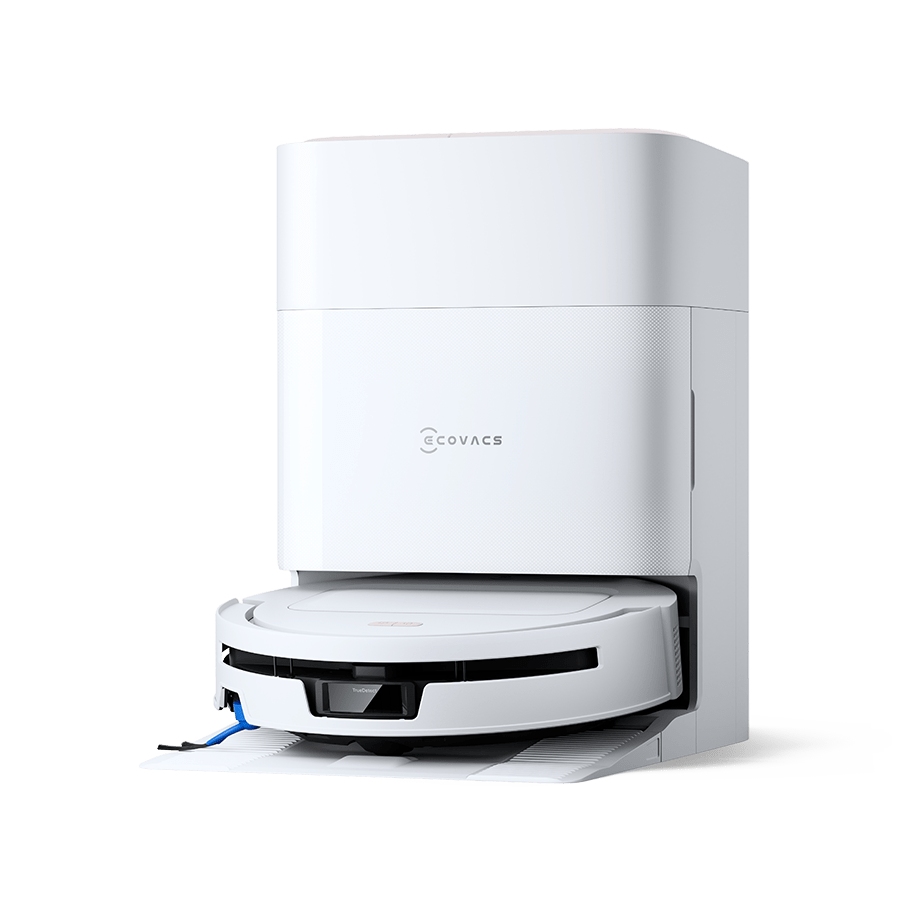
| DEEBOT T30e OMNI | 3-liter bag, up to 90 days according to the manufacturer | none, no HEPA class stated | Mild symptoms, smaller budget |
| eufy X10 Pro Omni | 2.5-liter bag, every 2 months according to the manufacturer | none on the product page | Hard floors that need mopping |
Roborock Saros 20
Our main recommendation, because of the ECARF listing, not because of the features. It means the emission limit, HEPA filter, timer and auto-empty station have been checked by a third party. The device plays in the premium class; whether that pays off for mild symptoms is something you’ll have to weigh up.
Roborock Saros 20 Neo
The second model in the directory; ECARF also lists the Saros 20 Flow Complete. The same arguments apply to the allergy question. Before buying, just compare features and price with the Saros 20.
Kobold VR7
Vorwerk doesn’t build a mopping robot here. The RB7 station empties into a filter bag that, according to Vorwerk, is TÜV-certified (TÜV is Germany’s best-known testing organization); a pressure sensor signals when to change it. The manufacturer calls it „ideal for allergies“, but there’s no ECARF listing. Vorwerk sells it through its own shop, which is why it appears here without a buy button and not in the table. At 11 cm, the VR7 is tall, and it only handles thresholds up to about 1.5 cm.
DEEBOT T90 PRO OMNI
The quieter Ecovacs: the data sheet states 60 dB, the T30e comes to 64.6 dB. That’s not an allergy argument, just one for everyday life. Dust ends up in the bag, and mopping is done with a roller, which according to ECARF helps on hard floors because dust is bound by moisture. Any independent proof of airtightness is missing.
DEEBOT T30e OMNI
The cheapest bagged station in our table. The bag holds 3 liters, and Ecovacs states 90 days. The station has no warm water for the mops, and there’s no proof of filtration. For people with mild symptoms, that’s acceptable; with asthma, we’d demand more.
eufy X10 Pro Omni
Bagged station with 2.5 liters, changed after two months according to eufy, so a little more often than with the Deebots. Rotating mops wipe the hard floors. The German product page says nothing about the filter class.
What about „99 percent of mites“?
Not much, as far as your home is concerned. Ecovacs states up to 95.45 percent of mites removed for the X12S, eufy even 99 percent for the HydroJet S2, citing TÜV Süd. These are manufacturer claims; the test conditions aren’t given. The German Allergy Information Service, by contrast, writes that vacuuming isn’t enough to remove mites from carpets. They cling firmly to the fibers; what’s removed is mainly droppings.
The surroundings remain far more important. Smooth floors instead of carpet, bedding washed at 60 degrees Celsius, bedroom humidity no higher than 45 to 55 percent; a dehumidifier (in German) can help with that. With pet allergies, keep in mind: animal allergens are also in dander, not just in hair. A robot collects hair, but cat allergens cling stubbornly to clothing. Against airborne dust, an air purifier (in German) is the better tool. Mopping technology is compared in our guide to robot vacuums with mopping (in German).
How we would decide
- Medically confirmed house dust allergy or asthma: Roborock Saros 20 or Saros 20 Neo, and hand bag changes over to someone else.
- Mild symptoms, limited budget: DEEBOT T30e OMNI, cleaning while no one is home.
- No need for mopping, filter bag is a priority: Kobold VR7.
- Bagless station: better not with an allergy.
How a robot vacuum with an auto-empty station holds up over the years is shown in our long-term test of the Ecovacs DEEBOT T9+.
Frequently asked questions
Does a robot vacuum help with house dust allergy?
It can ease the burden, because it runs on a schedule while you're out of the house. According to the German Allergy Information Service, the concentration of mites in the air rises during vacuuming. But clean air isn't guaranteed: Stiftung Warentest finds that even top robots lag behind a good vacuum cleaner in filtering. No device replaces medical treatment.
What does the ECARF seal mean for robot vacuums?
It's one of the few benchmarks that doesn't come from the manufacturer. It requires dust emissions below 0.02 percent for particles from 0.3 to 10 micrometers, a HEPA filter, a timer and an auto-empty station. Suction power plays no role. The manufacturer applies for the seal, so a missing listing doesn't prove poor filtration.
Is a HEPA filter in a robot vacuum enough for allergy sufferers?
No. According to ECARF, a HEPA filter helps little if the device leaks and dust escapes through gaps; the construction matters too. Look for measured emission values rather than the word in the brochure. For Ecovacs' Deebots, store listings and manuals state no HEPA class.
Bagged or bagless station for allergy sufferers?
Bagged. With bagless stations, the container is emptied over the trash can, and the filter and container are taken apart and rinsed by hand. ECARF calls emptying a dust-intensive task. Bag changes should also ideally not be done by allergy sufferers; otherwise a well-fitting dust mask helps. Wipe out the dust compartment when changing the bag.
What about claims like 99 percent of mites removed?
Not much, as far as your home is concerned. These are manufacturer claims without stated test conditions. According to the German Allergy Information Service, vacuuming isn't enough to remove mites from carpets; what's removed is mainly droppings. More important are smooth floors, bedding washed at 60 degrees Celsius and bedroom humidity no higher than 45 to 55 percent.
Sources
- ECARF Institute: Criteria for robot vacuums
- ECARF: Criteria catalog (PDF)
- ECARF Institute: Certified products
- ECARF: House dust mite allergy
- Allergieinformationsdienst: House dust mites, prevention (German)
- Allergieinformationsdienst: House dust mites, treatment (German)
- Allergieinformationsdienst: Pet allergy (German)
- Stiftung Warentest: Robot vacuums (freely accessible part, German)
- Stiftung Warentest: Does HEPA really help? (German)
- Barmer: House cleaning with allergies (German)
- Ecovacs: DEEBOT T90 PRO OMNI
- Ecovacs: DEEBOT T30e OMNI
- Ecovacs: T90 PRO manual (PDF)
- Ecovacs: X12S series manual (PDF)
- Ecovacs: X12S OmniCyclone manual (PDF)
- Vorwerk: Kobold VR7 with RB7
- eufy: X10 Pro Omni
- eufy: HydroJet S2
Where to buy
- Roborock Saros 20Check price at Amazon.de
- Roborock Saros 20 NeoView at CoolblueCheck price at Amazon.de
- DEEBOT T90 PRO OMNIView at EcovacsCheck price at Amazon.de
- DEEBOT T30e OMNIView at EcovacsCheck price at Amazon.de
- eufy X10 Pro OmniView at CoolblueCheck price at Amazon.de