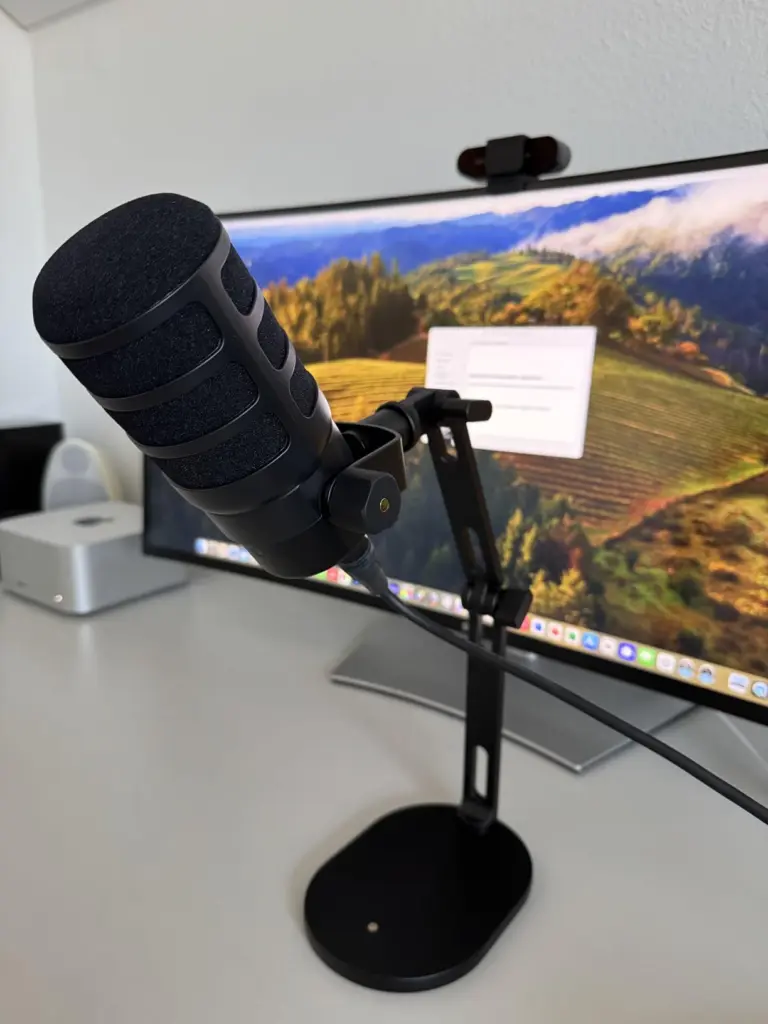
This review was first published in German on handgetestet.de.
The PodMic USB is a dynamic broadcast microphone from RØDE for podcasts, streaming and voice recordings. It has two outputs: XLR for an audio interface or mixer, and USB-C for going straight into a computer. We used the black version via USB at the desk and pitted it against our studio microphone, a Neumann TLM 103 in a soundproofed recording booth. The result is clear: well built, very convenient, but clearly inferior in sound. Three out of five stars.
Technical data
All values are RØDE specifications from the product page, as of November 14, 2026. We did not measure them ourselves. What we heard ourselves is described in the sections below.
| Acoustics | |
|---|---|
| Principle | dynamic |
| Polar pattern | cardioid |
| Address type | from the front (end-address) |
| Frequency range | 20 Hz to 20 kHz |
| Maximum SPL | 148 dB SPL |
| Sensitivity | -57 dB re 1 V/Pa (1.4 mV at 94 dB SPL), ±3 dB |
| Self-noise (A-weighted) | analog 26 dBA, digital 19 dBA |
| Output impedance | 460 Ω (XLR) |
| Digital and connections | |
| Outputs | XLR (3-pin) and USB-C |
| Headphones | 3.5 mm output with volume control, zero-latency monitoring |
| Resolution | 24-bit, 48 kHz |
| Signal processing | Revolution Preamp, APHEX processing in the built-in DSP |
| Power | via USB, 5 V, 100 mA |
| Systems | Windows 10 or later and macOS 10.15 or later, plus iOS and Android |
| Construction | |
| Housing | all metal |
| Pop filter | internal, plus an external pop filter included |
| Mount | integrated swivel mount, internal shock mount against vibrations |
| Weight | 900 g |
| Dimensions | 123 × 109 × 110 mm (L × W × H) |
Build quality: excellent
The PodMic USB is very well made. RØDE describes a sturdy all-metal construction with an integrated swivel mount, and inside there is a pop filter against plosives and a shock mount against vibrations. At 900 grams according to the manufacturer, it’s no lightweight. A sturdy desk stand or a strong boom arm is a must.
Convenient: straight into the computer via USB
In everyday use, the PodMic USB is pleasantly straightforward. It’s nice and easy to record with it right in front of the computer, and you don’t need an audio interface. According to RØDE, the housing contains a low-noise preamp and APHEX digital signal processing. According to the manufacturer, the headphone output with volume control lets you monitor yourself without delay. For settings, RØDE points to its own software, including RØDE Central and RØDE Connect.
The sound in comparison: thin and hollow
RØDE promises a rich, full-bodied sound and talks about studio quality. Our benchmark is the Neumann TLM 103, a large-diaphragm condenser microphone that we use in a soundproofed recording booth. Against this microphone, in a correspondingly treated room, the PodMic USB doesn’t stand a chance. In a direct comparison, it sounds thin and hollow. The difference is so clear that we keep going into the booth to the Neumann for voice recordings.
To be fair: this is a comparison with a high-quality condenser microphone in a room set up for it. Our advice is still clear: marketing copy and nice product photos are no measure of sound. If you’re used to a condenser microphone of this class, don’t expect the PodMic USB to be an equal replacement.
Its strength: recordings with background noise
Things look different when you record in places with lots of background noise. Then the polar pattern matters, and here the RØDE has a decisive advantage. As a dynamic microphone with a cardioid pattern, it mainly picks up what comes directly from the front, according to the manufacturer. A sensitive condenser microphone, on the other hand, clearly picks up the room and its ambient noise as well. That’s why it really plays to its strengths in an acoustically treated room.
Who the PodMic USB is for
It’s a good fit for:
- podcasts, streams and video calls at the desk without a separate audio interface
- rooms without acoustic treatment and environments with background noise
- anyone who wants to start with USB today and switch to an interface via XLR later
It’s less suitable for:
- voice-over artists who already record in an acoustically treated room or booth
- anyone who expects the sound of a high-quality large-diaphragm condenser microphone
What you need to know before buying
- RØDE offers the PodMic in two versions: the classic PodMic with XLR only and the PodMic USB with XLR and USB-C. We had the PodMic USB in black.
- Only the USB version works directly with a computer without an interface.
- At 900 grams according to the manufacturer, the stand or arm has to be able to carry enough weight.
- RØDE lists Windows 10 or later and macOS 10.15 or later as supported systems, plus iOS and Android.
- You speak into dynamic broadcast microphones from a short distance. If you like to sit farther away from the microphone, keep that in mind when setting it up.
Alternatives from our guides
Which microphone suits which room is explained in our buying guide Buying a podcast microphone (in German). Our guide USB microphones for streaming and gaming (in German) gives an overview of microphones that work directly via USB. If you switch to a condenser microphone with XLR, you need an interface; see our guide Buying an audio interface (in German). And for a secure hold at the desk: Buying a microphone arm (in German).
Where to buy the PodMic USB
Coolblue (an electronics retailer in Germany) and Amazon carry the PodMic USB in black, and the buttons below link directly to the model. On November 14, 2026, Coolblue listed it at €185.90.
Our verdict
The RØDE PodMic USB is a well-made microphone that will certainly find its fans. It’s nice and easy to record with it on the computer, and in loud environments its polar pattern helps. In sound, however, it can’t keep up with a high-quality condenser microphone like the Neumann TLM 103 in an acoustically treated room: in comparison, it sounds thin and hollow. If the sound had convinced us, its simplicity would have made it our microphone at the desk. As it is, it gets three out of five stars.
Are you a manufacturer or retailer and would like us to test your product? Offer a product for testing (in German).
Frequently asked questions
What is the difference between the PodMic and the PodMic USB?
The classic PodMic has only an XLR output and needs an audio interface or mixer. The PodMic USB also has USB-C, so it works directly with a computer.
Can the PodMic USB keep up with a Neumann TLM 103?
Not in our comparison. In an acoustically treated environment, the PodMic USB sounds thin and hollow next to the Neumann TLM 103 condenser microphone, and the difference is clear.
What is the PodMic USB especially good for?
For recording in places with background noise. As a dynamic microphone with a cardioid pattern, it mainly picks up what comes directly from the front, according to RØDE.
Does the PodMic USB need an audio interface?
No, it works directly with a computer via USB-C. According to RØDE, it has a built-in preamp, APHEX signal processing and a headphone output with volume control.
How heavy is the PodMic USB?
According to RØDE, it weighs 900 grams. A desk stand or boom arm should be able to hold this weight securely.
Sources
Conclusion
The PodMic USB is very well made and very easy to get going on a computer via USB. In a direct comparison with our Neumann TLM 103 in an acoustically treated environment, it sounds thin and hollow, and the difference is clear. It plays to its strength where background noise disrupts the recording: that's where its polar pattern helps. Three out of five stars.
Where to buy
- Rode Podmic USB SchwarzView at Coolblue
- RØDE PodMic USB, SchwarzCheck price at Amazon.de