Contents10 sections
This guide was first published in German on handgetestet.de.
If you drive to the Allgäu or the Black Forest once every winter and occasionally hit a snowy driveway there, snow socks will serve you well. If you drive to Austria, you still need real chains. That is the short answer. As a sock for Germany, Switzerland and France, we consider the AutoSock the solid choice; the DAC Active is the cheaper alternative.
What a snow sock does differently
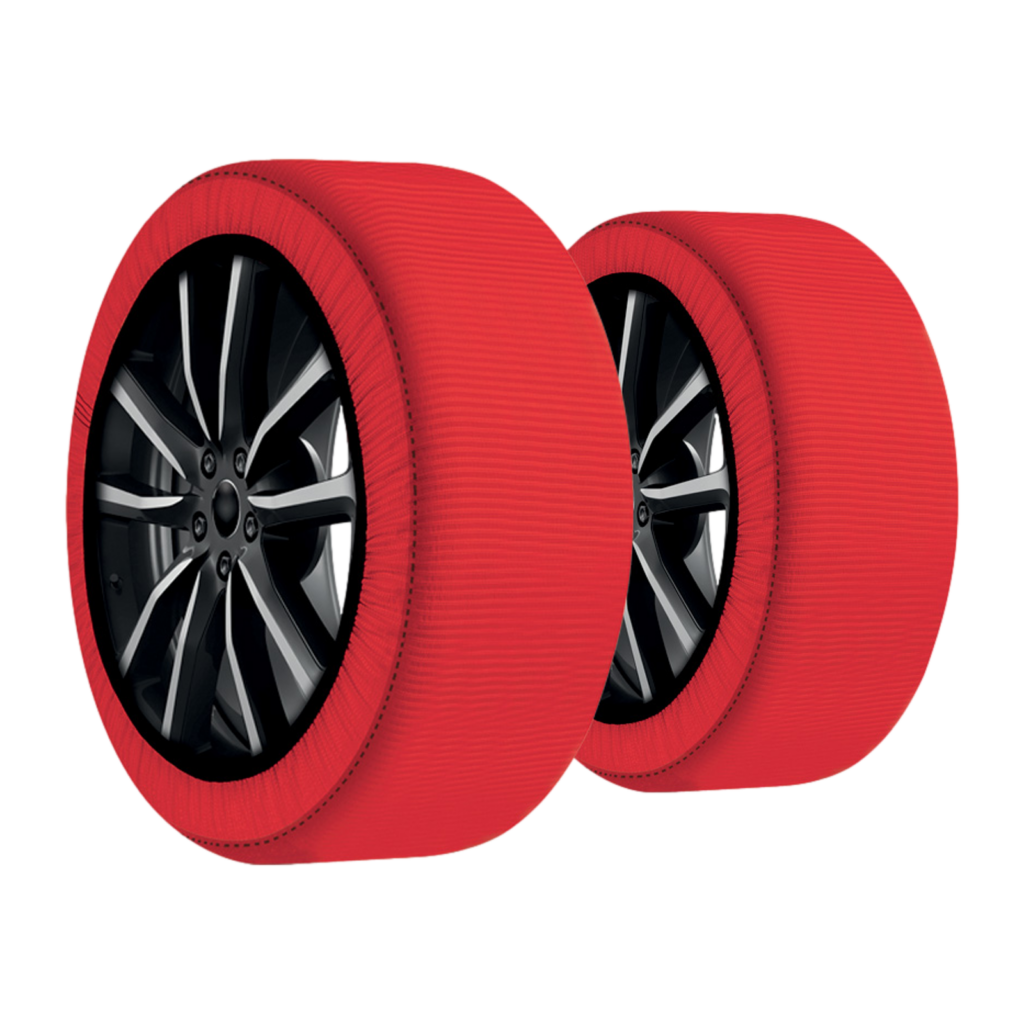
A snow sock is a cover made of technical fabric that is pulled over the tire. On snow and ice, the fabric provides additional grip. There is no metal. That is why nothing rattles and the rim is spared. According to retailer information on the DAC Active, socks are also suitable for cars with little space between tire and body. Whether your car allows traction devices at all is stated in the owner’s manual.
Their weakness is wear. In 2021, the Swiss automobile club TCS, together with its Austrian counterpart ÖAMTC, tested steel chains and textile traction aids on the tire size 225/50 R17. The AutoSock was rated „recommended“, with very easy fitting and smooth driving, but high wear. For the Goodyear Ultra Grip, the club noted high wear on dry roads. So as soon as asphalt shows through, the sock should come off.
What is behind EN 16662-1
EN 16662-1 is a European standard for supplementary grip devices on passenger cars and light commercial vehicles. It describes the test procedures and explicitly includes non-metallic solutions, as TÜV Austria explains as a testing body. According to AutoSock, the European standards body CEN published the 2020 version in May of that year. By the end of November 2020, member states had to adopt it as a national standard and withdraw conflicting older standards.
Sounds like it is valid across Europe. It is not quite that simple. The standard says how testing is done. Whether a country accepts a tested sock as a chain when chains are mandatory is up to each country. Still, when buying, look for the reference to EN 16662-1 on the packaging or product page; it is the minimum requirement.
Where snow socks may replace chains
Germany: There is no general chain requirement; it is imposed by the blue sign 268. The European Consumer Centre asked the German Federal Ministry of Transport. The answer: the regulations do not require snow chains to be made of metal, so the StVZO (German vehicle regulations) does not exclude textile. Accordingly, snow socks may be used instead of chains. With chains, Section 3 of the German road traffic regulations (StVO) allows a maximum of 50 km/h, and according to the manufacturers, many socks allow less.
Austria: This is where it gets strict. The Consumer Centre writes that snow socks are not recognized as a substitute when chains are mandatory. The ÖAMTC only accepts traction aids when chains are required if they have been tested according to ÖNORM V 5117 and labeled accordingly. AutoSock reports that the Austrian ministry informed it in writing that the AutoSock does not meet the requirements. The manufacturer disputes this decision. In practice, that means: on slippery roads without a chain requirement, yes; under the blue sign, no.
Switzerland, France, Italy: According to the Consumer Centre, snow socks are recognized there under certain conditions. The TCS confirms this for the AutoSock in Switzerland. For France, AutoSock states that the socks comply with the mountain law that requires winter equipment in mountain regions between November 1 and March 31. For other brands, check the manufacturer’s information before your trip.
Five models compared
| Model | Design | Standard and speed | Best for |
|---|---|---|---|
| AutoSock HP | Textile sock, many sizes | EN 16662-1:2020 according to the manufacturer | Anyone who also drives in Switzerland and France |
| DAC Active | Textile sock with 3D fabric, 6 sizes | EN 16662-1, recommended up to 30 km/h according to the retailer | Occasional drivers on a small budget |
| Goodyear Ultra Grip Textil | Textile sock | up to 40 km/h according to the listing | Emergency kit in the trunk |
| Michelin Easy Grip Evolution | Net of fiber-reinforced plastic mesh | up to 40 km/h according to the manufacturer | More traction, for those with the strength to fit it |
| ISSE Super | Textile sock | EN 16662-1 according to the listing | Alternative if the size fits |
AutoSock: the original, with evidence
According to the company, AutoSock was the first product worldwide to be certified to EN 16662-1:2020. According to the manufacturer, the passenger car socks are approved for cars and light commercial vehicles up to 3.5 t. The TCS praised the very easy fitting and smooth driving on snow, and rated the traction as satisfactory. AutoSock sizes are called „HP“ followed by a number, such as HP 697. The manufacturer’s table shows which one fits your tire size. Our choice, because here the standard, the club test and the country information all line up.
DAC Active: cheap, but slow
According to the retailer, DAC is made by the Italian accessories manufacturer Menabò. According to the retailer, the socks are approved to EN 16662-1, are made of 3D fabric and come with a waterproof bag and a pair of fitting gloves. They are pulled onto the drive wheels. Notable is the recommended top speed of 30 km/h, which is lower than for the others. They are hand-washed at no more than 30 degrees. For the occasional uphill drive to the vacation home, that is enough.
Goodyear Ultra Grip and ISSE Super
The TCS also rated the Goodyear sock „recommended“, with the same strengths and weaknesses as the AutoSock. According to the Amazon listing, a maximum of 40 km/h is allowed. According to the Amazon listing, the ISSE Super is homologated to EN 16662-1 and sold in sizes from T54 to T74. We are not aware of any independent measurements for it.
Michelin Easy Grip Evolution: the in-between option
Strictly speaking, not a sock. Michelin stretches a net of carbon fiber-reinforced plastic rope over the tire. In the ÖAMTC and TCS test, it delivered very high traction values on snow but increasingly lost its hold on the wheel above 40 km/h. According to the manufacturer, you are not allowed to drive faster anyway. Fitting it takes strength; removing it is easy. If you often drive up inclines, you get more bite here, but you have to stay slower.
Which solution for whom?
- Vacation in Germany, Switzerland or France, little desire to fit chains in slush: AutoSock in the right HP size.
- One or two snowy approaches a year, small budget: DAC Active, keeping the 30 km/h in mind.
- Lots of inclines, no time pressure: Michelin Easy Grip Evolution.
- Austria with a chain requirement, or long drives over mountain passes: steel chains. Which ones is covered in our guide to snow chains (in German).
Fit the socks once at home in the dry before you actually need them. The ÖAMTC recommends this for snow chains, and it applies to socks just the same. With cold fingers at the roadside, the first fitting is no fun. They go on the drive axle; with all-wheel drive, as specified by the car manufacturer. And no sock replaces winter tires. You will find the basics in our guide to winter tires (in German).
Frequently asked questions
Are snow socks allowed in Germany?
Yes. There is no general chain requirement in Germany; it is imposed by the blue traffic sign 268. According to the German Federal Ministry of Transport's reply to the European Consumer Centre, snow chains do not have to be made of metal, so snow socks may be used instead of chains.
Do snow socks count as snow chains in Austria?
No. According to the European Consumer Centre, snow socks are not recognized as a substitute in Austria when chains are mandatory. The Austrian automobile club ÖAMTC only accepts traction aids if they have been tested and labeled according to ÖNORM V 5117. If you are driving to Austria, you need real chains.
What does EN 16662-1 mean for snow socks?
It is a European standard for supplementary grip devices for passenger cars that explicitly includes non-metallic solutions. It describes how they are tested. Whether a country accepts a tested sock as a chain when chains are mandatory is up to each country. Still, a reference to the standard is the minimum requirement.
How fast can you drive with snow socks?
With chains, the German road traffic regulations (Section 3 StVO) allow a maximum of 50 km/h, and according to the manufacturers, many socks allow less. For the DAC Active, the retailer recommends up to 30 km/h; the Goodyear Ultra Grip Textil and the Michelin Easy Grip Evolution allow up to 40 km/h.
How long do snow socks last?
Their weakness is wear. In the 2021 test by the Swiss and Austrian automobile clubs TCS and ÖAMTC, the AutoSock was rated "recommended", with very easy fitting and smooth driving, but high wear. They are enough for occasional snowy driveways; for long drives over mountain passes, steel chains are the better choice.
Which axle do snow socks go on?
On the drive axle; with all-wheel drive, as specified by the car manufacturer. Fit the socks once at home in the dry before you actually need them.
Sources
- European Consumer Centre Germany: winter tire requirements 2026, snow socks (in German)
- ÖAMTC: snow chains, what to consider when using them (in German)
- TCS: snow chains and textile traction aids tested (in German)
- ÖAMTC: Michelin Easy Grip Evolution tested (in German)
- TÜV Austria: testing according to EN 16662-1
- AutoSock: certification according to EN 16662-1
- AutoSock: rules by country
- Rameder: DAC Active (retailer information)
- ACE: snow chains and sign 268 (in German)
- StVO Section 3(4): 50 km/h with snow chains (German law, in German)
Where to buy
- AutoSock HP 697Check price at Amazon.de
- DAC Active Größe MView at Rameder
- Goodyear Ultra Grip Textil Größe MCheck price at Amazon.de
- Michelin Easy Grip EvolutionCheck price at Amazon.de
- ISSE SuperCheck price at Amazon.de