Contents13 sections
This guide was first published in German on handgetestet.de.
Sous vide means cooking food in a bag in a water bath at a precisely set temperature. That rarely calls for a large water bath that disappears into a cupboard after three steaks. Usually a stick that clamps onto a pot you already own is enough. We consider the Caso SV 1200 Smart the sensible middle ground between power and app, and the Caso SV 400 the economical choice without an app. A water bath only makes sense if the appliance can stay on the countertop permanently.
How an immersion stick works
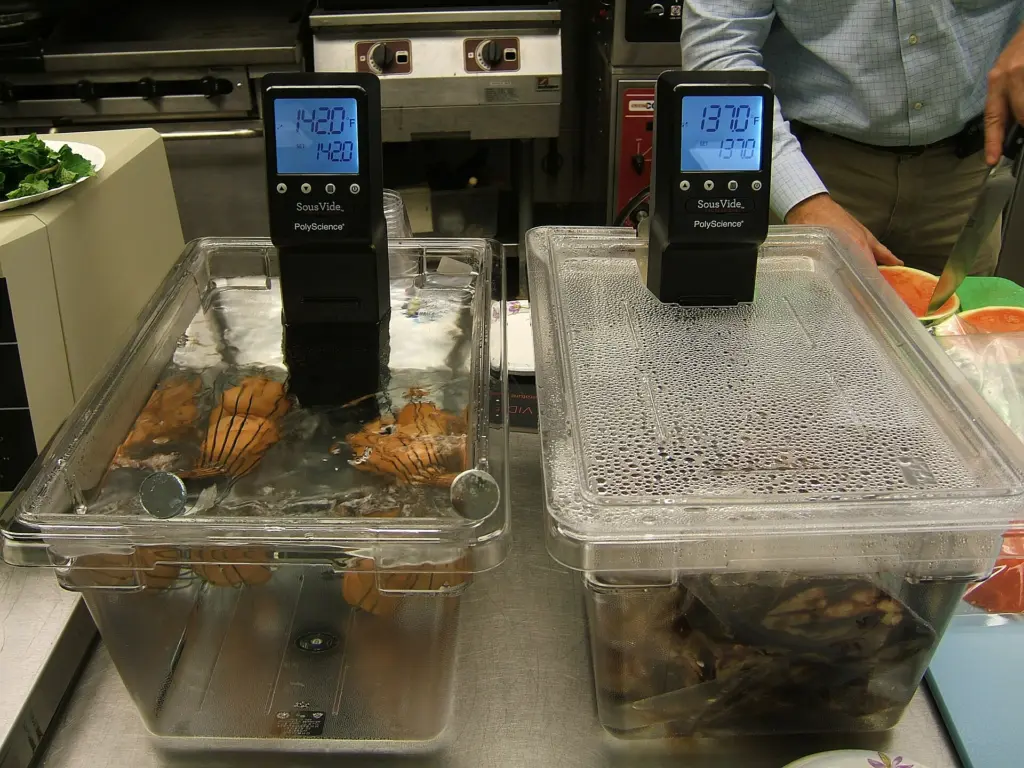
A stick heats the water and circulates it. The vessel is whatever you already have: a stockpot, a plastic container, a cooler. With a water bath, heater and tub are in one housing. You don’t need a pot, but you do need permanent counter space, and the volume is fixed. According to Caso, the SV 900 holds nine liters. A stick such as the Steba SV 75, on the other hand, heats 20 liters according to the manufacturer.
When it comes to power, one distinction helps. Power determines how quickly the water heats up. How precisely it holds the temperature is a different question. For a pot of 10 to 15 liters, 1,000 watts is enough; if you regularly cook for a lot of guests, look for 1,200 watts.
Almost all devices go up to 90 °C. That is enough for vegetables, too, and for poultry under the BfR standard.
And precision? Half-degree steps are enough for everyday cooking. A tenth-of-a-degree setting sounds more precise than it matters for an egg or a steak. Water depth is more important, because sticks need a certain minimum height in the pot: Caso specifies pots from 12 cm tall for the SV 1200 Smart, Steba from 15 cm for the SV 75. If the spec sheet says IPX7, the device will survive brief submersion.
What an app is good for
It isn’t necessary. Temperature and time can also be set on the device. For long cooking times it still helps, such as 24 hours for beef cheeks, because you can check progress while you’re out. The Wi-Fi band matters here. According to Inkbird, its cooker only connects to 2.4 GHz networks, while the Caso SV 1200 Smart also works on 5 GHz.
Bags and vacuum sealers: the underrated part
No sous vide without a tight bag. Zwilling explicitly recommends bags designed for cooking in a water bath and warns against ordinary household bags, from which plasticizers can migrate into food. A vacuum sealer removes the air. That way the bag doesn’t float, and the water surrounds the food evenly. For dry food such as steak or salmon, a simple external (bar) sealer with textured bags is enough. Liquid marinades are a struggle with it. On Amazon, Caso also sells the SV 400 bundled with the VC10 vacuum sealer.
Food safety: what the BfR requires
Many recipes cook chicken breast at 60 to 64 °C. Germany’s Federal Institute for Risk Assessment (BfR) sets a clear standard for poultry: a core temperature of at least 70 °C must be reached for two minutes, at every point. If you follow it, set the water bath above 70 °C for poultry and give the food enough time for even the thickest part to reach that temperature. A probe thermometer gives you certainty. According to the BfR, fresh poultry should be kept refrigerated at minus 2 to plus 4 °C until cooking, and a broken cold chain is particularly risky.
After cooking, the rule is: eat soon. If you cook ahead, Zwilling advises chilling the bags quickly in ice water and then storing them in the refrigerator. A bag left lukewarm in the kitchen for hours is the real risk.
Six sous vide cookers you can buy in 2026
| Model | Design and power | Temperature and controls | Best for |
|---|---|---|---|
| Caso SV 1200 Smart | Stick, 1,200 W, up to 20 liters | 0–90 °C in 0.5 °C steps, Wi-Fi 2.4 and 5 GHz, IPX7 | Most households that want an app |
| Caso SV 400 | Stick, 1,000 W, 6 to 20 liters | 25–90 °C in 0.5 °C steps, on-device controls, IPX7 | Beginners without an app |
| Inkbird ISV-300W | Stick, 1,000 W | 0–90 °C, ±0.1 °C, Wi-Fi 2.4 GHz, IPX7 | App users with a 2.4 GHz network |
| Princess 267003 | Stick, 1,200 W | 25–95 °C in 0.5 °C steps, on-device controls, IPX7 | Large pots without an app |
| Steba SV 75 | Stick, 800 W, 12 l/min circulation | up to 90 °C, max. deviation 0.1 °C, on-device controls, IPX7 | Pots up to 20 liters, simple controls |
| Caso SV 900 | Water bath, 9 liters, 2 racks | 30–90 °C in 0.1 °C steps, timer up to 99 h | A permanent station on the countertop |
All specifications according to the manufacturers. Anova shaped the market and is still missing here. On Amazon.de, alongside the Precision Cooker 3.0 for Europe (AN525-EU00), there are also 120-volt versions for the US market that do not belong in a German outlet. If you buy an Anova in Europe, check the model number for „EU“ and check the plug.
Caso SV 1200 Smart: the middle ground with an app
1,200 watts, which puts it ahead of the SV 400, the Inkbird ISV-300W and the Steba SV 75. Caso specifies up to 20 liters of water, around 8 liters of circulation per minute and an accuracy of ±0.5 °C. The Caso Control app works over Wi-Fi on both bands. According to Caso, pots from 12 cm tall are enough, and almost every kitchen has one.
Caso SV 400: no app, no detours
The stick without an app. 1,000 watts, control from 25 to 90 °C in half degrees, waterproof to IPX7. Caso recommends vessels of 6 to 20 liters and at least about 16 cm tall, and positions it one price bracket below the SV 1200 Smart. According to buyer reports, a full 20-liter pot takes noticeably long to heat up.
Inkbird ISV-300W
Inkbird specifies 1,000 watts, 0 to 90 °C with an accuracy of ±0.1 °C, plus IPX7 and a timer of up to 99 hours. The app only connects on 2.4 GHz networks.
Princess 267003: power without an app
Princess specifies 1,200 watts, the same as Caso’s SV 1200 Smart. You select the temperature on the LCD display from 25 to 95 °C in half degrees, and according to the manufacturer the stick is waterproof to IPX7. A practical touch: the timer only starts once the water has reached the target temperature. There is no Wi-Fi. If you fill large pots and put your phone away while cooking anyway, you lose nothing.
Steba SV 75: few watts, lots of flow
At 800 watts, the weakest stick in the comparison. Steba relies on the pump: 12 liters of circulation per minute, significantly more than the roughly 8 liters Caso states for the SV 1200 Smart. 20 liters of water are said to reach 56 °C in about 45 minutes. It is operated via the backlit display, the timer goes up to 99 hours, and there is no app. Steba currently lists the larger SV 100 Professional as out of stock. For a pot for two, the SV 75 is enough. For 30 liters, it isn’t.
Caso SV 900: the water bath
The only water bath here. Nine liters, circulation, 30 to 90 °C in tenths of a degree, and two stainless steel racks that hold up to five bags upright. Caso’s product page lists 2,000 watts. With a footprint of just over 31 by 35 cm, it needs permanent space on the countertop. Some buyers mention an audible pump noise.
How we would decide
If you want a cooker for almost everything, take the Caso SV 1200 Smart: enough power for large pots, an app without obligation. If money is tight and you can do without an app, that leaves the Caso SV 400. It lacks 200 watts and the remote control, and little else.
Inkbird fans go for the ISV-300W, as long as their home Wi-Fi offers a 2.4 GHz network. If you fill large pots without an app, look at the Princess 267003; the Steba SV 75 is enough for smaller quantities. And if a device should always be ready to go, the Caso SV 900 is an option, provided the countertop is free.
The stick is only half the equipment. Budget for bags and, if you cook this way often, a vacuum sealer (in German). For the crust afterwards you need heat: a hot pan from our pan sets (in German), a plancha for the patio (in German) or the burner of a gas grill with serious heat (in German).
Frequently asked questions
Sous vide stick or water bath: which is more practical?
A stick heats the water and circulates it, and a pot or container you already own serves as the vessel. With a water bath, heater and tub are in one housing, the volume is fixed and it needs permanent counter space. The Caso SV 900 holds nine liters, while the Steba SV 75 stick heats 20 liters according to the manufacturer.
How many watts does a sous vide cooker need?
Power determines how quickly the water heats up, not how precisely it holds the temperature. For a pot of 10 to 15 liters, 1,000 watts is enough. If you regularly cook for a lot of guests, look for 1,200 watts. Almost all devices go up to 90 °C.
Do you need an app for sous vide?
It isn't necessary; temperature and time can be set on the device. For long cooking times such as 24 hours for beef cheeks, it helps you check progress while you're out. Pay attention to the Wi-Fi band: Inkbird only connects to 2.4 GHz networks, while the Caso SV 1200 Smart also works on 5 GHz.
Which bags are suitable for sous vide?
Zwilling recommends bags designed for cooking in a water bath and warns against ordinary household bags, from which plasticizers can migrate into food. A vacuum sealer removes the air so the bag doesn't float. For dry food such as steak or salmon, a simple external (bar) sealer is enough.
At what temperature is poultry safe when cooked sous vide?
Germany's Federal Institute for Risk Assessment (BfR) sets a core temperature of at least 70 °C for two minutes for poultry, at every point. Many recipes cook chicken breast at 60 to 64 °C. If you follow the BfR standard, set the water bath above 70 °C and check with a probe thermometer.
How do you store pre-cooked sous vide bags?
Eat as soon as possible after cooking. If you cook ahead, Zwilling advises chilling the bags quickly in ice water and then storing them in the refrigerator. A bag left lukewarm in the kitchen for hours is the real risk.
Sources
- Caso: SV 1200 Smart
- Caso: SV 400
- Caso: SV 900
- Steba: SV 75 sous vide cooker
- Inkbird: ISV-300W
- Princess: 267003 sous vide stick
- Anova: Precision Cooker
- BfR: questions and answers on poultry meat
- Zwilling: questions about sous vide (in German)
Where to buy
- Caso SV 1200 SmartCheck price at Amazon.de
- Caso SV 400Check price at Amazon.de
- Inkbird ISV-300WCheck price at Amazon.de
- Princess 267003 Sous-Vide-StickView at Coolblue
- Steba SV 75View at Coolblue
- Caso SV 900Check price at Amazon.de