Contents11 sections
This guide was first published in German on handgetestet.de.
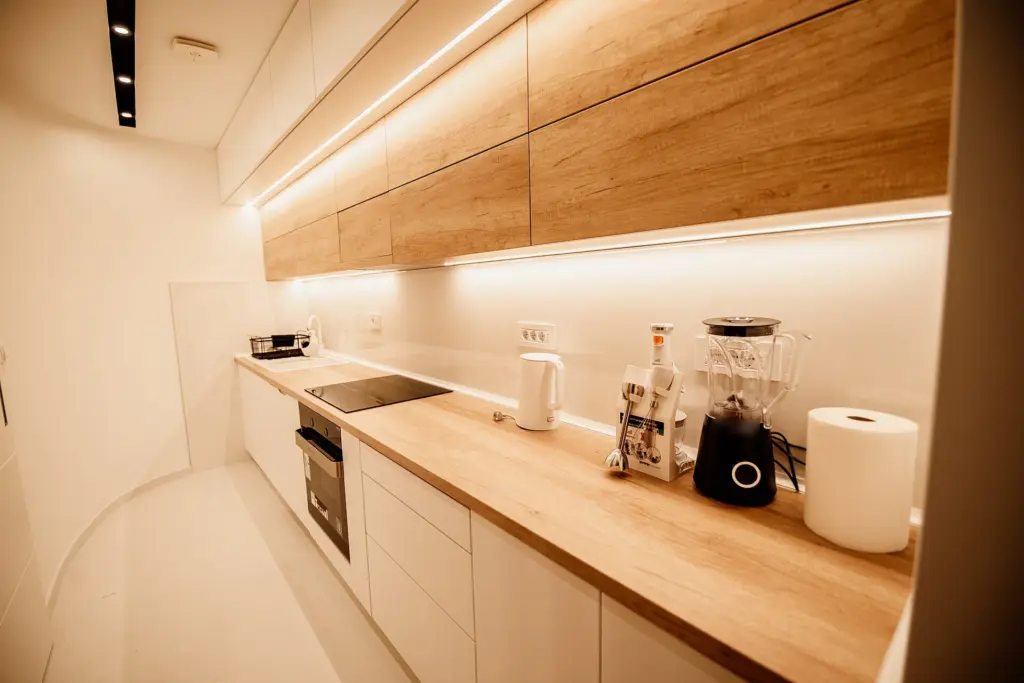
Evening at the countertop, the ceiling light behind you, and your own shadow falls right onto the cutting board. An under-cabinet light beneath the wall cabinets fixes that. For most kitchens, a ready-made light bar with a plug-in transformer and proximity sensor is enough: it goes into the wall socket and requires no changes to the home’s wiring. Our pick is the Inline starter set from Paulmann.
Before you compare light bars, look under the cabinets. Where is the nearest outlet? How long is the area that needs to be lit? And is there a cabinet or the range hood above the cooktop? These three answers determine almost the entire selection.
Plug or hard-wired connection
You can connect lights with a plug-in power supply yourself. Plug in the transformer, run the cable under the cabinet, done. Things are different as soon as a light is to be connected permanently to a cable coming out of the wall. Germany’s Low Voltage Connection Ordinance (Niederspannungsanschlussverordnung) only allows the grid operator or an electrical contractor listed in the operator’s installer register to install, extend or modify the wiring downstream of the main service fuse. Paulmann states just as clearly in its safety instructions that only a qualified electrician may carry out installation and repairs, and that the circuit breaker must be switched off before any work.
Then there is heat. Paulmann requires that the ambient temperature at the installation site not exceed 30 °C and only permits operation in dry rooms. Philips gives 40 °C as the upper limit for the Hue Flux. Right next to the cooktop, where steam and hot air rise, a light bar therefore has no business being. Place it on the sections to the left and right; above the stove, the range hood usually provides light anyway.
How bright, how warm?
The lumen figure alone says little, because the bars differ in length. Convert it to a per-meter figure. The Paulmann Inline comes to about 900 lumens per meter, the Linex 85 from Müller-Licht to about 1,570, the Hue Flux to only 400, spread over three meters of strip. If you chop and weigh there, you are better served by bars in the range of the Paulmann or Linex. A light strip makes things cozy, but not bright.
Color temperature is a matter of taste. 3,000 kelvin looks warm and suits wooden cabinet fronts; 4,000 kelvin shows the colors of vegetables and meat more neutrally. Daylight white at 6,500 kelvin quickly feels as cool as an office under wall cabinets in the evening. All six models below state a color rendering of Ra 80 or higher. That is sufficient for a kitchen.
A word about the sensor. A proximity sensor switches when your hand swipes in front of it. With dough on your fingers, that is more convenient than any switch. A bar with an app, on the other hand, only makes sense if a Zigbee or Hue system is already running in your home. You can read more about motion sensors in our guide to smart motion sensors (in German).
Six under-cabinet lights compared
| Model | Length and light output | Color temperature | Controls and connection | Best for |
|---|---|---|---|---|
| Paulmann Inline starter set | 2 × 55 cm, 500 lm each | 3,000 K | Proximity sensor, touch dimmer, 24 V plug-in transformer | Countertops up to 2.20 m without an electrician |
| Paulmann Bredo set of 3 | 3 lights 8 × 19 cm, 180 lm each | 3,000 K (92121) or 4,000 K (92122) | Proximity sensor, not dimmable, 12 V plug-in transformer | Short runs, shallow cabinet bottoms |
| Müller-Licht Linex Switch Tone 85 | 84 cm, 1,320 lm | 2,200, 3,000 or 4,000 K via switch | Switch, 220–240 V, linkable | Bright light without tech |
| Müller-Licht Cassia Sensor 80 | 80 cm, 540 lm | 3,000, 4,000 or 6,500 K via touch | Hand sensor for switching and dimming | Anyone who wants color selection and a sensor in one |
| Müller-Licht tint Alba 50 cm | 50 cm, 1,100 lm | 2,700 to 6,500 K | Touch, app via Bluetooth, Zigbee 3.0, plug-in power supply | Zigbee households |
| Philips Hue Flux Lightstrip 3 m | 3 m strip, 1,200 lm | White tones and colors | App, Bluetooth, Zigbee, can be cut to length | Accent lighting in a Hue system |
Paulmann Inline starter set
Two 55 cm bars, according to Paulmann 500 lumens each at 3,000 kelvin. A wave of the hand in front of the proximity sensor switches it, touch dims it, and the bar remembers the last brightness setting. Power comes from a 24-volt plug-in transformer. According to the installation instructions, a maximum of four lights can be run on one transformer with the 55 cm version, i.e. one extension set. For a kitchen with a 2.40 m countertop, that falls just short. The set is available in matte chrome (98616) and matte white (98618), plus a 35 cm version for narrow cabinets.
Paulmann Bredo
Three small lights instead of one bar. Each measures 80 × 190 mm and is only 6.5 mm high, delivers 180 lumens according to the manufacturer, and is glued or screwed in place. It is switched via a proximity sensor; the set cannot be dimmed. Because three points of light shine instead of one continuous band, darker zones appear between the lights. Under a 1.20 m run that hardly matters; under three meters, it does.
Müller-Licht Linex Switch Tone 85
No app, no sensor, but a great deal of light. According to Müller-Licht, the light source of the 84 cm bar delivers 1,320 lumens at 13 watts. Briefly switching it off and on again cycles between 2,200, 3,000 and 4,000 kelvin, and the light keeps the last color selected. Several Linex units can be connected with a cable or adapter without each needing its own power source. The bar runs on 220 to 240 volts. Before buying, find out whether the connection in your kitchen is at an outlet or a wall outlet box.
Müller-Licht Cassia Sensor 80
Here the controls are built into the bar itself. A wave of the hand turns it on and off; holding your hand under the sensor dims it. Touch switches the color temperature between 3,000, 4,000 and 6,500 kelvin, and color and brightness are saved. At 540 lumens over 80 cm, however, the Cassia is considerably dimmer than the Linex or the Inline. That is enough for cooking at a short run of cabinets; for a long countertop we would buy something brighter.
Müller-Licht tint Alba
Müller-Licht’s smart bar is 50 cm long and, according to the manufacturer, reaches 1,100 lumens. The white tones range from 2,700 to 6,500 kelvin. The app controls it via Bluetooth without an extra device; for a smart home, the Alba communicates via Zigbee 3.0. Magnets, adhesive tape and screws are included, plus a plug-in power supply. Müller-Licht states a rated lifetime of 20,000 hours, slightly less than the other lights here. If you already use a Zigbee gateway, you get a bright, short bar with automation.
Philips Hue Flux Lightstrip
Not a light fixture but a three-meter silicone strip that can be cut to length and extended. Philips states 1,200 lumens at 6,500 kelvin and 12 watts, plus colors, Bluetooth and Zigbee. The strip does not need Wi-Fi. At about 400 lumens per meter, it is too weak as task lighting. As an accent under wall cabinets or in a display cabinet, on the other hand, it fits well into a Hue system. If you already use Hue, you will find more in our guide to smart lamps.
How we would decide
- Rental apartment, outlet nearby, standard run of cabinets: Paulmann Inline starter set. Sensor, dimmer and plug-in transformer in one package.
- Long run, lots of light, no gimmicks: Müller-Licht Linex Switch Tone 85; clarify the connection first.
- Short section next to the refrigerator: Paulmann Bredo or the Cassia Sensor 80.
- Zigbee in the house: tint Alba. Hue in the house and a wish for mood lighting rather than task lighting: Hue Flux.
If the kitchen should get more light from above at the same time, read on in our guide to LED recessed spotlights (in German). Under-cabinet lights do not replace general lighting. They only light up the countertop, but they do so much better than any ceiling light.
If you prefer to build your own, you can also light the countertop with an LED strip in an aluminum channel. How to choose the right strip and power supply is explained in the guide to LED strips (in German).
Frequently asked questions
Can I connect an under-cabinet light myself?
You can connect lights with a plug-in power supply yourself: plug in the transformer, run the cable under the cabinet, done. Under Germany's Low Voltage Connection Ordinance (NAV), a hard-wired connection to a cable coming out of the wall is reserved for the grid operator or a registered electrical contractor.
How bright should an under-cabinet kitchen light be?
Convert the lumens to a per-meter figure, because the bars differ in length. The Paulmann Inline comes to about 900 lumens per meter, the Linex 85 to about 1,570, the Hue Flux to only 400. For chopping and weighing, bars like the Inline or Linex are better suited.
Which color temperature suits under kitchen cabinets?
3,000 kelvin looks warm and suits wooden cabinet fronts; 4,000 kelvin shows the colors of vegetables and meat more neutrally. Daylight white at 6,500 kelvin quickly feels as cool as an office under wall cabinets in the evening. All six models state a color rendering of Ra 80 or higher.
Can an under-cabinet light hang above the cooktop?
Better not. Paulmann requires that 30 °C not be exceeded at the installation site and only permits dry rooms; Philips states 40 °C for the Hue Flux. Place the bars to the left and right of the cooktop; above the stove, the range hood usually provides light anyway.
Is a proximity sensor worth it?
A proximity sensor switches when your hand swipes in front of it, which is more convenient than any switch when you have dough on your fingers. With the Cassia Sensor 80, you can also dim by holding your hand under the sensor. A bar with an app only makes sense if a Zigbee or Hue system is already running.
How many Paulmann Inline bars can run on one transformer?
According to the installation instructions, a maximum of four lights can be run on one transformer with the 55 cm version, i.e. the starter set plus one extension set. For a kitchen with a 2.40 m countertop, that falls just short.
Sources
- Paulmann: Inline starter set 98616
- Paulmann: Inline starter set 98618
- Paulmann: Inline installation instructions (PDF)
- Paulmann: Safety instructions (PDF)
- Paulmann: Bredo set of 3, 92121
- Müller-Licht: Linex 85 with color switching
- Müller-Licht: Cassia 80 with color switching
- Müller-Licht: tint Alba white 50 cm
- Philips Hue: Flux Lightstrip 3 m
- German Low Voltage Connection Ordinance (NAV), Section 13
Where to buy
- Paulmann Inline Starterset 98616Check price at Amazon.de
- Paulmann Bredo 92121 3er-SetCheck price at Amazon.de
- Müller-Licht Linex Switch Tone 85Check price at Amazon.de
- Müller-Licht Cassia Sensor 80Check price at Amazon.de
- Müller-Licht tint Alba 50 cmCheck price at Amazon.de
- Philips Hue Flux Lightstrip 3 mCheck price at Amazon.de