Contents13 sections
This guide was first published in German on handgetestet.de.
A bean-to-cup machine at the 300-euro mark grinds fresh beans and brews decent espresso. It doesn’t make cappuccino at the push of a button. If you can accept that, you’ll buy sensibly in this class, and among the machines compared here, we consider the Philips Series 2200 EP2220/10 the most sensible buy: twelve grind settings, a 1.8-liter tank, hot water, dishwasher-safe parts. The Krups Intensity costs less, but it makes do with three grind settings and no hot water. The overall picture across all price classes is in our guide to bean-to-cup coffee machines (in German). Here, it’s only about where the line runs in this class.
Does the espresso taste worse than from expensive machines?
Not necessarily. Stiftung Warentest, Germany’s leading consumer testing organization, writes about simple machines without automatic milk frothing that they’re often just as good as more expensive machines at their main task, meaning espresso from the built-in grinder. Based on its price data from July 2026, this group starts just under the 300-euro mark. At the same time, the testers report that the same beans sometimes turned out quite differently depending on the machine. So a high price guarantees little, and a low one rules out little.
What you can influence yourself is mainly the grind setting. Philips offers twelve settings, Melitta five, the Krups Intensity three. On the Krups Coffee Crush, it’s fixed. If you change beans often, you’ll notice the difference quickly. If you’ve been buying the same bag for years, it hardly matters.
What’s really missing in this class?
Above all, milk at the push of a button. None of the five machines draws in milk by itself and froths it into the cup. Philips, De’Longhi and the Krups Intensity have a wand that you guide by hand; the Melitta Solo and the Coffee Crush have no milk function at all. If you read „milk frother“ in the data sheet and picture a button, you’ll be annoyed after a week. The cheapest LatteGo in the Philips shop, the manufacturer’s tubeless milk system, sits in the 400-euro class there, and the LatteGo 2300 even in the 500-euro class.
Also not available are user profiles and long recipe lists. Philips and De’Longhi list two drinks, Melitta espresso and café crème. Krups comes to four with the Intensity, because ristretto, espresso, lungo and filter coffee count separately. Sounds like more than it is. All four are black coffee in different amounts.
Is a wand enough, or should you get a separate frother?
Let’s calculate with an assumption: two cappuccinos a day and two extra minutes each for frothing and wiping the wand. That’s four minutes a day and a good 24 hours a year. If milk coffee is only on the roughly 104 weekend days, it’s just under seven hours. In the first case, the extra cost of the next class deserves serious consideration. In the second, it doesn’t.
With the Melitta Solo and Coffee Crush, milk drinks require an additional device. Which type is suitable is explained in our guide to the milk frother (in German). Krups also sells the Coffee Crush in a set with one.
How much space do the machines need, and how often do you refill?
The Philips has a footprint of 24.6 by 43.3 centimeters and is 37.1 centimeters high; the Magnifica S is around 23 centimeters wide. Considerably narrower are the Melitta Solo at 20 and the Coffee Crush at 15 centimeters. Measure the depth too: even the Solo is almost 46 centimeters deep.
For the tank, a simple rough calculation helps. Assuming 150 milliliters per cup, 1.8 liters is enough for twelve cups by calculation, the Solo’s 1.2 liters for eight. Rinse cycles come off that. So for two people with two cups each, you’ll refill the Solo about every other day.
Five machines at the limit
Three of the five are above the 300-euro mark in the manufacturer’s shop, the Coffee Crush only just, De’Longhi and Melitta noticeably. This is noted for each.
| Model | Drinks | Milk | Grind settings | Tank | Best for |
|---|---|---|---|---|---|
| Philips Series 2200 EP2220/10 | 2 plus hot water | Manual wand | 12 | 1.8 l | Anyone who wants solid basic features |
| Krups Intensity EA5008E0 | 4, no hot water | Manual wand | 3 | 1.7 l | Black coffee on a tight budget |
| Krups Coffee Crush SA4001 | 2 | none | fixed | 1.8 l | Very little space, few cups |
| De’Longhi Magnifica S ECAM22.110.SB | 2 plus hot water | Manual wand | 13 according to retailer | 1.8 l | Rotary dial instead of a display, also ground coffee |
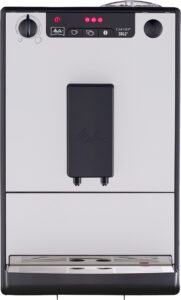
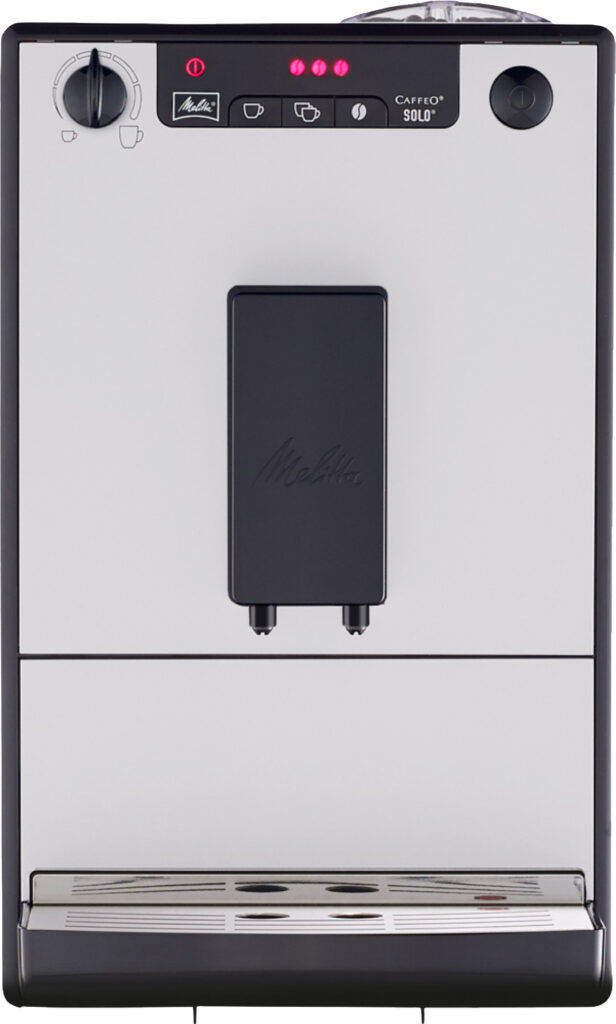
| Melitta Solo | 2, no hot water | none | 5 | 1.2 l | Narrow niche, adjustable temperature |
Philips Series 2200 EP2220/10
In the Philips shop, it’s just under the limit, while the recommended retail price is well above. Philips states a water temperature of 90 to 98 degrees Celsius and at least 20,000 cups for the ceramic grinder. The milk frother, drip tray and grounds container can go in the dishwasher; the brewing unit is rinsed under the tap. There are weaknesses too: lots of plastic, only two preprogrammed drinks, and the AquaClean filter isn’t included.
Krups Intensity EA5008E0
By manufacturer price, the cheapest machine in this comparison, operated with buttons. The stainless steel conical grinder has only three settings, and hot water and ground coffee aren’t supported. According to Krups, 10.5 centimeters fit under the spout, so tall latte glasses don’t. For tea, the kettle remains.
Krups Coffee Crush SA4001
Only 15 centimeters wide and just over the limit in the Krups shop. Espresso at 45 and lungo at 90 milliliters are preset, and you choose the strength with 7 or 9 grams of coffee. Pre-ground coffee also works, which helps with decaf. On the other hand, according to Krups, the grounds container has to be emptied after every cup, and the spout can’t be adjusted. That’s no good for a family. For a single office or a one-person kitchen, it is.
De’Longhi Magnifica S ECAM22.110.SB
The machine with the rotary dial. In the De’Longhi shop, it’s above the limit; in retail, the price fluctuates, so patience pays off here. It also takes ground coffee, brews two espressos at once and delivers hot water. The grounds container holds 14 portions. If you don’t like touch panels, this is the right place, but you don’t get more operating convenience than with Philips.
Melitta Solo
Narrow and pared down: 20 centimeters wide, 33.4 centimeters high. In the Melitta shop, it’s also above the limit, in retail sometimes below. Melitta states three selectable brewing temperatures from 85 to 95 degrees Celsius, and you set the amount steplessly from 30 to 220 milliliters. Coffee and nothing else: no wand, no hot water, only 125 grams of beans. That suits a kitchen where little space and little milk come together.
How we would decide
- Cappuccino now and then, otherwise black: Philips Series 2200. It covers most needs and stays within budget.
- Only black coffee, every euro counts: Krups Intensity.
- Niche under 21 centimeters: Melitta Solo for several cups a day, Coffee Crush for one or two.
- Decaf coffee in between: Magnifica S or Coffee Crush, because both accept ground coffee.
- Several milk drinks every day: better keep saving. A manual wand then quickly becomes a chore nobody wants to do.
Not sure whether it needs to be a bean-to-cup machine at all? For one cup a day, a capsule machine (in German) is also an option. Our guide calculates the cost per cup.
What costs money after the purchase
Cleaning tablets, descaler and filters add up over the years, and in this class they weigh more heavily relative to the machine’s price. Philips states up to 5,000 cups without descaling with eight filter changes. By calculation, that’s 625 cups per filter, so with three cups a day, a change just under every seven months. Whether a filter pays off at all with your tap water depends on the hardness; more on that in the guide Water filters (in German). Stiftung Warentest, by the way, checks whether descaler contains sulfamic acid, which is harmful to waterways. Read the ingredients list.
Frequently asked questions
Does espresso from inexpensive bean-to-cup machines taste worse?
Not necessarily. According to Stiftung Warentest, simple machines without automatic milk frothing are often just as good as more expensive machines at espresso. But the same beans sometimes turned out quite differently depending on the machine. So a high price guarantees little, and a low one rules out little.
Can inexpensive bean-to-cup machines froth milk?
Not at the push of a button. Philips, De’Longhi and the Krups Intensity have a wand that you guide by hand. The Melitta Solo and Krups Coffee Crush have no milk function at all; for that you need a milk frother. At Philips, the tubeless LatteGo system only starts in a higher price class.
How important are the grind settings on a bean-to-cup machine?
It depends on your beans. Philips offers twelve settings, Melitta five, the Krups Intensity three, and on the Coffee Crush the grind is fixed. If you change beans often, you'll notice the difference quickly. If you've been buying the same bag for years, it hardly matters.
Is a manual frothing wand worth it for a daily cappuccino?
With two cappuccinos a day and two minutes each for frothing and wiping, that adds up to a good 24 hours a year. If milk coffee is only a weekend thing, it's just under seven hours. In the first case, the extra cost of the next class deserves serious consideration; in the second, it doesn't.
Which bean-to-cup machine fits in a narrow niche?
The Melitta Solo is 20 centimeters wide, the Krups Coffee Crush only 15. The Solo suits several cups a day, the Coffee Crush one or two, because according to Krups its grounds container has to be emptied after every cup. Measure the depth too: the Solo is almost 46 centimeters deep.
What are the running costs of a bean-to-cup machine?
Cleaning tablets, descaler and filters add up over the years. Philips states up to 5,000 cups without descaling with eight filter changes, which works out to 625 cups per filter. Whether a filter is worth it depends on the water hardness. When buying descaler, check whether it contains sulfamic acid.
Sources
- Philips: Panarello 2200 EP2220/10 bean-to-cup machine
- Philips: Bean-to-cup machines, product range
- Krups: Intensity EA5008E0
- Krups: Coffee Crush SA4001E0
- De’Longhi: Magnifica S ECAM22.110.SB
- Melitta: Solo
- Stiftung Warentest: Bean-to-cup machines tested (freely accessible part, German)
Where to buy
- Philips Serie 2200 EP2220/10Check price at Amazon.deAvailable in Germany: Amazon.de
- Krups Intensity EA5008E0Check price at Amazon.deAvailable in Germany: Amazon.de
- Krups Coffee Crush SA4001Check price at Amazon.deAvailable in Germany: Amazon.de
- De’Longhi Magnifica S ECAM22.110.SBCheck price at Amazon.deAvailable in Germany: Amazon.de
- Melitta SoloCheck price at Amazon.deAvailable in Germany: Amazon.deView at CoolblueAvailable in Germany: Coolblue