This review was first published in German on handgetestet.de.
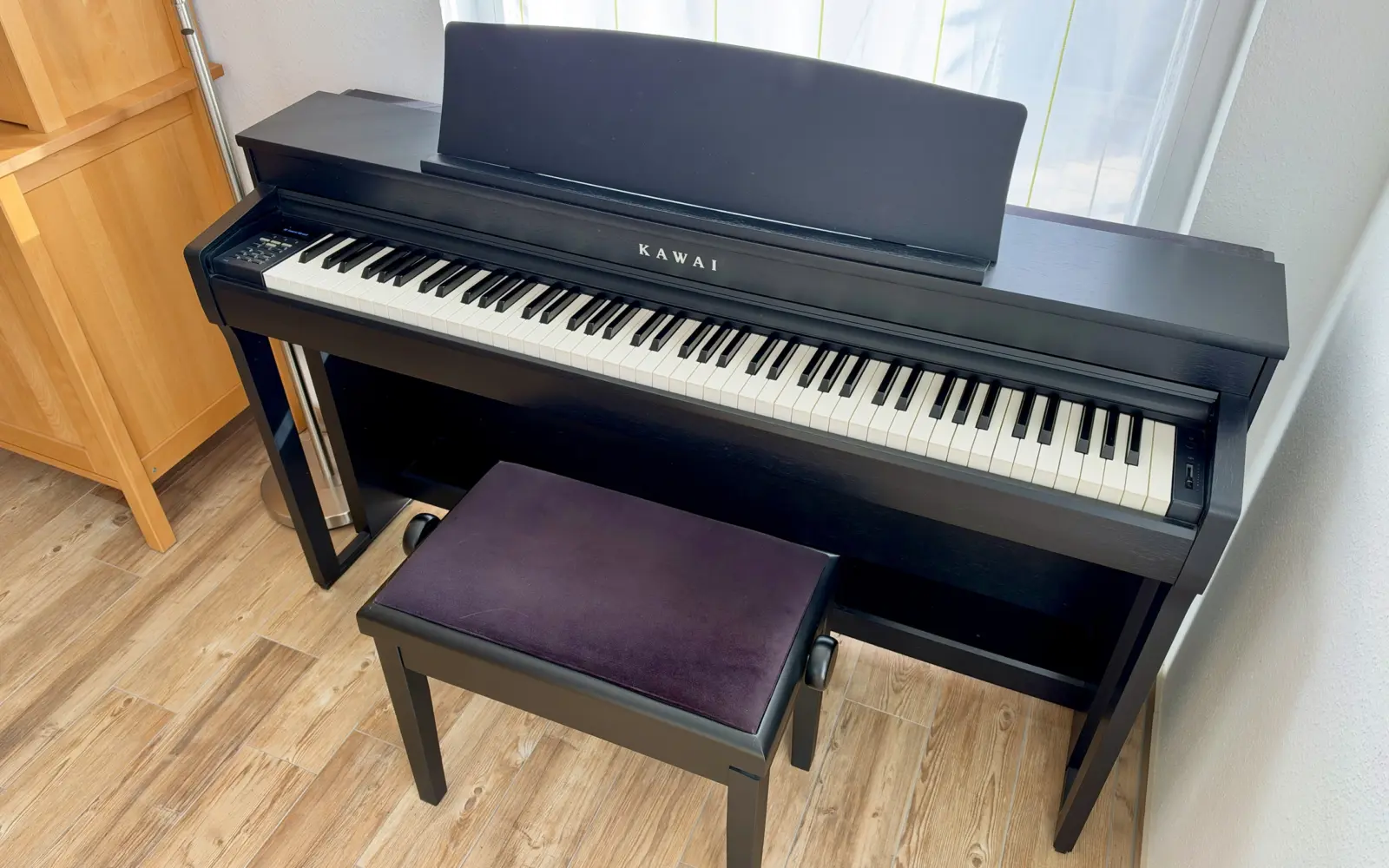
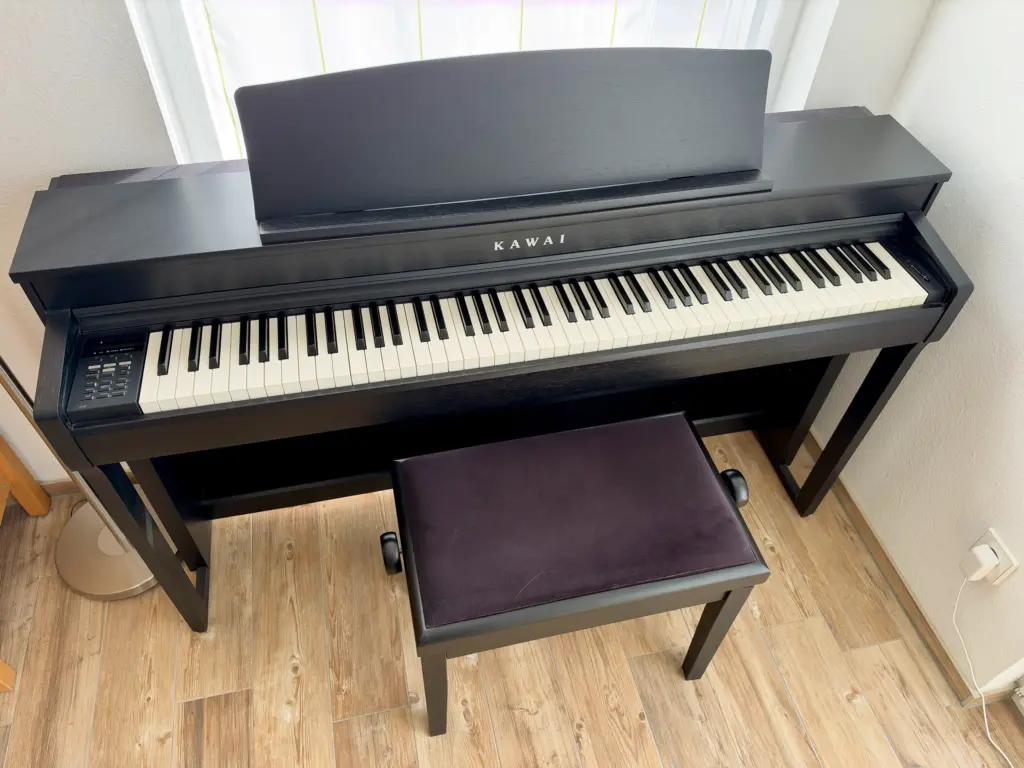
The Kawai CN39 is a digital piano in a furniture-style cabinet with 88 keys, hammer action and three pedals. We have been using it for several years in the satin black version, CN39 B. It is played mostly by a young pianist in the editorial team’s family who has been taking piano lessons for years. Her impression: easy to play, good touch response, beautiful sounds. But there are also a few things that get on your nerves in everyday use. Four out of five stars.
Specifications
All figures are Kawai’s specifications from the owner’s manual and the product page, as of November 14, 2026. We did not measure them ourselves. What we experienced firsthand is described in the sections below.
| Keyboard | |
|---|---|
| Action | Responsive Hammer III (RHIII), 88 keys, graded weighting, let-off simulation |
| Sensors | 3 per key |
| Key surface | Ivory Touch, plastic keys |
| Touch response | Touch Curve: Light 1 to 4, Normal, Heavy 1 to 4, Off (constant), 2 user curves |
| Sound | |
| Sound engine | Progressive Harmonic Imaging (PHI), 88-key sampling, including the Shigeru Kawai SK-EX and SK-5 |
| Sounds | 355, including 9 drum kits, GM2 compatible |
| Polyphony | up to 256 notes |
| Settings | Virtual Technician, including voicing, resonances, damper noise, individual key volume, half-pedal adjustment |
| Speakers and pedals | |
| Speakers | 2 × 13 cm woofers and 2 × (8 × 12 cm), developed with Onkyo |
| Amplifier | 2 × 20 W |
| Pedals | Grand Feel Pedal System: sustain (with half-pedal), sostenuto, soft |
| Connections | |
| Headphones | 2 jacks: 3.5 mm and 6.3 mm, Spatial Headphone Sound (SHS) |
| Audio | Line In and Line Out, 2 × 6.3 mm each |
| MIDI and USB | MIDI In/Out, USB to Host, USB to Device (recording and playback of MP3, WAV, MIDI) |
| Bluetooth | Bluetooth MIDI (Low Energy) and Bluetooth Audio, not available in every sales region according to Kawai |
| Cabinet | |
| Dimensions | 144.5 × 43.5 × 88 cm (W × D × H, without music rest) |
| Weight | 54 kg |
| Finishes | Premium Satin Black, Premium Satin White, Premium Rosewood |
| Other | Key cover, adjustable music rest, OLED display 128 × 64 pixels, lesson function with practice pieces |
Playing feel: pleasantly light
The CN39 is easy to play. Our pianist even finds it lighter to play than an acoustic piano, because no real strings have to be struck. That is her personal impression after years at the instrument and in lessons.
On the technical side, this is the Responsive Hammer III action. According to Kawai, the keys are graded like on a grand piano, heavier in the bass than in the treble. Three sensors per key detect each keystroke, and a let-off simulation reproduces the slight resistance you feel when a hammer is released. How strongly the tone responds to your touch can be set with the Touch Curve. According to the manual, the default setting „Normal“ matches the touch of a Kawai concert grand. Lighter curves need less finger force for a fortissimo, heavier curves need more. This does not change the mechanical key weight, only the volume that results from a keystroke.
Dynamics and sound
The touch response is good, so is the sound, and the selection of sounds is fun to explore. When you play, it feels like sitting at a real piano. Kawai lists 355 sounds, with the sampled Shigeru Kawai SK-EX and SK-5 grand pianos and the EX concert grand at the core. Polyphony goes up to 256 notes.
Now and then a note is too loud
One thing is annoying: every now and then, not often, a note suddenly comes out very loud when you strike a key. That gets a bit irritating during practice. We have not looked into whether it is tied to specific keys, and we don’t know the cause.
Kawai’s manual says nothing about this exact behavior. It does describe three settings in the Virtual Technician menu that affect the relationship between touch and volume: the Touch Curve for the whole keyboard, „Key Volume“ for keyboard ranges, and „User Key Volume“, which lets you make each of the 88 keys louder or quieter individually. We have not tested whether that helps with occasional overly loud notes. If the instrument no longer works normally, Kawai refers you to the dealer’s service department.
Pedals: real feel, loud snap-back
The three pedals feel like those on a real piano. Kawai calls it the Grand Feel Pedal System: the resistance is meant to match the pedals of a Shigeru Kawai SK-EX concert grand. The right pedal supports half-pedaling, and according to the manual its activation point is adjustable.
The downside: if your foot slips off the pedal, the pedal spring snaps back with a loud bang. Because the noise is mechanical, headphones don’t help. In the manual, Kawai recommends adjusting the screw under the pedal unit so that it touches the floor firmly, otherwise the pedal or the pedal unit could be damaged. We have not checked whether that changes the bang.
Speakers: decent, but limited
The built-in speakers sound decent overall, but the sound is limited. Kawai uses four speakers, two 13 cm woofers and two oval 8 × 12 cm drivers, driven by a 2 × 20 watt amplifier developed together with Onkyo. If you want a fuller sound in the room, Kawai says you can connect an external amplifier or powered speakers via the two Line Out jacks. For quiet practice there are two headphone jacks, so a teacher can listen in, for example. Our guide to open-back hi-fi headphones (in German) covers which headphones are suitable.
Black cabinet: beautiful, but delicate
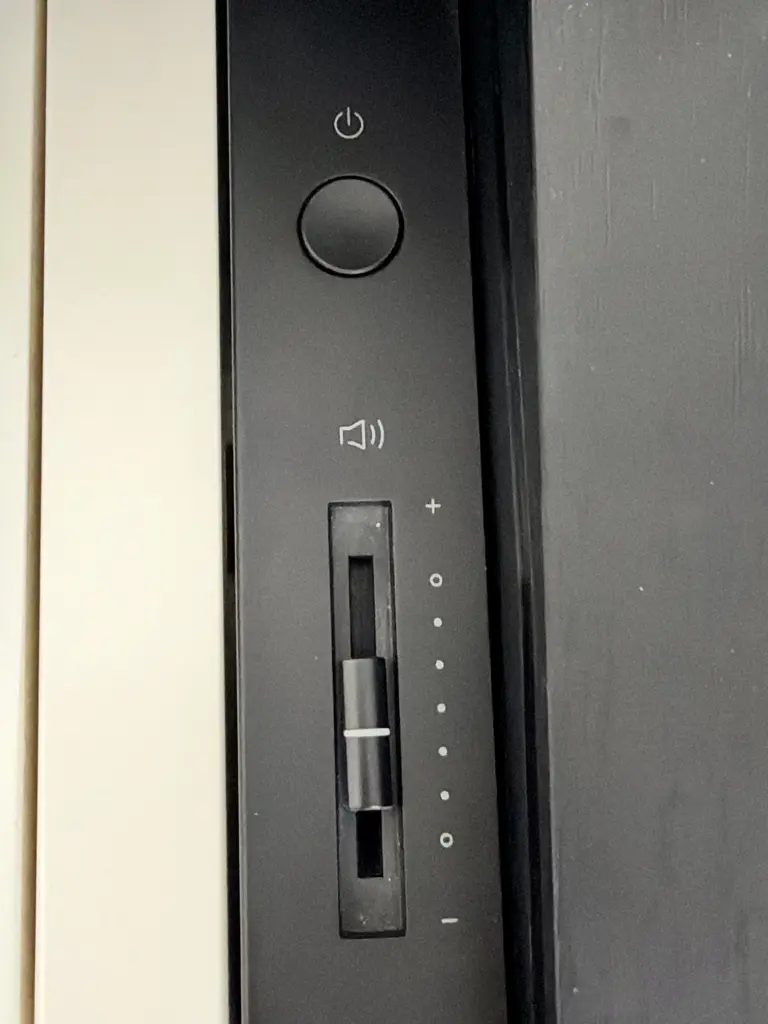
The satin black cabinet is delicate: dirt and smudges show quickly, and the surface scratches very easily. You have to be careful.
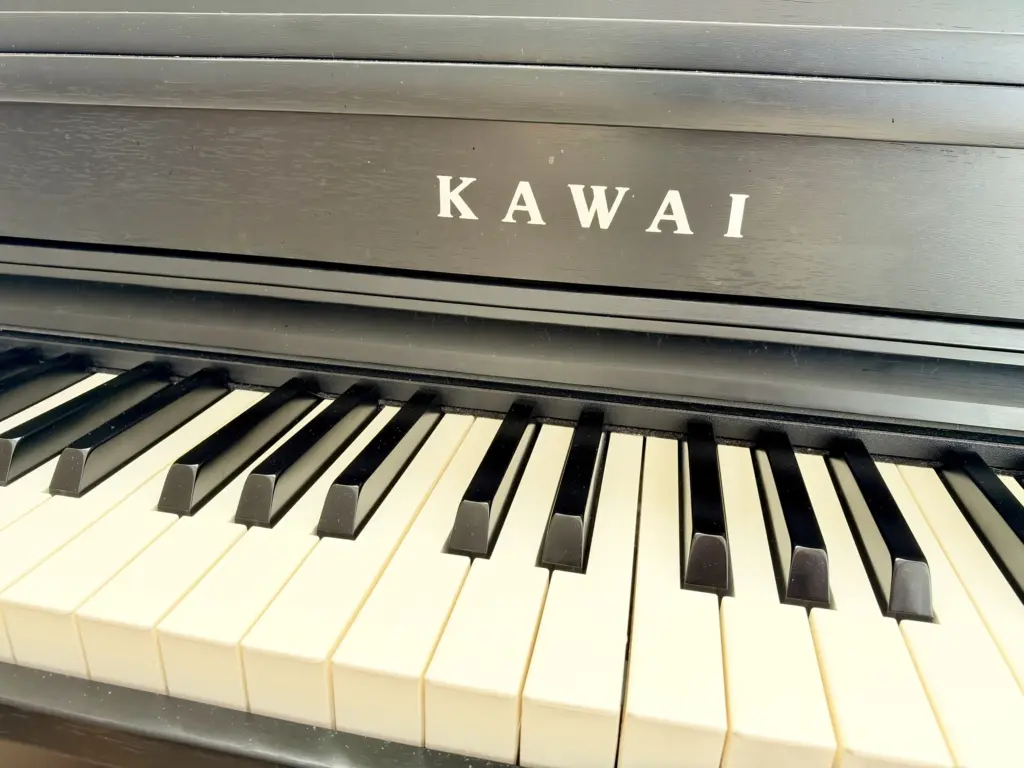
Kawai gives clear care instructions in the manual: never clean the cabinet with benzine or thinner, as it may discolor or deform. Use a soft cloth with lukewarm water and wring it out well first. Clean the pedals with a dry dish sponge; do not wipe gold-colored pedals with a cloth, as they will quickly lose their shine, and do not use rust remover. Do not place the instrument in direct sunlight under a window, next to fan heaters, or in very humid or dusty locations. Close the key cover slowly so nobody gets their fingers caught. Kawai also offers the CN39 in satin white and rosewood. We can’t say how delicate those finishes are.
Features for lessons and apps
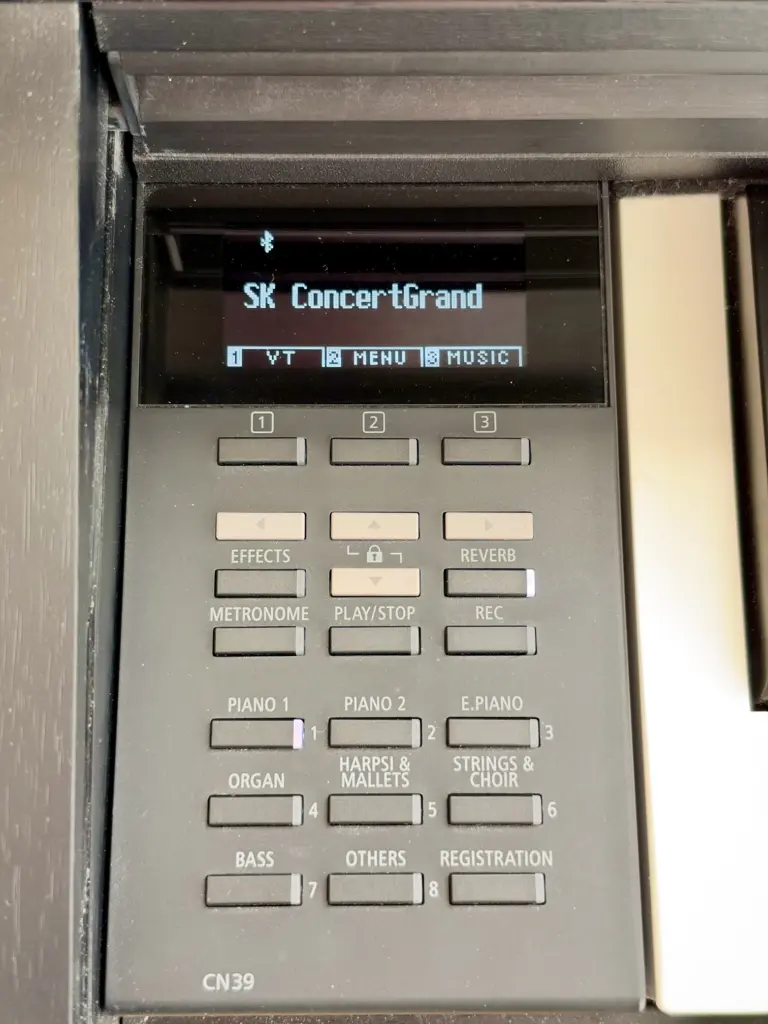
For lessons, the CN39 includes a lesson function with etudes by Czerny, Burgmüller, Beyer and Bach, according to Kawai, plus finger exercises, a metronome with rhythms and a four-hands mode in which teacher and student play in the same octave range. Via USB, you can record your own playing as MP3 or WAV to a flash drive. Bluetooth MIDI connects the piano wirelessly to sheet music and learning apps on a tablet or smartphone, and Bluetooth Audio plays music from your phone through the speakers. Our tablet guide (in German) explains which tablet works well for sheet music apps.
Successor and alternatives
The CN39 is no longer available new. Kawai lists it on its German website under „Older products“, and Thomann (German music retailer) no longer carries it. Kawai explicitly names the CN301 as the successor to the CN39. According to Kawai, it has a revised Responsive Hammer III with new key damping for quieter playing, upward-facing speakers with 360-degree diffusers, a function for balanced sound at low volume, and Bluetooth Audio and MIDI. Polyphony (256 notes), amplifier (2 × 20 W) and the Grand Feel Pedal System stay the same. However, it has far fewer sounds, 45 instead of 355, no longer has MIDI jacks, and at 47.5 kg it weighs less. On November 14, 2026, Thomann lists the CN301 B as in stock for €1,545. We have not tested the CN301.
If you are comparing digital pianos, you will find models from Roland, Yamaha, Casio and Korg in our guide to buying a digital piano (in German). For kids and beginners on a smaller budget, there is our guide to keyboards for beginners and kids (in German). If you want to produce music on a computer and don’t need speakers, read on in our guide to buying a MIDI keyboard (in German), and for recording via the line outputs, see our guide to audio interfaces for the home studio (in German).
Who the CN39 is for
A good fit for:
- piano students who practice regularly at home and need a hammer action with three pedals
- families where practice should be quiet, with headphones
- anyone with a permanent spot in the living space who wants a furniture-style cabinet rather than a stage piano
Less suitable for:
- anyone who needs to move the instrument often; at 54 kg, Kawai says it takes at least two people to carry it
- households where a delicate black cabinet will quickly pick up scratches
- large rooms, if you want to fill them with sound without external speakers
What to know before you buy
- The CN39 is no longer sold new. If you find a used one, check the keys, pedals and cabinet in person and play every key once softly and once loudly.
- According to Kawai, the Bluetooth functions are not included in every sales region.
- A pedal snapping back can be heard in the room even when you practice with headphones.
- Kawai recommends 5 cm of clearance all around for air circulation and no spot in direct sunlight.
Our verdict
The Kawai CN39 has proven itself in our daily practice routine over several years. It plays well, the touch response is convincing, so is the sound, and it feels like sitting at a real piano. Points come off for occasional unexpectedly loud notes, the pedal spring that snaps back loudly, the black cabinet that scratches and smudges easily, and the speakers, which sound decent but limited. For us: four out of five stars. If you are buying new today, the successor CN301 has the same action, the same pedal system and the same amplifier, but fewer sounds.
Are you a manufacturer or retailer and would like us to test your product? Offer a product for testing (in German).
Frequently asked questions
Does the Kawai CN39 have a hammer action?
Yes. According to Kawai, it uses the Responsive Hammer III: 88 graded-weight keys, three sensors per key and a let-off simulation. For us, it plays well and feels pleasantly light.
Can you adjust the touch response of the CN39?
Yes. According to the manual, the Virtual Technician menu offers ten Touch Curve settings from Light to Heavy, a constant setting and two user curves. User Key Volume also lets you adjust the volume of each key individually.
Does the CN39 have Bluetooth?
According to Kawai, yes: Bluetooth MIDI for apps and Bluetooth Audio for playing music from a smartphone through the speakers. Kawai points out that the Bluetooth functions are not included in every sales region.
How do you clean the black cabinet of the CN39?
According to the manual, with a soft cloth and lukewarm water; wring the cloth out well first. Benzine and thinner are off-limits. On our instrument, the satin black cabinet shows smudges quickly and scratches very easily.
Is the Kawai CN39 still available new?
No. Kawai lists it among its older products and names the CN301 as its successor. According to Kawai, the CN301 has the same polyphony and amplifier power and a revised action, but 45 instead of 355 sounds and no MIDI jacks.
How heavy is the Kawai CN39?
According to Kawai, it weighs 54 kg and measures 144.5 × 43.5 × 88 cm. Kawai recommends that at least two people carry the instrument.
Sources
- Kawai: CN39, product page and specifications
- Kawai: CN39 owner’s manual (PDF)
- Kawai: CN301, successor to the CN39
- Kawai Global: CN301, Specifications
- Thomann: Kawai CN-301 B
Conclusion
The Kawai CN39 plays well, the touch response is convincing, so are the sound and the selection of voices, and it feels like sitting at a real piano. Occasionally a note comes out unexpectedly loud, the pedal spring snaps back loudly when your foot slips off, the black cabinet scratches and smudges easily, and the speakers sound decent but limited. The CN39 is no longer sold new; its successor is the CN301. Four out of five stars.