Contents12 sections
This guide was first published in German on handgetestet.de.
A room thermostat for supplementary electric heating has to do one thing above all: switch the current safely. Display, app and weekly schedule come second. If you run a heating register in the ceiling or a hardwired fan heater alongside a heat pump, you are better off with a plain 16-amp relay than with a stylish smart home thermostat rated for only one amp. Our take: for Apple Home, the Eberle UTE 3800-U with Matter; for Homematic IP, the set of wall thermostat and 16-amp switch actuator; and if you don’t want anything smart, stick with a dial.
Load first, then comfort
A heating element is a resistive load. Its power rating is on the nameplate, and that gives you the current: 2,000 watts at 230 volts is just under 8.7 amps. The thermostat has to handle this current continuously, not just briefly. Many wall thermostats are not built for that at all. They control the small actuators of an underfloor heating system, which draw only a few watts.
A typical bad buy is the Homematic IP wall thermostat with switching output (HmIP-BWTH). It fits any 55 mm switch range and looks like exactly the right solution. According to Homematic IP, however, it switches at most 1 amp. For electric heating that only works with a contactor or relay in between, which then carries the actual load. Heatit, too, recommends a contactor for the Z-TRM6 above 13 amps, even though the unit can handle 16 amps.
Beyond that, a few terms from the spec sheet matter:
- Normally closed, normally open, changeover: in heating mode, the contact of a bimetal thermostat opens when it is warm enough. A changeover contact also has a second contact, for cooling or a contactor, for example. For a directly connected heater, a normally closed contact or a normally open relay that switches on when heat is needed is enough.
- On/off or PWM: an on/off (two-point) controller switches on when the temperature drops below the setpoint and off when it rises above it. PWM divides a fixed time period into on and off time and keeps the temperature more even. The electronic Eberle models and the Heatit support both.
- Sensor: a ceiling heating register warms the air at the top of the room. An internal thermometer at switch height measures what arrives at the bottom, and that is usually correct. You need floor or remote sensors for underfloor heating.
- Neutral wire: bimetal thermostats with thermal feedback and all electronic thermostats need one. Eberle writes that without a connected neutral the temperature fluctuates strongly.
Comfort features such as a weekly schedule, open-window detection and frost protection are secondary for pure supplementary heating. What matters more is that the thermostat fits the existing box: surface-mounted units like the Eberle RTR-E measure 75 by 75 millimeters, flush-mounted inserts fit the 55 mm frames of common switch ranges.
Supplementary heating and heat pump: which takes priority?
The heat pump should carry the base load. It turns one kilowatt-hour of electricity into several times as much heat, the heating element into exactly one. So set the room thermostat of the supplementary heater one to two degrees below the room temperature the heat pump already maintains. Then the element only kicks in when the heat pump can’t keep the room warm, for instance on very cold days. If it is set higher, it heats every day, and the heat pump runs up against a wall of expensive direct electric heat. That is our assessment based on physics, not a manufacturer’s promise.
Bimetal thermostats need some patience here. Eberle specifies five to six switching cycles per hour for its bimetal room thermostats. The switching point is only accurate after one to two hours of operation, and when you turn the knob it is lower than in normal operation. So if you readjust, wait half a day before turning it again.
Blocking periods are a topic of their own. Since 2024, German grid operators may dim new controllable consumer devices above 4.2 kilowatts in the event of grid overload. According to the Bundesnetzagentur (Germany’s Federal Network Agency), supplementary and emergency heaters such as immersion heaters count as part of heat pumps. Systems from before 2024 with an agreed control arrangement, i.e. the classic blocking periods, are grandfathered until the end of 2028. Whether your supplementary heater is connected to the heat pump meter and gets blocked along with it is stated in your grid use or electricity contract and visible in the meter cabinet. More on the tariff side is in our guide Electricity tariffs for heat pumps and wall boxes (in German).
What an hour of supplementary heating costs
The math is simple: power times running time times electricity price. For 2026, the BDEW (the German energy industry association) gives an average household electricity price of 37.3 cents per kilowatt-hour (as of October 2026). At that rate, a 1,000-watt element costs around 37 cents per hour at full load, a 2,000-watt element around 75 cents. If the 2,000-watt element runs three hours a day in a cold month, that adds up to 180 kilowatt-hours. At the electricity price above, that is a solid double-digit euro amount per month – for this one room alone. A thermostat set one degree too high can therefore cost more over a winter than the device itself. You’ll find your own unit rate on your electricity bill.
Six thermostats for electric heating
| Model | Switching capacity and control | Operation and connectivity | Best for | Price class (as of November 2026) |
|---|---|---|---|---|
| Eberle RTR-E 6121 | 1 normally closed contact, 10 (4) A, bimetal with thermal feedback | Dial 5 to 30 °C, no display, surface-mounted | Replacing the old thermostat, no smart home | 50-euro class (Eberle list price) |
| Eberle UTE 2800-R | Normally open relay, 16 A, PWM or on/off | Knob with power switch, status LED, 55 mm insert | Flush-mounted in the switch range, no app | 110-euro class (Eberle list price) |
| Eberle INSTAT+ 3R | Changeover relay, 16 (4) A, PWM | Display, weekly schedule, vacation and frost protection, surface-mounted | Fixed schedules without smart home | 270-euro class (Eberle list price) |
| Eberle UTE 3800-U | Normally open relay, 16 (4) A, PWM or on/off | Matter over Wi-Fi, Apple Home, Google, Alexa, 55 mm insert | iPhone households with Apple Home | 150-euro class (Eberle list price) |
| Homematic IP Set Elektroheizungssteuerung (electric heating control set) | Flush-mounted switch actuator HmIP-FSI16-2, continuous 14 A (3,220 W) | Wireless wall thermostat with display and weekly schedule, usable without a hub | Homematic IP households, retrofitting without a new wire to the thermostat | 110-euro class (ELV) |
| Heatit Z-TRM6 | Relay 16 A, 3,600 W resistive, hysteresis or PWM | Display, Z-Wave 800, open window, power metering, 55 mm frame | Z-Wave hubs; not yet official in homee | 130-euro class (retailer listings) |
Eberle RTR-E 6121: the dial that’s here to stay
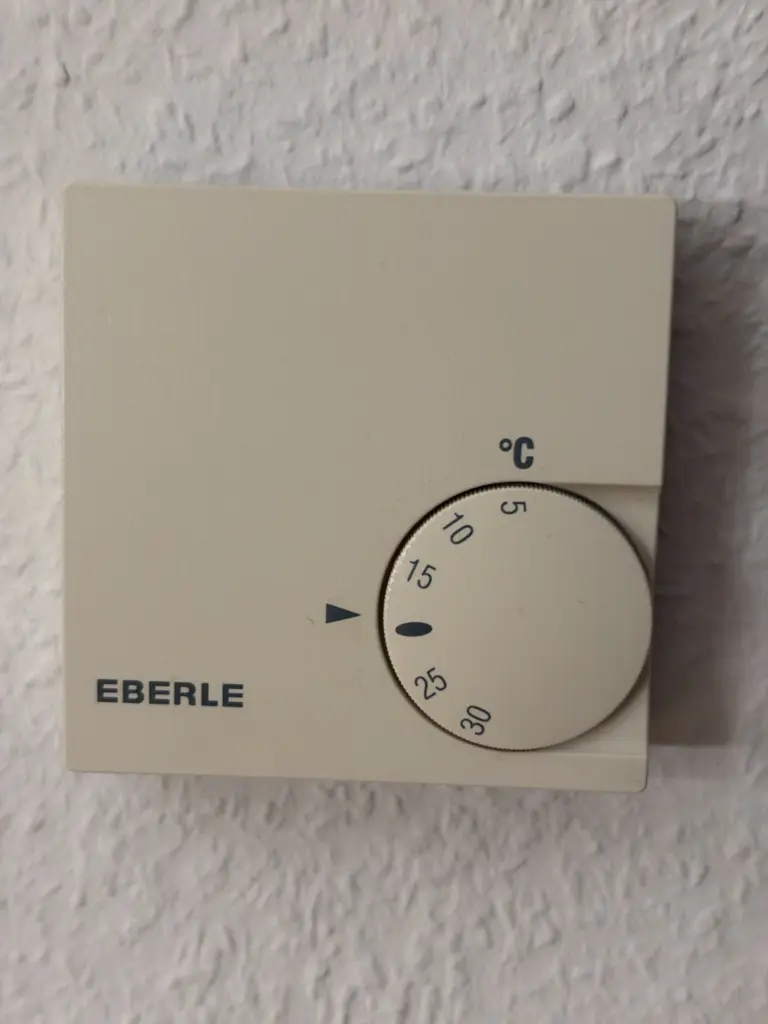
The RTR-E 6121 is not being phased out. Eberle lists it in its 2026 price list with a normally closed contact for 10 amps, 5 to 30 degrees and a hysteresis of about 0.5 kelvin. It is installed in many German new builds from the 2010s, and if you want to swap it like for like, you don’t need to rewire anything. What it can’t do is described in our long-term report on the Eberle RTR-E after eleven years: no display, no schedules, no data. For supplementary heating that only kicks in on cold days, that need not be a drawback.
Eberle UTE 2800-R: electronic, but without an app
The flush-mounted insert fits 55 mm frames and, according to Eberle, switches up to 16 amps via a relay. The installer sets PWM or on/off, an LED shows heating and setback, and the knob contains a power switch. It has no temperature display. It is the choice if the thermostat should disappear into the switch range and wireless plays no role.
Eberle INSTAT+ 3R: weekly schedule without smart home
This clock thermostat shows set and actual temperature to a tenth of a degree, offers two, four or six switching times per day plus vacation, party and frost protection functions. According to Eberle, it sets the time and daylight saving time by itself. The potential-free changeover contact handles 16 amps. It is still expensive, though. At the list price you can already get a connected device, and for supplementary heating that rarely runs, a weekly schedule is something you can do without.
Eberle UTE 3800-U: Matter for Apple Home
This is the Eberle for iPhone households. The insert for 55 mm frames switches up to 16 amps via a relay and joins Apple Home, Google Home or Alexa through Matter over Wi-Fi. According to the manufacturer, it doesn’t need its own Eberle app or hub; you set schedules in your smart home app. LEDs show heating, away mode, open window and Wi-Fi status. A remote sensor can be connected. A Matter device won’t show up in homee, however; there, Matter has so far only been available as a bridge to other systems.
Homematic IP Set Elektroheizungssteuerung (electric heating control set)
Here, measuring and switching are separate. The HmIP-WTH-3 wall thermostat runs on batteries and sits on the wall, with display, dial and weekly schedule. Switching happens in the flush-mounted HmIP-FSI16-2 actuator, which according to ELV (German electronics retailer) carries a continuous 14 amps or 3,220 watts of resistive load. The devices pair directly; no hub is needed. Handy for retrofits: the actuator sits in the box near the heater, and the thermostat goes where it should measure. If you already use Homematic IP, you can connect both to the Access Point or Home Control Unit later. More on the system is in our guide to the Homematic heating sets (in German).
Heatit Z-TRM6: Z-Wave with power meter
This thermostat from Scandinavia is built for electric heating. According to the spec sheet, it handles 16 amps or 3,600 watts of resistive load, measures power itself and offers open-window detection plus floor and remote sensors. Weekly scheduling is handled by the Z-Wave hub. homee’s official device list only includes its predecessor, the Z-TRM3. In March 2026, a user reported in the homee community that the Z-TRM6 could only be paired as a generic Z-Wave device and could not be controlled remotely. For homee, it is therefore not a safe choice at the moment.
How we would decide
- Old dial thermostat broken, everything else fine: Eberle RTR-E 6121, same terminals, same dimensions.
- Apple Home is the hub: Eberle UTE 3800-U. Check beforehand whether Wi-Fi reaches the installation spot reliably.
- Homematic IP in the house or no cable between thermostat and heater: the Homematic set with the 16-amp actuator.
- homee as the center: honestly, there is currently no officially listed thermostat with a load relay that we could recommend with a clear conscience. Until homee adds the Z-TRM6, the dial remains the more robust solution.
A room thermostat for electric heating is hardwired to 230 volts. That belongs in the hands of a licensed electrician, who will also check the wire cross-section and circuit protection. Other ways to network electric heaters are described in our guide Controlling electric heating smartly (in German).
Down to choosing between the Matter thermostat and the wireless set? Read the direct comparison at Eberle UTE 3800-U or Homematic IP set.
Frequently asked questions
Which room thermostat is suitable for electric heating?
One that switches the heater's current continuously, usually with a 16-amp relay. For Apple Home, the Eberle UTE 3800-U with Matter fits; for Homematic IP, the set of wall thermostat and 16-amp switch actuator; and if you don't want anything smart, stick with a dial like the Eberle RTR-E 6121.
How many amps does a thermostat need to switch for 2,000 watts?
2,000 watts at 230 volts is just under 8.7 amps, and the thermostat has to handle that continuously. Many wall thermostats for underfloor heating can't: according to the manufacturer, the Homematic IP HmIP-BWTH switches at most 1 amp and would need a contactor or relay in between.
How do you set supplementary heating alongside a heat pump?
Set the room thermostat of the supplementary heater one to two degrees below the temperature the heat pump already maintains. Then the heating element only kicks in when the heat pump can't keep the room warm. If it is set higher, it runs every day with expensive direct electric heat.
What does an hour of electric heating cost?
Power times running time times electricity price. At the average German household electricity price of 37.3 cents per kilowatt-hour (BDEW 2026), a 1,000-watt element costs around 37 cents per hour at full load, a 2,000-watt element around 75 cents. You'll find your own unit rate on your electricity bill.
Does a room thermostat need a neutral wire?
Bimetal thermostats with thermal feedback and all electronic thermostats need one. According to Eberle, the temperature fluctuates strongly without a connected neutral.
Which thermostat for electric heating works with homee?
There is currently no officially listed thermostat with a load relay. The homee device list only includes the Heatit Z-TRM3; according to a user report, its successor, the Z-TRM6, could not be controlled remotely, and homee does not accept Matter devices such as the Eberle. Until then, the dial remains the more robust solution.
Sources
- Eberle: temperature controller catalog (RTR-E 6000, UTE, INSTAT+)
- Eberle: illustrated price list 2026, valid from September 1, 2026
- Eberle: bimetal room thermostats, general technical notes
- Homematic IP: technical data HmIP-BWTH
- ELV: Homematic IP electric heating control set with HmIP-WTH-3 and HmIP-FSI16-2
- Heatit: Z-TRM6 data sheet
- homee community: Heatit Z-TRM6
- homee: compatible devices
- BDEW: electricity price analysis, as of October 2026
- Bundesnetzagentur: controllable consumer devices under Section 14a of the German Energy Industry Act (EnWG)
Where to buy
- Eberle UTE 3800-UCheck price at Amazon.deAvailable in Germany: Amazon.de
- Eberle RTR-E 6121Check price at Amazon.deAvailable in Germany: Amazon.de
- Homematic IP Set ElektroheizungssteuerungView at ELVAvailable in Germany: ELV
- Eberle UTE 2800-RCheck price at Amazon.deAvailable in Germany: Amazon.de
- Eberle INSTAT+ 3RCheck price at Amazon.deAvailable in Germany: Amazon.de
- Heatit Z-TRM6Check price at Amazon.deAvailable in Germany: Amazon.de