Contents17 sections
This guide was first published in German on handgetestet.de.
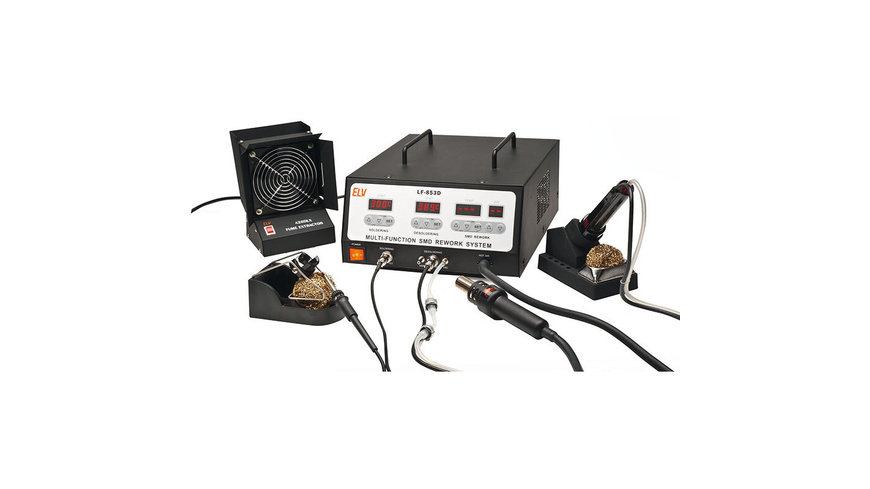
A QFN chip has its connections underneath the package. No soldering tip can reach them, however fine it may be. For the repair bench where through-hole components and SMD come up equally, we consider the ELV LF-853D the most sensible purchase, because soldering iron, desoldering iron with pump, hot air and fume extraction come in one package. If you already own a good soldering station and only want to add hot air, take a look at the Atten ST-862D.
Why a hardware store heat gun has no place here
A heat gun (in German) is built for paint, film and heat-shrink tubing. A rework station works differently: temperature and airflow can be set separately, the nozzle measures a few millimeters, and a control loop holds the setting. The classic soldering station with an iron (in German) still stays on the bench, because as soon as a pin is freely accessible, it’s faster.
The temperature profile: the number on the display isn’t the number on the board
According to an overview by the German statutory accident insurer for the electrical industry, lead-free solders melt at about 217 to 227 degrees Celsius, leaded solders at 179 to 189. At the solder joint itself, the same overview gives around 250 and 215 degrees, respectively. Even so, rework devices are often set much higher. The air cools on its way, and the copper areas of the board draw heat away.
Texas Instruments describes this step by step for a small module: preheat the board to 90 degrees, a 90-second soak at a nozzle temperature of 225 degrees, a 30-second ramp to 335 degrees, then 65 seconds at 370 degrees. That applies to exactly this package on a professional system and is not a recipe for your motherboard. But the principle stays the same: ramp up slowly instead of blasting. TI advises determining the profile with an attached thermocouple or a thermal imaging camera.
Weller is open about how large the uncertainty can be for the WTHA1: the temperature accuracy of the hot air is plus/minus 30 degrees. The WXHotAir system comes with thermocouples for monitoring; ELV and Atten don’t mention anything comparable for the stations here. With those, you’re left feeling your way, following ELV’s principle: if the component doesn’t come loose after a few seconds, don’t keep heating, but let it cool and start again at a higher temperature.
Airflow: the low end of the scale is what counts
A lot of air brings heat. But it also blows tiny resistors away and shifts a chip’s neighbors as soon as their solder melts. In the process mentioned, TI works with only 20 to 25 percent airflow. For small parts, how far a station can be turned down is therefore more interesting than its maximum.
The ELV LF-853D starts at 1.5 liters per minute and ends at 40. Atten gives 20 to 120 liters for the ST-862D. The values can only be compared to a limited extent, because Weller gives 60 or 110 liters as the upper limit for the WTHA1, depending on air temperature. Our assessment: for phone boards and small modules, ELV’s pump unit is enough. With thick multilayer boards with lots of copper, 600 watts and 40 liters gets tight.
Nozzles and distance
The LF-853D comes with four attachments, two square ones with 14 and 9 millimeters inside dimension and two round ones with 7.5 and 4.5 millimeters. The manual gives the distance as 5 to 10 millimeters, and 3 to 5 millimeters for single contacts such as resistors. Never touch down on the board. And never pry: if you lift a component before the solder is liquid everywhere, you’ll tear off the pads with it. Tools for opening devices are covered in our guide to repair kits (in German).
Preheating and drying: the two steps hobbyists skip
A cold board pulls the heat out of the solder joint, so many people turn the temperature up. It’s better to warm the entire assembly moderately beforehand. Weller includes a preheating plate for this in its largest WXHotAir set, and Atten sells its own preheaters. If you’re replacing large chips, plan for it.
Moisture is less well known. Plastic packages and circuit boards absorb water. TI strongly recommends baking populated boards before any rework and refers to the J-STD-033 standard.
ESD: the station is only part of the protection
Both ELV stations have an equipotential bonding socket on the back, Atten includes a grounding cable, and Weller lists WXHotAir as ESD-safe. But the cable also has to be connected. Otherwise, the socket is just decoration. And a grounded station doesn’t protect a chip lying on a plastic mat. A dissipative bench mat and wrist strap are part of the setup for sensitive semiconductors.
Solder fumes: hot air doesn’t make them harmless
According to the Institute for Occupational Safety and Health of the German Social Accident Insurance (IFA of the DGUV), solder fumes contain rosin, formaldehyde and amines, among other things, and can irritate the airways and eyes. According to the accident insurer, the particles are so fine, at 0.01 to 0.15 micrometers, that they reach the alveoli in the lungs. However, its measurements concern iron soldering; it gives no figures for hot air. ELV’s manuals require solder fume extraction at the workstation and good ventilation in any case.
In the institute’s 2003 test bench comparison, hoods with a powerful blower and two filter stages for particles and gas performed best. Some devices with the filter and fan directly in the hood performed poorly. The small tabletop unit of the LF-853D has the fan and filter in one housing, and ELV doesn’t state an airflow rate. Better than nothing. If you work daily, still plan for an extraction arm.
Safety: what the manuals actually require
According to ELV, the heat is still effective some distance from the nozzle. That’s why the manual requires heat-resistant gloves, sturdy shoes and IR safety glasses. The heater must never run without airflow; that destroys it and, according to the manual, is a fire hazard. When switched off, the pump cools the handpiece for about a minute to around 100 degrees. Only then should the whole station be disconnected from the power supply. Freeze spray on hot components is prohibited.
Six stations side by side
| Model | Hot air according to the manufacturer | Airflow | Best for |
|---|---|---|---|
| ELV LF-853D soldering station | 600 W, 100–480 °C | 1.5–40 l/min | Repair bench with everything in one unit |
| ELV LS-180D+ soldering station | none, soldering iron only, 180 W | not applicable | Partner for a separate hot air station |
| Atten ST-862D | 1,000 W, 100–500 °C | 20–120 l/min | Adding hot air to an existing soldering station |
| Atten ST-8802 | 800 W, 100–500 °C, plus 65 W iron | not specified | Compact bench, two tools |
| Weller WTHA1 | 900 W, 50–600 °C | 5–60 l/min (20 °C), 5–110 l/min (300 °C) | Lab and workshop with profiles |
| Weller WXHotAir | 900 W, 50–600 °C | 1–50 l/min (50 °C), 2–90 l/min (300 °C) | Production with documentation requirements |
ELV LF-853D soldering station
Soldering iron and desoldering iron at 100 watts each, hot air at 600 watts, a vacuum pump in the desoldering iron and fume extraction: the equipment earns the recommendation. According to ELV, the station regulates the soldering and desoldering irons to plus/minus 3 degrees, and all three parts run at the same time. The weaknesses are just as clear. At 12 kilograms and a footprint of 30 by 36 centimeters, it’s a piece of furniture, the hot air tops out at 480 degrees, and the manual doesn’t mention profile memory. The TWZ90 SMD tweezers are not included.
ELV LS-180D+ soldering station
No hot air, you need to know that. It’s listed here because 180 watts and 400 degrees in 15 seconds help with ground contacts where weak irons starve. It makes sense as a team with a standalone hot air unit.
Atten ST-862D
According to Atten, this standalone hot air station has 1,000 watts, more than the ELV. Atten mentions three presets for air and temperature, calibration, password protection and automatic cooling; four nozzles and the grounding cable are included. The airflow only starts at 20 liters, so feel your way carefully with tiny components.
Atten ST-8802
Two tools in 12.5 centimeters of width. The iron has 65 watts, the hot air 800 watts, plus a brushless fan, a timer from 10 to 900 seconds and a cold air function. There’s no desoldering pump and no extraction.
Weller WTHA1
The turbine is brushless, and five presets can run automatically as a profile if you want. That way, the station does on its own what TI describes above. This price range is hard to justify for private use, but not in a lab.
Weller WXHotAir
An integrated vacuum lifts the component off directly, thermocouples monitor the temperature, and the software documents every cycle. That matters where rework has to be traceable. Not in a hobby workshop.
How we would decide
- Repairs on consoles, phones and audio equipment, plus through-hole work: ELV LF-853D soldering station.
- Good soldering station already on hand, only hot air missing: Atten ST-862D.
- Little space and mostly SMD: Atten ST-8802.
- Large ground contacts, hot air comes later: ELV LS-180D+ soldering station.
- Lab with recurring processes: Weller WTHA1, with documentation requirements Weller WXHotAir.
We advise beginners against starting here. First practice soldering on an electronics kit (in German), then on a scrap board. The best way to check the result is under a USB microscope.
Frequently asked questions
Why isn't a regular heat gun enough for SMD?
A heat gun is built for paint, film and heat-shrink tubing. A rework station controls temperature and airflow separately, the nozzle measures a few millimeters, and a control loop holds the setting. The soldering station with an iron still stays on the bench, because as soon as a pin is freely accessible, it's faster.
What temperature do I need for hot air desoldering?
According to the German statutory accident insurer for the electrical industry, lead-free solders melt at about 217 to 227 degrees Celsius. The device is often set much higher anyway, because the air cools on its way and copper areas draw heat away. The principle: ramp up slowly instead of blasting. If the component doesn't come loose, let it cool and start again at a higher temperature.
How much airflow does an SMD hot air station need?
For small parts, the low end of the scale is what counts. A lot of air blows tiny resistors away and shifts neighboring components. The ELV LF-853D starts at 1.5 liters per minute, the Atten ST-862D only at 20 liters. With thick multilayer boards with lots of copper, 600 watts and 40 liters gets tight.
How far should the nozzle be from the board?
The LF-853D manual gives 5 to 10 millimeters, and 3 to 5 millimeters for single contacts such as resistors. Never touch down on the board. And never pry: if you lift a component before the solder is liquid everywhere, you'll tear off the pads with it.
Are solder fumes dangerous when working with hot air?
According to the IFA, the occupational safety institute of the German Social Accident Insurance (DGUV), solder fumes contain rosin, formaldehyde and amines, among other things, and can irritate the airways and eyes. However, the measurements concern iron soldering. The ELV manuals require extraction and good ventilation in any case. If you work daily, plan for an extraction arm.
What protective equipment does the manual require?
Heat-resistant gloves, sturdy shoes and IR safety glasses, because according to ELV, the heat is still effective some distance from the nozzle. The heater must never run without airflow. When switched off, the pump cools the handpiece for about a minute to around 100 degrees; only then is the station disconnected from the power supply.
Sources
- ELV: 3-in-1 soldering station LF-853D (retailer information)
- ELV: LF-853D user manual (PDF)
- ELV: Hot air handpiece attachments (PDF)
- ELV: LS-180D+ soldering station (retailer information)
- ELV: LS-180D+ user manual (PDF)
- Atten: ST-862D
- Atten: ST-8802
- Weller: WTHA1 set 230 V
- Weller: WXHotAir Basic Set
- Weller: WXHotAir brochure (PDF)
- Texas Instruments: Rework Guidelines, MicroSiP
- BG ETEM (German accident insurer): Exposure during lead-free soft soldering (PDF)
- IFA of the DGUV: Solder fume emissions during soft soldering
Where to buy
- ELV Lötstation LF-853DView at ELVAvailable in Germany: ELV
- ELV Lötstation LS-180D+View at ELVAvailable in Germany: ELV
- Atten ST-862DCheck price at Amazon.deAvailable in Germany: Amazon.de
- Atten ST-8802Check price at Amazon.deAvailable in Germany: Amazon.de
- Weller WTHA1Check price at Amazon.deAvailable in Germany: Amazon.de
- Weller WXHotAirCheck price at Amazon.deAvailable in Germany: Amazon.de