Contents11 sections
This guide was first published in German on handgetestet.de.
Before we get to cones, flat burrs and settings, there is a simpler question: what is the grinder actually supposed to grind? For filter coffee, almost any decent conical burr grinder will do. If you run a portafilter espresso machine with a non-pressurized basket, however, you need fine, small adjustment steps in the espresso range. That is where the models part ways. If you drink both, the Baratza Encore ESP is, in our view, the most sensible middle ground.
Espresso leaves little room for error
Half a step on the grind setting, and the extraction time changes noticeably. Filter coffee, French press and pour-over are more forgiving. That is why other things matter more when buying than design or display size.
First, the burrs. Conical burrs usually run slower, are compact and are common in home grinders; flat burrs are more often found in espresso-focused grinders such as the Eureka Mignon. Then the fineness of the steps: 18 settings across the whole range are enough for filter. For espresso, many settings in the fine range or stepless adjustment help.
A timer or a contact switch on the portafilter holder saves weighing and mess. For more precise control, though, you still need a kitchen scale with a 0.1 gram display (in German). Also check whether holders or adapters for your portafilter size are included, usually 51, 54 or 58 mm.
A removable upper burr makes it easier to clear out old coffee residue. And if the manufacturer sells replacement burrs, the grinder often lasts longer than the housing would suggest.
Blade grinders are deliberately missing here. They smash the beans unevenly. That is hardly usable for espresso.
What stays behind in the grinder
The coffee that remains in the machine after grinding is often underestimated. A few grams of leftover grounds in the chute and grinding chamber end up in your next cup. If you change beans often, you should therefore grind a small amount after switching and throw it away. In buyer reviews of the Graef CM 702, exactly this retention comes up again and again as a complaint. So the honest question to ask yourself is: one bean for weeks, or something new all the time?
Six grinders from Graef to Eureka
| Model | Burrs | Adjustment | Best for |
|---|---|---|---|
| Baratza Encore ESP | Conical, 40 mm, steel | 40 settings, 1–20 as fine steps for espresso | Switching between portafilter and filter |
| Sage the Smart Grinder Pro | Conical, stainless steel | 60 settings, timer in 0.2-second steps | Those who want to dose by time |
| Graef CM 802 | Conical, stainless steel | 40 settings, 350 g bean hopper | Portafilter beginners with a Graef machine or similar |
| Graef CM 702 | Conical, stainless steel | 24 settings, 250 g bean hopper | Small budget, mostly filter |
| Eureka Mignon Specialità | Flat burrs, 55 mm | Stepless, two doses via touchscreen | Espresso first |
| De’Longhi Dedica KG 521.M | Conical, stainless steel | 18 settings, display, 350 g | Filter and Dedica portafilter with pressurized basket |
Baratza Encore ESP
The well-known Encore, reworked for espresso. According to Baratza, it grinds with a 40 mm steel conical burr set; the scale runs from 1 to 40, settings 1 to 20 are designed as micro steps for espresso, and the filter range starts at 21. A dosing cup for 54 mm portafilters with an adapter for 58 mm is included. It has no timer. You grind with a button or the rotary switch. If you accept that and weigh anyway, you get a grinder that covers both worlds well.
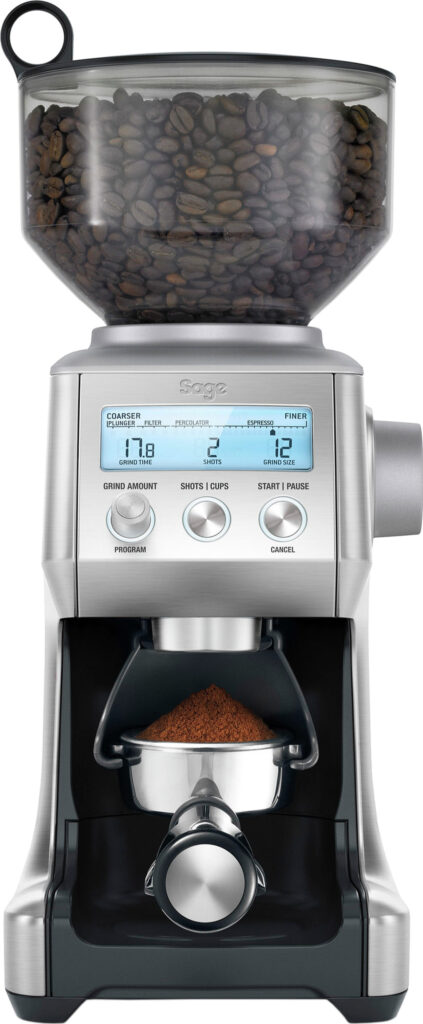
Sage the Smart Grinder Pro
Sage focuses on convenience. According to the manufacturer, there are 60 grind settings, a backlit display and time-based dosing in 0.2-second steps, plus adapters for 50 to 54 mm and for 58 mm. For espresso, the manual recommends starting at setting 12. Buyers praise the repeatable settings. A few mention coffee dust when filling the portafilter.
Graef CM 802
Stainless steel conical burrs, 40 grind settings, a lockable bean hopper for around 350 grams and two portafilter holders: that is how Graef describes the CM 802. The grinder runs as long as the portafilter presses against a contact switch. Simple and quick in everyday use. For exactly identical doses without a scale, however, it lacks a timer.
Graef CM 702
The smaller sibling costs considerably less. According to Graef, it also has stainless steel conical burrs, but only 24 settings and a 250 gram hopper. Filter coffee and French press turn out well with it. On a portafilter with a single-wall basket, 24 steps run out faster, which is why Graef offers a shim set; according to the manual, it shifts the range about seven settings toward fine.
Eureka Mignon Specialità
No cone this time. Eureka uses flat 55 mm burrs made of hardened steel, and adjustment is stepless. Two dosing programs can be selected via a touchscreen, grinding is started by a microswitch on the portafilter, and the hopper holds 300 grams. It is built for people who pull espresso every day and fine-tune the grind in tiny steps. If you mostly drink filter, you pay for precision you will hardly use.
De’Longhi Dedica KG 521.M
Visually the counterpart to the portafilter series of the same name. De’Longhi lists stainless steel conical burrs, 18 grind settings, a display with cup selection and a 350 gram hopper; a portafilter holder is included. According to buyers, the finest setting works well with pressurized baskets. With single-wall baskets, it sometimes does not grind fine enough. For filter coffee, that does not matter.
Which grinder suits which cup
Switching between portafilter and filter: the Baratza Encore ESP, with fine espresso steps, a filter range and replacement burrs from the manufacturer. If you want to dose without a scale, go for the Sage the Smart Grinder Pro and its timer. Almost only espresso? Then the Eureka Mignon Specialità, with flat burrs instead of a cone and stepless adjustment.
On a small budget and mostly filter, the Graef CM 702 is enough; for ambitious espresso, rather the CM 802 or the Baratza. And the De’Longhi KG 521.M suits the Dedica machine with a pressurized basket, as long as single-wall baskets are not on the agenda.
No machine for freshly ground coffee yet? Our guide to bean-to-cup coffee machines (in German) presents the more convenient option with a built-in grinder. One last thought. The most expensive grinder does little if the beans are stale, and freshly roasted coffee often makes more of a difference than ten extra grind settings.
Few beans, little waste: the guide Bean-to-cup coffee machine for singles shows the alternative.
Still undecided between the two routes? The guide Bean-to-cup machine or portafilter (in German) does the math on time, beans and cleaning effort.
Frequently asked questions
Which coffee grinder is good enough for filter coffee?
For filter coffee, almost any decent conical burr grinder will do; 18 settings across the whole range are sufficient. Filter, French press and pour-over are more forgiving about grind size than espresso. On a small budget and mostly filter, the Graef CM 702 with 24 settings is enough.
What should I look for in a grinder for espresso?
Espresso leaves little room for error: half a step on the grind setting noticeably changes the extraction time. Many settings in the fine range or stepless adjustment help. Also check whether holders or adapters for your portafilter size are included, usually 51, 54 or 58 mm.
What is the difference between conical burrs and flat burrs?
Conical burrs usually run slower, are compact and are common in home grinders. Flat burrs are more often found in espresso-focused grinders. The Eureka Mignon Specialità, for example, grinds with flat 55 mm burrs made of hardened steel and is adjusted steplessly.
Why are blade grinders not suitable?
Blade grinders smash the beans unevenly. That is hardly usable for espresso, which is why they were deliberately left out of the comparison. All models presented work with conical or flat burrs.
What is retention in a coffee grinder?
It means the leftover grounds that stay in the chute and grinding chamber after grinding and end up in your next cup. If you change beans often, grind a small amount after switching and throw it away. With the Graef CM 702, this retention comes up again and again as a complaint in buyer reviews.
Can you dose with a grinder without a scale?
A timer or a contact switch on the portafilter holder saves weighing and mess. According to the manufacturer, the Sage the Smart Grinder Pro doses in 0.2-second steps. For more precise control, though, you still need a kitchen scale with a 0.1 gram display.
Sources
- Baratza: Encore ESP
- Sage Appliances: the Smart Grinder Pro
- Sage Appliances: Smart Grinder Pro user manual (PDF)
- Graef: CM 802 coffee grinder
- Graef: CM 702 coffee grinder
- Eureka: Mignon Specialità
- De’Longhi: Dedica KG521.M
Where to buy
- Baratza Encore ESP (230 V, weiß)Check price at Amazon.de
- Sage the Smart Grinder ProView at Coolblue
- Graef CM 802Check price at Amazon.de
- Eureka Mignon Specialità (schwarz)Check price at Amazon.de
- De'Longhi Dedica KG 521.MCheck price at Amazon.de
- Graef CM 702Check price at Amazon.de