Contents12 sections
This guide was first published in German on handgetestet.de.
You choose a telephoto lens for wildlife by the lens mount first, and only then by focal length. If you shoot Sony or Nikon and cover a lot of ground on foot, we’d point you to the Tamron 150-500 mm, which according to the manufacturer weighs about 1.7 kilograms and focuses from 60 centimeters at the short end. If, on the other hand, you regularly need 600 millimeters or more, take the zoom from your own camera maker, because Sony, Nikon and Canon approve teleconverters for their models. Everything else is fine-tuning.
How much focal length does a bird on a branch need?
The distance determines the focal length. Not the other way around. At a feeding station in your yard, you can choose the distance yourself; the Bavarian bird conservation association Landesbund für Vogel- und Naturschutz (LBV) even recommends setting the distance between perch and camera according to your own focal length. At the edge of the reeds or in the forest, that’s not possible: the animal is where it is, and every millimeter counts.
On a camera with an APS-C sensor, every lens looks longer. For its 150-500 on such bodies, Tamron states an angle of view equivalent to 225 to 750 millimeters on full frame. That’s a tighter crop, not extra detail. Our take: 400 to 600 millimeters cover the yard, pond and field edge; 800 and more are for shy species and good light.
Weight, stabilization, minimum focus distance
Two kilograms sounds harmless on paper. On a dike in a headwind, with the camera to your eye, it feels different. The range across the five zooms in our overview is considerable: Canon states about 1,370 grams for the RF 100-500, Tamron 1,725 grams without tripod foot, Nikon 1,955 grams without tripod collar, Sigma 2,100 grams with tripod collar and Sony 2,115 grams. If you shoot almost exclusively handheld, take these numbers more seriously than half a stop of maximum aperture.
A stabilizer steadies your hand, not the animal. Nikon states 5.5 stops according to the CIPA standard for the Z 180-600, and Canon up to five stops for the RF 100-500 on an EOS R and up to six together with the in-body stabilization of an EOS R5. For a heron taking off, you still need a fast shutter speed. A dedicated mode helps with panning. Tamron offers three stabilization modes via a switch on the Sony and Fuji versions; on Nikon Z, the stabilizer is controlled through the camera.
The minimum focus distance decides whether dragonflies and butterflies make it onto the memory card too. Sigma focuses from 58 centimeters at the short end, Tamron from 60, both with a magnification of around 1:3. For the 200-600, Sony states 2.4 meters, by contrast. At a garden pond, that’s a real difference.
The mechanics matter too. Nikon’s 180-600 zooms internally, so its length stays the same, and according to Nikon the zoom ring only needs a 70-degree turn. The Tamron extends from just under 21 to about 28 centimeters when zooming.
Teleconverters: more reach, less light
A 1.4x converter extends the focal length by 40 percent and takes away one stop of light; a 2x converter doubles it and takes away two. Canon shows this very clearly on the RF 100-500. With the Extender RF1.4x, it becomes 420 to 700 millimeters at f/8 to f/10, with the RF2x 600 to 1,000 millimeters at f/11 to f/14. And with the extender attached, the zoom can only be moved between 300 and 500 millimeters. That’s worth knowing before you buy.
Sony approves its two converters, the SEL14TC and SEL20TC, for the 200-600, with autofocus according to the manufacturer. Nikon lists the 180-600 as compatible with teleconverters but notes that autofocus may not always lock on, depending on subject and light. At Sigma, approval for the TC-1411 and TC-2011 applies only to the L-Mount; the Sony version has none. Tamron lists no converter for the 150-500.
Our position: a converter is a reserve for bright light. It doesn’t replace a longer focal length.
Getting closer isn’t always allowed
A long lens is also a tool for keeping your distance. The LBV explicitly lists wildlife photographers among the possible sources of disturbance at black stork nests. The guideline there is not to cause disturbance within a radius of 300 meters around the nest tree from March 1 to August 31, and breeding sites are protected under § 44 of the German Federal Nature Conservation Act (Bundesnaturschutzgesetz). According to the LBV, only a few people directly involved should know the exact location of a nest. So if you find one, it’s better to post the photo online without location information.
In the yard, the LBV advises against using flash, for the animals‘ sake. A remote shutter release creates additional distance.
Five super-telephoto zooms side by side
| Model | Mount | Focal length, aperture | Weight according to manufacturer | Best for |
|---|---|---|---|---|
| Tamron 150-500 mm F/5-6.7 Di III VC VXD | Sony E, Nikon Z | 150–500 mm, f/5–6.7 | 1,725 g (Sony E), 1,720 g (Nikon Z), without tripod foot | Hikers, yard and pond |
| Sony FE 200-600 mm F5.6-6.3 G OSS | Sony E | 200–600 mm, f/5.6–6.3 | 2,115 g | Sony shooters who want a converter |
| Nikon NIKKOR Z 180-600 mm f/5.6-6.3 VR | Nikon Z | 180–600 mm, f/5.6–6.3 | 1,955 g without, 2,140 g with tripod collar | Nikon shooters who need 600 mm |
| Canon RF 100-500 mm F4.5-7.1 L IS USM | Canon RF | 100–500 mm, f/4.5–7.1 | about 1,370 g | Canon shooters who carry a lot |
| Sigma 150-600 mm F5-6.3 DG DN OS Sports | Sony E, L-Mount | 150–600 mm, f/5–6.3 | 2,100 g with tripod collar | L-Mount with converter, close range |
Tamron 150-500 mm F/5-6.7 Di III VC VXD
For Sony E and Nikon Z, the lightest of the five, plus an 82 mm filter thread instead of 95 mm. At 150 millimeters, it focuses down to 60 centimeters, which makes it usable for insects at the pond’s edge too. On the other hand, it ends at 500 millimeters and f/6.7, with no converter option. Tamron describes a moisture-resistant construction with seals in the barrel; a version for Fujifilm X is also available.
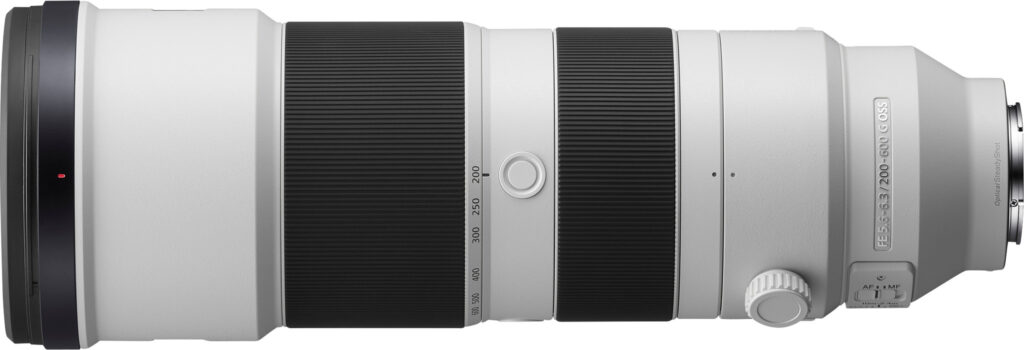
Sony FE 200-600 mm F5.6-6.3 G OSS
The direct route to 600 millimeters on Sony cameras. Sony states 2,115 grams, a 95 mm filter thread and a minimum focus distance of 2.4 meters at a maximum magnification of 0.2x. With the SEL14TC, it becomes 840 millimeters, and according to the manufacturer autofocus is retained. It’s not a lens for insects. If you want to place the system’s other lenses, you’ll find them in our overview of Sony E-mount lenses (in German).
Nikon NIKKOR Z 180-600 mm f/5.6-6.3 VR
Internal zoom, 5.5 stops of stabilization and a short 70-degree zoom throw make it pleasant to handle in the field. Nikon states 1,955 grams without tripod collar; the minimum focus distance is 1.3 meters at the short end and 2.4 meters at the long end, and the magnification is 0.25x. Teleconverters fit, with the autofocus caveat mentioned above. For Nikon shooters for whom 500 millimeters isn’t enough, this is our first choice; there’s more on the system in our guide to Nikon Z lenses (in German).
Canon RF 100-500 mm F4.5-7.1 L IS USM
At about 1,370 grams, the lightest lens in the overview, and that with 100 millimeters at the short end. Canon states a minimum focus distance of 0.9 meters and a magnification of 0.33x; the filter thread measures 77 millimeters. At the long end, it reaches 500 millimeters at f/7.1, so slightly less reach than the competition. If you want more, combine it with an extender and accept the zoom restriction described above. Other RF lenses are covered in our guide to Canon RF lenses (in German).
Sigma 150-600 mm F5-6.3 DG DN OS Sports
Sigma builds this zoom for Sony E and the L-Mount, at 2,100 grams including the tripod collar. You can zoom either by pushing/pulling or by turning. At the short end, it focuses from 58 centimeters, and the maximum magnification is 1:2.9. Sigma states about four stops of stabilization at 600 millimeters, and up to 5.5 with the newer OS2 control algorithm and current firmware. It’s sealed against dust and splashes, suitable for light rain according to Sigma, not waterproof. On Sony cameras, it offers a shorter close-focus distance than the Sony 200-600, but does without a converter.
Which lens suits whom
- Sony or Nikon Z, lots of walking, insects at the pond too: Tamron 150-500 mm.
- Sony, with the wish to go to 840 millimeters later: Sony FE 200-600 mm with SEL14TC.
- Nikon Z and regularly shy birds at a distance: NIKKOR Z 180-600 mm.
- Canon EOS R and long hikes: RF 100-500 mm, with the extender only for bright light.
- L-Mount with converter option, or Sony with the wish for a short close-focus distance: Sigma 150-600 mm DG DN.
Frequently asked questions
How much focal length do you need for bird photography?
The distance determines the focal length. 400 to 600 millimeters cover the yard, pond and field edge; 800 and more are for shy species and good light. At a feeding station, the Bavarian bird conservation association LBV recommends setting the distance between perch and camera according to your own focal length.
How heavy are super-telephoto zooms?
The range is considerable: Canon states about 1,370 grams for the RF 100-500, Tamron 1,725 grams without tripod foot, Nikon 1,955 grams, Sigma 2,100 grams with tripod collar and Sony 2,115 grams. If you shoot almost exclusively handheld, take these numbers seriously.
Is a teleconverter worth it on a telephoto zoom?
A 1.4x converter extends the focal length by 40 percent and costs one stop of light, a 2x converter two stops. On the Canon RF 100-500, with an extender attached you can only zoom between 300 and 500 millimeters. A converter is a reserve for bright light and doesn't replace a longer focal length.
Why does minimum focus distance matter for telephoto lenses?
It decides whether dragonflies and butterflies make it into the picture too. Sigma focuses from 58 centimeters at the short end, Tamron from 60, both with a magnification of around 1:3. For the 200-600, Sony states 2.4 meters, by contrast.
Does a lens look longer on APS-C?
Yes, the framing gets tighter. For the 150-500 on APS-C, Tamron states an angle of view equivalent to 225 to 750 millimeters on full frame. However, that's only a tighter crop and doesn't add any detail.
What should you keep in mind when photographing near nesting sites?
The LBV lists wildlife photographers as a possible source of disturbance at black stork nests. From March 1 to August 31, a radius of 300 meters applies there as a guideline, and breeding sites are protected under the German Federal Nature Conservation Act. Photos of nests belong online without location information.
Sources
- Tamron: 150-500mm F/5-6.7 Di III VC VXD, specifications
- Tamron: 150-500mm F/5-6.7 Di III VC VXD, product page
- Sony Japan: FE 200-600 mm F5.6-6.3 G OSS, specifications
- Nikon: NIKKOR Z 180-600mm f/5.6-6.3 VR
- Canon: RF100-500mm F4.5-7.1 L IS USM
- Canon Japan: Extender RF1.4x, compatible lenses
- Canon Japan: Extender RF2x, compatible lenses
- Sigma: 150-600mm F5-6.3 DG DN OS Sports
- LBV: Nest protection for the black stork
- LBV: Tips for bird photography
Where to buy
- Tamron 150-500mm F/5-6.7 Di III VC VXD (Sony E)Check price at Amazon.deAvailable in Germany: Amazon.de
- Sony FE 200-600 mm F5.6-6.3 G OSS (SEL200600G)View at CoolblueAvailable in Germany: Coolblue
- Nikon NIKKOR Z 180-600 mm f/5.6-6.3 VRCheck price at Amazon.deAvailable in Germany: Amazon.de
- Canon RF 100-500 mm F4.5-7.1 L IS USMCheck price at Amazon.deAvailable in Germany: Amazon.de
- Sigma 150-600 mm F5-6.3 DG DN OS SportsCheck price at Amazon.deAvailable in Germany: Amazon.de