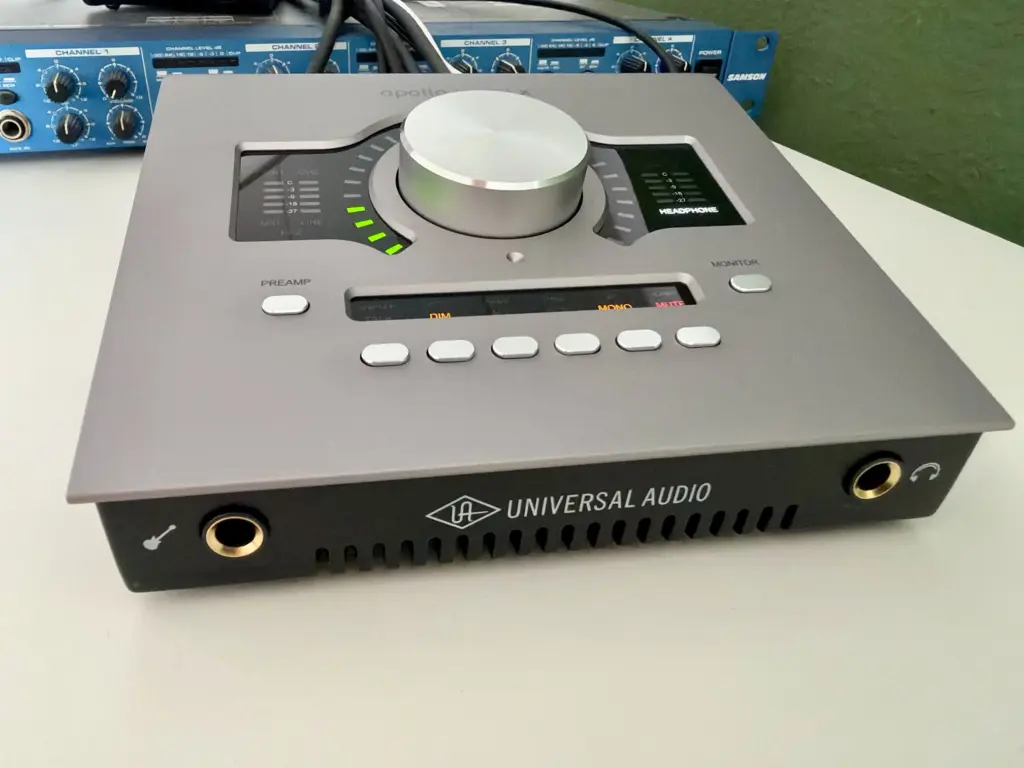
This review was first published in German on handgetestet.de.
In a home studio, the audio interface is the bottleneck: everything you record passes through its preamps and converters, and so does everything you listen to. We have been working with Universal Audio’s Apollo Twin for almost ten years. The Apollo Twin X in its QUAD version is the third unit from this series in our studio and has been in daily use since August 2025. After all this time, our verdict is clear: five out of five stars. We still have one wish, though.
Sound: pro-grade recordings on your desk
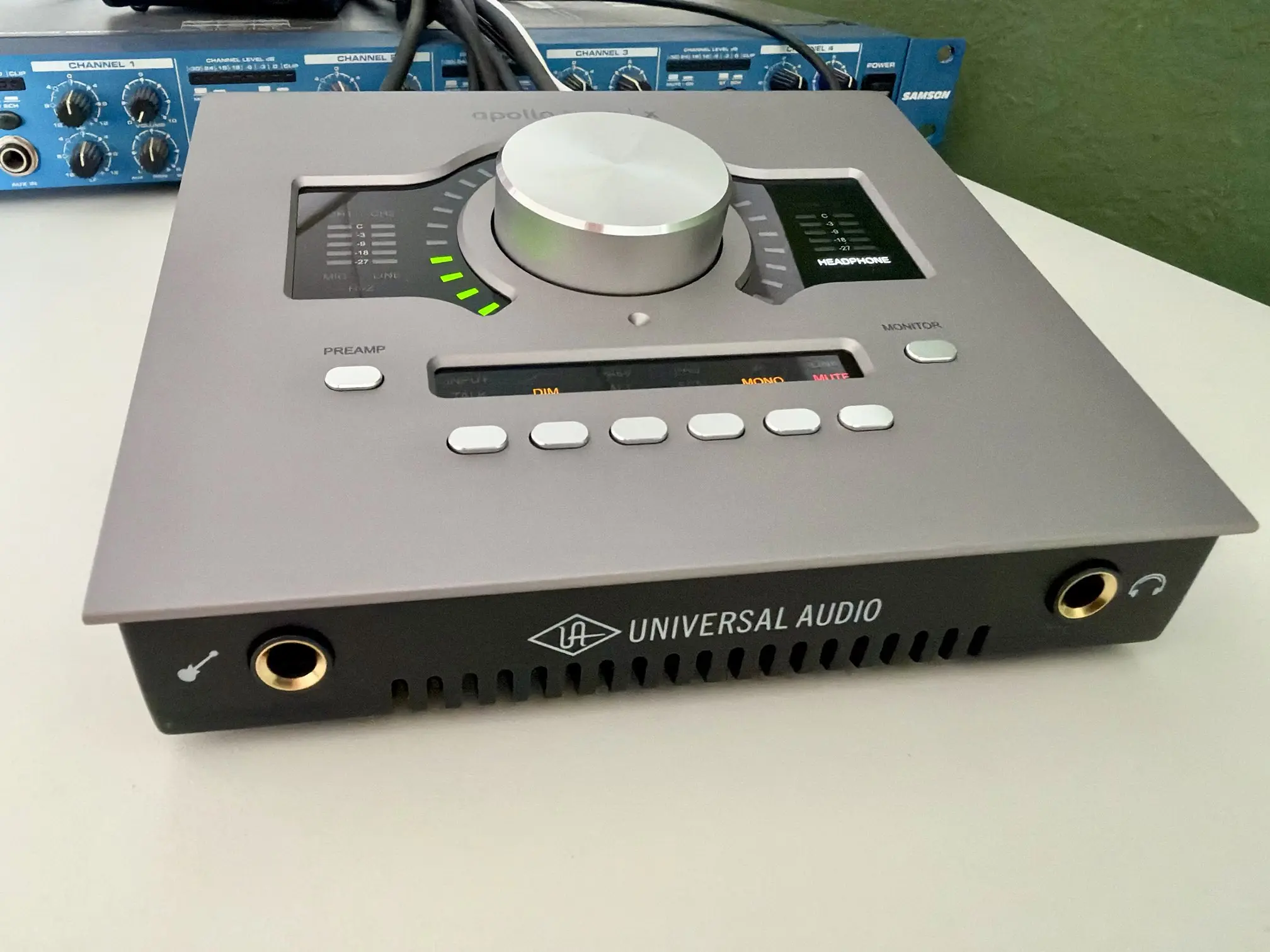
Recording quality is the reason we have stuck with Universal Audio. With the right microphones and instruments, the Twin X produces recordings that can hold their own against professional productions. In all these years, we have never doubted the unit’s technical sophistication.
According to the manufacturer, the converters work at up to 24-bit and 192 kHz, and the monitor outputs reach a dynamic range of 127 dB (A-weighted). The two mic preamps offer 10 to 65 dB of gain, phantom power, a 20 dB pad, a low-cut filter and polarity inversion. Universal Audio specifies the path through the converters and mixer at 1.1 milliseconds at 96 kHz.
Latency: record and monitor without delay
One of its greatest strengths shows when you are actually tracking. Through the Twin X, we record with extremely low latency: vocals and instruments reach the headphones without any noticeable delay, even with effects such as compressor, EQ or reverb already running. Anyone who hears their own signal while singing or playing notices right away how much more relaxed it is to work this way.
This is made possible by the processing power inside the unit. According to the manufacturer, the UAD plug-ins run in real time on the Apollo’s DSP cores with latencies under 2 milliseconds, and several plug-ins can be chained without latency increasing further. According to Universal Audio, recording through the Unison preamps also happens with near-zero latency.
UAD plug-ins: the real asset
For us, the UAD plug-ins are at least as important as the hardware. They run on the signal processors in the unit, two (DUO) or four (QUAD) processing cores depending on the version, according to the manufacturer. Compressors, EQs, tape machines and guitar amps can be used while recording, without noticeably taxing the computer. Universal Audio has been at home in professional audio for decades, and it shows in the plug-ins: lots of attention to detail, beautifully designed interfaces and a very wide selection. For mixing, effects processing and mastering, they are among the finest tools we have worked with.
According to the manufacturer, the Unison preamps adapt their behavior to the preamp plug-in loaded, for example an emulation of a classic tube preamp. The plug-ins work in combination with the hardware, so if you want to use them, you need a UAD device like the Twin X.
Operation: hardware and software speak the same language
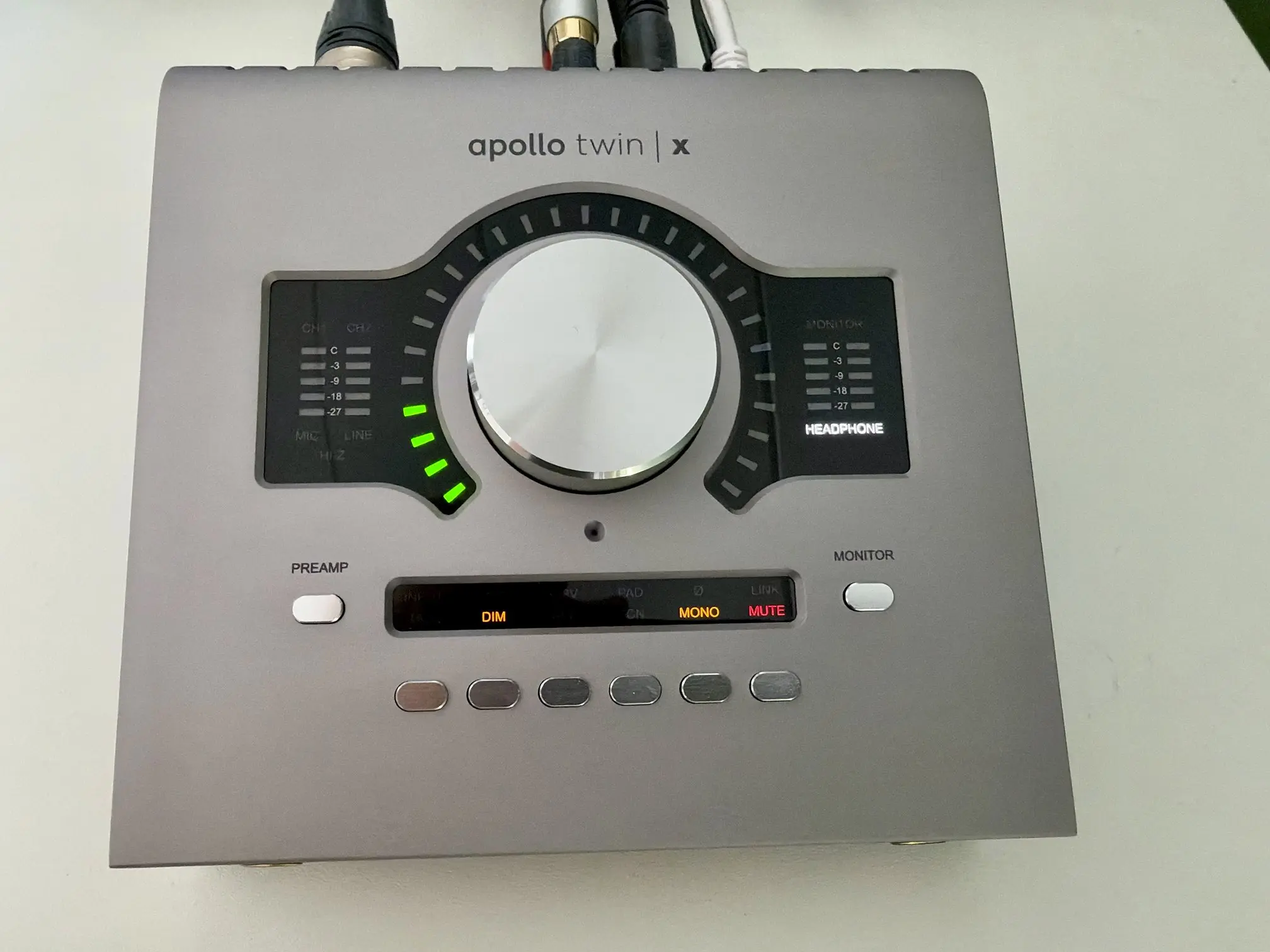
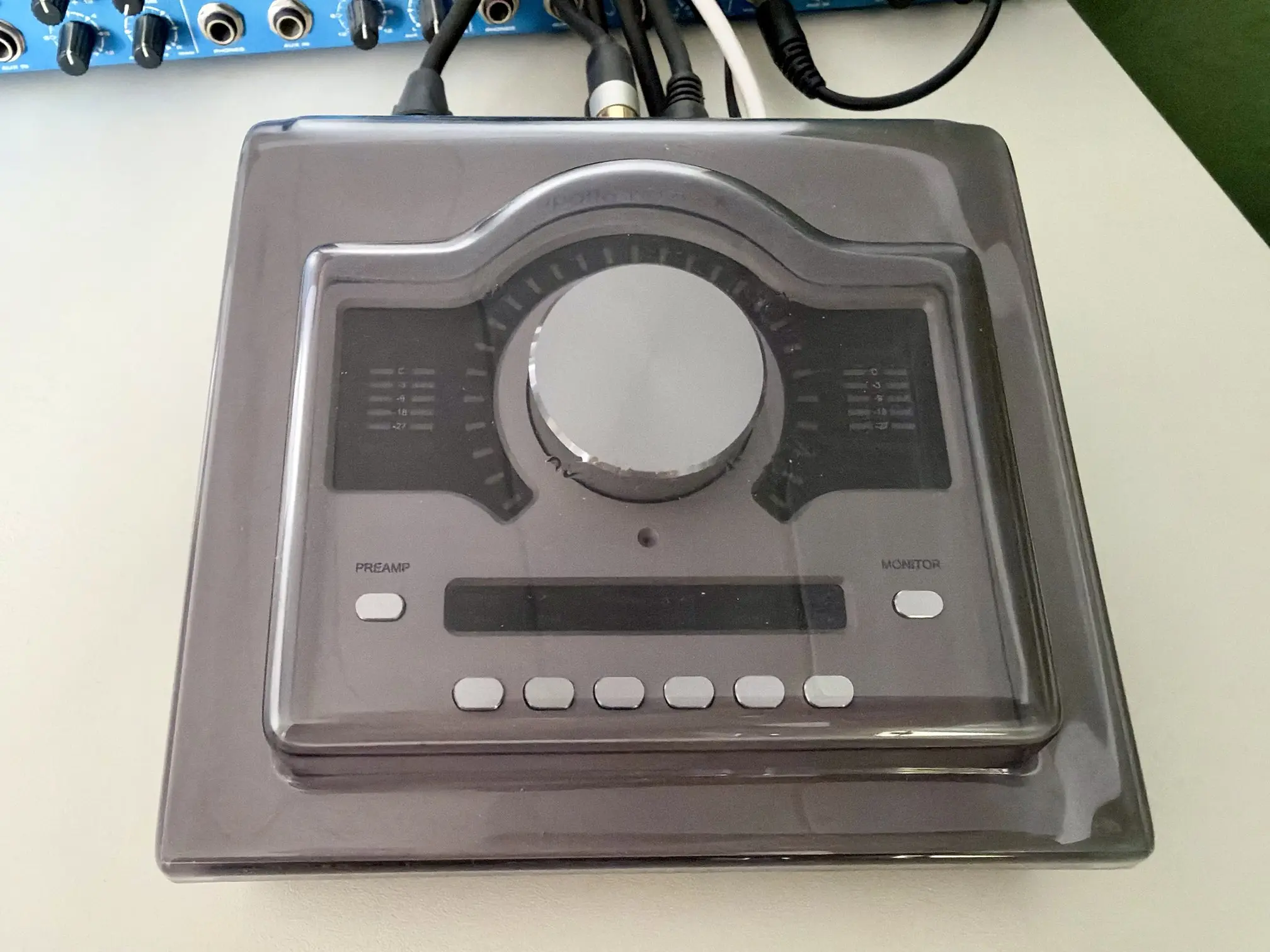
Operation is simple. Depending on the selected mode, a large knob controls either the preamp gain or the volume of the speakers and headphones; the MONITOR button switches between the two. Below it are buttons for functions such as Dim, Mono and Mute. The UA Console software mirrors the unit one to one: whatever you set on the Twin X appears instantly on screen, and vice versa. It takes no lengthy learning curve.
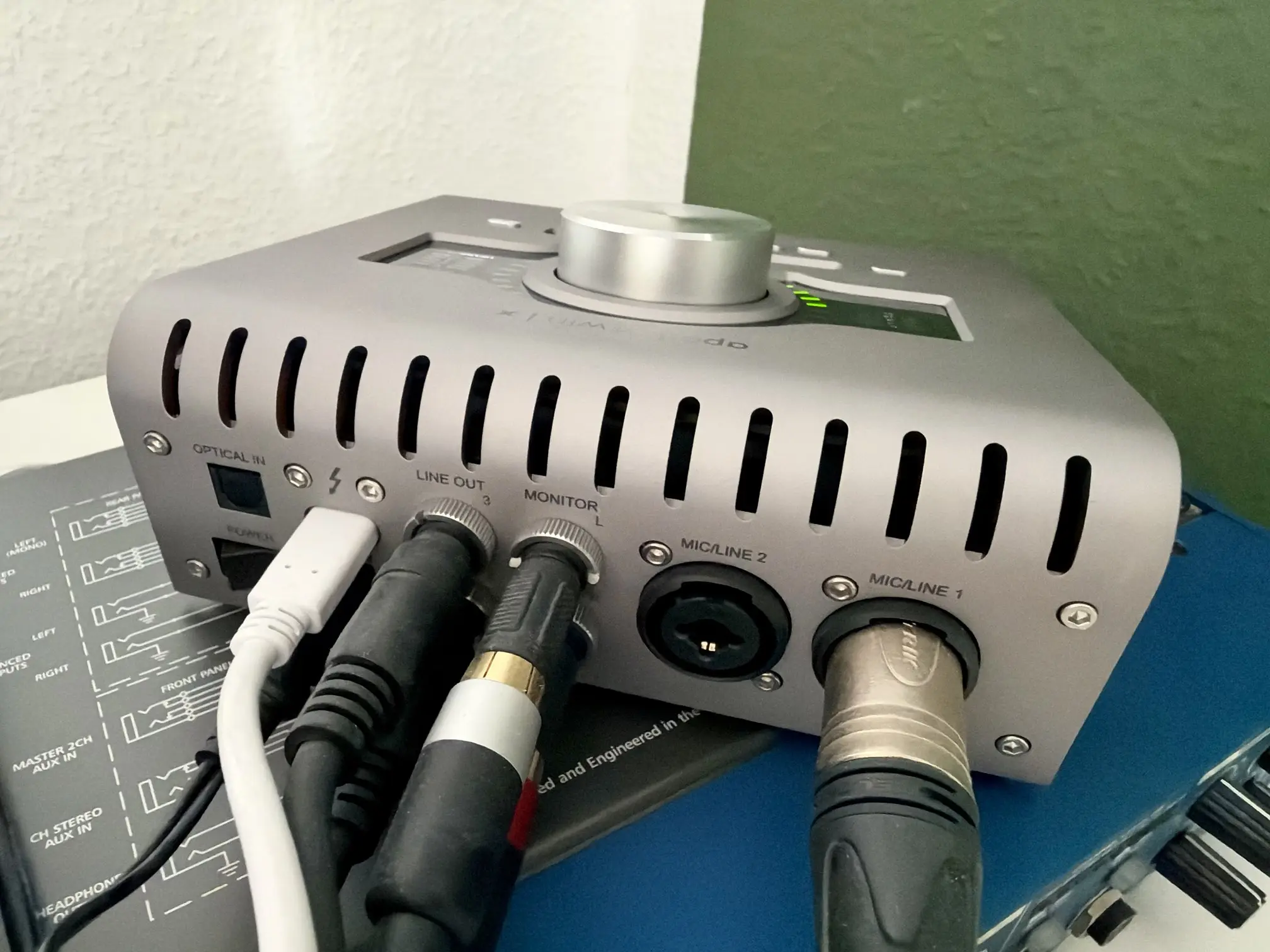
The Twin X works with the common music programs. Universal Audio lists LUNA, Logic Pro, Pro Tools, Cubase and Ableton Live, among others; according to the manufacturer, the plug-ins are available in VST, AU and AAX 64 formats. It connects via Thunderbolt 3, and a suitable cable is not included. Power comes from an external power supply; the unit does not run on Thunderbolt alone. According to the manual, it works on Macs with Thunderbolt 1 or 2 via Apple’s Thunderbolt 3 to 2 adapter, but not on Windows PCs. Universal Audio lists the currently supported macOS and Windows versions in its help section.
Only one headphone output
There is one thing we would have liked to be different. The Twin X has exactly one headphone output, a large jack on the front right. That is enough when you work alone. But as soon as a second person needs to listen in, for example while recording vocals or an instrument, two outputs would be more practical. The solution is an additional headphone amplifier. According to the manual, line outputs 3 and 4 can be used as a separate cue mix for this. It works without any problems, but it is one more device on the desk.
Only the next larger model, the Apollo x4 Gen 2, has two headphone outputs, according to the manufacturer with independently adjustable outputs HP1 and HP2 and four Unison preamps. It does cost a few hundred euros more, though. For us, the extra cost was not worth it for a second headphone output. We have not tested the x4.
Durability: what we experienced with the predecessors
Our current Twin X has had no failures so far. The predecessor models were a different story. In each case, individual modules failed after a few years, probably due to cold solder joints. Suddenly there was no signal, and recording was no longer possible. The unit had to be sent in, which is a hassle. Outside the warranty, we paid for the repair ourselves; there was no goodwill. Universal Audio is based in California and handles its warranty terms strictly.
According to Universal Audio’s warranty policy, the standard term is one year from purchase from Universal Audio or an authorized dealer. For consumers who live in and buy within the European Economic Area, it is two years. The manufacturer requires proof of purchase. If you work with the unit a lot, you should know what you are getting into. Under intensive use, technology can break, but over such a long product life cycle we would like to see more reliability.
A useful accessory: the Decksaver cover
Our Twin X sits under a custom-fit cover from Decksaver, printed with “Made in the UK”. The smoke-gray transparent cover follows the shape of the unit, so the cables at the back can stay plugged in. It keeps the dust out, and dusting the control panel has not been an issue since. According to Decksaver, the cover fits the Apollo Twin series including the Twin X.
Specifications
All specifications according to the manufacturer (Universal Audio, Apollo Twin X Hardware Manual, version 210429), as of November 25, 2026.
| Model | Universal Audio Apollo Twin X (DUO and QUAD versions) |
|---|---|
| Channels | up to 10 inputs × 6 outputs simultaneously |
| Inputs | 2 mic/line combo jacks (XLR/jack), 1 Hi-Z instrument input (front), 1 optical digital input (ADAT or S/PDIF) |
| Outputs | Monitor L/R, line outputs 3/4, 1 stereo headphone output (6.3 mm jack) |
| Converters | 24-bit, 44.1 to 192 kHz |
| Dynamic range | Monitor outputs 127 dB, line outputs 126 dB, mic inputs 123 dB, headphones 124 dB (all A-weighted) |
| Headphone output | max. 96 mW RMS into 300 ohms |
| Preamps | 2 × Unison, gain +10 to +65 dB, 48 V phantom power, 20 dB pad |
| Latency | 1.1 ms round trip at 96 kHz |
| DSP | 2 (DUO) or 4 (QUAD) SHARC processing cores for UAD plug-ins |
| Connection | Thunderbolt 3 (cable not included), external 12 V power supply |
| Other features | built-in talkback mic, monitor functions Dim, Mono, Mute and speaker switching |
| Dimensions | 16.03 × 6.6 × 14.88 cm (W × H × D, housing) |
| Weight | 1.07 kg |
The successor: Apollo Twin X Gen 2
Universal Audio now offers the Apollo Twin X Gen 2, also as DUO and QUAD. According to the manufacturer, the converters have been revised, and the monitor outputs now reach 129 dB of dynamic range. Also new is speaker and headphone calibration with Apollo Monitor Correction. Connections and operating concept remain the same, and the Gen 2 also has one headphone output. We have not tested the Gen 2.
Our verdict
The Apollo Twin X is an interface for anyone who wants to record and mix at a professional level at home. Over our years of use, the excellent recording quality, the easy operation and the UAD plug-ins satisfied us throughout. The single headphone output is a small limitation that can be solved with an extra device. When it comes to durability, we recommend knowing the warranty terms. Bottom line: five out of five stars. If you want to read more on the topic, you will find a market overview in our guide to audio interfaces for the home studio, and suitable headphones in our studio headphones guide.
Frequently asked questions
How many headphone outputs does the Apollo Twin X have?
One stereo headphone output (6.3 mm / 1/4-inch jack) on the front, rated by the manufacturer at up to 96 mW into 300 ohms. The successor, the Twin X Gen 2, also has just one. The larger Apollo x4 Gen 2 offers two independently adjustable headphone outputs.
Can you connect two pairs of headphones to the Apollo Twin X?
Not directly. If two people want to listen, you need an additional headphone amplifier. According to the manual, line outputs 3 and 4 can be used as a separate cue mix for this.
Which DAWs work with the Apollo Twin X?
Universal Audio lists LUNA, Logic Pro, Pro Tools, Cubase and Ableton Live, among others. The UAD plug-ins are available in VST, AU and AAX 64 formats.
What connection does the Apollo Twin X need?
Thunderbolt 3; the cable is not included. Power comes from an external power supply. On Macs with Thunderbolt 1 or 2 it works via the Apple adapter; on Windows PCs only with a Thunderbolt 3 port (Thunderbolt 1 and 2 are not supported there).
What is the difference between the Apollo Twin X DUO and QUAD?
The DUO version has two SHARC processing cores for UAD plug-ins, the QUAD version has four. With the QUAD, you can run more plug-ins simultaneously in real time; connections and converters are the same.
Is there a successor to the Apollo Twin X?
Yes, the Apollo Twin X Gen 2, also available as DUO and QUAD. According to the manufacturer, it has revised converters (129 dB dynamic range at the monitor outputs) and Apollo Monitor Correction. We have not tested the Gen 2.
How long is the Universal Audio warranty?
According to the warranty policy, one year from purchase from Universal Audio or an authorized dealer; for consumers who live in and buy within the European Economic Area, it is two years. Proof of purchase is required.
How durable is the Apollo Twin X?
Our current Twin X has run without any failure. With predecessor models, individual modules failed on us after a few years (no more signal), and the units had to be sent in; outside the warranty we paid for the repair ourselves.
Is a dust cover worth it for the Apollo Twin?
In our experience, yes: the custom-fit Decksaver cover keeps dust off the control panel while the cables stay plugged in.
How high is the latency of the Apollo Twin X?
In our own studio use, we record without any noticeable delay, even with effects running. According to Universal Audio, the UAD plug-ins run in real time on the unit's DSP cores with latencies under 2 milliseconds; chaining several plug-ins does not increase latency.
Sources
- Universal Audio: Apollo Twin X Hardware Manual (version 210429)
- Universal Audio: Apollo Twin X Gen 2 Hardware Manual (version 260619)
- Universal Audio: Apollo x4 Gen 2 Hardware Manual (version 260619)
- Universal Audio: Warranty Policy
- Decksaver: Universal Audio Apollo Twin Cover
Are you a manufacturer or retailer and would like us to test your product? Offer a product for testing (in German).
Conclusion
The Apollo Twin X is an audio interface for anyone who wants to record and mix at a professional level at home. In our years of use, it delivered pro-grade recordings with the right microphones and instruments, it is easy to understand, and the UA Console software mirrors the hardware one to one. To us, the UAD plug-ins are among the finest tools for recording, mixing and mastering. One small limitation is the single headphone output; if two people want to listen, you need an additional headphone amplifier. With predecessor models, individual modules failed on us after a few years, and outside the warranty we paid for the repair ourselves. Bottom line: five out of five stars.
Where to buy
- Decksaver dust cover for Apollo Twin (accessory, DS-PC-APOLLOTWIN)Check price at Amazon.deCheck price at Amazon.co.ukCheck price at Amazon.nlCheck price at Amazon.com.beCheck price at Amazon.frCheck price at Amazon.itCheck price at Amazon.esCheck price at Amazon.plCheck price at Amazon.seAvailable in Germany: Amazon.de
Still undecided?
Keep comparing at your own pace – every article in this category is checked monthly for new and discontinued models.
Share this review
For manufacturers and retailers: embed the review seal
Do you make or sell this product? Then you can show the seal for this review on your website. It links to this review. Embedding is free of charge.


Please embed the code unchanged. The seal applies only to this product and this review. Terms of use and embedding notes