Contents14 sections
This guide was first published in German on handgetestet.de.
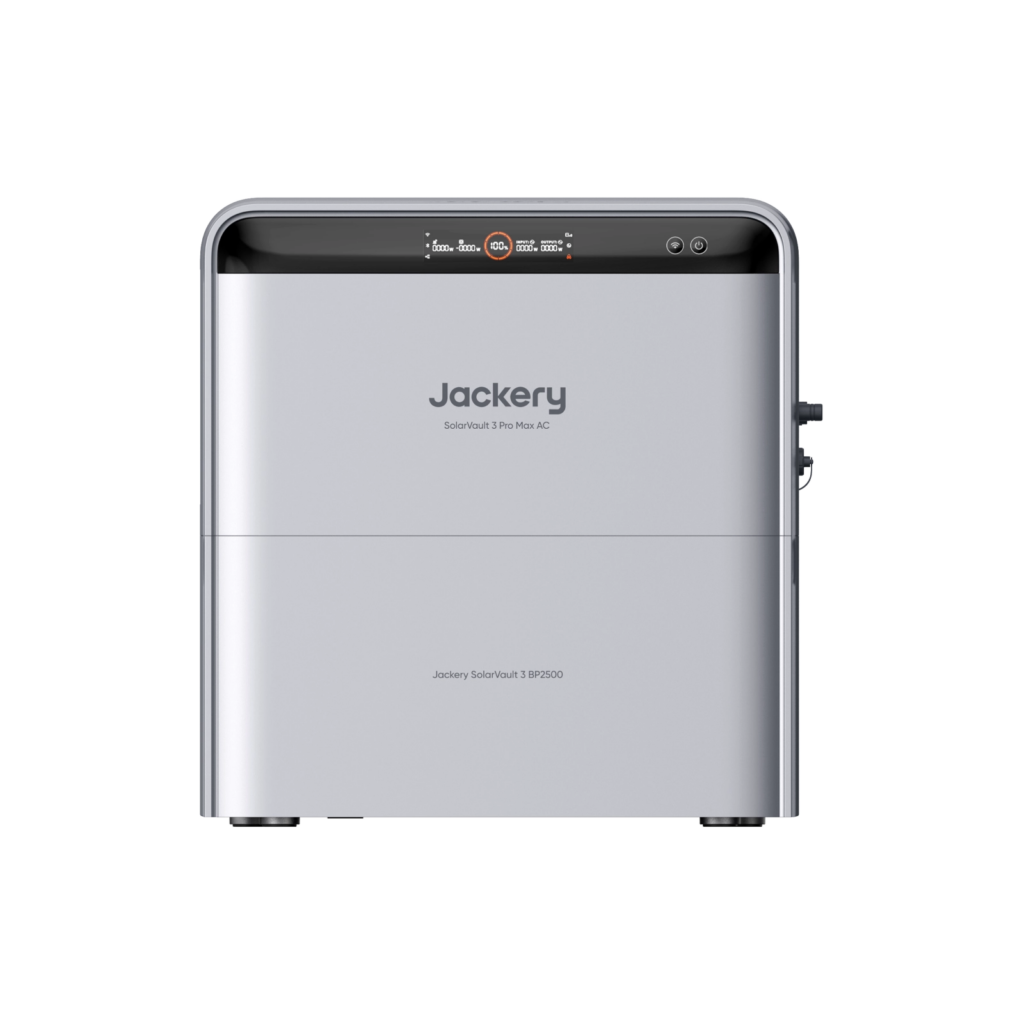
Fill the battery cheaply at night, avoid expensive power in the evening: it sounds like easy money, and usually little of it is left over. We would not buy a home battery for a dynamic tariff alone. If, on the other hand, you are planning an AC-coupled battery for your solar system anyway, such as the Jackery SolarVault 3 Pro Max AC with an expansion battery, grid charging is a small extra for the dark months.
How the tariff works and who it suits is explained in our guide to dynamic electricity tariffs (in German). This guide is about a single question. What happens to the kilowatt-hour that takes the detour through the battery?
The spread is smaller than the advertising suggests
For its 2026 battery storage inspection (Stromspeicher-Inspektion), HTW Berlin analyzed a typical dynamic tariff from 2025. On average, a kilowatt-hour cost 34 cents. The price was below 20 cents for only 63 hours of the year, because grid fees, levies, electricity tax, margin and value-added tax remain due even at an exchange price of zero. Between the cheapest and the most expensive moment of a day, the gap averaged 15.6 cents.
That figure is a maximum. A battery charges and discharges over hours, so it never hits the two extremes exactly. On top of that, the calendar works against you. In the second quarter, the daily spread was 19 cents; in the first and fourth, only 13 cents. When the spread is largest, your own solar system usually fills the battery anyway. In winter there would be room in the battery. Then the price gap is missing.
The detour through the battery costs a quarter
Every kilowatt-hour is converted twice and stored once. For a very efficient home battery, HTW gives an overall efficiency of 78 percent when it is charged at 4,000 watts and discharged at 200 watts. A weak system loses 37 percent under the same conditions.
Discharging is what matters. In the evening, a household often draws only a few hundred watts. That is exactly where inverters perform poorly. According to the study, even very good units drop to less than 90 percent below 300 watts. With the weaker system, it was only 54 percent at 100 watts, and then less than half of the stored energy reaches the house.
Plug-in batteries like those in our table were not part of the test field, and the SolarVault data sheet does not state an efficiency. So we calculate with an assumption.
The calculation, cards on the table
Profit per kilowatt-hour = discharging price − (charging price ÷ system efficiency) − wear
Our assumptions: 75 percent system efficiency, 2 kWh output per day on 200 days a year, so 400 kWh. For wear, we assume 5 cents per kilowatt-hour. You get your own figure by dividing the purchase price by the lifetime throughput. For the SolarVault, according to the data sheet, that would be 2.52 kWh times 90 percent depth of discharge times 6,000 cycles, about 13,600 kWh, not counting aging.
- Winter day, charging at 25 cents, discharging at 38 cents: 25 ÷ 0.75 gives 33.3 cents. That leaves 4.7 cents, and nothing after wear. Even without wear, it would come to less than twenty euros a year.
- Day with a large spread, charging at 22 cents, discharging at 41 cents: the kilowatt-hour costs 29.3 cents. That leaves 11.7 cents, and 6.7 cents after wear. Over 400 kWh, that would be less than thirty euros.
Here is a quicker check: the charging price divided by the discharging price gives you the minimum efficiency your battery needs. At 25 and 35 cents, that is 71 percent, as HTW calculates. At 24 and 30 cents, it is already 80 percent. Even good systems do not always manage that at 200 watts.
Time-variable grid fees under Section 14a of the German Energy Industry Act (EnWG) provide a bigger gap. In the Stromnetz Berlin grid, they ranged in 2025 from 3.5 cents at night to 18.6 cents in the evening, and according to HTW, households that are not obliged to can also enter into such an agreement. How the model works is shown in our guide to electricity for heat pumps and wallboxes (in German).
The tariff also applies to the entire household. For one house analyzed by HTW, with a 24 kW system and a 21 kWh battery, grid power in 2025 cost exactly as much on the dynamic tariff as at a fixed 34 cents.
Nothing works without an intelligent metering system
Germany’s Federal Network Agency (Bundesnetzagentur) is unequivocal: for a dynamic tariff, you need an intelligent metering system. Since 2025, you can ask your metering point operator to install one; what that costs is covered in our smart meter guide (in German). The battery manufacturer’s meter or optical reading head is something else. It only supplies the reading for control, as our guide to zero feed-in (in German) explains.
Then there is the control software. It has to know the state of charge, consumption, the solar forecast and the next day’s prices, which are only available in the early afternoon. Not every program factors in the losses. HTW shows a measured day on which a battery charged at 31 cents and discharged in the evening at 34 cents. A losing deal.
What applies to the battery drawing from the grid
Charging from the grid is allowed, according to HTW, even with a solar system. Four points still belong in the calculation.
- Charges: the exemption from grid fees in Section 118(6) of the German Energy Industry Act (EnWG) requires that the electricity flows back into the same grid. The rule for storage in Section 5(4) of the German Electricity Tax Act (Stromsteuergesetz) applies to utilities. So if you charge the battery for your own home, you pay the full price, including on the losses.
- Feed-in tariff: under Section 19(3a) of the German Renewable Energy Sources Act (EEG), you receive it for power from the battery if only renewable electricity goes into it during the calendar year. So before charging from the grid for the first time, clarify in writing with your grid operator how your system is metered and whether the feed-in tariff is affected.
- Mixed operation: the Federal Network Agency’s MiSpeL determination of October 1, 2026, lifts the strict separation of green power and grid power. The law ties its two options to the market premium, that is, to direct marketing. Until the end of September 2027, the consent of the grid operator and the metering point operator is required, and the flat-rate option is also still awaiting approval from Brussels.
- Control by the grid operator: when charging, batteries fall under Section 14a of the EnWG if their grid connection power exceeds 4.2 kW. According to the data sheet, the SolarVault 3 Pro Max AC stays below that at 3.68 kW.
Registration, the official register and the electrician are covered in our guide to retrofitting a home battery.
Batteries that charge from the grid
| Model | Capacity according to manufacturer | Charging from the grid | Price control according to manufacturer | Best for |
|---|---|---|---|---|
| Jackery SolarVault 3 Pro Max AC | 2.52 kWh, up to 15.12 kWh | up to 3,680 W | charging during low-tariff periods | rooftop system already in place |
| Jackery SolarVault 3 BP2500 | 2.52 kWh per battery | expansion battery | via main unit | if you want to make full use of grid charging power |
| Jackery SolarVault 3 Pro | 2.52 kWh, up to 15.12 kWh | up to 2,300 W | charging during low-tariff periods | balcony solar system |
| Jackery HomePower 2000 Ultra | 2.05 kWh, up to 8 kWh | up to 2,300 W | dynamic tariffs, charging schedule | balcony with a wish for backup power |
| Anker SOLIX Solarbank Max AC | 7 kWh, up to 42 kWh | up to 3,500 W (figure for the Solarbank Max) | dynamic prices, automatic | high evening consumption |
| EcoFlow STREAM AC Pro | 1.92 kWh, up to 11.52 kWh | up to 1,050 W | not stated in the data sheet | small entry point |
Jackery SolarVault 3 Pro Max AC
It suits the job because it connects to the household grid without a solar input and charges quickly. That counts when the price dip is short. According to the data sheet, however, the battery on its own handles 46 amps, which at 41.6 volts works out to about 1.9 kW. The full 3,680 watts are therefore likely to arrive only with an expansion battery. According to Jackery, the series charges during low-tariff periods, and an advertisement at launch mentions tariffs such as Tibber’s. Before buying, check whether your tariff can be selected in the app. The powerful connection belongs on its own circuit.
Jackery SolarVault 3 BP2500
Another 2.52 kWh, IP65 protection, LiFePO₄ cells. For grid charging, it mainly means more charging power. We would not buy more than one for that purpose.
Jackery SolarVault 3 Pro
The balcony version with four solar inputs. It delivers 800 or 1,200 watts into the house, which is enough for the nighttime load.
Jackery HomePower 2000 Ultra
Here, Jackery explicitly advertises charging according to dynamic prices, including its own charging schedule. Output is 800 watts by default. Interesting if backup power counts at least as much as the tariff.
Anker SOLIX Solarbank Max AC
For the Solarbank Max, Anker describes automatically charging to full during low-price periods, and according to the manufacturer the Max AC shares its operating modes. With 7 kWh in the base unit, it is too large for pure tariff speculation.
EcoFlow STREAM AC Pro
According to the data sheet, it stores power from a solar system or the grid, though at a leisurely 1,050 watts. It therefore only partly takes advantage of short price dips.
Do the math or skip it?
- No solar system, no electric car: skip it. Price gaps alone do not pay for a battery.
- Rooftop system and a wish for a battery: Jackery SolarVault 3 Pro Max AC with one BP2500. Grid charging is a winter bonus, never the reason to buy.
- Feed-in tariff in effect: ask your grid operator first, then turn on grid charging.
- Set a minimum price gap in the app, if possible. We would not charge below 10 cents.
Frequently asked questions
Is a home battery worth it with a dynamic electricity tariff?
Not without a solar system and an electric car. In our example with 400 kWh a year, nothing is left after losses and wear on a winter day, and on days with a large spread it is 6.7 cents per kilowatt-hour. Grid charging is a bonus, never the reason to buy.
How big is the price difference with a dynamic tariff?
According to HTW Berlin, a kilowatt-hour cost 34 cents on average in 2025, and it was below 20 cents for only 63 hours of the year. Between the cheapest and the most expensive moment of a day, the gap averaged 15.6 cents, and only 13 cents in winter.
How much energy does a home battery lose?
According to HTW, a very efficient home battery reaches an overall efficiency of 78 percent, while a weak system loses 37 percent. Discharging at low load is critical: below 300 watts, even good units drop to less than 90 percent.
At what price gap does charging from the grid pay off?
Divide the charging price by the discharging price; that gives you the minimum efficiency your battery needs. At 25 and 35 cents, that is 71 percent, and at 24 and 30 cents it is already 80 percent. We would not charge with a gap below 10 cents.
Do I need a smart meter for a dynamic tariff?
Yes. According to Germany's Federal Network Agency (Bundesnetzagentur), you need an intelligent metering system, and since 2025 you can ask your metering point operator to install one. The battery manufacturer's meter or optical reading head does not replace it; it only supplies the reading for control.
Does grid charging put the feed-in tariff at risk?
It can. Under Section 19(3a) of the German Renewable Energy Sources Act (EEG), you receive the feed-in tariff for power from the battery if only renewable electricity goes into it during the calendar year. So before charging from the grid for the first time, clarify in writing with your grid operator how your system is metered.
Sources
- HTW Berlin and aquu: Battery Storage Inspection 2026 (PDF)
- German Federal Network Agency (Bundesnetzagentur): Metering equipment and meters
- German Federal Network Agency: Controllable consumer devices
- German Federal Network Agency: MiSpeL determination
- German Federal Network Agency: Press release on MiSpeL
- Section 19 EEG (German Renewable Energy Sources Act)
- Section 118 EnWG (German Energy Industry Act)
- Section 41a EnWG (German Energy Industry Act)
- Section 5 Stromsteuergesetz (German Electricity Tax Act)
- Jackery: Technical data SolarVault 3 Pro Max AC (PDF)
- Jackery: Technical data SolarVault 3 Pro (PDF)
- Product information from Jackery on the SolarVault 3, BP2500 and HomePower 2000 Ultra
- t3n: Advertisement for the SolarVault 3 series
- Anker SOLIX: Solarbank Max and Solarbank Max AC
- EcoFlow: Data sheet STREAM AC Pro (PDF)
Where to buy
- Jackery SolarVault 3 Pro Max ACView at JackeryAvailable in Germany: JackeryCheck price at Amazon.deAvailable in Germany: Amazon.de
- Jackery SolarVault 3 BP2500View at JackeryAvailable in Germany: JackeryCheck price at Amazon.deAvailable in Germany: Amazon.de
- Jackery SolarVault 3 ProView at JackeryAvailable in Germany: JackeryCheck price at Amazon.deAvailable in Germany: Amazon.de
- Jackery HomePower 2000 UltraView at JackeryAvailable in Germany: JackeryCheck price at Amazon.deAvailable in Germany: Amazon.de
- Anker SOLIX Solarbank Max ACCheck price at Amazon.deAvailable in Germany: Amazon.de
- EcoFlow STREAM AC ProCheck price at Amazon.deAvailable in Germany: Amazon.de