Contents13 sections
This guide was first published in German on handgetestet.de.
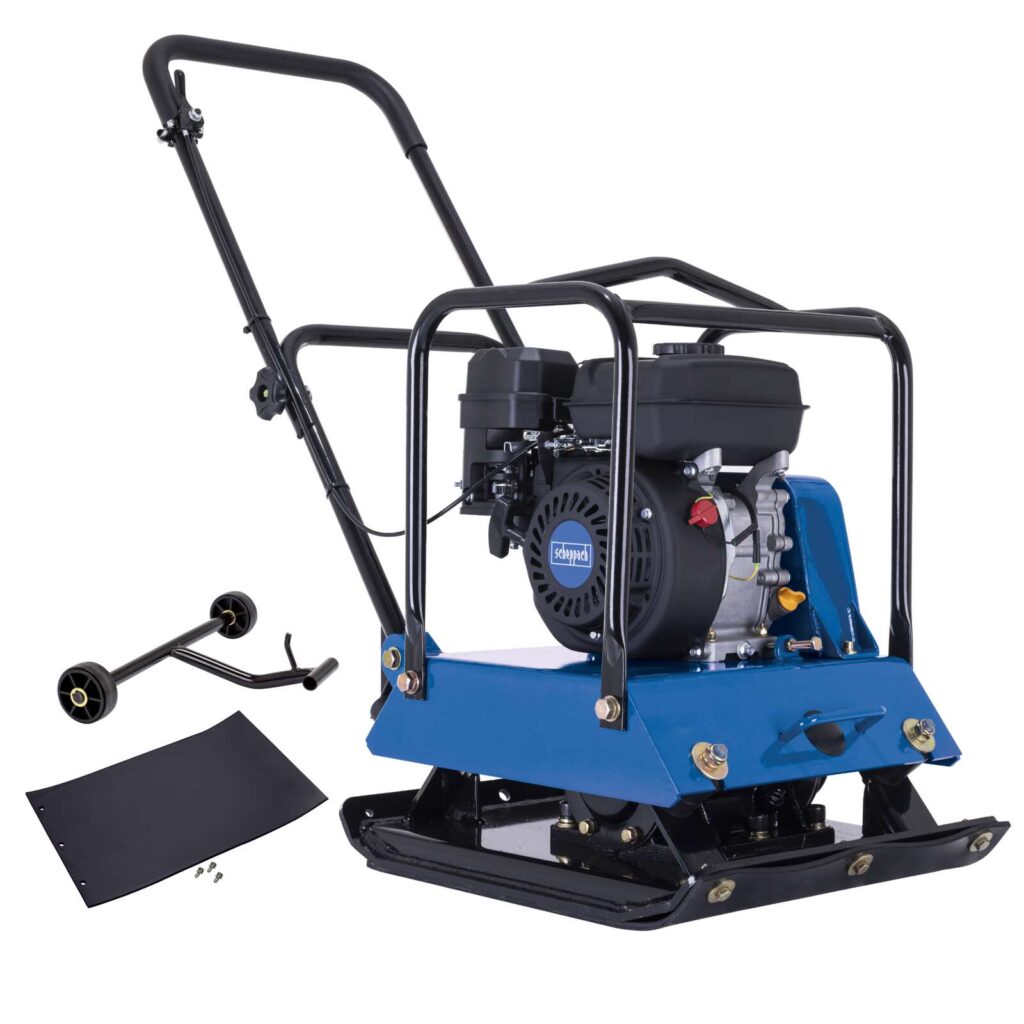
Garden path, patio, parking space for the car: for these jobs, a gasoline plate compactor with about 23 kN and 30 cm of compaction depth is enough, for example the Scheppach HP1800S. The light 8 kN plates suit paved areas in the garden and touch-up work. If you are building a driveway with a thick layer of crushed stone, you need more weight or you rent the machine for a weekend.
What do kN and compaction depth actually tell you?
The kilonewtons describe the centrifugal force of the vibrator, in other words how hard the plate strikes the ground. The compaction depth indicates how far this effect reaches, according to the manufacturer. With Scheppach, both rise together: 8.2 kN and 20 cm on the HP1400S, 23 kN and 30 cm on the HP1800S, 28 kN and 40 cm on the HP2500S.
In practice, this means crushed stone and chippings go in in layers, with each layer compacted separately. A layer that is much thicker than the stated depth will not become firm at the bottom. With a 30 cm base course, a small plate will only get you there in several thin layers, with a correspondingly large number of passes.
How do I know the ground is firm?
Scheppach describes it quite vividly in the manual. How often you need to pass over a surface depends on the material and its moisture. Once maximum compaction is reached, you feel a very strong recoil. A little moisture helps; bone-dry crushed stone compacts poorly and clogs the air filter. It should not be too wet either, though, or the fine material sticks together.
Two types of ground are off-limits. According to Scheppach, a plate compactor does not work properly on clay and other cohesive ground, and on concrete and very hard, dry surfaces it bounces instead of vibrating, which can damage the engine and plate.
Do I need the rubber mat?
Only on paving. When settling concrete pavers and concrete slabs, it keeps edges from chipping and the surface from getting scratched. On gravel and chippings, it comes off. Scheppach also points out that a black rubber mat can discolor light-colored stones. All five models below include a mat; Güde’s is made of polyurethane.
Is reverse worth it?
A simple plate compactor only runs forward. Always. At the end of a pass, you pull the machine around, and at 88 kg that is work. Reversible plates such as the Scheppach HP2500S or the Güde GRP 260 also move backward via a lever on the handle. In tight yards, along house walls and on narrow paths, that is a real gain. On open ground, you can do without it.
What about exhaust, noise and slopes?
A gasoline engine emits carbon monoxide, a gas you can neither smell nor see. The BG BAU (Berufsgenossenschaft der Bauwirtschaft, the German statutory accident insurance institution for the construction industry) measured plate compactors in test trenches. At ground level outdoors, the values stayed below the occupational exposure limit. In trenches deeper than shoulder height, gasoline engines can be expected to exceed it. For the garden, that means: never run one in the garage, in the basement or in a deep utility trench. Hearing protection and safety shoes are mandatory. Scheppach states a guaranteed sound power level of 108 dB(A) for the HP1800S and HP2500S, and Güde likewise gives 108 dB for the GRP 260. For the hands, Scheppach states a vibration of 10.8 m/s² in the HP1800S manual and advises taking regular breaks. For slopes, the manual gives a maximum gradient of 20 degrees. Approach from below and never stand on the downhill side. Also stay away from trench edges, because a tipping plate here weighs between 48 and 260 kg.
You will find the right gear in the hearing protection guide.
Five plate compactors from light to heavy
| Model | Force, depth | Plate, forward speed | Weight | Best for |
|---|---|---|---|---|
| Scheppach HP1800S | 23 kN, 30 cm | 550 × 440 mm, 25 m/min | approx. 88 kg | Paths, patio, parking space |
| Scheppach HP1400S | 8.2 kN, 20 cm | 495 × 320 mm, 25 m/min | 48 kg | Garden paving, small areas |
| Güde GRP 50 | 8.5 kN, 20 cm | 430 × 300 mm, 6.5 m/min | 54 kg | Very tight spots |
| Scheppach HP2500S | 28 kN, 40 cm | 630 × 400 mm, forward and reverse 15 m/min | approx. 128 kg | Driveway, tight yards |
| Güde GRP 260 | 38 kN, 90 cm | 820 × 480 mm, 22 m/min, reversible | 260 kg | Large areas, thick base course |
All specifications according to the manufacturer.
Scheppach HP1800S
The middle ground. 23 kN on a 550 × 440 mm plate, driven by a 196 cc four-stroke engine with 4.1 kW. A rubber mat and transport wheels are included, and the handle folds in for transport. Scheppach gives the forward speed as 25 m/min on the product page and as 18 m/min in the manual.
Scheppach HP1400S
Small and light, with a 1.5 kW engine. Scheppach names garden paths and paving as its uses, and 48 kg can be moved by one person. A thick base course of coarse crushed stone, however, is only manageable with 8.2 kN and 20 cm in many thin layers.
Güde GRP 50
Similar force to the HP1400S, but a narrower plate at 430 × 300 mm. That helps between flower beds and along walls. Güde, however, only states a travel speed of 6.5 m/min, so on a larger area each pass takes considerably longer.
Scheppach HP2500S
28 kN, 40 cm and forward and reverse. Plus low-oil protection that safeguards the engine. At around 128 kg, it is not a machine for the trunk of your car. If you are building a driveway with a thicker sub-base yourself, it saves you many layers and the turning at the end of each pass.
Güde GRP 260
A different weight class: 38 kN, 90 cm of compaction depth, a 389 cc engine with 8.2 kW and 260 kg of its own weight. For a private property, that is rarely necessary. Without a trailer and ramp, you will not get the machine moving anywhere either.
Buy or rent?
For a single garden path, a rental unit from a home improvement store or construction equipment rental is often enough: you pick it up with a trailer on Friday afternoon, use it over the weekend on crushed stone, chippings and paving, and bring it back cleaned and refueled early Monday morning. Buying pays off when several projects are coming up or the property needs touch-up work again and again. Then this is how we would choose:
- Garden path, patio, parking space with a crushed-stone sub-base: Scheppach HP1800S.
- Compacting garden paving, little space in the shed: Scheppach HP1400S.
- Lots of tight corners: Güde GRP 50, with patience on larger areas.
- Driveway and yard along the house wall: Scheppach HP2500S with reverse.
The concrete for curbstones and foundations is better mixed by machine; more on that in the concrete mixer guide. For moving material around the site, the wheelbarrow guide helps. If you want to dig out the excavation yourself, you will find the right machine in the mini excavator guide (in German).
Frequently asked questions
Which plate compactor do I need for a patio and garden path?
For a garden path, patio and parking space, a gasoline plate compactor with about 23 kN and 30 cm of compaction depth is enough, for example the Scheppach HP1800S. Light 8 kN plates suit paved areas in the garden and touch-up work. A driveway with a thick layer of crushed stone needs more weight.
What do kN and compaction depth mean on a plate compactor?
The kilonewtons describe the centrifugal force of the vibrator, in other words how hard the plate strikes the ground. The compaction depth indicates how far the effect reaches, according to the manufacturer. That is why crushed stone and chippings go in in layers, with each layer compacted separately.
When do you need the rubber mat on a plate compactor?
Only on paving. When settling concrete pavers and slabs, it keeps edges from chipping and the surface from getting scratched. On gravel and chippings, it comes off. According to Scheppach, a black mat can discolor light-colored stones.
On which ground does a plate compactor not work?
According to Scheppach, it does not work properly on clay and other cohesive ground. On concrete and very hard, dry surfaces, it bounces instead of vibrating and can damage the engine and plate.
Why does a plate compactor need reverse?
A simple plate only runs forward, so at the end of every pass it has to be pulled around. Reversible plates such as the Scheppach HP2500S or the Güde GRP 260 also move backward via a lever, a real plus in tight yards, along house walls and on narrow paths.
Buy or rent a plate compactor?
For a single garden path, a rental unit from a home improvement store or construction equipment rental over the weekend is often enough. Buying pays off when several projects are coming up.
Sources
- Scheppach HP1800S
- Scheppach plate compactors HP1200S to HP2200S, original operating manual
- Scheppach HP1400S
- Scheppach HP2500S
- Güde GRP 50
- Güde GRP 260
- BG BAU: Safe and healthy compaction work in trenches
Where to buy
- Scheppach HP1800SCheck price at Amazon.deAvailable in Germany: Amazon.deView at scheppachAvailable in Germany: scheppach
- Scheppach HP1400SView at scheppachAvailable in Germany: scheppachCheck price at Amazon.deAvailable in Germany: Amazon.de
- Güde GRP 50Check price at Amazon.deAvailable in Germany: Amazon.de
- Scheppach HP2500SView at scheppachAvailable in Germany: scheppachCheck price at Amazon.deAvailable in Germany: Amazon.de
- Güde GRP 260Check price at Amazon.deAvailable in Germany: Amazon.de