Contents13 sections
This guide was first published in German on handgetestet.de.
A laser TV is almost always bought like a television, by diagonal and spec sheet. But furniture, wall and daylight decide the picture. Among the units compared here, we consider the Hisense PL2 the sensible entry point, because specialist magazines have measured its distances and brightness and it sits one price class below the PX3 Pro. If you often watch during the day, take the brighter Hisense PX3 Pro. And if you do not want to darken the room at all, stick with a TV.
One centimeter on the TV stand is two inches on the wall
Most ultra-short-throw projectors lack zoom and lens shift. You set the picture size by sliding the unit. audiovision checked this on the PL2 with a tape measure: 11.6 centimeters between the back and the wall produce 80 inches, 31.1 centimeters 120 inches, and 45.7 centimeters 150 inches. That makes it easy to calculate. Over 19.5 centimeters, the diagonal grows by 40 inches, so by around two inches per centimeter.
The furniture therefore has to be level and stable. If you bump the TV stand while vacuuming, you will be realigning.
Then comes the depth, where most plans fall apart. Add the housing depth and the wall distance. For the PL2, according to hifi.de, that means around 21 centimeters of distance and 33.5 centimeters of unit for 100 inches, about 55 centimeters in total. For 120 inches, it becomes 65. A TV stand 45 centimeters deep, our assumption for a typical model, is therefore not enough as long as it stands against the wall. Move it out or plan a deeper piece of furniture. There is little room behind the unit anyway: on the PL2, the connections sit quite low at the back, which hifi.de explicitly criticizes when the wall distance is very small.
Height is even more awkward. A 120-inch picture in 16:9 measures about 2.66 by 1.49 meters and, according to hifi.de, starts around 45 centimeters above the underside of the PL2. If it stands on a 45-centimeter-high piece of furniture, the lower edge is at 90 centimeters and the upper edge at 2.39 meters. Under a ceiling of 2.50 meters, that just about fits, but the center of the picture moves up to 1.65 meters. From the sofa, you then look noticeably upward. For 120 inches, the projector belongs on low furniture. At 100 inches, around 2.21 by 1.25 meters, the whole calculation becomes more relaxed.
The screen belongs in the budget, not in „later“
In the evening, a smooth white wall will do. During the day, it will not. audiovision writes about the PL2 that a CLR screen for ultra-short-throw projectors is needed to use it like a TV during the day, and cites a high three-digit euro amount as the entry price. Stiftung Warentest (Germany’s consumer testing organization) describes this design as demanding when it comes to the projection surface. According to hifi.de, a fixed frame also helps with alignment.
Which screen material suits your room is covered in our guide to projector screens (in German). You should know about two side effects beforehand. According to the retailer, the celexon CLR material has a gain of 0.6, so mathematically it reflects around 40 percent less light than a surface with gain 1, but in return it keeps ceiling light away from the sofa. And on vinyl and contrast surfaces, the fine sparkle of laser light is more visible than on fabric, as audiovision describes for the LG CineBeam S.
Why the lumen figure reveals little here
According to the spec sheet, the LG CineBeam HU915QE delivers 3,700 ANSI lumens and the Hisense PX3 Pro 3,000. In neutral picture mode, hifi.de measures exactly the opposite: around 180 nits for the LG and around 210 for the Hisense. For the PL2, the paper says 2,700 lumens; audiovision measures 2,460 in Standard mode and 2,190 after calibration. That is no scandal; peak values usually come from modes in which hardly anyone watches a film.
As a guideline, hifi.de expects around 200 nits from a laser TV. Keep the picture size in mind. Going from 100 to 120 inches increases the area by 44 percent; the light is spread out and the luminance drops by around 30 percent. According to the same magazine, modern TVs manage over 3,000 nits. No screen material makes up that gap.
Five laser TVs with measured values
| Model | Wall distance for 100 inches | Total depth required | Measured brightness (SDR) | Best for |
|---|---|---|---|---|
| Hisense PL2 | around 21 cm | around 55 cm | around 150 nits; 2,190 lumens calibrated | Entry level, evenings and dimmed light |
| Hisense PX3 Pro | around 20 cm | around 50 cm | around 210 nits | Lots of daytime use, consoles |
| XGIMI Aura 2 | 17 to 18 cm | around 45 to 55 cm | around 215 nits | Shallow surface, dark scenes, no Netflix app |
| LG CineBeam HU715QW | 15 to 20 cm | around 50 cm | around 180 nits | Living room look, webOS, no gaming |
| LG CineBeam S PU615U | 38 cm at 2.50 m picture width | small housing, 1.9 kg | 542 lumens calibrated | Second unit in a dark room, up to 100 inches |
Nits come from hifi.de, lumens from audiovision. The two labs measure differently, so the column only compares values in the same unit. We calculated the total depth from the housing depth and wall distance.
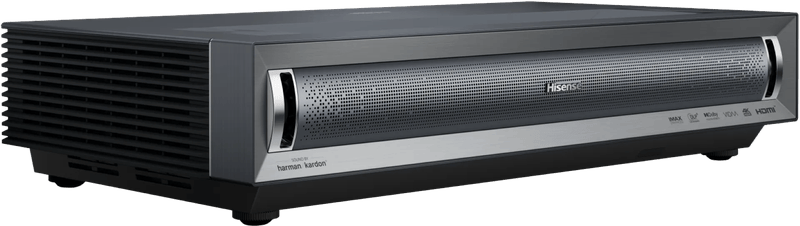
Hisense PL2
The most thoroughly documented entry point. audiovision awards 82 points and measures an ANSI contrast of 350:1; in the loudest light mode, it stays at 27 decibels. According to hifi.de, Netflix, Prime Video and DAZN are preinstalled. On the other hand, it lacks a TV tuner and autofocus, the colors look paler next to the PX3 Pro, and at 150 nits it is below the guideline. That is enough for the evening, but not for a bright afternoon without a CLR screen.
Hisense PX3 Pro
The score of 8.9 from hifi.de is the top value in its list; the triple laser brings more color and more light. At 4K with 60 hertz, the magazine measures around 21 milliseconds of input lag, and about seven in Full HD mode. It names 120 inches as a good size, not the possible 150. Setup via a smartphone photo worked sometimes better, sometimes worse in the lab; done by hand, it takes minutes. The extra cost over the PL2 is worth it for daytime viewers and gamers, otherwise hardly.
XGIMI Aura 2
With a throw ratio of 0.177:1, according to XGIMI, it gets especially close to the wall, and hifi.de also measures around 400:1 in the checkerboard test, the highest value in its series. The sound stands out positively there. One real drawback remains: Netflix cannot be officially installed, so you need a streaming stick for it. XGIMI itself recommends 90 to 130 inches, even though more is possible.
LG CineBeam HU715QW
The rounded, fabric-covered housing is pleasantly unobtrusive as a piece of technology in the living room, and according to hifi.de, setup is quick. At around 190:1 in the checkerboard test, however, its contrast falls clearly behind the XGIMI. Over 50 milliseconds of input lag is enough for slow-paced games. Not for shooters. It tops out at 120 inches.
LG CineBeam S PU615U
It looks like a laser TV at a low price, but it is something else. According to audiovision, 542 calibrated lumens are enough for picture widths up to 2.40 meters, and only in the dark. If you want to watch soccer in the afternoon, you have to make compromises, according to the magazine. It is no replacement for a TV, but it works as a light second projector at 1.9 kilograms. Adjustable feet are missing, and sharpness toward the edges varied on the test sample.
When the TV remains the better answer
Stiftung Warentest lists three points in favor of the TV: cheaper to buy and run, works well in daylight, everything built in. For the laser TV, add the screen, often a new piece of furniture and, because of the thin sound, a soundbar (in German) on the eARC port. Hisense dropped the antenna input on the PL2. If you regularly watch broadcast TV, you need an external receiver. Many DLP units also show the rainbow effect, colored fringes on hard edges that bother some people and that others never notice.
Below 100 inches, there is little to be said for the concept. Up to that size, a large set from our TV buying guide (in German) is the more relaxed solution in a bright room. If, on the other hand, you have three meters of space and a ceiling mount, a classic unit from the general projector guide (in German) offers more flexibility. For consoles, it is worth looking at the guide to gaming projectors (in German).
How we would decide
- Evening viewing, 100 to 120 inches, furniture with at least 55 centimeters of depth: Hisense PL2.
- Also in the afternoon and with a console: Hisense PX3 Pro, with a CLR screen.
- Little depth and dark films, Netflix via a stick: XGIMI Aura 2.
- The unit stands visibly in the room and games play no role: LG CineBeam HU715QW.
- Only occasionally in a dark room: LG CineBeam S PU615U.
Laser TVs for Black Friday and Christmas: compare the whole package
A laser TV under the Christmas tree is rarely just one device. Around Black Friday on November 27, calculate the whole package: projector, CLR screen, perhaps a deeper TV stand and the soundbar. A discount on the unit counts for less than it looks if, according to audiovision, the screen costs a high three-digit euro amount. Most deals apply without a screen. Only compare sets with a screen at the same size and of the same type.
With strikethrough prices, the law helps. Anyone advertising a price reduction in Germany must state the lowest price of the previous 30 days (§ 11 of the German Price Indication Ordinance), whereas a discount on the manufacturer’s recommended retail price is no proof of a good deal. The Hisense PX3 Pro is carried by Coolblue (German retailer); the price next to it comes from the retailer’s product data and shows its date. Price drops and the Black Week edition of our newsletter are collected on the Black Friday 2026 (in German) page.
Frequently asked questions
How deep does the TV stand for a laser TV need to be?
Add the housing depth and the wall distance. For the Hisense PL2, according to hifi.de, that comes to about 55 centimeters in total for 100 inches and 65 for 120 inches. A typical TV stand 45 centimeters deep is therefore not enough as long as it stands against the wall. The furniture also has to be level and stable.
How do you set the picture size on an ultra-short-throw projector?
By moving the unit, because most lack zoom and lens shift. According to audiovision, the diagonal of the PL2 grows by around two inches per centimeter of distance. If you bump the TV stand while vacuuming, you have to realign it. According to hifi.de, a fixed screen frame helps with alignment.
Does a laser TV need a special screen?
In the evening, a smooth white wall will do; during the day, it will not. According to audiovision, a CLR screen for ultra-short-throw projectors is needed to use it like a TV during the day. It keeps ceiling light away from the sofa but reflects less light. Plan it into the costs from the start.
Why does the lumen figure say little about laser TVs?
Peak values usually come from picture modes in which hardly anyone watches a film. According to the spec sheet, the LG CineBeam HU915QE is brighter than the Hisense PX3 Pro; in neutral mode, hifi.de measures exactly the opposite. As a guideline, hifi.de expects around 200 nits from a laser TV; modern TVs manage far more.
When is a TV the better choice than a laser TV?
According to Stiftung Warentest, a TV is cheaper to buy and run, works well in daylight and has everything built in. A laser TV often requires a screen, new furniture and a soundbar as well, and the PL2 also lacks an antenna input. Below 100 inches, there is little to be said for the concept.
Which laser TV is suitable for console gaming?
The Hisense PX3 Pro: hifi.de measures around 21 milliseconds of input lag at 4K with 60 hertz and about seven in Full HD mode. The LG CineBeam HU715QW comes in at over 50 milliseconds, which is enough for slow-paced games but not for shooters.
What is a laser TV?
That is the name for ultra-short-throw projectors that sit on the TV stand directly in front of the wall like a television. The picture size depends on the distance: according to audiovision, 11.6 centimeters produce around 80 inches on the Hisense PL2 and 31.1 centimeters 120 inches. During the day, a laser TV needs a CLR screen.
Can you place a projector directly in front of the wall?
Yes, with an ultra-short-throw projector. It projects steeply upward from just a few centimeters away. Add the housing depth and the wall distance: according to hifi.de, the Hisense PL2 needs about 55 centimeters of total depth for 100 inches and around 65 for 120.
Sources
- audiovision: Hisense PL2 Laser Cinema
- hifi.de: Hisense PL2
- AV-Magazin: Hisense PL2 Laser Cinema
- hifi.de: Hisense PX3 Pro
- hifi.de: XGIMI Aura 2
- XGIMI: Aura 2, technical data
- hifi.de: LG CineBeam HU715QW
- hifi.de: LG CineBeam HU915QE
- audiovision: LG CineBeam S
- hifi.de: Ultra-short-throw projectors in the magazine’s comparison
- Stiftung Warentest: Projectors tested (free section)
- beamer-freund.de: celexon CLR, retailer information
- German Price Indication Ordinance, § 11: Price reductions
Where to buy
- Hisense PL2Check price at Amazon.deAvailable in Germany: Amazon.de
- Hisense PX3 ProView at CoolblueAvailable in Germany: CoolblueCheck price at Amazon.deAvailable in Germany: Amazon.de
- XGIMI Aura 2Check price at Amazon.deAvailable in Germany: Amazon.de
- LG CineBeam HU715QWCheck price at Amazon.deAvailable in Germany: Amazon.de
- LG CineBeam S PU615UCheck price at Amazon.deAvailable in Germany: Amazon.de