Contents14 sections
This guide was first published in German on handgetestet.de.
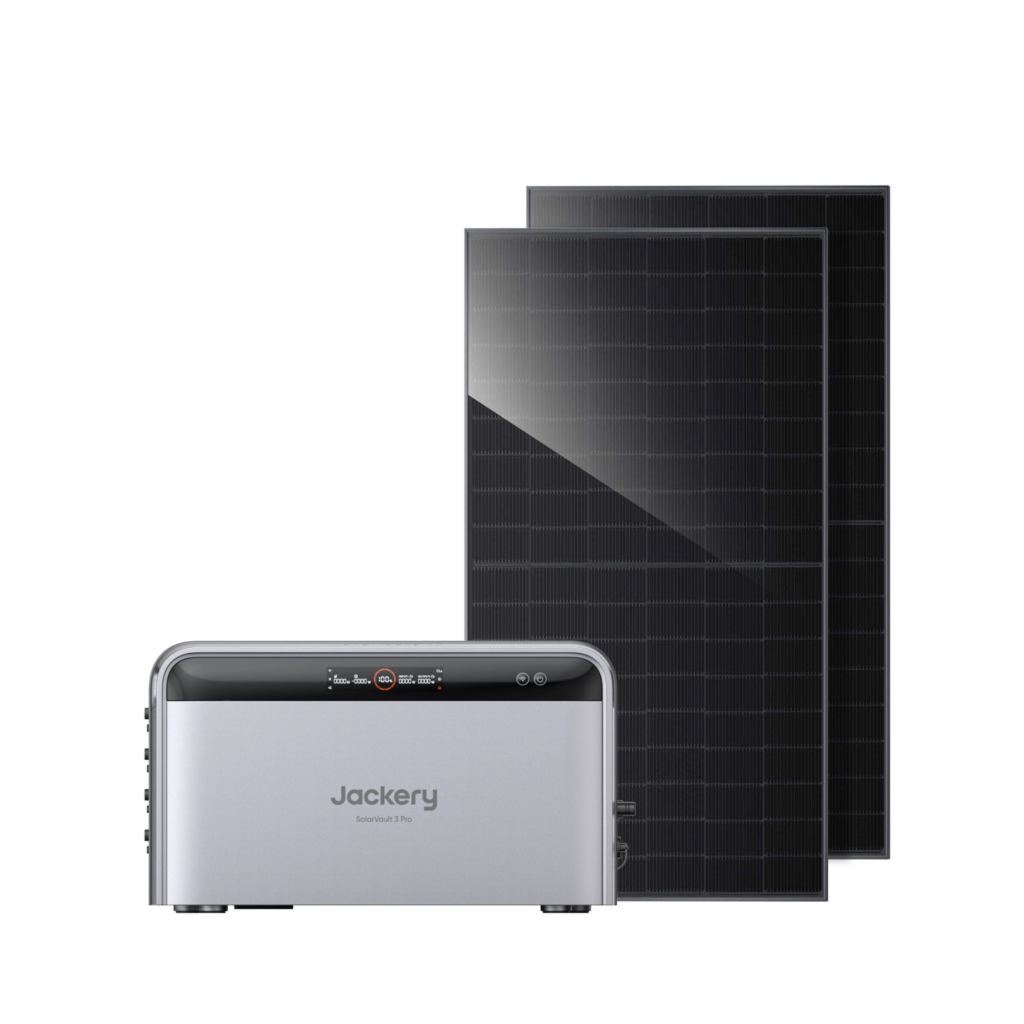
A power station accepts solar power from the balcony. That doesn’t make it a balcony battery, because none of the stations compared here feeds power back into the home grid in the evening. If you want to lower your electricity bill, the Jackery SolarVault 3 Pro is the better fit, and according to Jackery, its base configuration currently even sits in the same price range as a station with one kilowatt-hour. If the battery should also come along when camping, take the Explorer 1000 Plus v2 and live with a bit of manual work.
Island or home grid: what it’s really about
A balcony solar system pushes its power into the apartment through the wall outlet. The fridge, router and washing machine use it without anyone having to plug anything in differently. To do this, the device needs the power grid; otherwise, according to the Verbraucherzentrale, a German consumer advice center, it does not work at all. A power station works the other way around. It is an island. Only what is plugged into its own outlets gets power.
A true balcony battery, by contrast, sits between the panels and the home grid and releases the energy through the wall outlet in the evening. The SolarVault 3 Pro data sheet lists a dedicated grid-tied mode with 800 watts for this. How much it delivers is controlled by a meter at the electricity meter; see our guide to zero export (in German). This automation is exactly what the power station lacks, and almost all of the savings depend on it.
Two connections work, one is off-limits
Panels directly to the station
The panels connect to the solar input via an adapter, and the inverter is left out. That is simple, but it rarely pays off. In our example calculation for a balcony battery, a vertical pair of panels avoids 367 kilowatt-hours of grid consumption per year through the inverter, without any battery at all. If you reconnect both panels, you give that up and only get back what you plug into the station yourself. An additional panel that only fills the station makes more sense.
Charging the station from the outlet at midday
The balcony solar system stays as it is. The station is connected to the home grid, charges around midday and powers its own outlets in the evening. Anker offers a time-of-use mode for this, and for Jackery’s Plus models, the retailer GreenDrive describes similar functions in the app.
Do the math, though, because the station doesn’t know your surplus. According to the manufacturer, the Anker C1000 Gen 2 draws up to 1,200 watts. If only 300 watts are left over from the balcony, 900 watts come from the grid, at full price and with losses. With the factor of 0.85 from our guide to power station runtime, 33 cents per kilowatt-hour becomes around 39 cents. Jackery mentions a quiet charging mode, but gives no wattage for it.
What you should avoid
Two DIY solutions are going around: the inverter plugged into the station’s outlet, and a male-to-male cable from the station into the wall outlet. None of the stations compared here mentions such operation. Manufacturers of power inverters explicitly prohibit it, as our guide to power inverters shows. According to the BBK, Germany’s Federal Office of Civil Protection and Disaster Assistance, work on the home’s electrical installation belongs in the hands of a qualified electrician. The SolarVault is a different case, because according to Jackery, its device outlet is designed for an existing microinverter.
Does my panel fit the solar input?
This is often where the plan fails, because stations are built for folding panels. According to the data sheet, a 450 Wp JA Solar panel delivers 39.3 volts open-circuit voltage and 13.7 amps in operation. The Trina Vertex S+ with 415 to 440 Wp is at 50 to 52 volts, but under 12 amps.
According to the retailer, Jackery allows 16 to 60 volts on the Explorer Plus stations, Anker a maximum of 60 volts. Individually, that works. Two JA panels in series, however, reach a good 78 volts, which is too much. And cold raises the voltage: with Trina, it is 0.24 percent per degree, so on a morning at minus 10 degrees, around 56 volts instead of 52.
Then there is the current. Anker allows 14.5 amps from 29 volts, Bluetti 15 amps at 12 to 145 volts on the AC200L. There, two JA panels can theoretically be connected in series. For the v2 Explorers, no published current rating exists. The manual for the predecessor, the Explorer 2000 Plus, lists 12 amps per input, and there Jackery disclaims responsibility for third-party panels. So compare your panel with the manual before you order adapters. The SolarVault hardly has this problem: four inputs with 60 volts and 28 amps each.
What does it deliver per year?
According to our calculation, a battery with control recovers 171 kilowatt-hours a year from the surplus of the vertical panel pair with its first kilowatt-hour. That is the benchmark. For the power station, let’s assume a router and TV, a combined 120 watts, for five hours in the evening. That is 0.6 kilowatt-hours a day. On 200 days with enough sun left over, you reach 120 kilowatt-hours.
The dishwasher and washing machine keep running on the grid. So it’s not about the cycles, but about the missing control.
What is allowed and what has to be registered
The power station involves little paperwork. The Marktstammdatenregister, Germany’s official energy market register, states clearly that non-stationary systems such as portable batteries or power stations do not need to be registered. Your balcony solar system, of course, still has to be registered; see registering a balcony solar system.
The true battery involves more effort. According to the Verbraucherzentrale, it belongs in the register and must also be reported to the grid operator, via a simplified form up to 800 watts of feed-in power. The German product standard DIN VDE V 0126-95 so far only applies to devices without storage; a standard covering storage is in the works.
A power station doesn’t belong on the balcony. Anker writes that the C1000 Gen 2 is not waterproof, and in the predecessor’s manual, Jackery requires a clean, dry environment. At GreenDrive, the operating range of the Plus models ends at 45 degrees. The SolarVault is designed for outdoor use with IP65 and minus 20 to 55 degrees.
Six devices, two designs
| Model | Capacity | Solar input according to seller | Into the home grid | Best for |
|---|---|---|---|---|
| Jackery SolarVault 3 Pro | 2,520 Wh | 4 × 1,000 W, 16–60 V, 28 A | yes, 800 W | lowering your bill |
| Jackery Explorer 1000 Plus v2 | 1,024 Wh | 400 W, 16–60 V | no | router and TV in the evening, also on the go |
| Jackery Explorer 2000 Plus v2 | 2,048 Wh | 800 W, 16–60 V | no | garden shed with its own panels |
| Jackery Explorer 500 v2 | 512 Wh | no voltage specified | no | low demand, small budget |
| Anker SOLIX C1000 Gen 2 | 1,024 Wh | 600 W, up to 60 V, 14.5 A | no | one balcony panel, time-of-use mode |
| BLUETTI AC200L | 2,048 Wh | 1,200 W, 12–145 V, 15 A | no | two standard panels in series |
Jackery SolarVault 3 Pro
Not a battery to take along, but storage for the home grid. 2.52 kilowatt-hours, LiFePO4 with 6,000 cycles, and an existing inverter can stay. Against it: 25.5 kilograms and the registration. This is not a mobile device. In a power outage, according to the manual, the device outlet switches to the battery within 20 milliseconds.
Jackery Explorer 1000 Plus v2
Our pick if it has to be a power station. The calculation above shows that the first kilowatt-hour brings the most benefit, and you don’t need more than that in the evening. At 10.8 kilograms, it remains portable, according to the retailer it charges from minus 10 degrees, and it can grow with an expansion battery (in German). With 400 watts of solar input, some of the output from two balcony panels goes unused. For one kilowatt-hour, that is still enough.
Jackery Explorer 2000 Plus v2
Two inputs, 800 watts combined. According to Jackery, both must be fitted with identical panels. For a garden shed without grid power, that makes sense; on the balcony, the extra cost compared with the SolarVault is hard to justify.
Jackery Explorer 500 v2
Small, and light at 5.7 kilograms. After losses, a good 430 watt-hours remain, or around three and a half hours for the router and TV.
Anker SOLIX C1000 Gen 2
The time-of-use mode is clearly described, and 600 watts of solar input is enough for one powerful panel. Anker specifies 4,000 cycles to 80 percent. It only charges from zero degrees, and the station cannot be expanded.
BLUETTI AC200L
Technically the most forgiving with standard panels, because 145 volts allow two of them in series. The station does weigh 28.3 kilograms, though, and Bluetti specifies 3,000 cycles to 80 percent.
Which approach suits you?
- You want to buy less grid power and keep your balcony solar system: Jackery SolarVault 3 Pro, after a look at the example calculation.
- The battery should also travel, and individual devices run on it in the evening: Explorer 1000 Plus v2.
- Just a few hours of router and lights, small budget: Explorer 500 v2.
- Panels without a grid connection, for example in the garden: Explorer 2000 Plus v2 or, with two standard panels in series, BLUETTI AC200L.
- What you’re really after is backup for power outages: then read backup power with a power station (in German).
Frequently asked questions
Is a power station on a balcony solar system a balcony battery?
No. A power station is an island: only what is plugged into its own outlets gets power. A balcony battery sits between the panels and the home grid and releases the energy through the wall outlet in the evening. The power station lacks this consumption-based control, and almost all of the savings depend on it.
Does my balcony panel fit the power station's solar input?
Individually, usually yes; in series, often not. According to the retailer, Jackery allows 16 to 60 volts on the Explorer Plus stations, Anker a maximum of 60 volts. Two JA panels in series reach a good 78 volts, and cold raises the voltage further. Compare your panel's data sheet with the manual before you order adapters.
Can I feed the power station into the home grid with a male-to-male cable?
We advise against it. None of the stations compared mentions such operation, and manufacturers of power inverters explicitly prohibit it. According to Germany's Federal Office of Civil Protection and Disaster Assistance, work on the home's electrical installation belongs in the hands of a qualified electrician. The SolarVault is a different case: its device outlet is designed for an existing microinverter.
Do I have to register a power station in the Marktstammdatenregister?
No. According to the Marktstammdatenregister, Germany's official energy market register, non-stationary systems such as power stations do not need to be registered. The balcony solar system itself still has to be registered. A true battery such as the SolarVault, on the other hand, belongs in the register according to the Verbraucherzentrale and must also be reported to the grid operator, via a simplified form up to 800 watts.
How much does a power station on a balcony deliver per year?
In our example calculation, it powers a router and TV drawing a combined 120 watts for five hours in the evening. On 200 sunny days, that comes to 120 kilowatt-hours. A controlled battery recovers 171 kilowatt-hours from the surplus with its first kilowatt-hour. The difference comes from the missing control, not from the cycles.
Can the power station stand outside on the balcony?
Better not. Anker writes that the C1000 Gen 2 is not waterproof, Jackery requires a clean, dry environment, and according to the retailer, the Plus models only operate up to 45 degrees. The SolarVault, by contrast, is designed for outdoor use with IP65 and minus 20 to 55 degrees.
Sources
- Verbraucherzentrale: FAQ on plug-in solar devices
- Verbraucherzentrale NRW: Laws and standards for plug-in solar
- Marktstammdatenregister: Registration requirement for systems
- BBK: Power outages, preparedness and self-help (PDF)
- Jackery: SolarVault 3 Pro data sheet (PDF, via Zajadacz, German retailer)
- Jackery: Explorer 2000 Plus manual (PDF)
- GreenDrive (retailer information): Explorer 1000 Plus v2
- GreenDrive (retailer information): Explorer 2000 Plus v2
- Anker SOLIX: C1000 Gen 2
- BLUETTI: AC200L
- JA Solar: JAM54D40 435–460 data sheet (PDF)
- Trina Solar: Vertex S+ data sheet (PDF)
Where to buy
- Jackery SolarVault 3 ProView at JackeryAvailable in Germany: JackeryCheck price at Amazon.deAvailable in Germany: Amazon.de
- Jackery Explorer 1000 Plus v2View at JackeryAvailable in Germany: JackeryCheck price at Amazon.deAvailable in Germany: Amazon.de
- Jackery Explorer 2000 Plus v2View at JackeryAvailable in Germany: JackeryCheck price at Amazon.deAvailable in Germany: Amazon.de
- Jackery Explorer 500 v2View at JackeryAvailable in Germany: JackeryCheck price at Amazon.deAvailable in Germany: Amazon.de
- Anker SOLIX C1000 Gen 2Check price at Amazon.deAvailable in Germany: Amazon.de
- BLUETTI AC200LCheck price at Amazon.deAvailable in Germany: Amazon.de