Contents14 sections
This guide was first published in German on handgetestet.de.
A thousand watt-hours on the box come to about 850 at the outlet. With this one correction, the runtime calculation is already pretty accurate: capacity times 0.85, divided by the device’s power draw. If that tells you that you need about 1,000 watt-hours and you are connecting compressor appliances, the Jackery Explorer 1000 Plus v2 is a good choice, because its 1,800 watts leave headroom for start-up. The calculation itself works with any station. One caveat up front: the Explorer 1000 Plus v2 is new, and we only had information from Jackery and one retailer, no data sheet and no independent measurement. Read its figures with appropriate caution.
Watt-hours are the tank, watts the speed
Watts describe how much a device is drawing at the moment. Watt-hours describe how much energy is in there in total. A 60-watt laptop uses 180 watt-hours in three hours; a 2,000-watt electric kettle gets through the same amount in a little over five minutes.
These two quantities lead to two separate questions. Is the continuous output enough for the device to run at all? An Explorer 500 v2 with 500 watts fails with the kettle, no matter how full it is. Only after that comes the question of how long it runs. An expansion battery (in German) does not change that either; it only extends the hours. Amp-hours, as printed on car batteries and cooler boxes, are converted using the voltage: 24 Ah at 12 volts is 288 Wh.
Where the 15 percent goes
The battery holds direct current, while your device wants 230-volt alternating current. The inverter takes care of that, and it does not do so for free. Jackery does not state an efficiency for the Explorer series online. Other figures mark out the range: heicko lists 85 percent in the data sheet for its voltage converters, and Victron 87 to 90 percent for small 12-volt units, though those are best-case values. Anker calculates 16 to 18 hours instead of 20 for 2,000 watt-hours and 100 watts, which is 80 to 90 percent. An authorized Jackery retailer calculates its examples with a factor of 0.85. We adopt that.
On top of that comes standby consumption. A Victron inverter in the 500 VA class draws about 6 watts with no load. That sounds harmless, but it adds up to 144 watt-hours a day. With a 20-watt router, that carries a lot of weight; with a hair dryer, none at all. So keep the outlets off when nothing is plugged in, and use USB-C or the 12-volt socket wherever the device allows it. There, the conversion to 230 volts is not needed.
Age comes on top of that. Jackery states the service life down to 70 percent remaining capacity. At the end of that span, 1,024 watt-hours have become just over 700, and the 0.85 applies in addition.
Three everyday calculations
The laptop is the easy case. Explorer 1000 v2, 60 watts: 1,070 × 0.85 ÷ 60 gives 15 hours. That matches the retailer’s figure.
With anything that has a compressor, the type plate is misleading. For a compressor cooler box, Dometic states 48 watts while running, but only about 22 percent running time, so under 24 amp-hours a day. On average, that is about 12 watts instead of 48. The Explorer 500 v2 would therefore last 36 hours on paper. The retailer assumes an average of 45 watts for the same class of device and ends up at just under 10 hours. Both are correct, depending on whether the box sits in a cool basement or runs constantly in midsummer.
The refrigerator counts in kilowatt-hours. The energy label states the annual consumption; divided by 365, that gives you the daily figure. Our assumed example, a fridge-freezer using 0.8 kWh a day, runs for a little over two days on the Explorer 2000 v2. For longer outages, see our guide to backup power with a power station (in German).
One more trap with small loads: when active, the Explorer 500 v2’s energy-saving mode switches off outputs after six hours if the outlet carries 25 watts or less. A router would then go off in the middle of the night.
Inrush current: why 150 watts sometimes need 1,000
Motors and compressors draw a multiple of their rated power when starting. heicko gives two to eight times in its manual, Ective three to ten times. Jackery itself gives a range of 15 to 520 watts for a household refrigerator. That is how far apart idle and peak can be.
Do the math. A refrigerator with a rated power of 150 watts can demand 1,200 watts at a factor of eight. According to the retailer, the Explorer 500 v2 delivers 1,000 watts of peak power, and the Explorer 1000 v2 three times that. Jackery does not say how long the peak is sustained. With heicko, it is about 0.3 seconds. Because inductive loads differ greatly, heicko advises trying it out with the specific device. Do that before the power goes out. The cooler box has it easier: it runs on 12 volts and needs no inverter.
Measuring beats estimating
Type plates usually state the maximum value. A plug-in power meter that runs for 24 hours gives you an honest daily consumption figure, or better a whole week for cooling appliances. The German Environment Agency (Umweltbundesamt) also recommends a meter like this for assessing old refrigerators. The available models are covered in our guide to the energy meter (in German). The plug-in meter does not capture 12-volt devices. For those, use the power station’s display, which shows input and output in watts, or the cooler box’s app. Also compare the battery level before and after a night.
Runtimes compared
The basis is these values: router 20 watts and fridge-freezer 0.8 kWh a day (assumed examples from retailer information), laptop 60 watts, compressor cooler box 12 watts on average according to Dometic. Everything calculated with a factor of 0.85.
| Model | Capacity, continuous output | Router 20 W | Laptop 60 W | Cooler box 12 W | Fridge-freezer 0.8 kWh/day |
|---|---|---|---|---|---|
| Jackery Explorer 300D | 288 Wh, 300 W (no outlet) | 12 h | 4 h | 20 h | not possible |
| Jackery Explorer 500 v2 | 512 Wh, 500 W | 22 h | 7 h | 36 h | just over 12 h |
| Jackery Explorer 1000 v2 | 1,070 Wh, 1,500 W | 45 h | 15 h | 76 h | just over 1 day |
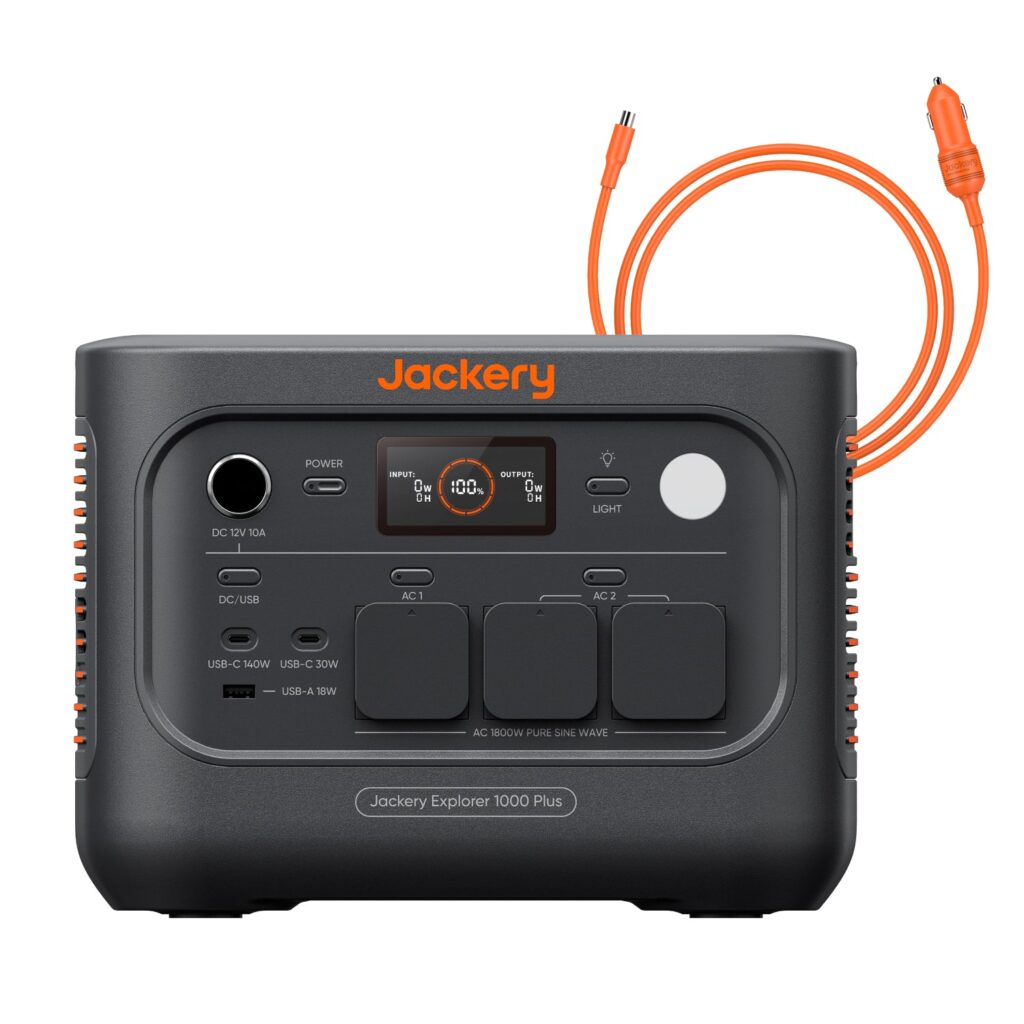
| Jackery Explorer 1000 Plus v2 | 1,024 Wh, 1,800 W | 44 h | 14.5 h | 72 h | just over 1 day |
| Jackery Explorer 2000 v2 | 2,042 Wh, 2,200 W | 87 h | 29 h | 145 h | just over 2 days |
| Jackery Explorer 2000 Plus v2 | 2,048 Wh, 2,400 W | 87 h | 29 h | 145 h | just over 2 days |
Manufacturer tables are only useful as a rough guide. For a 60-watt portable refrigerator, Jackery states 15 hours on the Explorer 1000 v2, but only 4.5 hours on the Explorer 500 v2 with half the capacity. You are better off calculating it yourself.
Medical devices: clarify first, then calculate
For the ResMed AirSense 11 AutoSet, a data sheet states a power consumption of 56.1 watts, and 1.9 watts in standby. Eight hours would therefore be at most about 450 watt-hours, or about 530 from the battery after the deduction. That is only a calculation, not an approval. Whether and how a medical device may run on a power station is something to clarify with the manufacturer and your doctor, and for life-sustaining devices also with your medical equipment provider.
Jackery Explorer 1000 Plus v2
Our sample calculation for most households: 1,024 watt-hours, 1,800 watts of continuous output and 3,600 watts of peak power at 10.8 kilograms, plus 6,000 cycles. According to Jackery, the UPS switchover takes 10 milliseconds; what that can and cannot do is explained in our UPS guide. Drawback: it costs more than the Explorer 1000 v2 and stores slightly less.
Jackery Explorer 1000 v2
Slightly more capacity, 1,500 watts, 3,000 watts peak. Without expansion plans, the less expensive choice. Jackery states 4,000 cycles, which is 2,000 fewer than the Plus model. In spring 2025, the ADAC, the German automobile club, downgraded the Explorer 1000 v2 to „poor“ because its two DC inputs are not decoupled. So never charge it via solar and the vehicle outlet at the same time; otherwise, damage to the 12-volt vehicle electrical system is possible.
Jackery Explorer 500 v2
It is enough for a router, laptop and lights, but things get tight with compressors. At 5.7 kilograms, it is the lightest station in this list with a real outlet.
Jackery Explorer 300D
The special case with no inverter loss at the outlet, because it has no outlet at all. For USB-C and 12 volts, with 288 watt-hours at 2.5 kilograms. The factor of 0.85 is on the cautious side here.
Jackery Explorer 2000 v2 and 2000 Plus v2
Both offer about 2 kilowatt-hours. The 2000 v2 delivers 2,200 watts at 17.5 kilograms; according to the retailer, the 2000 Plus v2 delivers 2,400 watts, 4,800 watts peak and weighs 19.1 kilograms, but it can be expanded. Worthwhile if your calculation comes out above 1,500 watt-hours. Other brands are compared in our guide to buying a power station (in German).
Your calculation in four steps
- List all devices that run at the same time and add up the watts: that is the continuous output you need.
- For compressor appliances, check the start-up load, with a factor of two to eight.
- Measure or calculate the daily consumption in watt-hours.
- Divide by 0.85, add 20 percent reserve, then choose the station.
That turns a requirement of 600 watt-hours into about 850, which fits the 1 kWh class.
How to preserve the capacity for a long time is covered in our guide to storing a power station (in German).
How many watt-hours a battery charge costs on the road is calculated in our guide to charging an e-bike with a power station (in German).
Frequently asked questions
How do I calculate the runtime of a power station?
Capacity in watt-hours times 0.85, divided by the device's power draw in watts. The factor covers the inverter's losses. Example: an Explorer 1000 v2 with 1,070 watt-hours powers a 60-watt laptop for about 15 hours. Check first whether the continuous output is enough for the device at all.
Why does a power station deliver less than the stated watt-hours?
The inverter converts direct current into 230-volt alternating current and loses energy in the process; figures from other manufacturers are 80 to 90 percent. On top of that comes standby consumption: a Victron inverter in the 500 VA class draws about 6 watts with no load, or 144 watt-hours a day. USB-C and 12 volts avoid the conversion.
How long does a refrigerator run on a power station?
Divide the annual consumption from the energy label by 365 to get the daily figure. A fridge-freezer using 0.8 kWh a day runs for a little over two days on the Explorer 2000 v2. With compressor cooler boxes, the type plate is misleading: Dometic states 48 watts while running, but the average is about 12 watts.
What is inrush current and why does it matter?
Motors and compressors draw a multiple of their rated power when starting; heicko gives two to eight times. A 150-watt refrigerator can therefore demand 1,200 watts. According to the retailer, the Explorer 500 v2 delivers 1,000 watts of peak power. Try out the specific device before the power goes out.
How do I measure the actual consumption of my devices?
With a plug-in power meter that runs for 24 hours, or better a week for cooling appliances. Type plates usually state the maximum value. The plug-in meter does not capture 12-volt devices; for those, use the power station's display or the cooler box's app. Also compare the battery level before and after a night.
Can I run a medical device on a power station?
The math is possible: for the ResMed AirSense 11 AutoSet at 56.1 watts, eight hours would be at most about 450 watt-hours, or about 530 from the battery after the deduction. That is not an approval. Whether and how the device may run on a power station is something to clarify with the manufacturer and your doctor, and for life-sustaining devices also with your medical equipment provider.
Sources
- Product information from Jackery on the Explorer models 300D, 500 v2, 1000 v2, 1000 Plus v2, 2000 v2 and 2000 Plus v2
- GreenDrive (authorized Jackery retailer): Explorer 1000 v2
- GreenDrive: Explorer 500 v2
- GreenDrive: Explorer 1000 Plus v2
- GreenDrive: Explorer 2000 Plus v2
- heicko: HPLS2000 manual (PDF)
- heicko: HPLS1000 manual (PDF)
- Ective: SI/TSI manual (PDF)
- Victron Energy: Phoenix Inverter data sheet (PDF)
- Anker SOLIX: Power stations, capacity and usable energy
- Dometic: CFX3 45, consumption and cooling technologies
- German Environment Agency (Umweltbundesamt): Refrigerators
- VitalAire: AirSense 11 AutoSet data sheet (PDF)
- ADAC (German automobile club): Portable power stations tested (spring 2025)
Where to buy
- Jackery Explorer 1000 Plus v2View at JackeryAvailable in Germany: JackeryCheck price at Amazon.deAvailable in Germany: Amazon.de
- Jackery Explorer 500 v2View at JackeryAvailable in Germany: Jackery
- Jackery Explorer 1000 v2View at JackeryAvailable in Germany: JackeryCheck price at Amazon.deAvailable in Germany: Amazon.de
- Jackery Explorer 300DView at JackeryAvailable in Germany: Jackery
- Jackery Explorer 2000 v2View at JackeryAvailable in Germany: Jackery
- Jackery Explorer 2000 Plus v2View at JackeryAvailable in Germany: JackeryCheck price at Amazon.deAvailable in Germany: Amazon.de