Contents17 sections
This guide was first published in German on handgetestet.de.
If you already have solar panels on your roof or balcony, adding a battery requires neither rewiring the panels nor swapping the inverter. An AC-coupled battery simply connects to the household grid and charges with the power that would otherwise flow into the grid. For an existing rooftop system, we consider the Jackery SolarVault 3 Pro Max AC the most coherent solution; for a small balcony solar system, it is the SolarVault 3 Pro, whose outlet lets the existing microinverter keep working. Before we get to the models, it is worth looking at the technology. It determines how much of your sunshine actually makes it to the evening.
AC or DC: where does the battery connect?
Solar panels produce direct current, batteries store direct current, and the house needs alternating current. A DC-coupled battery takes power directly from the panels and only converts it when discharging. For this, the SolarVault 3 Pro has four solar inputs, each handling up to 1,000 watts at 16 to 60 volts. That suits balcony panels, not a rooftop system with a string voltage of several hundred volts.
The AC-coupled battery works on the other side of the inverter. It only sees the household grid. According to its data sheet, the SolarVault 3 Pro Max AC has no solar inputs at all, but instead a grid connection through which it can charge at up to 3,680 watts. The rooftop system stays as it is. In return, an extra conversion is added: direct current becomes alternating current, turns back into direct current in the battery and becomes alternating current again in the evening. Each of these steps costs some energy.
In between, there is a third option. The SolarVault 3 Pro accepts up to 1,200 watts at its outlet. You can plug in the plug of an existing balcony solar system there, while new panels go to the solar inputs. What is generally allowed with balcony systems and how much panel output you may connect is covered in our buying guide to balcony solar systems with storage (in German).
What the kilowatt hours on the box mean
The number on the packaging is the energy content of the cells. The usable amount is usually somewhat lower. For the HomePower 2000 Ultra, Jackery states 2,048 watt hours of total energy and 1,945 watt hours of rated energy. For the SolarVault 3 series, the data sheet lists 2,520 watt hours, and the 6,000 charge cycles there refer to a 90 percent depth of discharge and a remaining capacity of at least 70 percent. EcoFlow also cites 6,000 cycles down to 70 percent capacity for the STREAM AC Pro.
How big does the battery need to be? Calculate with your base load in the evening and overnight. If the house runs at 300 watts through the night, 2.5 kilowatt hours will last a good eight hours on paper. More capacity only helps if there is also enough surplus during the day to fill the battery. A 7 kWh battery on an 800-watt balcony system would rarely be full in winter. Incidentally, this is exactly the value the Marktstammdatenregister (Germany’s national energy installation register) asks for: the usable storage capacity.
Charging and discharging power: why 800 watts is a limit
Capacity tells you how long. Power tells you how much at once. If a battery only delivers 800 watts, it covers the fridge, router and TV, but not the electric kettle. The grid supplies the rest.
The 800 watts are no coincidence. Under the rules that the VDE FNN (the German grid standards body) describes for plug-in solar devices, a Schuko plug may carry at most 800 volt-amperes of inverter output. Anker spells this out explicitly for the Solarbank Max: up to 800 watts via a Schuko plug on your own, and above that only with a qualified electrician, a dedicated circuit with a Wieland connector or a fixed connection in the distribution board. Jackery offers the SolarVault 3 Pro Max AC in three versions with 800, 1,500 and 2,500 watts of grid output. According to the data sheet, full power at the unit’s own outlet is only available with at least one expansion battery; without it, the figures are 1,600 watts when discharging and 1,800 watts when charging.
Expanding: stacking battery on battery
All seven batteries in our table can be expanded. With Jackery, up to five BP2500 units of 2.52 kWh each can be added to a SolarVault main unit, for a total of 15.12 kWh. The HomePower 2000 Ultra grows to 8 kWh, EcoFlow’s STREAM AC Pro to 11.52 kWh, Zendure’s SolarFlow 2400 AC+ to 16.8 kWh, and Anker’s Solarbank Max AC from 7 to 42 kWh. It is better to buy small and expand once a summer’s readings show that the battery is regularly empty in the evening. Remember the register when you do: according to the Bundesnetzagentur (Germany’s Federal Network Agency), an expansion must be entered for the existing unit within one month.
Backup power: what really runs during a power outage
Less than many people expect. The Bundesnetzagentur explains that the inverters of solar systems and batteries shut down when the grid fails. A battery connected to the household grid then no longer supplies the house. The Verbraucherzentrale (German consumer advice center) points out that most batteries for plug-in solar devices have their own backup outlet. Only what is plugged in there keeps running.
The differences are in the details. For the HomePower 2000 Ultra, Jackery states 1,500 watts at the load output and a switchover time of 20 milliseconds. Anker’s Solarbank Max AC delivers up to 3,680 watts at its separate off-grid connection and, according to the manufacturer, switches over in 10 milliseconds; Zendure cites up to 2,400 watts and 15 milliseconds for the SolarFlow 2400 AC+. The SolarVault 3 Pro Max AC delivers up to 2,500 watts at the unit’s outlet without the grid, though only with at least one expansion battery, and switches in 20 milliseconds. Jackery states explicitly in the manual that this is not a professional UPS. Servers and workstations therefore do not belong on it. If you want to keep your fridge and freezer going through a longer outage, you will find the math in our guide to backup power with a power station (in German).
Registration: the register and the grid operator
A permanently installed battery that is connected to the grid through the household wiring must be entered in the Marktstammdatenregister. The Bundesnetzagentur classifies battery storage there as a generating installation, and the deadline is one month from commissioning. Portable power stations are exempt. With a rooftop system, the battery is registered as a separate unit; with a balcony solar system, it is registered together with it.
One detail that many people overlook: the simplified rules for balcony solar systems do not apply to the battery. The Verbraucherzentrale writes that the EEG (Germany’s Renewable Energy Sources Act) makes no exception for batteries on plug-in solar devices. The battery must therefore also be reported to the grid operator; some grid operators waive this, so ask beforehand. According to the Verbraucherzentrale, the new German product standard DIN VDE V 0126-95 for the Schuko plug only applies to plug-in solar devices without storage.
What the electrician does and what they do not
You may set it up yourself, plug it in up to 800 watts, configure the app and fill in the register. Under VDE FNN rules, only a qualified electrician may assess the circuit and replace a fuse. An electrician is also needed as soon as more than 800 watts are to be fed in: Wieland outlet, dedicated circuit, fixed connection and, according to Anker, the grid connection application to the grid operator. The same applies to a power meter in the meter cabinet that the battery needs for its control. A reading head that only attaches to the outside of the meter does not require an electrician. Which meters are available is shown in our guide to energy meters (in German).
Seven batteries for retrofitting
| Model | Connection | Capacity according to manufacturer | Grid output according to manufacturer | Best for |
|---|---|---|---|---|
| Jackery SolarVault 3 Pro Max AC | AC-coupled, no solar input | 2.52 kWh, up to 15.12 kWh | 800, 1,500 or 2,500 W | existing rooftop system |
| Jackery SolarVault 3 Pro | 4 solar inputs, outlet for microinverter | 2.52 kWh, up to 15.12 kWh | 800 or 1,200 W | existing balcony solar system |
| Jackery SolarVault 3 Pro Max | 4 solar inputs | 2.52 kWh, up to 15.12 kWh | 800, 1,500 or 2,500 W | new large plug-in system |
| Jackery HomePower 2000 Ultra | 2 solar inputs | 2.05 kWh, up to 8 kWh | 800 W, load output 1,500 W | balcony with backup power in mind |
| Anker SOLIX Solarbank Max AC | AC-coupled | 7 kWh, up to 42 kWh | 800 W, up to 3,500 W via dedicated circuit | high evening consumption |
| Zendure SolarFlow 2400 AC+ | AC-coupled, no solar input | 2.4 kWh, up to 16.8 kWh | 800 W, up to 2,400 W after inspection | rooftop system, backup power without expansion battery |
| EcoFlow STREAM AC Pro | AC-coupled, outlet | 1.92 kWh, up to 11.52 kWh | 800 W, 1,200 W per outlet | small entry point |
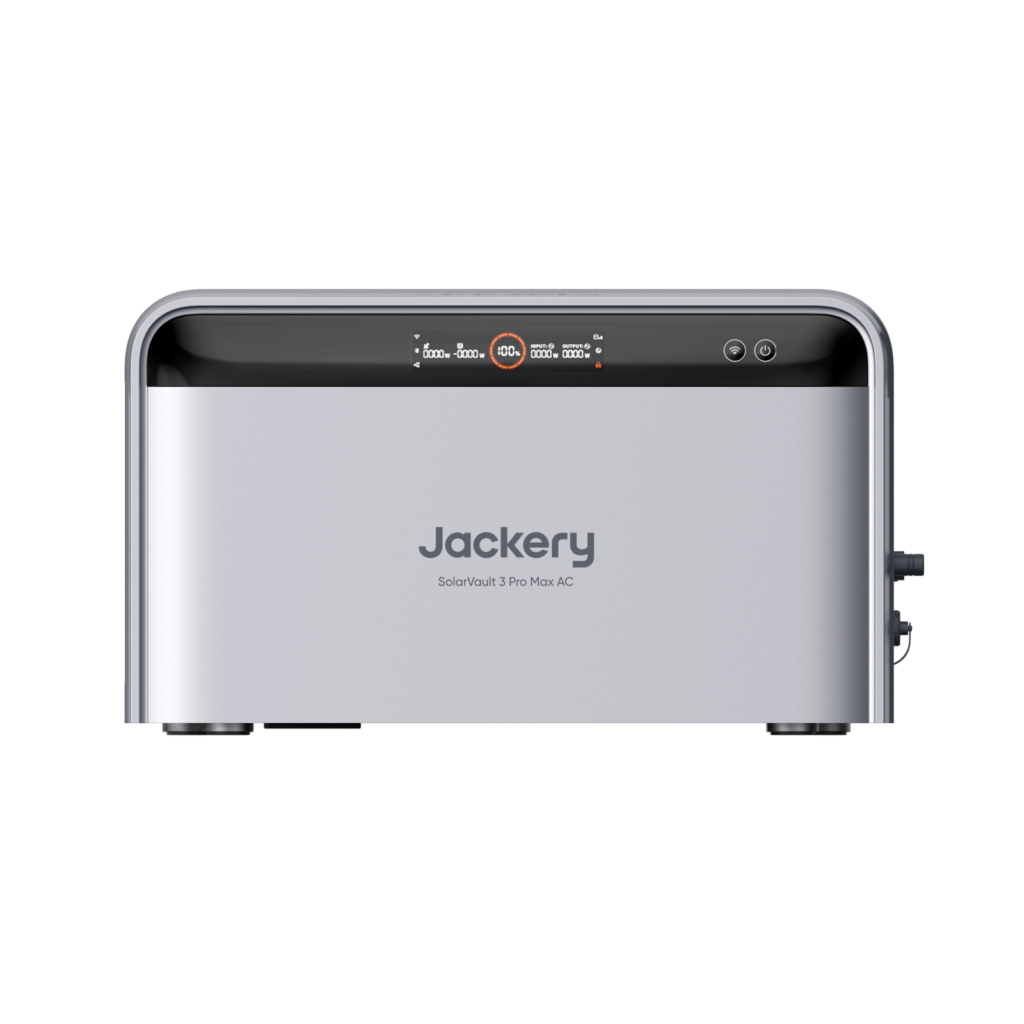
Jackery SolarVault 3 Pro Max AC
Built for exactly the case this guide is about. The battery charges via the grid connection at up to 3,680 watts, delivers up to 2,500 watts depending on the version and has its own outlet with 3,680 watts of pass-through. According to Jackery, the housing is rated IP65 and operates from minus 20 to 55 degrees Celsius. Installation is more involved. The high-output version belongs on a dedicated circuit, and for control, Jackery specifies its own smart meter or its reading head. At 25.5 kilos, it is also not a device for a third-floor walk-up.
Jackery SolarVault 3 Pro
The choice for an existing balcony solar system that is meant to grow. New panels go to the four solar inputs, and the old microinverter plugs into the unit’s outlet. According to the data sheet, the Pro delivers 800 or 1,200 watts into the house. For most apartments, the 800-watt version is the less complicated one.
Jackery SolarVault 3 Pro Max
Technically, this is the Pro Max AC with solar inputs. It makes sense if you are planning from scratch and want to connect panels directly. For retrofitting a rooftop system, it is no better than the AC version; it just comes with inputs you will not use.
Jackery HomePower 2000 Ultra
A balcony battery with two solar inputs of up to 1,000 watts each and a built-in aerosol fire suppression system. The load output with 1,500 watts and a 20-millisecond switchover time makes it interesting if backup power for individual devices matters. According to Jackery, it regulates with the Shelly Pro 3EM or Pro EM 50. By default, it feeds 800 watts into the grid.
Anker SOLIX Solarbank Max AC
Designed on a much larger scale: 7 kWh in the base unit, an off-grid connection with 3,680 watts, IP66 protection. Anker cites 10,000 cycles. Above 800 watts, a qualified electrician is mandatory, and even the base unit is often too big for a two-person household with a small system.
Zendure SolarFlow 2400 AC+
It, too, has no solar inputs and only connects to the household grid, so the rooftop system remains untouched. According to the manual, it charges at up to 3,200 watts and delivers 800 watts out of the box. More, namely 2,400 watts, can only be requested in the app after an electrician has inspected the installation. Its advantage over the Jackery lies in the backup output: in the manual, Zendure does not tie the 2,400 watts to an expansion battery. Out of the box, however, this outlet is switched off and has to be activated in the app. At 27.8 kilos, it is not something you carry down to the basement on your own either.
EcoFlow STREAM AC Pro
The smallest battery here, 21.5 kilos, passively cooled. According to the data sheet, it charges from the outlet at 1,050 watts and feeds back at a rated 800 watts; its two outlets deliver up to 2,300 watts combined. With 1.92 kWh, it covers one evening’s base load, no more.
How we would decide
- Rooftop system without storage, electrician coming anyway: Jackery SolarVault 3 Pro Max AC with one expansion battery.
- Balcony solar system in place, more panels planned: Jackery SolarVault 3 Pro in the 800-watt version.
- Backup power for the fridge and router is the main goal: Jackery HomePower 2000 Ultra.
- High evening consumption, heat pump or electric car: Anker SOLIX Solarbank Max AC.
- Rooftop system, powerful backup output without an expansion battery: Zendure SolarFlow 2400 AC+.
- Only covering the overnight base load, without any rewiring: EcoFlow STREAM AC Pro.
If you also want to charge with cheap grid power, you need a suitable tariff. When that pays off is explained in the guide to dynamic electricity tariffs (in German).
What charging from the grid brings and which rules apply is covered in the guide charging a battery with grid power (in German). Whether a balcony battery pays for itself is shown in the guide balcony battery: a worked example (in German).
Frequently asked questions
Can I add battery storage to an existing solar system?
Yes. An AC-coupled battery works downstream of the inverter and only sees the household grid, so the rooftop system stays as it is. In return, an extra conversion step is added, and each of these steps costs some energy.
How big does the battery need to be?
Calculate with your base load in the evening and overnight. If the house runs at 300 watts through the night, 2.5 kilowatt hours will last a good eight hours on paper. It is better to buy small and expand once a summer shows that the battery is regularly empty in the evening.
Why do many batteries only deliver 800 watts?
Under the rules described by the VDE FNN (the German grid standards body), a Schuko plug may carry at most 800 volt-amperes of inverter output. More is only possible with a qualified electrician, a dedicated circuit with a Wieland connector or a fixed connection. 800 watts covers the fridge, router and TV, but not the electric kettle.
Does the battery keep running during a power outage?
Not for the whole house. According to the Bundesnetzagentur (Germany's Federal Network Agency), inverters shut down when the grid fails. Only what is plugged into the battery's backup outlet keeps running, for example up to 1,500 watts on the Jackery HomePower 2000 Ultra. It is no substitute for a professional UPS.
Do I have to register a battery?
Yes. In Germany, a permanently installed battery connected to the household grid must be entered in the Marktstammdatenregister (the national energy installation register) within one month; portable power stations are exempt. On a balcony solar system, it also has to be reported to the grid operator, because according to the Verbraucherzentrale (German consumer advice center), the simplified rules for plug-in solar devices do not apply to the battery.
What can I do myself, and when do I need an electrician?
You may set it up, plug it in up to 800 watts, configure the app and fill in the register yourself. A qualified electrician is needed for feeding in more than 800 watts, a dedicated circuit, a fixed connection and a power meter in the meter cabinet. A reading head that simply attaches to the outside of the meter does not require an electrician.
Sources
- Bundesnetzagentur: Which installations must be registered in the Marktstammdatenregister?
- Marktstammdatenregister: Frequently asked questions (battery storage, expansion, balcony solar)
- Marktstammdatenregister: Deadlines
- Bundesnetzagentur: Solar systems and other renewable energy installations
- VDE FNN: Connecting and registering plug-in PV systems
- Verbraucherzentrale: Plug-in solar, solar power from the balcony
- Jackery: SolarVault 3 Pro Max AC specifications (PDF)
- Jackery: SolarVault 3 Pro Max specifications (PDF)
- Jackery: SolarVault 3 Pro specifications (PDF)
- Product information from Jackery on the SolarVault 3, the BP2500 expansion battery and the HomePower 2000 Ultra
- Jackery: SolarVault 3 Pro Max AC user manual (PDF)
- Anker SOLIX: Solarbank Max and Solarbank Max AC
- Anker SOLIX: Solarbank Max AC, product page
- Zendure: SolarFlow 2400 AC+ user manual (PDF)
- EcoFlow: STREAM AC Pro data sheet (PDF)
Where to buy
- Jackery SolarVault 3 Pro Max ACView at JackeryAvailable in Germany: JackeryCheck price at Amazon.deAvailable in Germany: Amazon.de
- Jackery SolarVault 3 ProView at JackeryAvailable in Germany: JackeryCheck price at Amazon.deAvailable in Germany: Amazon.de
- Jackery SolarVault 3 Pro MaxView at JackeryAvailable in Germany: JackeryCheck price at Amazon.deAvailable in Germany: Amazon.de
- Jackery HomePower 2000 UltraView at JackeryAvailable in Germany: JackeryCheck price at Amazon.deAvailable in Germany: Amazon.de
- Anker SOLIX Solarbank Max ACCheck price at Amazon.deAvailable in Germany: Amazon.de
- Zendure SolarFlow 2400 AC+Check price at Amazon.deAvailable in Germany: Amazon.de
- EcoFlow STREAM AC ProCheck price at Amazon.deAvailable in Germany: Amazon.de