Contents14 sections
This guide was first published in German on handgetestet.de.
10x sounds like more. So the 10×42 ends up in the shopping cart, and that is exactly where the mistake begins. For birdwatching in the backyard, at the edge of the woods or on a hike, an 8×42 is usually the better fit, because it shows a larger, steadier image. Among the upper mid-range binoculars, the Zeiss Conquest HDX 8×42 brings together field of view, weight and eyeglass compatibility most coherently, according to the manufacturer’s data. If you mostly look far out over water, mudflats or fields, on the other hand, you should consider a 10×42 or go straight to a stabilized pair.
What do the two numbers actually mean?
The first number is the magnification, the second the objective lens diameter in millimeters, and dividing one by the other gives you the exit pupil. For 8×42, that is just over 5 mm; for 10×42, around 4 mm. A larger exit pupil means more leeway at dusk and an image that does not go black right away when your eye shifts slightly.
Why do you often see more with 8x?
Because of the field of view. For the Conquest HDX 8×42, Zeiss states a field of view of 128 m at 1,000 m, and 115 m for the 10×42 version. With Nikon’s Monarch M7, the 8×42 and 10×42 come in at 145 and 121 m. Then there is hand shake, which grows with every step up in magnification. When a wren darts through the undergrowth, you simply find it more easily in a larger, steadier image.
Which values on the spec sheet matter?
Four figures are worth comparing:
- Field of view in meters at 1,000 m: Below 120 m, finding things at 8x gets tedious; above 140 m is generous.
- Eye relief for eyeglass wearers: It describes how far your eye can be from the eyepiece. The models below range from 16 to 18.5 mm. With glasses, turn the eyecups all the way in. Only then can you tell whether you see the whole image.
- Close focus distance: When watching butterflies or your own bird feeder, you notice the difference between 1.8 and 2.5 m.
- Weight: Between 670 g and more than a kilo there is a world of difference once the binoculars hang around your neck all day.
Do you need image stabilization?
In most cases, no. Stabilized binoculars compensate for hand shake electronically; for the 10x42L IS WP, Canon states a correction range of ±0.8°. That comes at a cost. And not only at the checkout. According to Canon, the binoculars weigh around 1,110 g without batteries and run on two AA cells. At +25 °C, Canon states about 2.5 hours of runtime with alkaline batteries; at −10 °C, only about 10 minutes. For winter days by the water, plan on lithium cells or spares.
In the backyard, you do not need that much technology. On the coast and at lakes, for resting birds at long distances, it does become a serious alternative to a spotting scope.
Six binoculars, the data side by side
| Model | Field of view at 1,000 m | Eye relief | Weight | Best for |
|---|---|---|---|---|
| Zeiss Conquest HDX 8×42 | 128 m | 16.5 mm | 715 g | Nature watchers who want to buy once |
| Nikon Monarch M7 8×42 | 145 m | 17.1 mm | 670 g | Getting started with a wide field of view |
| Swarovski NL Pure 8×42 | 159 m | 18 mm | 840 g | Frequent observers with a big budget |
| Leica Trinovid HD 8×42 | 124 m | 17 mm | 730 g | Rugged binoculars for travel and the backyard |
| Steiner Ranger Xtreme 8×42 | 125 m | 18.5 mm | 800 g | Eyeglass wearers, rough weather |
| Canon 10x42L IS WP | 114 m | 16 mm | 1,110 g (without batteries) | Long distances, coast, lakes |
All values are manufacturer specifications. Several models are also available as 10×42; the figures above apply to the version listed.
Zeiss Conquest HDX 8×42
On the market since fall 2024. Zeiss states 90% light transmission, a magnesium housing and a close focus distance of 2 m. At 715 g, it is noticeably lighter than the Swarovski. The 128 m field of view is solid, but not a top value. For outings in the forest and along its edges, it delivers the key qualities of the premium class for considerably less money.
Nikon Monarch M7 8×42
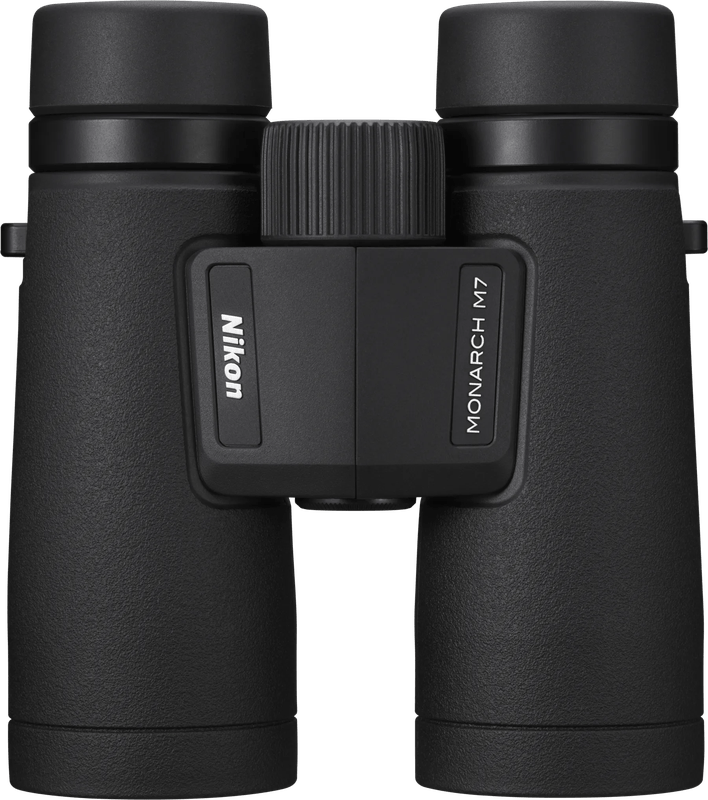
No pair in the comparison is lighter, and according to the spec sheet it has a very wide field of view: 145 m at 670 g. Nikon uses ED glass, and the housing is made of glass-fiber-reinforced polycarbonate. The close focus distance is somewhat longer at 2.5 m. The 8×42 was recently out of stock in the Nikon shop; Amazon.de carries it.
Swarovski NL Pure 8×42
159 m. None of the six binoculars offers a wider field of view, and Swarovski also states 91% transmission and 18 mm of eye relief. The slim housing is shaped to be held with both hands, but it weighs 840 g. In terms of price, it plays in an entirely different league from the Zeiss. Occasional observers pay here for added value they will hardly use; if you are out every weekend, you are more likely to see the difference in field of view.
Leica Trinovid HD 8×42
Compact in design, 730 g according to the spec sheet and waterproof to 4 m, it has the shortest close focus distance in the field at around 1.8 m. The field of view is smaller: 124 m. Binoculars for anyone who values ruggedness over panorama and likes to get close to flowers or insects.
Steiner Ranger Xtreme 8×42
Steiner actually builds it for hunters. Some of the specs still suit nature watching: 18.5 mm of eye relief, a close focus distance of 2 m, waterproof to 3 m, plus a 10-year warranty according to the manufacturer. The housing is polycarbonate. At 800 g, it is not light. Eyeglass wearers should take a look if their binoculars also need to stand up to rain and rough handling.
Canon 10x42L IS WP
It is the only stabilized pair in the comparison and carries Canon’s red L designation. Canon states waterproofing to JIS grade 7, 16 mm of eye relief and diopter adjustment of ±3. At 114 m, the field of view is small. The weight is large. If you look far and make use of the steadiness of the image stabilizer, you accept that. For walks, it is too heavy.
Which binoculars for which view?
Backyard, forest, hiking: here the Zeiss Conquest HDX 8×42 comes out ahead. Light enough for your hiking backpack (in German), with enough reserves for dusk.
On a smaller budget, if you want a wide field of view, that leaves the Nikon Monarch M7 8×42. Based on the manufacturers‘ price information, it costs a small fraction of what the Swarovski does.
Eyeglass wearers should look at the Steiner Ranger Xtreme 8×42 or the Swarovski NL Pure 8×42, both with at least 18 mm of eye relief. For close-up observation at a nest box and of flowers, the Leica Trinovid HD 8×42’s close focus distance of around 1.8 m speaks in its favor. And for coasts, lakes and wide fields, the Canon 10x42L IS WP is an option if weight and batteries are not a deterrent.
One more piece of advice. If possible, hold the binoculars up to your eyes with your glasses on at a specialist retailer before buying. Interpupillary distance and eyecups do not suit every face equally well, and that is not on any spec sheet.
The Nikon Monarch M7 10×42 is the higher-magnification sibling of the 8×42; Nikon states ED glass, a maximum of 680 g for the 42 mm models and waterproofing to 1 m for 10 minutes.
Binoculars for Christmas: check the numbers first, then the discount
Binoculars often end up under the Christmas tree, and around Black Friday on November 27, brand-name binoculars get cheaper too. When you see a deal, check the two numbers first. Almost all the binoculars here come as both 8×42 and 10×42, and a strikingly low price quite often refers to the other version. Some models also come in bundles with a case or cleaning kit, which makes comparing even harder.
If you are giving binoculars as a gift, you often do not know the recipient’s eyes. If they wear glasses, the eye relief from the table matters more than any discount. If a retailer in Germany advertises a price reduction, it must state the lowest price of the last 30 days (Section 11 of the German Price Indication Ordinance, Preisangabenverordnung). Our partner Coolblue lists the higher-magnification version of the Nikon, the Monarch M7 10×42, with a price. If you also want to observe the night sky in the evening, read our guide to the telescope (in German). More deals are collected on our Black Friday 2026 (in German) page.
Frequently asked questions
What do the numbers 8×42 mean on binoculars?
The first number is the magnification, the second the objective lens diameter in millimeters. Dividing one by the other gives you the exit pupil: just over 5 mm for 8×42, around 4 mm for 10×42. A larger exit pupil means more leeway at dusk and an image that does not go black right away when your eye shifts.
8x or 10x: which is better for birds?
For most observation, 8x, because of the field of view. Zeiss states 128 m at 1,000 m for the Conquest HDX 8×42 and 115 m for the 10×42 version. On top of that, hand shake grows with every step up in magnification. If you mostly look far out over water, mudflats or fields, a 10×42 is worth considering.
Which binoculars are suitable for eyeglass wearers?
The key figure is eye relief. The Steiner Ranger Xtreme 8×42 and the Swarovski NL Pure 8×42 both have at least 18 mm. With glasses, turn the eyecups all the way in; only then can you tell whether you see the whole image. If possible, try the binoculars with your glasses at a specialist retailer beforehand.
Do you need binoculars with image stabilization?
In most cases, no. The Canon 10x42L IS WP compensates for hand shake electronically, but weighs around 1,110 g without batteries. At −10 °C, Canon states only about 10 minutes of runtime with alkaline batteries. On the coast and at lakes, for resting birds at long distances, it becomes a serious alternative to a spotting scope.
Which values on the spec sheet matter for binoculars?
Four figures: the field of view in meters at 1,000 m, the eye relief for eyeglass wearers, the close focus distance and the weight. Below 120 m of field of view, finding things at 8x gets tedious; above 140 m is generous. Between 670 g and more than a kilo there is a world of difference when the binoculars hang around your neck all day.
Which binoculars for a smaller budget?
According to the spec sheet, the Nikon Monarch M7 8×42 offers a 145 m field of view at 670 g and is the lightest pair in the comparison. Nikon uses ED glass, and the housing is made of glass-fiber-reinforced polycarbonate. At 2.5 m, the close focus distance is somewhat longer.
Which binoculars do you recommend for birdwatching?
For backyard, forest and hiking, an 8x42 with a wide field of view. Among the six binoculars in the comparison, the Zeiss Conquest HDX 8x42 brings together field of view (128 m at 1,000 m), weight (715 g) and eyeglass compatibility most coherently, according to the manufacturer's data. On a smaller budget, the Nikon Monarch M7 8x42 offers a 145 m field of view at 670 g, according to the spec sheet.
Sources
- Zeiss: Conquest HDX, technical data 8×42 and 10×42
- Zeiss: Conquest HDX press release (2024)
- Nikon: Monarch M7 8×42/10×42, technical data
- Swarovski Optik: NL Pure 8×42
- Leica: Trinovid 8×42 HD
- Steiner: Ranger Xtreme 8×42
- Canon: 10x42L IS WP, technical data
- Nikon Monarch M7 10×42: product information
- German Price Indication Ordinance, Section 11: Price reductions
Where to buy
- Zeiss Conquest HDX 8x42Check price at Amazon.deAvailable in Germany: Amazon.de
- Nikon Monarch M7 8x42Check price at Amazon.deAvailable in Germany: Amazon.de
- Swarovski NL Pure 8x42Check price at Amazon.deAvailable in Germany: Amazon.de
- Leica Trinovid HD 8x42Check price at Amazon.deAvailable in Germany: Amazon.de
- Steiner Ranger Xtreme 8x42Check price at Amazon.deAvailable in Germany: Amazon.de
- Canon 10x42L IS WPCheck price at Amazon.deAvailable in Germany: Amazon.de
- Nikon Monarch M7 10x42View at CoolblueAvailable in Germany: Coolblue