Contents11 sections
This guide was first published in German on handgetestet.de.
If you cut meter-long firewood down to stove length, you’ll know by the third stacked cubic meter (a „Ster,“ as it’s called in Germany) whether the saw is right. For logs up to about 17 cm in diameter on a standard outlet, a tilting-table saw with a 505 mm blade and 3,000 watts is enough, for example the Scheppach HS550 or the ATIKA BWS 500-2. The small 405 mm class is only worth it if you mostly cut branches and thin wood.
First, measure your thickest log
Blade size determines almost everything. With a 405 mm blade diameter, manufacturers top out at a cutting diameter of 140 mm, with 505 mm it’s 170 mm, and only the 700 mm class manages around 240 mm. These are manufacturer figures for a single cut. Thicker trunks don’t fit on the tilting table.
So take a folding rule to your woodpile. If there are many pieces over 17 cm, the 505 mm class becomes a test of patience: every piece that’s too thick has to be split or cut with a chainsaw first. Then a saw with a 700 mm blade is the more honest purchase, even though it weighs almost 100 kg.
Length matters too. Scheppach allows wood up to 1 m on the HS550, while the HS520 takes up to 1.2 m. So if you cut meter-long wood into 33 cm logs, you’ll position each piece three times.
Outlet, cable and a number hardly anyone reads
All models below run on 230 volts, the standard household voltage in Germany. Atika requires a 16 A slow-blow fuse for the BWS 500-2. For extension cords, Scheppach specifies H07RN-F rubber cables, with at least 1.5 mm² up to 25 m in length and 2.5 mm² beyond that. A thin cable reel from the basement doesn’t qualify.
Then the duty cycle. The manuals for the HS410 and HS550 state S2 with 15 minutes. That’s short-time duty: after a quarter of an hour under load, the motor should cool down. For the BWS 500-2, Atika specifies duty type S6 at 40 percent, i.e. intermittent duty with load phases alternating with idling. If you want to get through five stacked cubic meters on a Saturday, plan breaks with both. With the Scheppach rating, they’re mandatory.
What the guard flap has to do
Firewood circular saws fall under the European standard EN 1870-6. Its February 2018 version was based on accident analyses by the SVLFG, Germany’s social insurance for agriculture, forestry and horticulture. According to the German Commission for Occupational Health and Safety and Standardization (KAN), the area where the wood is fed in must since then be better protected, and during the cut it must not be possible to reach directly the point where the blade protrudes from the hood. Helpers bringing wood over are also meant to be protected.
On Scheppach and Atika saws, a guard flap over the tilting table takes care of this. When it’s open, the table stays locked. When buying, make sure such a flap is explicitly mentioned. Scheppach lists spare parts for the HS410 separately for the old and new standard; units from October 2018 onward meet the new standard. A used saw without a flap isn’t a good buy, even if it’s cheap.
The HS550 manual lists further rules that apply to any tilting-table saw. Only one piece on the table, at least 30 mm thick, and it has to rest in the V-cradle on both sides of the blade. Never hold the wood by hand. Stand to the side of the blade, and always wear safety glasses, plus hearing protection and safety shoes. Only people aged 18 or over may operate it. If the blade keeps running for more than 10 seconds after switching off, the brake is probably defective, and according to Scheppach the saw must not be used any further.
It’s loud in any case. For the HS410, HS550 and BWS 500-2, the manufacturers state a sound power level of 115 dB(A). Which earmuffs are up to the job is covered in our hearing protection guide (in German).
Five tilting-table saws for 230 volts
| Model | Blade, power | Wood (Ø, length) | Weight | Best for |
|---|---|---|---|---|
| Scheppach HS550 (230 V) | 505 mm, 3,000 W | 30–170 mm, 300–1,000 mm | 69 kg | stove wood from meter-long logs |
| ATIKA BWS 500-2 | 505 mm, 3,000 W | 30–170 mm, 250–1,000 mm | approx. 57.6 kg | same class, adjustable working height |
| Scheppach HS410 | 405 mm, 2,200 W | 30–140 mm, 300–1,000 mm | 40 kg | branches and thin wood |
| Scheppach HS520 | 500 mm, 2,600 W | up to 170 mm, 200–1,200 mm | 75 kg | longer pieces up to 1.2 m |
| Scheppach HS720 (230 V) | 700 mm, 3,000 W | up to 240 mm, 250–1,500 mm | 95.5 kg | thick trunks without three-phase power |
All figures according to the manufacturer. For the HS720, Scheppach states 3,000 W in the product title and 2,100 W power input in the data sheet.
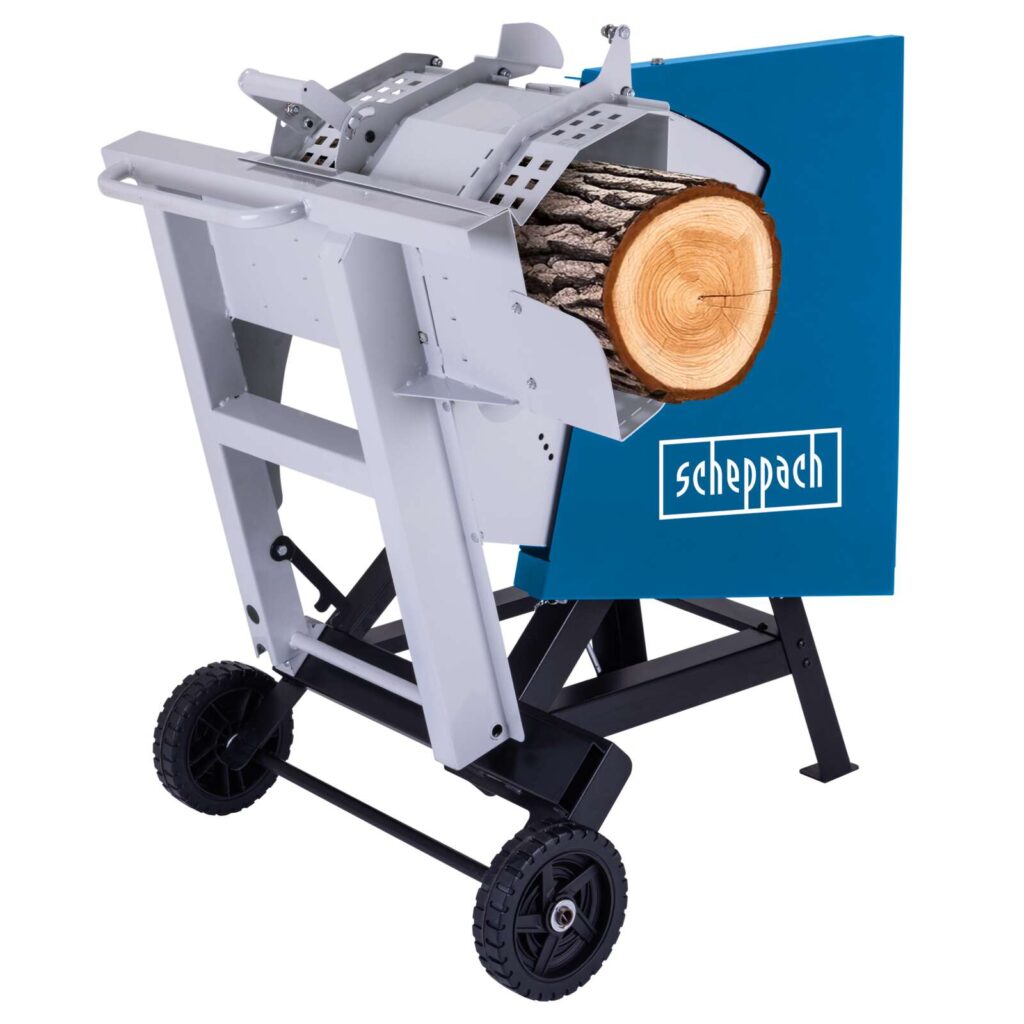
Scheppach HS550: the middle ground, sensibly equipped
A 505 mm carbide blade, 3,000 W on 230 V and a 170 mm cutting diameter. A typical fireplace owner rarely needs more. Add to that a table extension with an indicator for 250 and 330 mm so the logs come out the same length, plus wheels, a table lock for transport and a port for dust extraction. According to the manual, the brake stops the blade within 10 seconds at most. The S2 short-time duty of 15 minutes remains a consideration.
ATIKA BWS 500-2: same class, lighter
Blade, power and cutting diameter match the HS550. Atika states about 57.6 kg and lets you adjust the working height in ten steps between 810 and 1,150 mm, which is easier on the back for both tall and short people. A no-volt release prevents it from restarting after a power outage. Atika doesn’t mention a table extension with a length indicator like Scheppach’s.
Scheppach HS410: small and light
At 40 kg, two people can move it easily. According to the product page, the 405 mm blade manages 140 mm; the data sheet says 135 mm. That’s enough for branch wood and leftovers from pruning fruit trees. With meter-long beech from the forest, you’ll quickly hit the limit.
Scheppach HS520: for longer pieces
A 500 mm blade, 2,600 W and, as the only one here, wood lengths up to 1.2 m. According to Scheppach, it’s made in Germany. At 75 kg, it’s heavier than the HS550, and according to the scope of delivery, a table extension with a length indicator isn’t included.
Scheppach HS720: 700 mm on household power
Up to 240 mm in diameter and 1.5 m in length, turning considerably slower than the small saws at 1,400 revolutions per minute. It comes assembled and weighs 95.5 kg net. For occasional stove wood, that’s too much machine. But if you regularly bring thick trunks out of your own woods and don’t have three-phase power, this is the right size. A 400-volt version with 4,500 W is also available.
How we’d decide
Meter-long wood up to 17 cm in diameter, logs of 25 or 33 cm: Scheppach HS550, because the length indicator gives you even logs without measuring. If you’d rather work at an adjusted height, take the ATIKA BWS 500-2. Only branches and thin pieces? Then the Scheppach HS410. Lots of wood over 17 cm points to the Scheppach HS720.
After sawing comes splitting. How many tons of force that takes is explained in our log splitter guide (in German), and where to put the logs afterward is shown in our firewood rack guide (in German).
For tilting-table saws driven by a PTO shaft, our compact tractor guide (in German) explains what power, three-point hitch and registration the tractor needs.
Frequently asked questions
What blade size does a firewood saw need?
It depends on your thickest log. With a 405 mm blade, manufacturers top out at a cutting diameter of 140 mm, with 505 mm at 170 mm; only the 700 mm class manages around 240 mm. For meter-long wood up to 17 cm on a standard outlet, a saw with a 505 mm blade and 3,000 watts is enough.
Can a tilting-table firewood saw run on 230 volts?
Yes, all models in this guide run on 230 volts (the standard household voltage in Germany), including the Scheppach HS720 with a 700 mm blade. Atika requires a 16 A slow-blow fuse for the BWS 500-2. According to Scheppach, extension cords should be H07RN-F rubber cables, at least 1.5 mm² up to 25 m and 2.5 mm² beyond that.
What does S2 15 minutes mean on a firewood saw?
Short-time duty: after a quarter of an hour under load, the motor should cool down. That's what the manuals of the Scheppach HS410 and HS550 state. For the BWS 500-2, Atika specifies S6 at 40 percent, i.e. intermittent duty. If you saw a lot of wood in one day, plan breaks with both.
What should I watch for regarding the safety of a tilting-table saw?
Firewood circular saws fall under the European standard EN 1870-6. Make sure a guard flap over the tilting table is explicitly mentioned; when the flap is open, the table stays locked. Load only one piece, at least 30 mm thick, never hold it by hand, stand to the side, and wear safety glasses, hearing protection and safety shoes. Only people aged 18 or over may operate it.
How loud is a tilting-table firewood saw?
For the HS410, HS550 and BWS 500-2, the manufacturers state a sound power level of 115 dB(A). Earmuffs are therefore always a must.
Scheppach HS550 or ATIKA BWS 500-2?
Blade, power and cutting diameter are the same. The HS550 has a table extension with a length indicator for 250 and 330 mm, which gives you logs of equal length without measuring. At about 57.6 kg, the BWS 500-2 is lighter and lets you adjust the working height in ten steps.
Sources
- KANBrief 1/18: new standards for log splitters and firewood circular saws
- Scheppach HS550 (230 V)
- Scheppach HS550, original operating manual
- Scheppach HS410
- Scheppach HS410, original operating manual
- Scheppach HS520
- Scheppach HS720 (230 V)
- ATIKA BWS 500-2
Where to buy
- Scheppach HS550 (230 V)Check price at Amazon.deAvailable in Germany: Amazon.deView at scheppachAvailable in Germany: scheppach
- ATIKA BWS 500-2Check price at Amazon.deAvailable in Germany: Amazon.de
- Scheppach HS410Check price at Amazon.deAvailable in Germany: Amazon.deView at scheppachAvailable in Germany: scheppach
- Scheppach HS520View at scheppachAvailable in Germany: scheppachCheck price at Amazon.deAvailable in Germany: Amazon.de
- Scheppach HS720 (230 V)View at scheppachAvailable in Germany: scheppachCheck price at Amazon.deAvailable in Germany: Amazon.de