Contents10 sections
This guide was first published in German on handgetestet.de.
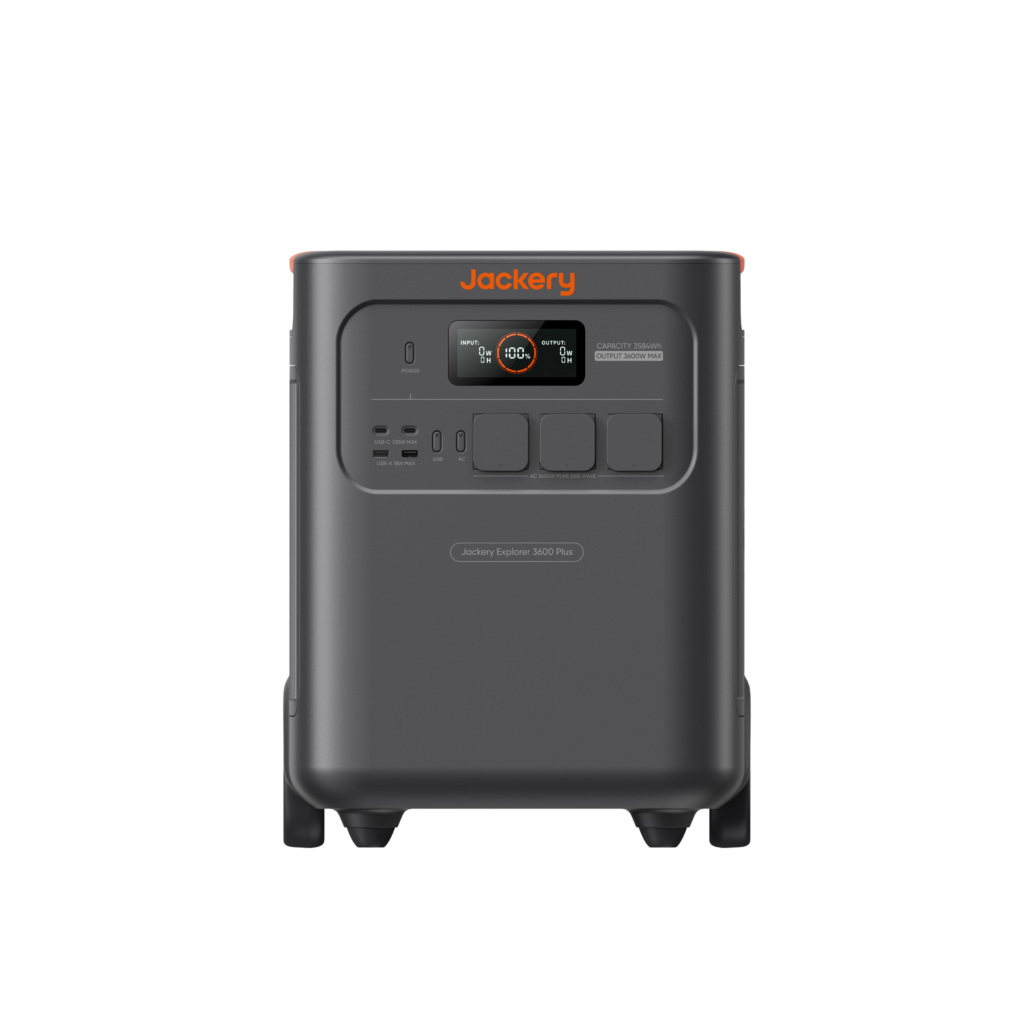
From three kilowatt-hours up, you are no longer buying a camping gadget. You are buying a power reserve on wheels that almost always sits in a fixed spot and is only moved in an emergency. For the home, we consider the Jackery Explorer 3600 Plus the most coherent choice because it can be expanded and is the only station on this list that also charges in freezing temperatures. If you can do without both, the Explorer 3000 v2 saves you eight kilograms and a price tier.
What three kilowatt-hours really mean
Less than the number suggests. The authorized Jackery retailer GreenDrive calculates with 85 percent of the rated capacity because some energy is lost in conversion. On that basis, a fridge-freezer using 0.8 kWh a day runs for a good three days on the Explorer 3000 v2 and just under four on the 3600 Plus. Add a router, lights and a computer and you are at around 2 kWh a day, and the 3600 Plus is empty after a day and a half. A 2,500-watt oven takes 1.9 kWh in 45 minutes. That is more than half of the 3000 v2 for one casserole.
So several days only work with discipline or with a way to recharge. If a router, lights and your phone are enough for you, a much smaller station will serve you better; our guide to backup power with a power station (in German) runs the numbers on sizes, and the power station buying overview (in German) covers the market below 3 kWh.
Six stations and bundles worth considering
| Model | Capacity and continuous output | Weight | Charges from | Best for |
|---|---|---|---|---|
| Jackery Explorer 3600 Plus | 3,584 Wh, 3,600 W | 35 kg | −20 °C | home, cold garage, expandable to 21.5 kWh |
| Jackery Explorer 3000 v2 | 3,072 Wh, 3,600 W | 27 kg | 0 °C | workshop, home without expansion plans |
| Jackery Solargenerator 3600 Plus | Explorer 3600 Plus with SolarSaga panels | 35 kg plus panels | −20 °C | vacation home, cabin |
| Jackery Solargenerator 3000 v2 | Explorer 3000 v2 with SolarSaga panels | 27 kg plus panels | 0 °C | weekend property in summer |
| BLUETTI Elite 300 | 3,014 Wh, 2,400 W | 26.3 kg | 0 °C | large motorhome with 12-volt systems |
| BLUETTI Apex 300 + B300K | 5,530 Wh, 3,840 W | 38 kg plus battery | 0 °C | home battery that should grow with you |
The Jackery figures come from Jackery’s product specifications and from the authorized retailer GreenDrive, the BLUETTI figures from the manufacturer.
You want to protect your home against a long outage
Then the math leads to the Jackery Explorer 3600 Plus. It starts at 3,584 watt-hours and, according to Jackery, takes up to five Batteriepack 3600 Plus expansion batteries, 21.5 kWh in total. At the 2 kWh a day from above, that would be about nine days. If the grid fails, it switches over in 10 milliseconds according to the retailer, and Jackery specifies 6,000 cycles to 70 percent remaining capacity as well as a five-year warranty, two years of which require registration.
The decisive difference, however, is in the fine print on temperatures. According to the retailer, charging and discharging are possible from minus 20 to plus 45 degrees Celsius. If you park the station in an unheated basement or garage, you have nothing to worry about in January. All the other devices here only charge from zero degrees.
Our reservations: 35 kilograms at 49 centimeters tall rolls across level floors, but a basement staircase remains a job for two. There is no 12-volt socket. And each battery pack weighs another 25 kilograms. What an expansion battery can and cannot do is covered in the expansion battery guide (in German). Also keep in mind that a portable station powers individual devices by cable. Integrating it into your home’s electrical installation is a job for a licensed electrician.
You work in a workshop or shed
Here, watts count, not days. The Jackery Explorer 3000 v2 delivers the same 3,600 watts of continuous power as its big sibling and 7,200 watts peak, but weighs only 27 kilograms and, according to the retailer, rolls on wheels with a telescopic handle. On mains power, it is full in 1 hour 50 minutes. For anything with a motor, the rule still applies: read the rating plate. Compressors and pumps draw a multiple of their rated power when starting up, as our guide to power inverters explains.
Cold is its weakness. It only charges from zero degrees, and between minus 15 and minus 10 degrees, it limits output to 2,000 watts, according to the retailer. In hard frost, an unheated workshop is therefore 1,600 watts short. It cannot be expanded, and at 4,000 cycles to 70 percent, its cycle rating is below that of the 3600 Plus. For a station that runs a few times a month, that matters little. And unlike the 3600 Plus, it has a 12-volt socket.
You are far away from any outlet
Off the grid, recharging is what decides. Both stations are available as bundles, the Jackery Solargenerator 3600 Plus and the Jackery Solargenerator 3000 v2, with varying numbers of 200-watt SolarSaga panels depending on the version. Both inputs together accept 1,000 watts. According to Jackery, four panels charge the station in around four to six hours of full sun; with two, the 3000 v2 already needs eleven. From the third panel on, the 3000 v2 needs a solar connector accessory, according to the retailer.
Full sun means June, not November. So only buy a bundle if you will really set up the panels, and expect a fraction of that in winter. How orientation and voltage determine the yield is shown in the guide Charging a power station with a solar panel (in German). For a permanent cabin in the countryside, Power in the garden shed (in German) helps first.
You travel in a large motorhome
Now the onboard voltage matters. The 3600 Plus does not provide 12 volts. The BLUETTI Elite 300, by contrast, has a 12-volt output with 30 amps next to the car socket, where a cooler and water pump can connect without going through the inverter. With 3,014 watt-hours and 26.3 kilograms, it is close to the Explorer 3000 v2; BLUETTI specifies 6,000 cycles and a 10-millisecond switchover time. However, it only delivers 2,400 watts, and the manufacturer does not list any expansion batteries for it.
At this size, the car socket is no good for charging: BLUETTI states 30.6 hours, and the Explorer 3000 v2 needs 36. If you really want to recharge on the road, plan for a charging booster (in German).
You want to build up to a home battery
At 2,765 watt-hours, the base unit BLUETTI Apex 300 is just below our threshold, which is why we list the bundle with one B300K: 5,530 watt-hours at 3,840 watts. Up to six batteries are possible, 19.4 kWh with B300K according to BLUETTI. Two solar inputs accept 1,200 watts each, and the rating of 6,000 cycles refers to 80 percent remaining capacity, a stricter value than Jackery’s. The base unit alone weighs 38 kilograms. It is portable in name only, and at 20 milliseconds, the switchover time is longer than on the 3600 Plus.
When we advise against it
If the battery is supposed to shift solar power from the balcony into the evening every day, a power station is the wrong idea. For that, there are storage units that regulate along with the outlet; the guide to retrofitting a battery storage system shows them. And if you need a lot of power outdoors for many days without sun, a generator will get you further. It is loud. But its tank can be refilled.
Three questions, and the choice is made
- Will the station sit below zero degrees in winter? Then the Explorer 3600 Plus.
- Is one charge enough for what you have in mind, and should it be lighter? Then the Explorer 3000 v2.
- Do you need 12 volts with high current on board? Then the BLUETTI Elite 300, with the trade-off in output.
How much starting power saws and rotary hammers demand is shown in the guide Power station for the construction site (in German).
An overview of the Plus series is in the Jackery model overview; it goes up against EcoFlow’s large units in the comparison Jackery or EcoFlow.
If you are planning to live off the grid year-round, you’ll find the December math in the guide to off-grid systems.
What the compressor start demands and how long the battery lasts is shown in the guide Air conditioner on a power station.
Frequently asked questions
How long does a power station with three kilowatt-hours last?
Less than the number suggests; around 85 percent is usable. A fridge-freezer using 0.8 kWh a day runs for a good three days on the Explorer 3000 v2. Add a router, lights and a computer and you are at around 2 kWh a day, and the 3600 Plus is empty after a day and a half.
Which large power station also charges in freezing temperatures?
According to the retailer, the Jackery Explorer 3600 Plus charges and discharges from minus 20 to plus 45 degrees Celsius. All other devices in the comparison only charge from zero degrees. For an unheated basement or garage in January, that is the decisive difference.
Which power station is suitable for the workshop?
The Explorer 3000 v2 delivers the same 3,600 watts of continuous power as the 3600 Plus but weighs only 27 kilograms and has a 12-volt socket. Its weakness is cold: between minus 15 and minus 10 degrees, it limits output to 2,000 watts, according to the retailer.
How fast does a large power station charge with solar panels?
According to Jackery, four 200-watt SolarSaga panels charge it in around four to six hours of full sun; with two, the 3000 v2 already needs eleven. Full sun means June, not November. Only buy a bundle if you will actually set up the panels.
Which large power station fits in a motorhome?
The BLUETTI Elite 300, because it has a 12-volt output with 30 amps that a cooler and water pump can connect to directly. The 3600 Plus does not provide 12 volts. However, the Elite 300 only delivers 2,400 watts, and charging via the car socket takes 30.6 hours.
When is a power station the wrong choice?
When the battery is supposed to shift solar power from the balcony into the evening every day; for that, there are storage units that regulate along with the outlet. And if you need a lot of power outdoors for many days without sun, a generator whose tank can be refilled will get you further.
Sources
- Jackery product specifications for the Explorer 3000 v2, Explorer 3600 Plus, Batteriepack 3600 Plus and the Solargenerator bundles
- GreenDrive (authorized Jackery retailer): Explorer 3600 Plus
- GreenDrive: Explorer 3000 v2
- GreenDrive: Battery Pack 3600 Plus
- BLUETTI: Elite 300
- BLUETTI: Apex 300
- BLUETTI: Apex 300 + B300K
Where to buy
- Jackery Explorer 3600 PlusView at JackeryAvailable in Germany: JackeryCheck price at Amazon.deAvailable in Germany: Amazon.de
- Jackery Explorer 3000 v2View at JackeryAvailable in Germany: JackeryCheck price at Amazon.deAvailable in Germany: Amazon.de
- Jackery Solargenerator 3600 PlusView at JackeryAvailable in Germany: Jackery
- Jackery Solargenerator 3000 v2View at JackeryAvailable in Germany: Jackery
- BLUETTI Elite 300Check price at Amazon.deAvailable in Germany: Amazon.de
- BLUETTI Apex 300 + B300KCheck price at Amazon.deAvailable in Germany: Amazon.de