Contents16 sections
This guide was first published in German on handgetestet.de.
On paper, the two brands are rarely as close as they are at one kilowatt-hour. The Jackery Explorer 1000 Plus v2 and the EcoFlow DELTA 3 Plus each offer 1,024 watt-hours and 1,800 watts. We prefer the EcoFlow, because ADAC (the German automobile club) rated it 2.1 („good“ on the German grading scale) in spring 2025. According to the retailer, the Jackery is lighter, charges in freezing temperatures and expands further; if you need that, take it with the caveat below. But if you want to connect a lot of solar power, EcoFlow is the better choice, because its inputs accept 1,000 instead of 400 watts. So the brand matters less than the question of what you are buying the station for. One caveat up front: the Explorer 1000 Plus v2 is new, and all we had to go on were figures from Jackery and one retailer, no data sheet and no independent measurement. Read its figures with appropriate caution.
How the product lines relate
At Jackery, one word separates two worlds. The Explorer v2 models are closed units; the Explorer 1000 v2, for example, stays at 1,070 watt-hours and 1,500 watts. Only the Plus models accept expansion batteries. EcoFlow sorts things differently: the DELTA 3 series stands for the class around 1 kilowatt-hour, the DELTA Pro 3 for the large unit with 4 kilowatt-hours.
For the balcony, both have dedicated lines: SolarVault and HomePower at Jackery, STREAM at EcoFlow. There is a reason for that. Stiftung Warentest (the German consumer testing organization) considers power stations poorly suited as buffer storage for balcony solar systems, because they do not feed their power into the home grid and would have to be replugged constantly. EcoFlow does list the PowerStream microinverter as compatible with its DELTA units. If your goal is a lower electricity bill, though, you are better off reading the guide to retrofitting a home battery.
6,000 versus 4,000 cycles: not a fair comparison
Both rely on lithium iron phosphate. The specifications list 6,000 cycles to 70 percent remaining capacity for the Explorer 1000 Plus v2 and 4,000 cycles to 80 percent for the DELTA 3 Plus. The figures measure different finish lines. Deriving a longer service life from that would be misleading. With one full charge per week, either figure will last you for decades anyway; at that point, the electronics and the calendar matter more. How the cell chemistry ages is explained in the LiFePO4 guide.
Charging: sun for EcoFlow, frost for Jackery
This is where the two 1-kilowatt-hour stations differ most. According to the manual, the DELTA 3 Plus accepts 500 watts at each of its two inputs, 1,000 watts in total. The Explorer 1000 Plus v2 tops out at 400 watts according to the retailer; with two SolarSaga 200W panels, a full charge takes just under four hours. That matters for a motorhome with a large roof panel. Suitable panels and voltages are covered in the guide Charging a power station with a solar panel (in German).
In winter, the picture flips. The DELTA 3 Plus is only designed to charge from 0 degrees Celsius; according to GreenDrive, the Jackery can do so from minus 10 degrees, and the Explorer 3600 Plus even from minus 20 degrees. On grid power, there is little between them: around 49 minutes for the Jackery in emergency charging mode, about 1 hour 15 minutes normally; for the EcoFlow, MediaMarkt (German retailer) states one hour to 80 percent.
What the app really decides
Both apps connect via Wi-Fi and Bluetooth, and with both, features that sound like hardware in the advertising sit behind the screen. The Jackery’s 49 minutes are only available in the app’s emergency charging mode. On the EcoFlow, X-Boost is off by default. You sign in to your account, switch it on, and can then draw 2,400 instead of 1,800 watts at 230 volts, mainly for heaters according to the manual. It does not work while connected to the grid, and sensitive devices may shut off at the reduced voltage.
According to its manual, EcoFlow offers more settings to adjust: self-consumption mode, a reserve for power outages, time-of-use rates. For computers and NAS units, the DELTA 3 Plus works with the Power Manager software via USB-C. According to the retailer, the Jackery supports priority per outlet and charging during off-peak rate periods. If the grid fails, both take over after 10 milliseconds.
Expansion: where the paths diverge
The Explorer 1000 Plus v2 takes up to five Battery Pack 2000 Plus V2 units, 11,264 watt-hours in total. The station itself stays at a light 10.8 kilos; the rest sits in the basement. For the DELTA 3 Plus, the figure given is up to three extra batteries with 1,024 watt-hours each, so around 4 kilowatt-hours. Jackery stays ahead at the top end as well: the Explorer 3600 Plus grows to 21.5 kilowatt-hours, the DELTA Pro 3 to 12 according to the Amazon listing.
Both manufacturers tie their batteries closely to the product line. EcoFlow advises against combining the DELTA 3 extra battery with stations from other series. At Jackery, the older Battery Pack 2000 Plus does not fit the v2 models, and the Battery Pack 1000 Plus does not fit the Explorer 1000 Plus v2 either. So read carefully before buying more; the pitfalls are covered in the guide to a power station with an expansion battery (in German).
Service and warranty
Jackery offers 3 years plus another 2 after registration, and lists a German phone number with hours on weekdays from 9 a.m. to 6 p.m. EcoFlow has a German subsidiary in Düsseldorf and can be reached by email; for the DELTA Pro 3, five years of warranty were mentioned at launch, ten for the STREAM storage units. For the DELTA 3 Plus, the manual does not state a period, so ask to be shown it when you buy.
There is one clause EcoFlow buyers should know about. If the unit is neither charged nor discharged for more than six months, the warranty is void according to the manual. For the emergency station in the closet, that means: put a reminder in your calendar. The schedule is in the guide Storing a power station (in German).
Independent measurements are of little help. The Stiftung Warentest power station comparison dates from 2023 and says little about today’s product lines. In the balcony storage test from issue 4/26, EcoFlow was represented with the Stream Ultra; Jackery was missing.
Seven units side by side
| Model | Capacity, output | Weight | Expansion | Best for |
|---|---|---|---|---|
| Jackery Explorer 1000 Plus v2 | 1,024 Wh, 1,800 W | 10.8 kg | up to 11.26 kWh | Taking along and growing later |
| EcoFlow DELTA 3 Plus | 1,024 Wh, 1,800 W | 12.5 kg | around 4 kWh | Lots of solar, computers and NAS |
| Jackery Explorer 3600 Plus | 3,584 Wh, 3,600 W | 35 kg | up to 21.5 kWh | Backup power at home, cold |
| EcoFlow DELTA Pro 3 | 4,096 Wh, 4,000 W | around 51.5 kg | up to 12 kWh | High continuous load, fixed location |
| BLUETTI Apex 300 | 2,765 Wh, 3,840 W | 38 kg | up to 19.4 kWh per unit | Lots of output with mid-size capacity |
| Jackery SolarVault 3 Pro | 2,520 Wh, 800 or 1,200 W | 25.5 kg | up to 15.12 kWh | Balcony solar system with panels |
| EcoFlow STREAM AC Pro | 1,920 Wh, 800 W | 21.5 kg | up to 11.52 kWh | Existing balcony solar system |
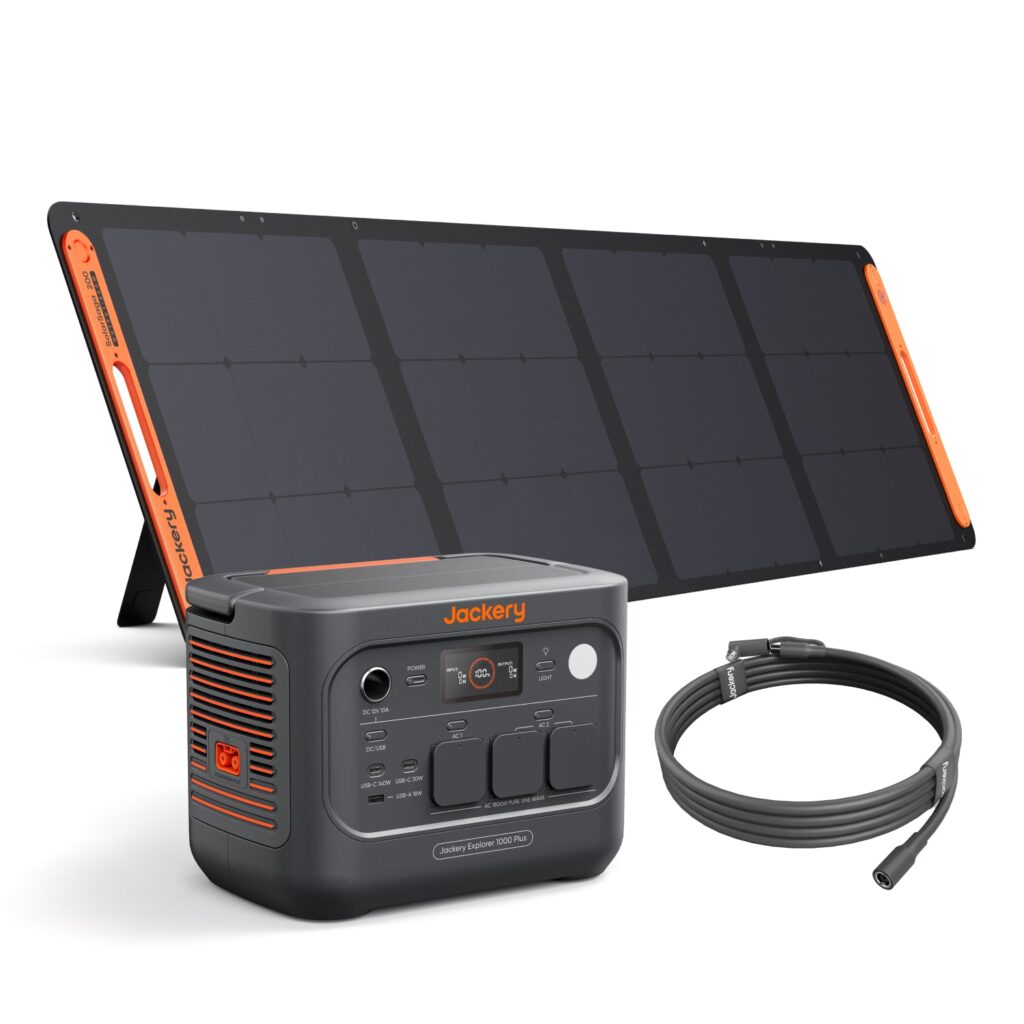
Jackery Explorer 1000 Plus v2
The station for anyone who wants to start small today and does not know what will be needed in three years. The solar input remains its weak point. The data comes mostly from Jackery itself and from the retailer GreenDrive; we are not aware of any independent measurement.
EcoFlow DELTA 3 Plus
The stronger solar input and X-Boost are the arguments in its favor, and the connection to computers is cleanly handled. In return, you carry 1.7 kilos more, and it does not charge in freezing temperatures.
Jackery Explorer 3600 Plus
At 35 kilos, it rolls or stays put rather than travels. There is no 12-volt socket; the comparison with other large stations is in the guide Large power stations (in German).
EcoFlow DELTA Pro 3
The most powerful station on this list, with 4,000 watts. The roughly 51.5 kilos come from the Amazon listing.
BLUETTI Apex 300
A third brand comes into play when output matters more than capacity. BLUETTI states 3,840 watts and 6,000 cycles to 80 percent, a stricter figure than Jackery’s. Switchover takes 20 milliseconds, and 38 kilos is not a carrying weight.
Jackery SolarVault 3 Pro
Four solar inputs make it the storage unit for new balcony systems. With IP65, it may stand outdoors according to the data sheet; it is not meant for the campsite.
EcoFlow STREAM AC Pro
With no solar input, it connects to the home grid and complements existing microinverters. It feeds no more than 800 watts into the grid, while devices plugged into its outlet get up to 2,300 watts in pass-through.
Who should buy what
- Mobile, room to grow, winter: Jackery Explorer 1000 Plus v2.
- Tighter budget with no expansion plans and no vehicle: Jackery Explorer 1000 v2 with 1,070 watt-hours, but only 1,500 watts. In 2025, ADAC downgraded it to „poor“ because of DC inputs that are not decoupled, so never charge it via solar and the vehicle socket at the same time.
- Large solar area on a vehicle or a computer on a NAS: EcoFlow DELTA 3 Plus.
- Backup power for the house: Jackery Explorer 3600 Plus; it is lighter and expands further than the DELTA Pro 3.
- Very high continuous load: EcoFlow DELTA Pro 3 or BLUETTI Apex 300.
- Balcony solar system: no power station at all, but the SolarVault 3 Pro or STREAM AC Pro.
Frequently asked questions
Which power station charges faster with solar, Jackery or EcoFlow?
According to the manual, the DELTA 3 Plus accepts 500 watts at each of its two inputs, 1,000 watts in total. The Explorer 1000 Plus v2 tops out at 400 watts according to the retailer; with two SolarSaga 200W panels, a full charge takes just under four hours. That matters for a motorhome with a large roof panel.
What do 6,000 versus 4,000 cycles mean?
The figures measure different finish lines: 6,000 cycles to 70 percent for the Jackery, 4,000 to 80 percent for the EcoFlow. Deriving a longer service life from that would be misleading. With one full charge per week, both figures last for decades, at which point the electronics and the calendar matter more.
What does X-Boost do on EcoFlow?
With X-Boost, you can draw 2,400 instead of 1,800 watts at 230 volts, mainly for heaters according to the manual. It is off by default and is switched on in the app after signing in to your account. It does not work while connected to the grid, and sensitive devices may shut off at the reduced voltage.
How far can Jackery and EcoFlow be expanded?
The Explorer 1000 Plus v2 takes up to five Battery Pack 2000 Plus V2 units, 11,264 watt-hours in total. The DELTA 3 Plus takes up to three extra batteries with 1,024 watt-hours each. Both tie their batteries closely to the product line; older Jackery packs do not fit the v2 models.
What warranty do Jackery and EcoFlow offer?
Jackery offers 3 years plus another 2 after registration. For the DELTA 3 Plus, the manual does not state a period, so ask to be shown it when you buy. If an EcoFlow unit is neither charged nor discharged for more than six months, the warranty is void according to the manual.
Is a power station suitable as storage for a balcony solar system?
Stiftung Warentest (the German consumer testing organization) considers power stations poorly suited for this, because they do not feed their power into the home grid and would have to be replugged constantly. Both brands have dedicated lines: the Jackery SolarVault 3 Pro for new systems with panels, the EcoFlow STREAM AC Pro for an existing balcony solar system.
Sources
- EcoFlow: DELTA 3 Plus manual (PDF)
- EcoFlow: DELTA 3 extra battery manual (PDF)
- EcoFlow: STREAM AC Pro data sheet (PDF)
- MediaMarkt: product information EcoFlow DELTA 3 Plus
- ChargerLAB: report on the DELTA Pro 3 launch
- GreenDrive: Jackery Explorer 1000 Plus v2 (retailer information)
- GreenDrive: Jackery Explorer 3600 Plus (retailer information)
- Jackery: SolarVault 3 Pro technical data (PDF)
- BLUETTI: Apex 300
- Stiftung Warentest: Power stations
- Stiftung Warentest: Storage for balcony solar systems (issue 4/26)
- ADAC: Portable power stations tested (spring 2025)
Where to buy
- Jackery Explorer 1000 Plus v2View at JackeryAvailable in Germany: JackeryCheck price at Amazon.deAvailable in Germany: Amazon.de
- Jackery Explorer 1000 v2View at JackeryAvailable in Germany: JackeryCheck price at Amazon.deAvailable in Germany: Amazon.de
- EcoFlow DELTA 3 PlusCheck price at Amazon.deAvailable in Germany: Amazon.de
- Jackery Explorer 3600 PlusView at JackeryAvailable in Germany: JackeryCheck price at Amazon.deAvailable in Germany: Amazon.de
- EcoFlow DELTA Pro 3Check price at Amazon.deAvailable in Germany: Amazon.de
- BLUETTI Apex 300Check price at Amazon.deAvailable in Germany: Amazon.de
- Jackery SolarVault 3 ProView at JackeryAvailable in Germany: JackeryCheck price at Amazon.deAvailable in Germany: Amazon.de
- EcoFlow STREAM AC ProCheck price at Amazon.deAvailable in Germany: Amazon.de